
SAA liquidation means financial hardship, DPE warns
The Department of Public Enterprises (DPE) cautioned South African Airways (SAA) employees, labour unions and creditors that the liquidation of the airline will lead to financial hardship for employees and substantial undervaluation of assets.
In a statement issued on Thursday, the department said SAA stakeholders should realise that business rescue provides a better outcome than liquidation and should be supported for their collective interests.
The SAA Business Rescue Practitioners (BRPs) have scheduled a creditors’ meeting for 14 July after last month’s vote on the business rescue plan was postponed.
“A vote in favour of the plan by 75% of the voting interests would be required to carry the vote. A vote against the plan would result in the protracted and costly liquidation of the airline,” said the DPE.
As the shareholder on behalf of government, the department said it was of the view that business rescue is a viable alternative to liquidation.
“This option supports job preservation and the ability to bring the airline back from the brink to a position where some employees, labour unions and creditors can continue to contribute to the South African economy and its integration into the global economy.”
The department believes in the case of liquidation, a liquidator will be appointed to consolidate the company’s assets in order to raise capital which will be distributed to the creditors when the airline is wound up.
During the drawn-out process, the DPE says, creditors would in all likelihood receive a negligible dividend after all secured and preferred creditors have been paid in the liquidation proceedings.
For employees, the liquidation of SAA means they would receive a maximum of R32 000 per staff member, regardless of years of service, to the extent that there are funds available.
“They will only receive payment once the final liquidation and distribution account has been approved which can take up to 24 months,” the department said.
“Therefore it stands to reason that generally, business rescue dividends should result in a higher return for creditors than would result in a liquidation situation.”
The DPE is convinced that the R2.2 billion budgeted for Voluntary Severance
Packages (VSPs) for SAA employees is the best available option at a time when government is faced with massive financial demands and fiscal constraints.
The VSPs, which can be offered to employees immediately after a creditors vote endorses the Business Rescue Plan, meet the requirements of Basic Conditions of Employment Act and the Labour Relations Act, including one week calculated per year of completed service, one-month notice pay, accumulated leave paid out, a 13th Cheque and a top-up of severance packages.
The VSPs are supported by a social plan and a skills development programme for affected SAA employees.
“The social plan is aimed at equipping individuals to re-enter the job market. Employees who take up the VSPs will be entitled to re-apply for positions in a new, restructured national airline which is anticipated to emerge from the business rescue proceedings, as it grows,” reads the statement.
The department added that the transformation of SAA into a competitive airline will require sacrifices and a major restructuring, starting on a conservative basis and gradually and systematically building up over the next three years to re-employ as many of the displaced employees who have necessary skills and competence.
The DPE said it supports a restructuring process as it would achieve:
● an internationally competitive performance;
● a demographic profile of skilled, competent and committed employees; and
● for the employees that remain, the task will be to grow the airline and provide opportunities for their former colleagues to be re-employed.
“It would require a level of commitment and cooperation from both SAA and the unions to overcome the devastating consequences of the COVID-19 pandemic where thousands of jobs are being lost on an unprecedented scale in South Africa and globally,” the department said.
The outcomes approach
Summary
The outcomes approach is embedded in and a direct resultant of the electoral mandate. Contained below is a summary of the process that contextualises the Cabinet approved outcomes.
Step 1: The Ruling Party’s election manifesto identified five priority areas: decent work and sustainable livelihoods, education, health, rural development, food security and land reform and the fight against crime and corruption.
Step 2: Development of the Medium Term Strategic Framework which is an expression of government’s Programme of Action where ten strategic priority areas were identified.
Step 3: Development of twelve Key Outcomes, with accompanying outputs and strategic activities and metrics.
Step 4: Development and signing of Performance Agreements between the President and Ministers, which outline high level outputs, metrics and key and contributing activities towards each outcome.
Step 5: Conversion of high level outputs and metrics into a detailed Delivery Agreement with key partners that need to work together to achieve the outputs. The negotiated Agreement spells out who will do what by when and with what resources.
Step 6: Establishment of effective coordinating structures to ensure that key partners of the Delivery Agreements work together to achieve the outputs. These structures would coordinate the implementation of the outcomes, reviewing progress and deciding on interventions when required. These structures would also conduct monitoring & evaluation of the degree to which the outcomes are being achieved, which will provide a feedback loop to annual reviews of the Delivery Agreements.
Outcomes
The outcomes for 2014 to 2019 is published as annexures to the Medium Term Strategic Framework:
- Outcome 1: Improved quality of basic education [PDF]
- Outcome 2: A long and healthy life for all South Africans [PDF]
- Outcome 3: All people in South Africa are and feel safe [PDF]
- Outcome 4: Decent employment through inclusive economic growth [PDF]
- Outcome 5: A skilled and capable workforce to support an inclusive growth path [PDF]
- Outcome 6: An efficient, competitive and responsive economic infrastructure network [PDF]
- Outcome 7: Vibrant, equitable and sustainable rural communities with food security for all [PDF]
- Outcome 8: Sustainable human settlements and improved quality of household life [PDF]
- Outcome 9: A responsive, accountable, effective and efficient local government system [PDF]
- Outcome 10: Environmental assets and natural resources that are well protected and continually enhanced [PDF]
- Outcome 11: Create a better South Africa and contribute to a better and safer Africa and World
- Outcome 12: An efficient, effective and development oriented public service and an empowered, fair and inclusive citizenship [PDF].
The President signs performance agreements with all Cabinet Ministers. In these performance agreements, Ministers establish an Implementation Forum for each of the outcomes. In each implementation forum Ministers and all other parties responsible for delivering on an outcome, develop a Delivery Agreement. All departments, agencies and spheres of government involved in the direct delivery process required to achieve an output, should be party to the agreement.
The Delivery Agreement refines and provides more detail to the outputs, targets, indicators and key activities for each outcome, and identify required inputs and clarify roles and responsibilities. It spells out who will do what, by when and with what resources.
Delivery Agreements further unpack each outcome and each output and the requirements to reach the targets. Aspects described in detail include the legislative and regulatory regime, the institutional environment and decision-making processes and rights, the resources needed and re-allocation of resources where appropriate.
Understanding the logic model
Government needs to go beyond the work that we do and interrogate the impact that it has. This approach involves management using a logic model which links inputs, activities, outputs outcomes and impacts. The triangle below demonstrates these links more clearly:
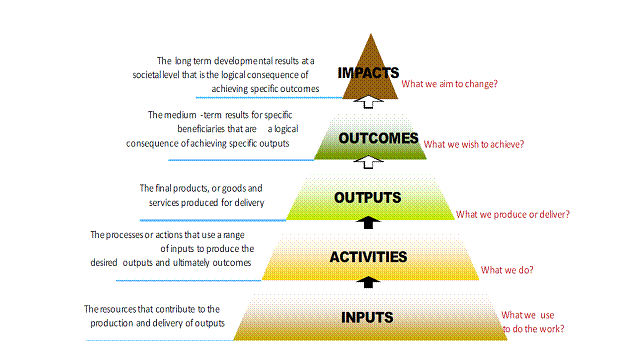
It becomes useful to standardise the use of the following terms:
- INPUTS are everything we need to accomplish a task. This could be in terms of finance, human resources, infrastructure etc.
- ACTIVITIES describe a collection of functions (actions, jobs, tasks) that consume inputs and which deliver benefits and impacts.
- OUTPUTS can be immediate and intermediate. These are the direct products and services generated through processes or activities without specific reference to their ultimate purpose.
- OUTCOMES refer to a changed state of being. They describe the effects, benefits or consequences that occur due to the outputs of programmes, processes or activities. The realisation of the outcomes has a time factor and can be in either the medium or long-term.
Delivery agreements
- Delivery agreement for outcome 1: Improved quality of basic education, 29 October 2010 [PDF]
- Delivery agreement for outcome 2: A long and healthy life for all South Africans, 23 November 2010 [PDF]
- Delivery agreement for outcome 4: Decent employment through inclusive growth, 9 November 2010 [PDF]
- Delivery agreement for outcome 5: Establish a credible institutional mechanism for skills planning, 8 November 2010 [PDF]
- Delivery agreement for outcome 6: An efficient, competitive and responsive economic infrastructure network, 30 October 2010 [PDF]
- Delivery agreement for outcome 7: Vibrant, equitable and sustainable rural communities and food security for all, 9 November 2010 [PDF]
- Delivery agreement for outcome 8: Sustainable human settlements and improved quality of household life, 19 September 2010 [PDF]
- Delivery agreement for outcome 9: A responsive, accountable, effective and efficient local government system, 30 September 2010 [PDF]
- Delivery agreement for outcome 10: Environmental assets and natural resources that are well protected and continually enhanced, 23 September 2010 [PDF]
- Delivery agreement for outcome 12: An efficient, effective and development oriented public service and an empowered, fair and inclusive citizenship, 8 November 2010 [PDF]
Media statements on signing of delivery agreements
- Minister Jeff Radebe: Release of Medium-Term Strategic Framework 2014-2019, 7 August 2014
- Medium Term Strategic Framework 2014-2019 in numbers, 8 August 2014
- Performance Management and Evaluation Budget Votes
- Performance Monitoring and Evaluation releases monitoring and evaluation survey, 18 October 2013
- A Motshekga: Outcome 1, 29 October 2010
- J Radebe: Outcome 3, 24 October 2010
- B Nzimande: Outcome 5, 2 November 2010
- S Shiceka: Outcome 9, 1 October 2010
- B Sonjica: Outcome 10, 30 September 2010
- L Sisulu: Outcome 11, 17 November 2010
- R Baloyi: Outcome 12, 14 October 2010
Related links
National Electricity Efficiency Programme
About the National Energy Efficiency Campaign
Documents
National Electricity Summit, 16 May 2008
South Africans have since the winter of 2014 again been urged to use electricity sparingly to help ease the pressure off the national grid.
In the last three years, Eskom had increased maintenance work at its plants. The completion of the Medupi power plant is expected to ease the pressure from Eskom’s ageing power grid, but the collapse of a coal silo at Majuba power station has led to load shedding in the short term.
The National Energy Efficiency Campaign
South Africa is one of the world’s least energy efficient nations. We use approximately 40% of Africa’s electricity, and are the 11th highest emitter of greenhouse gasses in the world. Our national addiction to energy has led to the situation where our reserve margin is unsustainably low, and the reliability of our electricity supply is under threat. Our energy habits have adverse effects on our economy, our environment and our health.
The government and Eskom have committed to increase our energy capacity, but this will not be enough on its own. The government has been reaching out to all South Africans through the National Energy Efficiency campaign to encourage all sectors of society to conquer their “energy addictions”. By growing a culture of activism around energy savings, we can take control of our energy situation and ensure a better future for all.
A website for the National Energy Efficiency Campaign provides more information on what you can do to save energy.
As energy champions, your willingness to participate in this campaign is important for its success. Your voices will add credibility to the campaign and will help to highlight the need for South Africa to become energy efficient and adopt a culture of energy savings. In addition, your involvement will help to highlight the severity of the challenges that confront the country’s energy infrastructure
Policy documents
- Post-2015 National Energy Efficiency Strategy: Comments invited, 24 December 2016
- Integrated Energy Plan: Draft, 2 December 2016 (Comments invited by 31 Mar 2017)
- Renewable Energy (Solar Park) Programme 2016, 27 May 2016
- State of Renewable Energy in South Africa, 5 October 2015
- National Energy Act: Regulations: Registration, reporting on energy management and submission of energy management plans: Draft, 27 March 2015
- National Energy Efficiency Strategy of South Africa: Second review, 29 November 2012
- National Energy Efficiency Strategy of South Africa, 26 June 2009
- Nuclear Energy Policy for the Republic of South Africa, 12 December 2008
National Electricity Summit, 16 May 2008
- Nedlac hosts National Stakeholder Summit on electricity
- Declaration of the National Stakeholder Summit [PDF]
- P Molefe, Director-General: Department of Public Enterprises – South Africa: Electricity Pricing Considerations [PDF]
- N Magubane, Deputy Director-General: Department of Minerals and Energy – Summarised Draft of the Electricity Pricing Policy [PDF]
- Draft Nedlac Agreement on the electricity emergency response [PDF]
- Nedlac submission on Eskom’s application for price increase for 2008/09 [PDF]
More information on energy-saving programmes
The New Growth Path
The New Growth Path framework
Government, under the leadership of Minister Ebrahim Patel, on 23 November 2010 released the New Growth Path Framework aimed at enhancing growth, employment creation and equity. The policy’s principal target is to create five million jobs over the next 10 years. This framework reflects government’s commitment to prioritising employment creation in all economic policies. It identifies strategies that will enable South Africa to grow in a more equitable and inclusive manner while attaining South Africa’s developmental agenda.
Central to the New Growth Path is a massive investment in infrastructure as a critical driver of jobs across the economy.
- The framework identifies investments in five key areas namely: energy, transport, communication, water and housing. Sustaining high levels of public investment in these areas will create jobs in construction, operation and maintenance of infrastructure.
- The new growth path sees the infrastructure programme as a trigger to build a local supplier industry for the manufacture of the components for the build-programme.
- Specific measures, particularly changes to procurement policy and regulations, are identified to ensure that this is achieved. Risks include the still fragile global recovery; competition and collaboration with the new fast-growing economies; and competing interests domestically.
The New Growth Path identifies five other priority areas as part of the programme to create jobs, through a series of partnerships between the State and the private sector.
- Green economy: expansions in construction and the production of technologies for solar, wind and biofuels is supported by the draft Energy on Integrated Resource Plan. Clean manufacturing and environmental services are projected to create 300 000 jobs over the next decade.
- Agriculture: jobs will be created by addressing the high input costs and upscaling processing and export marketing. Support for small holders will include access to key inputs. Government will explore ways to improve working and living conditions for the country’s 660 000 farm workers. The growth path also commits the Government to unblocking stalled land transfers, which constrain new investment.
- Mining: calls for increased mineral extraction and improving infrastructure and skills development. It focuses support for beneficiation on the final manufacture of consumer and capital goods, which can create large-scale employment. It foresees the establishment of a state mining company concentrating on beneficiation and enhanced resource exploitation in competition with a strong private mining sector.
- Manufacturing: calls for re-industrialisation in the South African economy based on improving performance through innovation, skills development and reduced input costs in the economy. The document targets a doubling of South Africa’s research and development investment to 2% of gross domestic product by 2018.
- Tourism and other high-level services: hold employment potential and the framework calls for South Africa to position itself as the higher education hub of the African continent.
Smarter coordination between government and stronger partnerships with the private sector and organised labour will galvanise our resources in achieving the aims of the New Growth Path.
- Government calls on every South African to contribute to building our nation over the coming 20 years to ensure a collective effort, creativity and solidarity.
- Good leadership and strong governance are critical in ensuring that South Africa takes charge of the new opportunities. Government commits to cut wasteful spending, tackle corruption and align the allocation of public money with developmental priorities.
- Government recognises that job targets can only be achieved if the State performs better and if the private sector grows in labour-absorbing parts of the economy.
- The New Growth Path identifies measures to strengthen the capacity of the state and enhance the performance of the private sector to achieve employment and growth goals.
The New Growth Path proposes major improvements in government, with a call for slashing unnecessary red tape, improving competition in the economy and stepping up skills development.
- The role of government departments and agencies in meeting set targets for scarce and key skills is critical. This emphasis on skills applies across the economy and will be a centrepiece of partnership with business and labour.
- Key targets include the aim to produce 30 000 engineers by 2014, with a focus on Mathematics and Science as well as changes to university funding formulae to achieve this, and 50 000 artisans by 2015, with annual targets for Eskom and Transnet and for individual Sector Education and Training Authority institutions to achieve this.
- The document calls for greater focus on workplace training, targeting on-the-job training and refresher programmes for 10% of the workforce every year.
- It also calls for measures to make it easier to import scarce skills by streamlining the work permit and visa system. This will be accompanied by a skills transfer programme to ensure that local skills development is enhanced.
The framework identifies a “development package” – a coordinated set of actions across a broad front, this consists of macroeconomic strategies, microeconomic measures and stakeholder commitments to drive employment and economic growth.
- The document recognises the challenges of an uncompetitive currency and sets out clear steps for government to address the impact of the Rand on the economy.
- In expanding on government’s tools to address inflation, a stronger role will be considered for competition policy and strategic investigations into conduct leading to high and volatile prices for intermediate inputs for producers and basic consumer goods, including important commodities such as maize, steel and fertilisers.
- Government calls for greater focus by South African business on opportunities in Africa’s fast-growing economies. This is accompanied by commitments to improve cross-border infrastructure and measures to address unnecessary regulatory obstacles to the movement of people and goods, as part of building a common market on the continent.
Publications
- National Skills Accord [PDF]
- Basic Education Accord [PDF]
- Local Procurement Accord [PDF]
- Green Economy Accord [PDF]
- Youth Employment Accord [PDF]
National Infrastructure Plan
The South African Government adopted a National Infrastructure Plan in 2012. With the plan we aim to transform our economic landscape while simultaneously creating significant numbers of new jobs, and strengthen the delivery of basic services. The plan also supports the integration of African economies.
Government planned to invest R827 billion in building new and upgrading existing infrastructure over the three years from 2013/14 , Minister of Finance Pravin Gordhan announced in his 2013 Budget Speech.
These investments would improve access by South Africans to healthcare facilities, schools, water, sanitation, housing and electrification. Investment in the construction of ports, roads, railway systems, electricity plants, hospitals, schools and dams would contribute to faster economic growth.
Challenges
18 years into our democracy, there were still major challenges of poverty, unemployment and inequality in 2012.
The New Growth Path identified structural problems in the economy and pointed to opportunities in specific sectors and markets or “jobs drivers” to reach its goal of five million new jobs by 2020. The first jobs driver is infrastructure: laying the basis for higher growth, inclusivity and job creation.
In order to address these challenges and goals, Cabinet established the Presidential Infrastructure Coordinating Committee (PICC) to:
- coordinate, integrate and accelerate implementation
- develop a single common National Infrastructure Plan that will be monitored and centrally driven
- identify who is responsible and hold them to account
- develop a 20-year planning framework beyond one administration to avoid a stop-start pattern to the infrastructure roll-out.
Under their guidance, 18 strategic integrated projects (SIPS) have been developed.
Achievements
Government and public agencies invested more than R1 trillion in infrastructure between 2009 and 2014.
The investments were in energy, road, rail, ports, public transport, bulk water and sanitation, hospitals, basic and higher education infrastructure and innovative projects such as the Square Kilometre Array and Meerkat telescopes.
By January 2013, work had commenced on all 18 SIPs.
Investment in infrastructure continues to grow, with R300 billion invested in the National Infrastructure Plan by both the public and private sector in 2016/17.
Achievements in 2016/17 include:
Education
- 82 schools were either built or refurbished in 2016/17.
- Since 2009 Government has built a total of 920 schools through both the Accelerated Schools Infrastructure Delivery Initiative (ASIDI) and the various provincial infrastructure projects. The biggest beneficiary of these new schools has been the Eastern Cape with a total of 334 schools delivered in that time period.
>> Minister Angie Motshekga: Media briefing ahead of Basic Education Budget Vote 2017/18, 24 May 2017
- 3 693 new student beds at universities were provided (excluding buildings erected by the private sector).
- Two new TVET campuses and two new universities were under construction.
>> Minister Ebrahim Patel: Economic Development Dept Budget Vote 2017/18, 25 May 2017
Energy
- 4 562 megawatt (MW) were completed. This includes a further unit of Medupi providing 794 MW by 3 April 2017, resulting in 2 100 MW usable energy, enough to supply electricity to a metro equivalent to twice the size of Johannesburg (including Alexandra and Soweto).
- 585 km of new transmission lines were erected.
- 1 957 solar water heaters were installed by Johannesburg, bringing the total installed to 504 060.
- 318 898 households were connected to the grid. According to Stats SA’s 2016 Community Survey more than 15 million households now have access to electricity.
>> Minister Ebrahim Patel: Economic Development Dept Budget Vote 2017/18, 25 May 2017
Transport logistics and related rolling stock
- 29 360 km of roads across the country were maintained and 332 km of new roads were added.
- 46 km of new bus lanes were completed in Johannesburg, eThekwini and Cape Town to support the Bus Rapid Transport systems.
- 205 new buses were locally manufactured using 80% local content, bringing the total number of buses manufactured since 2009 to 612.
- 13 330 new taxis were locally manufactured, bringing the total number of manufactured taxis since 2011 to 57 910.
- 100 new rail wagons were locally manufactured, bringing the total number of manufactured wagons since 2009 to 16 507.
- 185 new locomotives were assembled this year bringing the total number of locally assembled locomotives since 2009 to 770.
- 303 km of rail were refurbished and 68 km of new rail between Ermelo and Majuba power station were being completed (2017).
>> Minister Ebrahim Patel: Economic Development Dept Budget Vote 2017/18, 25 May 2017
Human settlements
- 89 009 new houses were built bringing the total built since 1994 to 2,6 million.
>> Minister Ebrahim Patel: Economic Development Dept Budget Vote 2017/18, 25 May 2017
Health
- Since 2012 130 new and replacement clinics have been completed and 180 others are still being constructed.
- In the same period 289 existing clinics have been refurbished and 412 are in progress.
>> Minister Aaron Motsoaledi: Health Dept Budget Vote 2017/18, 16 May 2017
Water and sanitation
- The Mzimvubu Water Scheme aims to create 5 000 employment opportunities in the construction phase and 3 700 post-construction. This will also result in water supply to over 726 000 people within the catchment and in the areas of Alfred Nzo, Joe Gqabi and OR Tambo.
- Phase 2 of the Lesotho Highlands Water Project will augment the Vaal River System through the transfer of additional volumes of water from Lesotho. The main features of Phase 2 are the Polihadi Dam and the expansion of the pipeline to Katse Dam.
- In the Northern Cape, the Vaal Gamagara water project entails the development of a 432 kilometre pipeline. Phase 1 of the project will focus on the 82 kilometer pipeline that will stretch from Roscoe in Kathu to Black Rock. On completion of Phase I, beneficiaries will include the mining sector, livestock farms, solar parks and the communities of Kathu, Olifantshoek and Hotazel, benefiting a populace of 23 500. It is expected to be completed by August 2018.
- The raising of the Clanwilliam Dam Wall and Irrigation Scheme in the Western Cape will increase water storage capacity and support the economic potential of the area.
- The raising of Tzaneen Dam (Limpopo) will start in 2017.
- The Lower Thukela Regional Bulk Water Scheme (KwaZulu-Natal) will supply additional water to the coastal and inland areas of KwaDukuza and Mandeni local municipalities.
- The Mogalakwena Bulk Water Supply in Limpopo will benefit 94 000 people as well as mines in the Waterberg area. The project aims to deliver water to Mokopane and villages to the immediate north of the town.
- The Namakwa Bulk Water Supply Scheme is set to benefit 11 500 households in the Namakwa region of the Northern Cape.
- Phases 1 and 2 of the Hoxane Water Treatment Works in Mpumalanga has been completed. Phase 3 will provide an additional 27 million litres per day of purified water for the benefit of emerging black farmers.
- Phase 2A of the Mokolo Crocodile West Augmentation comprises a 160 km pipeline to transfer water from the Crocodile River West near Thabazimbi to the Lephalale area. This project will support electricity generation for the country.
- The Jozini water treatment plant in KwaZulu-Natal has been completed. The project comprises a 40 million litres per day water treatment plant and 13 reservoirs along the main bulk pipeline. An additional 14th reservoir is under construction and another three pump stations will be constructed along the main bulk pipeline.
>> Minister Nomvula Mokonyane: Water and Sanitation Budget Vote 2017/18, 26 May 2017
Communication
- Additional “on-air” WiFi spots brought the total to almost 12 000 across the country.
- Smart phone penetration was increased to about 50% of the country.
- 24 new MeerKAT antennae were completed bringing the total to 45.
- New sources of funding for infrastructure were identified.
- A new Infrastructure Project Management Technical Unit was being set up.
>> Minister Ebrahim Patel: Economic Development Dept Budget Vote 2017/18, 25 May 2017
The 18 Strategic Integrated Projects (SIPs)
The SIPs cover social and economic infrastructure across all nine provinces (with an emphasis on lagging regions).
The SIPs include catalytic projects that can fast-track development and growth. Work is being aligned with key cross-cutting areas, namely human settlement planning and skills development.
The SIPs comprise:
- Five geographically-focussed SIPs
- Three energy SIPs
- Three spatial SIPs
- Three social infrastructure SIPs
- Two knowledge SIPs
- One regional integration SIP
- One water and sanitation SIP
Geographic SIPs
SIP 1: Unlocking the northern mineral belt with Waterberg as the catalyst
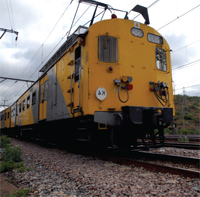
- Unlock mineral resources.
- Rail, water pipelines, energy generation and transmission infrastructure.
- Thousands of direct jobs across the areas unlocked.
- Urban development in Waterberg – first major post-apartheid new urban centre will be a “green” development project.
- Rail capacity to Mpumalanga and Richards Bay.
- Shift from road to rail in Mpumalanga.
- Logistics corridor to connect Mpumalanga and Gauteng.
The Majuba Rail Project in Mpumalanga, which forms part of the move from road to rail for coal transport, was expected to be completed by December 2017 (Majuba Rail to be completed by December 2017, 7 April 2016)
SIP 2: Durban-Free State-Gauteng logistics and industrial corridor
- Strengthen the logistics and transport corridor between SA’s main industrial hubs.
- Improve access to Durban’s export and import facilities.
- Integrate Free State Industrial Strategy activities into the corridor.
- New port in Durban.
- Aerotropolis around OR Tambo International Airport.
Work has already started on a massive logistics corridor stretching between Durban and the central provinces of the Free State and Gauteng. Most of the projects that form part of the second Strategic Infrastructure Project (SIP 2), also known as the Durban-Free State-Johannesburg Logistics and Industrial Corridor, are still in the concept or pre-feasibility stage, but construction has already started on several projects.
These include:
- the building of a R2,3 billion container terminal at City Deep. Transnet completed an R800 million upgrade of the City Deep Container Terminal in Johannesburg in November 2016. SANews
- a R3,9 billion project to upgrade Pier 2 at the Port of Durban
- R14,9 billion procurement of rolling stock for the rail line which will service the corridor.
Work has also started on the R250 million Harrismith logistics hub development to set up a fuel distribution depot, as well as on phase one of the new multi-product pipeline which will run between Johannesburg and Durban and transport petrol, diesel, jet fuel and gas.
The aim of these projects and others which form part of SIP 2, is to strengthen the logistics and transport corridor between South Africa’s main industrial hubs and to improve access to Durban’s export and import facilities. It is estimated that 135 000 jobs will be created in the construction of projects in the corridor. Once the projects are completed a further 85 000 jobs are expected to be created by those businesses that use the new facilities.
SIP 3: South-Eastern node & corridor development
- New dam at Mzimvubu with irrigation systems.
- N2-Wild Coast Highway which improves access into KwaZulu-Natal and national supply chains.
- Strengthen economic development in Port Elizabeth through a manganese rail capacity from Northern Cape.
- A manganese sinter (Northern Cape) and smelter (Eastern Cape).
- Possible Mthombo refinery (Coega) and transshipment hub at Ngqura and port and rail upgrades to improve industrial capacity and performance of the automotive sector.
The Stanley Nkosi Sinter Mine at Hotazel, Northern Cape, was launched on 29 November 2013.
Progress in the Eastern Cape include the Port of Ngqura (launched on 16 March 2012), the Nelson Mandela Legacy Bridge (opened on 11 July 2012) and the Mzimvubu Water project (launched on 11 April 2014).
SIP 4: Unlocking the economic opportunities in North West
- Acceleration of investments in road, rail, bulk water, water treatment and transmission infrastructure.
- Enabling reliable supply and basic service delivery.
- Facilitate development of mining, agricultural activities and tourism opportunities.
- Open up beneficiation opportunities in North West province.
SIP 5: Saldanha-Northern Cape development corridor
- Integrated rail and port expansion.
- Back-of-port industrial capacity (including an IDZ).
- Strengthening maritime support capacity for oil and gas along African West Coast.
- Expansion of iron ore mining production and beneficiation.
The Saldanha Bay Industrial Development Zone (IDZ) was officially pronounced in a ceremony on 31 October 2013.
Energy SIPS
SIP 8: Green energy in support of the South African economy
- Support sustainable green energy initiatives on a national scale through a diverse range of clean energy options as envisaged in the Integrated Resource Plan (IRP2010).
- Support bio-fuel production facilities.
By March 2016 a total of 6 376 MW of renewable energy had been procured from 102 independent power producers under the Independent Power Producer Procurement. Programme (REIPPPP) (Minister Tina Joemat-Pettersson: Inauguration of Solar Capital De Aar 3 PV plant, 18 March2016).
SIP 9: Electricity generation to support socio-economic development
- Accelerate the construction of new electricity generation capacity in accordance with the IRP2010 to meet the needs of the economy and address historical imbalances.
- Monitor implementation of major projects such as new power stations: Medupi, Kusile and Ingula.
The first unit of the Kusile power station was connected to the national grid at the end of December 2016. It is the first power plant in Africa to implement clean fuel technology such as flue-gas desulphurisation (FGD). (Eskom on Unit 1 of the Kusile power station connected to the national grid, 27 December 2017)
Minister Lynne Brown reported in May 2017 that Ingwa was in full operation, and Medupi Units 5 and 6, and Kusile Unit 1 were in commercial operation. When Ingula Pumped Storage reached commercial operation an additional 1 332 MW of peaking power was added to the national grid. (Minister Lynne Brown: Public Enterprises Dept Budget Vote speech in NCOP, 14 June 2017)
SIP 10: Electricity transmission and distribution for all
- Expand the transmission and distribution network to address historical imbalances, provide access to electricity for all and support economic development.
- Align the 10-year transmission plan, the services backlog, the national broadband roll-out and the freight rail line development to leverage off regulatory approvals, supply chain and project development capacity.
Spatial SIPS
SIP 6: Integrated municipal infrastructure project
- Develop national capacity to assist the 23 districts with the fewest resources (19 million people) to address all the maintenance backlogs and upgrades required in water, electricity and sanitation bulk infrastructure.
- The road maintenance programme will enhance service delivery capacity thereby impacting positively on the population.
SIP 7: Integrated urban space and public transport programme
Coordinate planning and implementation of public transport, human settlement, economic and social infrastructure and location decisions into sustainable urban settlements connected by densified transport corridors. This will focus on the 12 largest urban centres of the country, including all the metros in South Africa.
Significant work is underway on urban transport integration. The National Transport Master Plan (NATMAP) 2050 Synopis Report [PDF] is the latest update of the plan.
SIP 11: Agri-logistics and rural infrastructure
Improve investment in agricultural and rural infrastructure that supports expansion of production and employment, small-scale farming and rural development, including:
- facilities for storage (silos, fresh-produce facilities, packing houses)
- transport links to main networks (rural roads, branch train-line, ports)
- fencing of farms
- irrigation schemes to poor areas
- improved R&D on rural issues (including expansion of agricultural colleges)
- processing facilities (abattoirs, dairy infrastructure)
- aquaculture incubation schemes
- rural tourism infrastructure.
Agri-parks are planned for 44 districts. By May 2017 three Agri-hubs were operational in Ncora, Springbokpan and Westonaria. Facilities are being constructed at 11 additional Agri-hubs and 12 farmer production support units.
Social infrastructure SIPS
SIP 12: Revitalisation of public hospitals and other health facilities
- Build and refurbish hospitals, other public health facilities and revamp 122 nursing colleges. The SIP contains major builds for six hospitals.
- Extensive capital expenditure to prepare the public healthcare system to meet the requirements of the National Health Insurance (NHI) system.
SIP 13: National school build programme
- A national school build programme driven by uniformity in planning, procurement, contract management and provision of basic services.
- Replace inappropriate school structures and address basic service backlog and provision of basic services under the Accelerated Schools Infrastructure Delivery Initiative (ASIDI).
- Address national backlogs in classrooms, libraries, computer labs and admin buildings.
SIP 14: Higher education infrastructure
- Infrastructure development for higher education, focusing on lecture rooms, student accommodation, libraries and laboratories, as well as ICT connectivity.
- Development of university towns with a combination of facilities from residence, retail to recreation and transport.
- Potential to ensure shared infrastructure such as libraries by universities, TVETs and other educational institutions.
- Two new universities will be built – in Northern Cape and Mpumalanga.
Sol Plaatje University (SPU) in the Northern Cape and the University of Mpumalanga (MPU) both opened their doors in 2014 in selected academic programmes, using existing buildings. The second phase of construction is nearing completion and has enabled a further large increase in enrolments to reach 1 250 at SPU and 2 130 at UMP for the 2017 academic year.
Knowledge SIPs
SIP 15: Expanding access to communication technology
- Provide for broadband coverage to all households by 2020 by:
- establishing core Points of Presence (POPs) in district municipalities
- extend new Infraco fibre networks across provinces linking districts
- establish POPs and fibre connectivity at local level
- further penetrate the network into deep rural areas.
- While the private sector will invest in ICT infrastructure for urban and corporate networks, government will co-invest for township and rural access, as well as for e-government, school and health connectivity.
- The school roll-out focus is initially on the 125 Dinaledi (science and maths-focussed) schools and 1 525 district schools.
- Part of digital access to all South Africans includes TV migration nationally from analogue to digital broadcasting.
SIP 16: SKA & MeerKAT
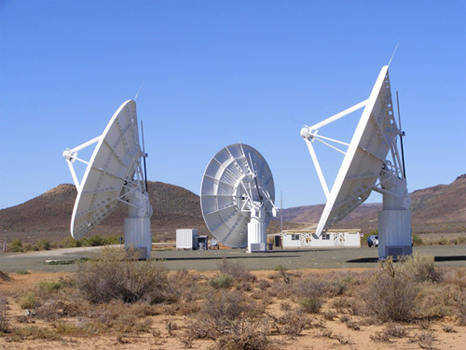 The Square Kilometre Array (SKA) is a global mega-science project, building an advanced radio-telescope facility linked to research infrastructure and high-speed ICT capacity and provides an opportunity for Africa and South Africa to contribute towards global advanced science projects.
The SKA precursor telescope the Karoo Array Telescope (MeerKAT) is at an advanced stage to test possible technologies to be used in the ultimate design of the SKA itself. It is expected to go live in March 2018.
Regional SIP
SIP 17: Regional integration for African cooperation and development
- Participate in mutually beneficial infrastructure projects to unlock long-term socio-economic benefits by partnering with fast-growing African economies with projected growth ranging between 3% and 10%.
- The projects involving transport, water and energy also provide competitively-priced, diversified, short and medium to long-term options for the South African economy. For example, electricity transmission in Mozambique (Cesul) could assist in providing cheap, clean power in the short-term whilst Grand Inga in the Democratic Republic of Congo (DRC) is long-term.
- All these projects complement the Free Trade Area (FTA) discussions to create a market of 600 million people in South, Central and East Africa.
Water and sanitation SIP
SIP 18: Water and sanitation infrastructure
- A 10-year plan to address the estimated backlog of adequate water to supply 1,4 m households and 2,1 m households to basic sanitation. The project will involve provision of sustainable supply of water to meet social needs and support economic growth.
- Projects will provide for new infrastructure, rehabilitation and upgrading of existing infrastructure, as well as improve management of water infrastructure.
Sources:
- A Summary of the South African National Infrastructure Plan [PDF] (3 MB)
- Government’s year of delivery 2012/2013 [PDF] [2 MB]
Related links:
National Development Plan 2030
The National Development Plan (NDP) offers a long-term perspective. It defines a desired destination and identifies the role different sectors of society need to play in reaching that goal, Minister in The Presidency: National Planning Commission, Trevor Manuel, said at a media briefing on the implementation of the plan on 19 February 2013.
The NDP aims to eliminate poverty and reduce inequality by 2030. According to the plan, South Africa can realise these goals by drawing on the energies of its people, growing an inclusive economy, building capabilities, enhancing the capacity of the state, and promoting leadership and partnerships throughout society.
The processes should be followed in the implementation of the plan:
- The NDP and its proposals will need to be implemented in the right order over the next 17 years until 2030. Three phases have been identified.
- The long term plans of departments are aligned with the NDP and areas areidentified where policy change is required to ensure consistency and coherence.
- The NDP is a plan for the whole country. Government will engage with all sectors to understand how they are contributing to implementation, and particularly to identify any obstacles to them fulfilling their role effectively.
- The Plan will shape budget allocation over the years until 2030.
- The Plan identifies the improvement of the quality of public services as critical to achieving transformation. This requires provinces to focus on identifying and overcoming the obstacles to achieving improved outcomes, including the need to strengthen the ability of local government to fulfil its developmental role.
- Planning and implementation should be informed by evidence-based monitoring and evaluation.
- The President and Deputy President will be the lead champions of the Plan within Cabinet, in government and throughout the country. Premiers and Mayors must be visible and active champions of the Plan, with their offices being the catalytic agencies to drive implementation at provincial and municipal levels.
- Read more about the implementation in this statement.
A new call to action was launched with a brand identity in August 2017.

Documents
- Executive Summary-National Development Plan 2030 – Our future – make it work [PDF], 15 August 2012
- National Development Plan 2030: Our future – make it work, 15 August 2012
Speeches
- Minister Trevor Manuel: National Development Plan launch,15 August 2012
- President Jacob Zuma: National Development Plan handover, 15 August 2012
- Minister Jeff Radebe: Public Lecture on “National Development Plan, Vision 2030 – Its Impact On The Development Of Good Governance”, 30 Sep 2015
- Minister Jeff Radebe: Launch of new NDP Vision 2030 Brand Identity, 21 Aug 2016
- Deputy Minister Buti Manamela: Vision 2030 Summit, 22 Jun 2017
- President Jacob Zuma: 5th anniversary of adoption of National Development Plan, 12 Sep 2017
- Minister Jeff Radebe: National Development Plan annual public lecture, 15 Sep 2017
For more information
- E-mail: info@npconline.co.za
- Tel: 012 312 0235
- Facebook: https://www.facebook.com/NDP2030/
Related links
Government and opportunities for youth
Bursasies, internships and learnerships
National Youth Development Agency
Government services for the youth
Documents
Links to youth websites
Government sees the youth as the future leaders of our country. This page focuses on opportunities that Government provides for the youth.
Minister in the Presidency Jeff Radebe signed 12 August 2015 the National Youth Policy 2020 (NYP2020). The NYP 2020 is a set of goals and commitments by government in advancing youth development. It was extensively consulted before being adopted by the executive cabinet.
Bursaries, internships and learnerships
Are you young, energetic, intelligent, physically and mentally fit individuals, dedicated to serving their country by pursuing a career in policing? The South African Police Service from time to time looks for applications from all races and gender to enlist as a police trainee. For the requirements, application form and an exercise guide, see https://www.saps.gov.za/careers/careers.php
- Higher Education and Training: List of bursaries
- Funza Lushaka Bursary scheme
- Learnerships and internships
- More internships
- SA learnerships
- If you cannot get a bursary or need additional funding, find out how to raise cash for studies.
Other opportunities:
- Further Education and Training (FET): A Guide To Opportunities for Further Learning [PDF]
- Further Education and Training (FET) colleges
- Career Development Services
- National Youth Development Agency programmes
- Western Cape opportunities
- Youth Services Guide [PDF]
- Guide to getting started in film and TV [PDF] – Gauteng Film Commission
- KwaZulu-Natal unemployed graduates website
- National Artisan Development Support Centre (NADSC) (call 011 736 4400 or email qualifications to info@eec.hipcc.co.za)
- Vuk’uzenzele regularly posts information on opportunities on their Facebook page.
- Volunteer opportunities at My Hands and Heart
Government has established a range of support programmes and strategies to empower youth in the various sectors such as:
- Minister of Arts and Culture Paul Mashatile reported in his budget vote speech for 2012/13 that
- As part of the Mzansi Golden Economy Strategy, a number of high impact programmes targeting youth and women in the arts have been identified. These include:
- the Indoni, My Heritage My Pride programme which aims to provide young people with life skills training, education and encouragement. They offer training for young people between the ages of 12 and 25 years throughout South Africa during public school holidays.
- the Trendsetter Initiative through which the department encourages youth to participate in the arts and thus contribute to the development of their communities
- the Public Art programme, skilling young people and employing them to beautify their communities using their artistic abilities
- the Emerging Creatives programmes, providing an opportunity for 40 young designers to showcase their designs along side established designers at the Design Indaba in Cape Town.
- Expanded Public Works Programme (EPWP) initiatives that sees young people involved in the refurbishment, rehabilitation, and maintenance of community infrastructure across the country.
- Learnerships and internships focussed on raising the skills capacity of young people through Sector Education and Training Authorities.
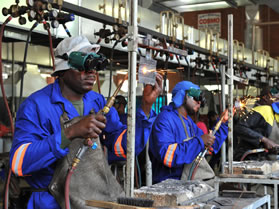
- National Rural Youth Service Corps programme aims to enhance skills development by providing unemployed youth in the rural areas with opportunities to work in their communities and to be trained to provide the necessary services for local socio-economic development.
 Learnerships and internships focussed on raising the skills capacity of young people through
 - Provincial programmes:
Central Application Clearing House
The Department of Higher Education and Training is operating the Central Application Clearing House or CACH. The CACH service is for learners who qualify for higher education studies but have not been accepted at an institution of their choice at the time the matric results were released.
It is also for those learners who did not apply before the closing dates last year and now find that they are eligible for higher education studies.
Learners looking for spaces in the university education system can contact the call centre on 0860 356 635 or send an SMS with their name and ID number to 49200 and be telephoned back free of charge. They can also access the system via the website http://cach.dhet.gov.za/Applicant/UsingCACH. The CACH service will verify the learner’s information and forward it to institutions that still have unfilled places. Where places exist and applicants meet the requirements, institutions will contact students to offer them available places.
National Youth Development Agency
 The National Youth Development Agency is a government agency whose role is to initiate, facilitate, implement, coordinate and monitor youth development interventions aimed at reducing youth unemployment and promoting social cohesion. The NYDA focusses on:
- tailor-made interventions for job preparedness and placement
- scholarship provision for those who excel in schools
- the scaling up of the YouthBuild Programme for out-of-school youth
- the increase of second chance opportunities for matriculants
- the intensification of our highly successful career guidance programme.
Call Centre 0800 52 52 52
Government services for the youth
Government has a number of services that benefit the youth.
Personal identification
It is essential to have an identity document when you want to register for writing the matric exams or getting a drivers licence.
Voting
You can register on the national voter’s roll when you are 16, but may only vote once you have turned 18.
Driving
You can get a drivers’ licence at eighteen.
Tertiary education
Tertiary education is becoming more important. Government supports students who cannot afford the fees.
- Register with a tertiary institution
- Apply for financial assistance from the National Student Financial Aid Scheme (NSFAS)
- The Funza Lushaka Bursary scheme
Career Development Services
The Department of Higher Education and Training runs a Career Development Services Centre to assist learners with career advice.
SMS or “Please Call Me”: 072 204 5056
Telephone: 086 999 0123
E-Mail: careerhelp@dhet.gov.za
Facebook: www.facebook.com/careerhelp
Twitter: https://twitter.com/rsacareerhelp
Website: www.careerhelp.org.za
National Career Advice Portal: http://ncap.careerhelp.org.za
Walk-in Centre: 123 Francis Baard Street, Pretoria
Employment
Once you have completed your education, you need to start looking for a job.
- Find a job
- Information on employment opportunities/vacancies in government
- Application forms for a position in government
- Find information on other employment opportunities
- Apply for a work permit/visa for South Africa
- Job interviews
- Write a winning CV
- Employment news
- Start your own business
Tax
With a job comes the responsibility to pay tax.
Travel outside SA
Some young people prefer to travel before pursuing further education.
- Apply for a passport or travel document
- Advice for South African nationals travelling abroad
- Registration of South Africans abroad
- Gap year information
Documents
- National Youth Policy 2020 (NYP2020), June 2015
- New Growth Path: Accord 1 – National Skills Accord, July 2011 [PDF]
- New Growth Path: Accord 2 – Basic Education and Partnerships with Schools, July 2011 [PDF]
- New Growth Path: Accord 6 – Youth Employment Accord [PDF]
Links
Government youth websites
- National Youth Development Agency
- KwaZulu-Natal Unemployed Graduates
- Department of Public Enterprises youth programmes
International websites
- International Youth Foundation
- United Nations Youth
- International Labour Organisation: Youth employment
Other
Anti Corruption
Make the pledge in the fight against corruption

In South Africa the fight against corruption is one of the major priorities of government. Corruption in both the private and public sector has a detrimental effect on government’s effort to deliver effective services to the people.
The Justice, Crime, Prevention and Security (JCPS) Cluster has prioritised the fight against this scourge in line with government’s zero tolerance stance towards corruption in the public or private sector.
Despite this there is a perception from the public that corruption is out of control. In March 2017, 78 per cent of households have said they believe corruption in South Africa is on the increase, while it has also been identified as one of the eight top challenges facing the country.
The public also largely sees corruption as an issue in the public sector, and this is constantly reinforced by the media, which tends to highlight public sector corruption. However, corruption is very much a societal issue that must be confronted head on by every facet of society.
View original post @ SAGov
Land reform
Historical context
Vision 2030 and the National Development Plan
Legislative framework
Progress and plans
Parliamentary process
25 years of democracy
Transforming the rural economy
Transforming the urban economy
Community Survey (2016) – agricultural household
Land audit
Recapitalisation and development programme
Women and land
Examples of successful land reform projects
Resources
Join the conversation
Historical context
The dispossession of land through the 1913 Natives Land Act was apartheid’s original sin. The “land question” goes back more than a century to the 1913 Natives Land Act, which provided legislative form to a process of dispossession that had been under way since colonial times.
The 1913 Natives Land Act saw thousands of black families forcibly removed from their land by the apartheid government. The Act became law on 19 June 1913 limiting African land ownership to 7 percent and later 13 percent through the 1936 Native Trust and Land Act of South Africa. The Act restricted black people from buying or occupying land. The apartheid government began the mass relocation of black people to poor homelands and to poorly planned and serviced townships. No longer able to provide for themselves and their families, people were forced to look for work far away from their homes. This marked the beginning of socio-economic challenges the country is facing today such as landlessness, poverty and inequality. The Land Act was finally repealed when the Abolition of Racially Based Land Measures Act, 1991 (Act No. 108 of 1991) came into force on 30 June 1991.
Vision 2030 and the National Development Plan
The National Development Plan (NDP) states that land reform will unlock the potential for a dynamic, growing and employment-creating agricultural sector. The NDP bases land reform on the following principles:
- Enable more rapid transfer of agricultural land to black beneficiaries without distorting land markets or business confidence in the agri-business sector.
- Ensure sustainable production on transferred land by making sure that human capabilities precede land transfer through incubators, learnerships, mentoring, apprenticeships and accelerated training in agricultural sciences.
- Establish monitoring institutions to protect land markets from opportunism, corruption and speculation.
- Bring land-transfer targets in line with fiscal and economic realities to ensure that land is successfully transferred.
- Offer white commercial farmers and organised industry bodies the opportunity to significantly contribute to the success of black farmers through mentorships, chain integration, preferential procurement and meaningful skills development.
Nelson Mandela said in 1995: “With freedom and democracy, came restoration of the right to land. And with it the opportunity to address the effects of centuries of dispossession and denial. At last we can as a people, look our ancestors in the face and say: Your sacrifices were not in vain.”
Legislative framework
The Constitution of the Republic of South Africa provides a framework for land reform protection of property rights and expropriation if it is in the public interest.
To address the consequences of the legacy of apartheid with respect to land, the South African Constitution included the following three clauses:
- A person or community dispossessed of property after 19 June 1913 as a result of past racially discriminatory laws or practices is entitled, to the extent provided by an Act of Parliament, either to restitution of that property, or to equitable redress.
- The state must take reasonable legislative and other measures, within its available resources, to foster conditions which enable citizens to gain access to land on an equitable basis.
- A person or community whose tenure of land is legally insecure as a result of past racially discriminatory laws or practices is entitled, to the extent provided by an Act of Parliament, either to tenure which is legally secure, or to comparable redress.
The Expropriation Act (Act 63 of 1975) provides for the expropriation of land and other property for public and certain other purposes as defined.
The three key elements of South Africa’s comprehensive land reform programme contained in the White Paper on Land Reform include: Restitution, redistribution and tenure reform which address the constitutional imperatives.
Constitution of the Republic of South Africa
Applicable legislation
Government has enacted several pieces of supporting legislation as part of a comprehensive land reform programme to redress inequity in land ownership and transform the spatial landscape.
Deeds Registries Act, Act No. 47 of 1937
The Act makes provision for the administration of the land registration system and the registration of rights in land. It requires that deeds and documents be prepared and lodged in a Deeds Registry by a Conveyancer or Notary Public. These deeds and documents are subjected to three levels of examination by legally qualified personnel who scrutinise the contents for accuracy and compliance with common law, case law and statutory law.
State Land Disposal Act, Act No. 48 of 1961
The Act makes provision for the disposal of certain State land and to prohibit the acquisition of State land by prescription.
Sectional Titles Act, Act No. 95 of 1986
The Act makes provision for the division of buildings into sections and common property and for the acquisition of separate ownership in sections coupled with joint ownership in common property. It further regulates the transfer of ownership of sections and the registration of sectional mortgage bonds over, and real rights in, such sections. It also makes provision for the establishment of bodies corporate to control common property.
Land Administration Act, Act No. 2 of 1995
The Act provides for the delegation of powers and the assignment of the administration of laws regarding land matters to the provinces.
Land Titles Adjustment Act, Act No. 111 of 1993
The Act regulates the allocation or devolution of certain land in respect of which one or more persons claim ownership, but do not have registered title deeds in respect thereof.
Spatial Planning and Land Use Management Act, Act No. 16 of 2013
The Act provides for a framework for spatial planning and land use management in the Republic.
Expropriation Act, Act 63 of 1975
The Act provides for the expropriation of land and other property for public and certain other purposes as defined.
Transformation of Certain Rural Areas Act, Act No. 94 of 1998
The Act provides for the transfer of certain land to municipalities and certain other legal entities and for the removal of restrictions on the alienation of land.
Property Valuation Act, Act No. 17 of 2014
The Act provides for the establishment of the Office of the Valuer-General; for the regulation of the valuation of property that has been identified for land reform as well as property that has been identified for acquisition or disposal by a department.
Upgrading of Land Tenure Rights Act, Act No. 112 of 1991
The Act makes provision for the upgrading and conversion into ownership of certain rights graded in respect of land, as well as for the transfer of tribal land in full ownership to a community.
Land Reform: Provision of Land and Assistance Act, Act No. 126 of 1993
This Act makes provision for the designation of certain land, the regulation of the subdivision of such land and the settlement of persons thereon. In addition, it provides for the acquisition, maintenance, planning development, improvement and disposal of property and the provision of financial assistance for land reform purposes.
Restitution of Land Rights Act, Act No. 22 of 1994
In 1994, the first law to be passed by the first democratically elected parliament was the Restitution of Land Rights Act (Act 22 of 1994). This was done with the conscious acknowledgement that land justice is important to deal with the challenges of poverty, unemployment and inequality.
The Act makes provision for the restitution of rights in land to persons or communities dispossessed of such rights after 19 June 1913 as a result of past racially discriminatory laws or practices. To administer this task, the Act established a Commission on Restitution of Land Rights and a Land Claims Court. The Minister is authorised to purchase, acquire in any other manner or expropriate land or rights in land for the purpose of restitution awards.
Land Reform (Labour Tenants) Act, Act No. 3 of 1996
The Act makes provision for the security of tenure of labour tenants and those persons occupying or using land as a result of their association with labour tenants. It also makes provision for the acquisition of land and rights in land by labour tenants.
Communal Property Associations Act, Act No. 28 of 1996
The Act makes provision for communities to form juristic persons, to be known as communal property associations, in order to acquire, hold and manage property on a basis agreed to by members of a community. This has to be done in terms of a written constitution.
Land Survey Act, Act No. 8 of 1997
The Act makes provision for the regulation of the survey of land in South Africa.
Extension of Security of Tenure Act, Act No. 62 of 1997
The Act makes provision for the facilitation of long-term security of land tenure, to regulate the conditions of residence on certain land and to regulate the conditions on and circumstances under which the right of persons to reside on land may be terminated.
Distribution and Transfer of Certain State Land Act, Act No. 119 of 1993
The Act makes provision for the distribution and transfer of certain land belonging to the State and designated by the Minister as land to be dealt with in accordance with the provisions of the Act.
Interim Protection of Informal Land Rights Act, Act No. 31 of 1996
The Act makes provision for temporary protection of certain rights to and interests in land which are not otherwise adequately protected by law.
Electronic Deeds Registration Systems Act 19 of 2019
The Act provides for electronic deeds registration.
KwaZulu-Natal Ingonyama Trust Act, Act No. 3 of 1994
The Act makes provision for establishment of the Ingonyama Trust and for certain land to be held in trust.
The Bill aims to provide for the expropriation of property for a public purpose or in the public interest and to provide for matters connected therewith.
Land reform: progress and plans
Government has settled 80 664 claims benefitting 2,1 million beneficiaries at the cost of R40 billion inclusive of financial compensation to beneficiaries. 163 463 of these are female-headed households. Furthermore, Government has restored 3,5 million hectares of land which can be used as a catalyst for agricultural and economic development.
The Department of Rural Development and Land Reform is strengthening integrated development to ensure that land access yields broader economic spin-offs. The department is also resolving systemic challenges which form barriers to the progress of beneficiaries. To support black farmers, preferential allocation of water rights, infrastructure provision and access to markets will be applied. In the 2018/19 financial year, Government intends to settle 1 151 land claims at a cost of R2 billion; and prioritize post settlement support on restituted farms, to the value of R700 million.
Parliamentary process – motion to amend the Constitution
On Tuesday 27 February 2018, the National Assembly adopted a motion to amend the Constitution so as to allow for the expropriation of land without compensation. The matter was subsequently referred to the Joint Constitutional Review Committee.
The Committee undertook an extensive nation-wide public hearing process from June to August 2018. Deliberations on the public hearings and written inputs are set to occur between 4 and 7 September 2018, with the adoption of the report expected on 11 September 2018, where the Committee will make a recommendation to both Houses of Parliament for approval. If Parliament agrees to amend section 25, government must then draft and introduce a Bill (Constitution Eighteenth Amendment) that will give effect to this motion and specify the wording of the amendment. In order for the Bill to pass, the National Assembly, with a supporting vote of at least two thirds of its members; and the National Council of Provinces, with a supporting vote of at least six provinces, must approve it.
The process has provoked many strong reactions, both in support and against the amendment. Certain groups and parties have also tried to use the process to fear monger.
Government position on the parliamentary process
Land reform in South Africa is a moral, social and economic imperative.
Government will continue to accelerate the pace of land reform within the framework of the Constitution of the Republic of South Africa, respective legislation and according to the rule of law. Government will at all times act in the best interest of our nation.
Government’s intention is to unlock the economic potential of land. Government supports a land restitution and redistribution process which supports agricultural production and investment in the land.
By bringing more land into productive use, by giving more South Africans assets and opportunities for sustainable livelihoods, the country is creating conditions for greater, more inclusive and more meaningful growth.
Government provides support to beneficiaries of land redistribution through financing, training, market access, irrigation and the provision of seeds, fertiliser and equipment, all of which contribute to the sustainability of emerging agricultural enterprises.
South Africans are urged to be patient and trust the parliamentary processes to address land dispossession, rural development and food security. The proposed Constitutional amendment seeks to clarify and reinforce the fundamental principles of the property clause, which, among other things, prohibits the arbitrary deprivation of property and holds that expropriation is possible in the public interest subject to just and equitable compensation.
Addressing the Land Reform matter will not erode property rights, but will instead ensure that the rights of all South Africans, and not just those who currently own land, are strengthened.
Together we can ensure that we create a land reform model that works for everyone.
25 years of democracy
- It is nearly 25 years since SA became a democracy, yet the promise of that historic achievement has not yet been fully realised by the millions of people who are unemployed and live in poverty.
- The dispossession of land continues to determine the prospects of millions of South Africans, and it holds back the country’s economic development.
- The greatest obstacles to growth is the severe inequality between black and white South Africans. For the South African economy to reach its full potential, it is therefore necessary to significantly narrow gaps in income, skills, assets and opportunities.
- South Africa’s historical, highly skewed distribution of land and productive assets is a source of inequality and social fragility (World Bank)
- After skills, current distribution of land is the second-biggest constraint to poverty reduction and shared prosperity.
- For decades, the country’s assets — its land, its minerals, its human resources, its enterprises — have been owned, controlled and managed in a way that has prevented the extraction of their full value.
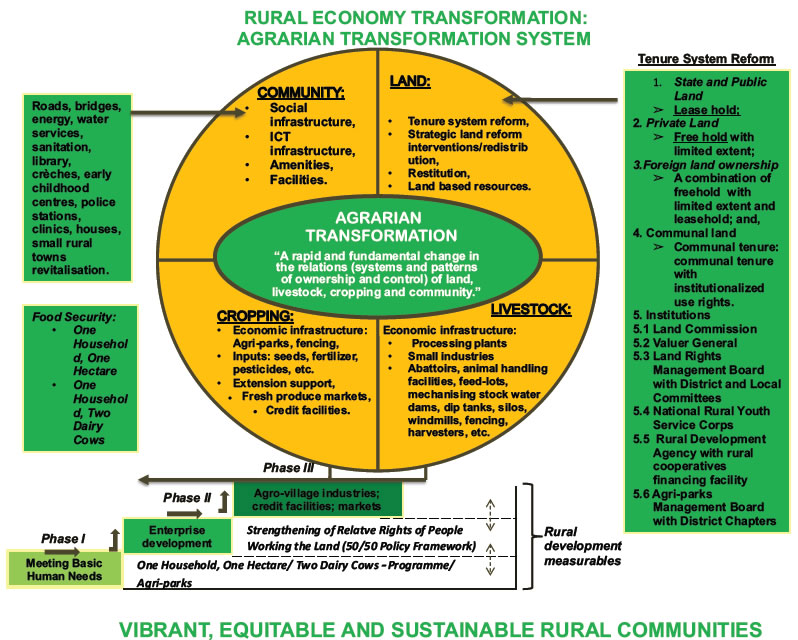
Transforming the rural economy
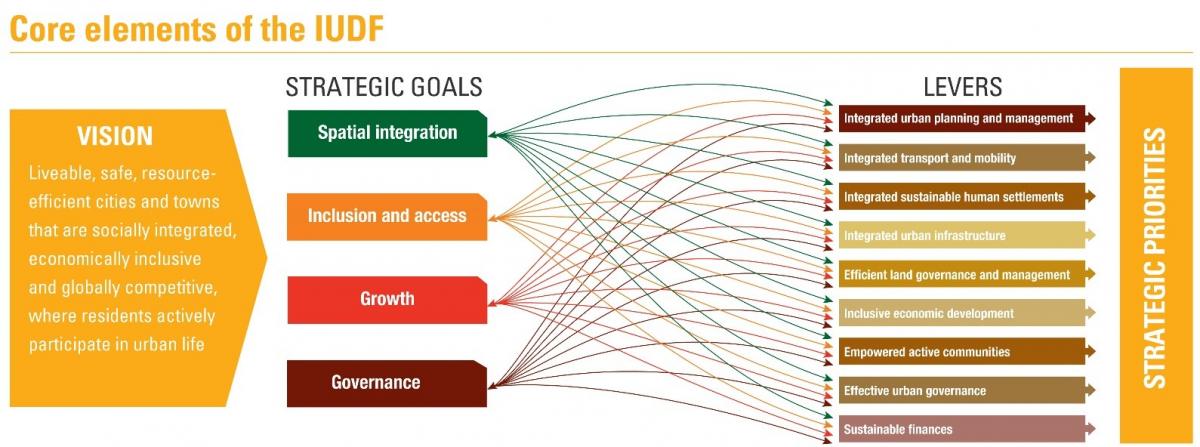
Transforming the urban economy
Glossary
Land redistribution
An effort by governments to modify the distribution of land ownership. It is often an attempt to transform an agrarian structure composed mainly of large-scale farms into one where family farms are predominant by taking land away from large landowners, or the state, and redistributing it to tenants and landless peasants. Historically, land redistribution has been carried out to abolish feudal, colonial, or collective forms of landownership and more generally to correct old wrongs.
Land tenure reform
A programme designed to change the legal and institutional framework for land administration. Other common changes attempted by land tenure reform programs include modification of the land tenure system and decentralization of the land administration and management function. In any society, the need for land reform reemerges regularly because the legislative and institutional frameworks for land administration have to be modified continually to adapt to changing political, economic, and social circumstances.
Land reform
A broader term comprising both land redistribution and land tenure reform. Land reform often takes place within an even broader strategy of agrarian reform: a collection of activities and changes designed to alter the agrarian structure of a country. Factors that influence the characteristics and evolution of this structure include bioclimatic conditions; socioeconomic, cultural, and political systems; population density; and technology. The objectives of an agrarian reform generally are to improve the levels of agricultural production both qualitatively and quantitatively and to improve the agricultural producers’ standards of living.
Community Survey (2016) – agricultural households
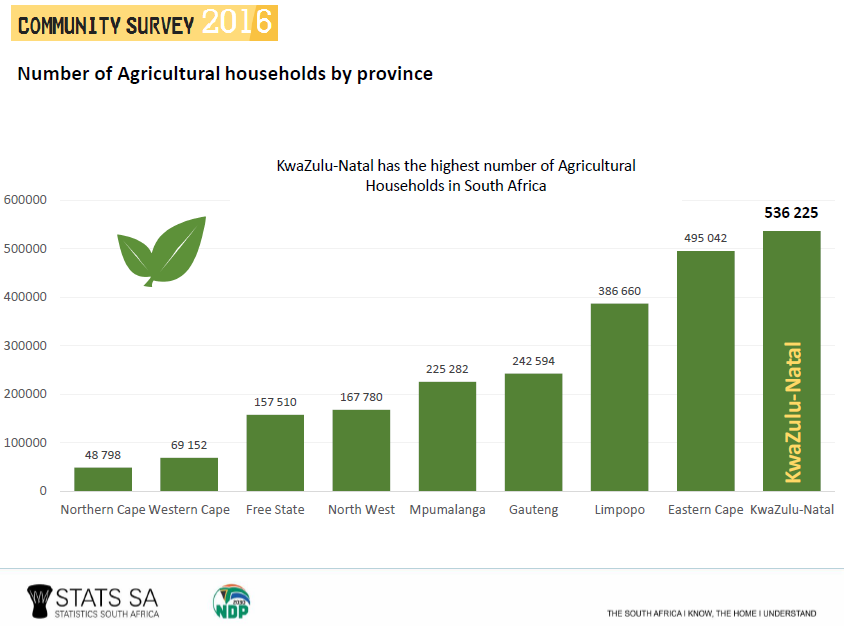
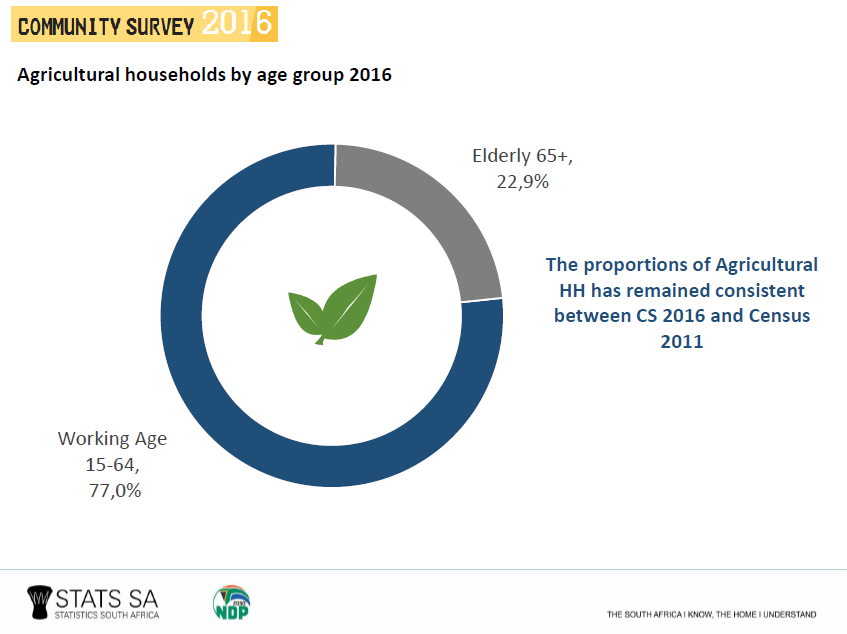
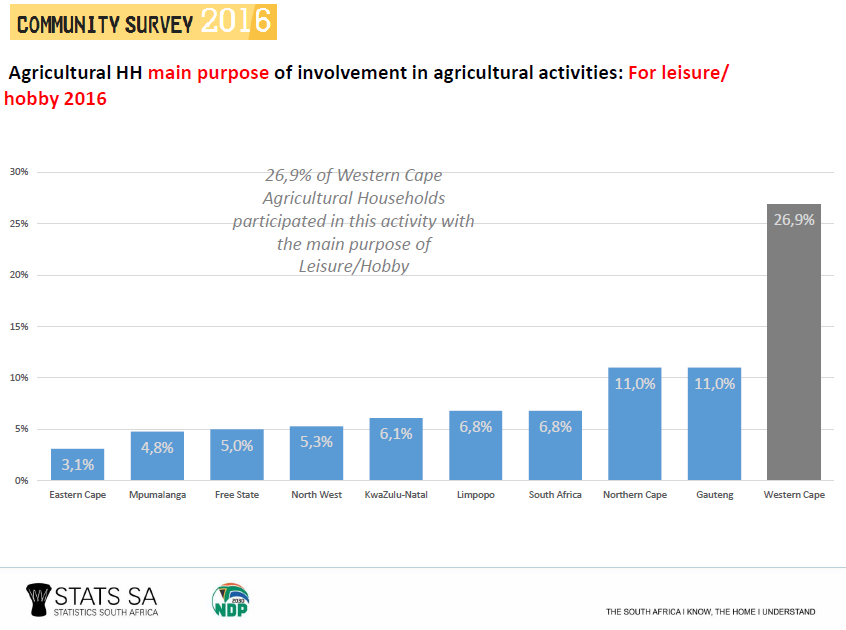
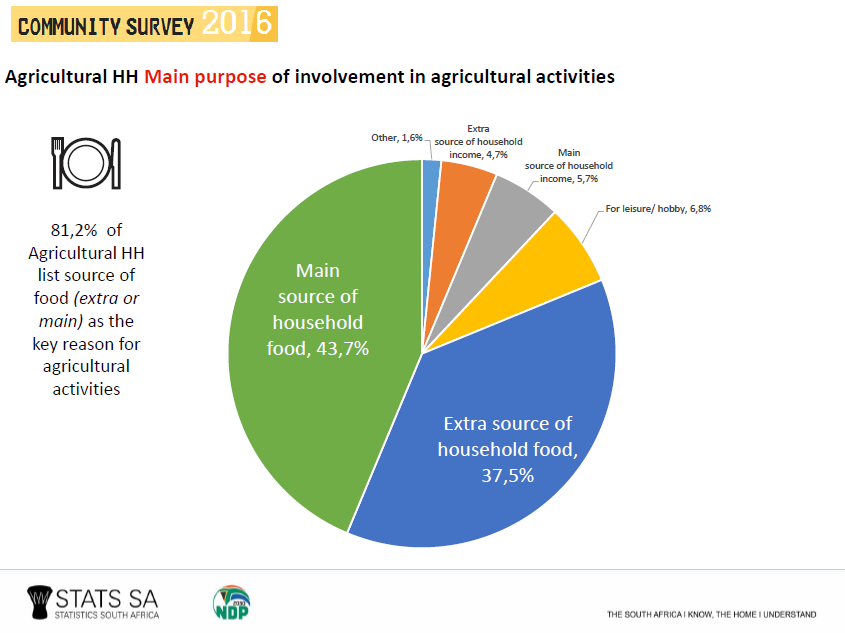
- The number of households engaged in agriculture (also referred to as agricultural households in this report) was 2,33 million in 2016 compared with 2,88 million in 2011. This represents a decrease of 19,1% between the two years.
- The bulk of households engaged in agriculture in South Africa were in KwaZulu-Natal (23,0% of country’s total), Eastern Cape (21,3%) and Limpopo (16,6%) in 2016. Free State, Western Cape and Northern Cape reported the lowest numbers of households engaged in agriculture, with 6,8%, 3,0% and 2,1% (of country’s total) respectively.
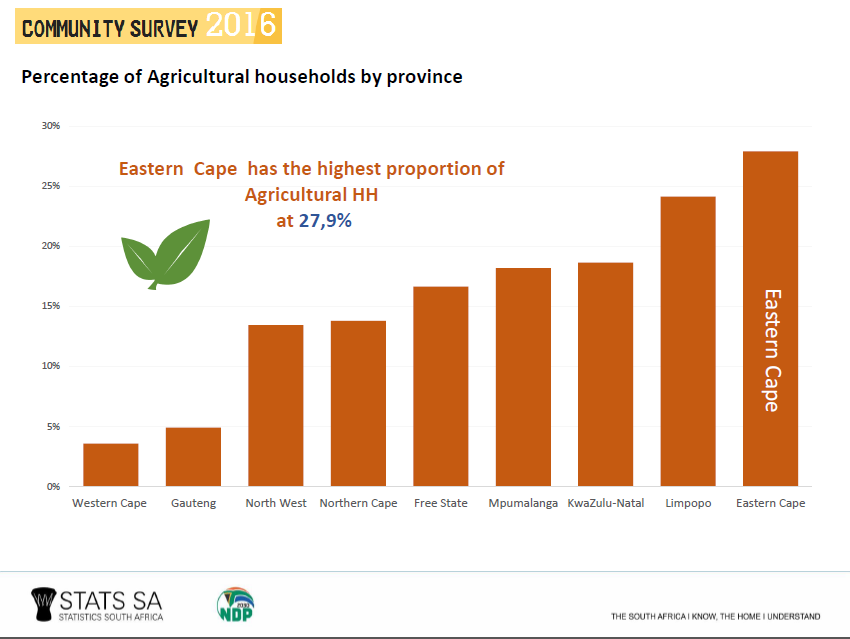
- Within the provinces, the highest proportion of households that were engaged in agriculture in 2016 was 27,9% in Eastern Cape, down from 35,4% in 2011. This was followed by 24,1% in Limpopo (33,0% in 2011) and 18,6% in KwaZulu-Natal (28,2% in 2011). Western Cape and Gauteng recorded the lowest participation rates, with 3,6% (5,2% in 2011) and 4,9% (7,1% in 2011) respectively.
Land audit
Government conducted a land audit in 2017
- Since the dawn of democracy in South Africa no official information has been published on land ownership according race, gender and nationality. There was need to show who owns South African land and to track progress of land reform to fulfil section 25(5) of the Constitution objectives to enable South African citizens access to land on equitable racial and gender basis.
- The Department of Rural Development and Land Reform published in 2013 the first Land Audit on State-Owned Land. That Land Audit revealed, among its findings, that most of this state land was un-surveyed and unregistered trust land which is occupied by individuals and communities in the former homelands. Cabinet instructed the department to conduct a second Land Audit with particular focus on private ownership and use of land by race, nationality and gender.
- The land audit only provides information on the private individual ownership of farms, agricultural holdings, erven and sectional title units by race, gender and nationality.
- The land audit provides such private landownership only on the basis of land parcels registered at the Deeds Office as of 2015.
- The Land Audit (2017) reveals the relationship of South Africans to one another through the management of land as a resource for sustainable development and nation-building.
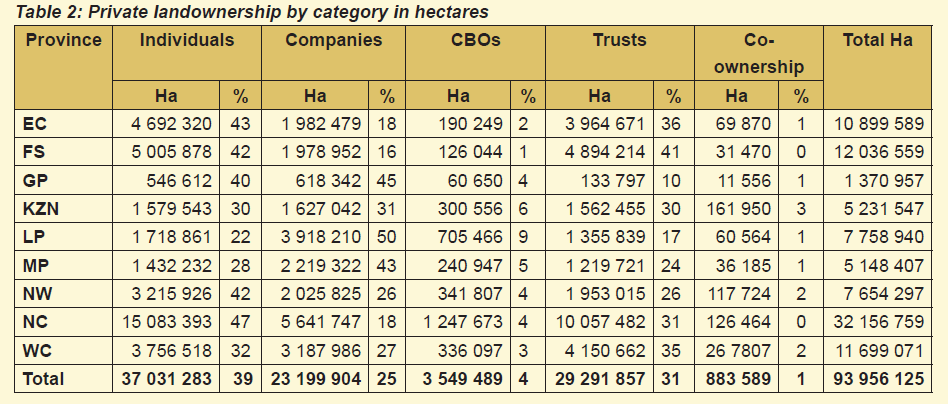
- 114 223 276 ha or 94% of 121 924 881 ha land in the country is registered in the Deeds Office. 7 701 605 ha or 6% is unregistered trust state land in the Eastern Cape and Limpopo at 5 545 156 ha.
- The Land Audit also shows that individuals, companies, and trusts own 89 523 044 ha or 90% of the 114 223 276 ha land.
- Individuals own 37 800 986 ha or 39% of this total land.
- Trusts own 29 291 857 ha of land.
- Companies own 23 199 904 ha of land or 25%.
- Community Based Organisations own 3 549 489 ha or 4% of land.
- Farms and agricultural holdings – with 469 258 or 6% of total land parcels and 111 025 515 ha or 97% of the total land – are owned by 588 045 or 7% of total landowners.
- 56 million of the total population found in these tiny land parcels command higher locational rent and prices than any in the R8 trillion national property market.
- The Land Audit reveals that White people own 26 663 144 ha or 72% of the total 37 031 283 ha farms and agricultural holdings by individual landowners.
- Coloured people own 5 371 383 ha or 15% of land
- Indians own 2 031 790 ha or 5% of Land
- Africans own 1 314 873 ha or 4% of land.
- The Land Audit also revealed that:
- Individual males own 26 202 689 ha or 72% of the total farms and agricultural holdings owned by individual owners; followed by females at 4 871 013 or 13%.
- Male-female own 3 970 315 ha or 11%, co-owners 655 242 ha or 2%, and other 1 379 029 ha or 3%.
Recapitalisation and development programme
- In 2008, the Department of Rural Development and Land Reform put distressed farms, which received subsidy from the land redistributed projects, under the Recapitalization and Development Programme (RADP) to revive them.
- The aims of the programme were to enhance food security; increase the output of farms towards commercial production; improve income for farmers and employees; increase the capacity of emerging farmers; increase productivity or efficiency levels on land reform farms; and contribute towards rural transformation.
- The programme involved mentoring support for the emerging farmers and guaranteed uptake of products produces by the farms.
Women and land
- The Extension of Security of Tenure Act gave women, for the first time, the same rights in land as men, by including women in its definition of “occupier”.
- The White Paper on Land Reform emphasises government’s intention to target women in its land reform policy.
- The democratically elected government of 1994, reviewed and amended past discriminatory policies and legislation – which addressed gender discrimination.
- Government established a Commission on Gender Equality and a Ministry responsible for Women to ensure the full and equal role of women in every aspect of society.
Examples of successful land reform projects
Case study 1: Double Drift Community, Eastern Cape Province
In 2017, the Double Drift Community claim was settled with the community of 1500 members, receiving 1300 hectares of land in the Eastern Cape which constitutes 21 farms and is now the Double Drift Nature Reserve. They are running a game farming venture.
Case study 2: Ravele Community, Limpopo Province
The transfer of this land was done in 2005.The Communal Property Association has since made great strides in making the land productive and thus contributing to food security in our country. The CPA continues to record profits and has been exporting their produce, macadamia and avocados amongst others, to Europe, China and other markets.
Case study 3: The High Haven Farm Project
The Nduzulwana family (then couple, children) are beneficiaries of a government land reform programme, the High Heaven, a 57ha farm outside East London. The project started with pigs, cows and chickens as a focus of operation. Extension officers offer continuous assistance and support. The High Heaven farm was leased from the state, with an option to buy, as stipulated in the Department of Rural Development and Land Reform’s Proactive Land Acquisition Strategy (PLAS) programme. It thus became a commercial farm. The farm employs 24 permanent employees, and 26 seasonal employees. The farm supplies poultry products for distribution in supermarket and restaurant stores across the province. The dairy and pork production is also supplied for local markets.
Case study 4: Fortune 40 Youth Farmer Incubation Programme
The Mpumalanga Fortune 40 Youth Farmer Incubation Programme aims to foster and accelerate the growth of agriculture and agro-processing sectors and catalyse the participation of youth in the farming sector. A fair and transparent recruitment and selection process was followed in choosing the beneficiaries which are mainly youth and women. The beneficiary youth were placed in a farm within 50 kilometre radius from their homes. 11 incubators were appointed based on their experience and capacity. All farms falls within the radius of an Agri-Park which supply Agri-hubs. In this way the young farmers have an opportunity to participate in the Mpumalanga International Fresh Produce Market. The Fortune 40 farms in total constitute 1600 ha with potential of expanding as and when additional farms are secured.
Case study 5: T-tlou farming
T-tlou farming is located in Pilgrimshoop farming area approximately 10 km North of Polokwane town along Dendron road. The size of the farm is 370 hectares. The farmer has entered into 20 years lease agreement with Polokwane local municipality from 2008 until 2028 with subject to renewal. The current farm (Pilgrimshoop) has been used for vegetable and livestock production ever since it was established. The farm is suitable for crop and livestock production. The Department of Agriculture and Rural Development in the province has assisted the farmer with the infrastructure such as: 10 ha drip irrigation, borehole drilling and equipping, and a 20ha Centre-pivot irrigation system. The farm has well defined markets for the produce, these include: KLM, APOL, Tiger brands, Mozambique, Peppadew international, NTK ,Goseame & local Hawkers.
Case study 6: Warrenton Super Chicken, Northern Cape
The broiler farm was purchased through LRAD funds from a commercial farmer. The previous employees (60) approached the Magareng Municipality to assist in procuring the farm on their behalf. The farm was purchased though the Land Reform transaction programme. Warrenton Super Chicken is 21ha in extent, with 9 chicken houses at the carrying capacity of 910 000 chickens per house. The company has 1 big storage shed and extra 3 small ones, kiosk, an abattoir with the through-put or capacity of 2 000 chickens that can be slaughtered per day. The company rears chicken from a day old up to day 35 on average where they are slaughtered, packaged and sold in different weights. The chicken produced by the company is brine free, ensuring good quality and taste. The farm produces innovative and added value to the chicken products by making chicken sausages and patties. They also sell chicken barbeque to the community and people who are driving on N12 on daily basis.
Case study 7: Batho Farming Youth Empowerment Project
The 5ha portion is leased from Matjhabeng Municipality in Virginia Farm Commonage. The beneficiaries transport its own produce to markets. The project is planning to employs up to 20 seasonal workers. The beneficiaries have full time support from economics and extension services access in preparation for production. Mentorship and intensive training have been provided.
Case study 8: Plot 7H14
The 24 ha PLAS farm was to Ms Mapule Fourie in December 2012. Initially Ms Fourie was leasing 4,6ha plot from the Tadcaster Primary school where she was producing cash crops like lucerne wheat, groundnuts, maize and vegetables. Vegetables were sold at a road stall next to N18 at a reasonable price. Income generated was utilized to pay school fees for her daughter at tertiary and the savings were used to plough back into the farming business. In 2009, she entered the Female Farmer Entrepreneur Awards and came first price under the category: Top Producer: Small holder: Horticulture & Crops.
Case study 9: Killarney Youth Cooperative
The 54ha farm was purchased in 2008 through LRAD transaction for extension of commonages under the administration of the Dikgatlong Municipality at Riverton. It was procured for 74 households, but only 15 youth individuals are currently active in the project. In 2009 Killarney Youth Cooperative was registered. Farmers are assisting other youth farmers in the area with sharing of implements and advice on production and upgrading of infrastructure and again during harvesting process. 15 youth members are employed seasonally during harvesting and in the vegetable project.
Case study 10: Iphemeleng CPA
The 20,9ha irrigation farm was purchased through LRAD funds in January 2006 for 36 small holder farmers; (20 Females & 16 Males). The farm has 20.ha of water rights and is 5km from Hartswater in Polokwane Local Municipality. It forms part of the Vaalhaarts Irrigation Scheme which consists of 35 000ha of the irrigation land and a comprehensive canal system is supplying water to the irrigation plots. The farm was identified for Recap in 2012/13 financial year. Beefmaster was appointed as the Strategic Partner (co-management) for the project. Implementation commenced in October 2012 The farm was listed for CPA regularization as not all the members were actively involved in the running of the project. The business is operating as Iphemeleng Small farmers (PTY) LTD on behalf of the CPA.
Case study 11: Project Lungisa Indlela Village, KwaZulu-Natal
Lungisisa Indlela Village (LIV) which is a non-profit organisation committed to uplifting the lives of orphans and vulnerable children in partnership with government and businesses. This organisation caters for the social and educational needs of approximately 120 children. To date, LIV has undertaken joint ventures and received financial support from various government departments including DARD and has successfully completed a number of projects which include the following: Construction of housing facilities, food security and commercial agriculture projects, sporting facilities, construction of school, etc. The Department also funded and facilitated the establishment of a hydroponic growing facility which cost R1.2million and was completed in In September 2015. As a joint venture, LIV has contributed approximately R1.3million towards the completion of the hydroponic project which includes the construction of a pack-house. The Departments total financial investment is R1 580 000 thus far which accounts for all agricultural interventions at LIV. The hydroponic project is designed for the commercial production of cucumbers in 10 tunnels and LIV has secured markets at Checkers and Pick and Pay. The first crop was established in September 2015 and the project is currently fully operational. The farm produces 180 000 cucumbers per annum.
Resources
Reports
Final Report of the Presidential Advisory Panel on Land Reform and Agriculture, released on 28 July 2019
Websites
- Brand South Africa www.brandsouthafrica.com
- Presidency www.thepresidency.gov.za
- Department of Rural Development and Land Reform www.drdlr.gov.za
References
High Level Panel on the Assessment of Key Legislation and the Acceleration of Fundamental Change
Booklet
Gender-based Violence

Government condemns any form of violence against women and children.
We must work together with police, prosecutors and courts to ensure that those who hurt and abuse others are arrested and convicted. Report all cases of rape, sexual assault or any form of violence to a local police station or call the toll-free Crime Stop number: 086 00 10111.
Gender-based violence (GBV) does not discriminate. Any person of any race, age, sexual orientation, religion or gender can be a victim or perpetrator of GBV. Men are encouraged to join movement to end gender based violence and sign the pledge
People may be victims of abuse if: They seem fearful of their partner; spend less time with family and friends; often criticised or belittled by their partner; partner is jealous, possessive and/or aggressive; have become unusually quiet or withdrawn and have physical injuries such as bruises or broken bones.
 Men can challenge the normalisation of violence To prevent violence against women and their children, we have to challenge the beliefs and behaviours that excuse, justify or condone violence and inequality. Make your voice heard by declaring publicly that enough is enough:
- challenge the normalisation of violence against women and children
- challenge gender stereotype and roles
- challenge condoning of violence against women and children
- challenge sexist jokes and remarks about women.
Signs to check against Men are called upon to challenge behaviours and attitudes that have an impact on violence against women and children. You may need help if you say YES to any of these statements:
- We cannot and can never separate or divorce.
- I cannot live without her.
- I have had sex with a drunk person.
- I have ignored someone asking me to stop continuing a sexual act.
- She cheated on me, so I had to punish her.
- I believe that when she says ‘NO’, she means ‘YES’.
- I spent money on her – she owed me sex, so I took what she owed me.
- She was dressed like she wanted sex. Dial the free helpline 0800 428 428 and find help immediately.
If you are a rape survivor and need help click on the Thuthuzela Care Centre logo below to find a care centre near you:

Useful numbers to keep:

View original post @ Gov.za