
Parliament passes Agricultural Amendment Bill

The National Assembly (NA) has passed the Agricultural Product Standards Amendment Bill and the National Veld and Forest Fire Amendment Bill during its hybrid plenary on Tuesday.
The Agricultural Product Standards Amendment Bill seeks to amend the Agricultural Product Standards Act, 1990; to provide for the auditing of a product for management control systems; to make provision for the setting of tariffs by assignees on a cost-recovery basis, and to make further provisions for the Minister to make regulations pertaining to audit and management control systems.
The National Veld and Forest Fire Amendment Bill seeks to amend the National Veld and Forest Fire Act, 1998, to provide for the facilitation of the formation of fire protection associations by a municipality or a traditional council.
It also seeks to compel a municipality, State-owned enterprise, public entity or another organ of State, which owns land to join the fire protection associations.
The Bill further seeks to extend the powers of entry, search, seizure, and arrest to peace officers and traditional leaders and to amend the title of the Act to the National Veldfire Act.
“Having considered and deliberated on the Bills, the Portfolio Committee on Agriculture, Land Reform and Rural Development and the Portfolio Committee on Forestry, Fisheries, and Environment recommended that the NA approve the Bills with amendments. The two Bills will now be sent to the National Council of Provinces (NCOP) for concurrence,” said Parliamentary spokesperson, Moloto Mothapo.
Rand Water to implement 30-hour planned maintenance

Rand Water has scheduled a 30-hour planned maintenance, which will commence from 3am on 24 February, until 9am on 25 February 2023.
In a statement, Rand Water spokesperson, Makenosi Maroo, said the 30-hour project will entail the implementation of various cross-connections on the entity’s S1, R1 and R5 pipelines to tie-in a portion of the S4 pipeline to the existing S1, R1 and R5 pipelines.
“This is part of the previously communicated strategy to refurbish and upgrade the infrastructure for sustainability purposes,” Maroo said.
She explained that the S1 pipeline runs from the Mapleton Booster Pumping Station to Rynfield Vlakfontein Reservoir, while R1 and R5 pipelines run from Rynfield to Rietvlei Nature Reserve in Tshwane.
“The S4 pipeline that will be tied-in runs from Van Dyk Park to Rynfield where it will cross connect to S1, R1 and R5,” Maroo said.
The following municipal customers will experience water supply shortages during this period:
• Ekurhuleni Metropolitan Municipality;
• Tshwane Metropolitan Municipality, and
• Thembisile Hani Local Municipality.
Other customers who will be affected include Spoornet; Corobrick Transvaal (Pty) Ltd; Sammy Marks Museum; Savannah Country Estate Home; and Plot 7 Benoni Agricultural Holdings.
Maroo said Rand Water has formally notified all the affected municipalities and direct customers, 21 days in advance, of the planned maintenance to allow them to implement their appropriate contingency measures ahead of the planned work.
“The affected municipalities will advise consumers on the extent of the impact of water supply shortages in their respective areas,” Maroo said.
Rand Water has also urged all consumers to use water sparingly.
Measles outbreak declared in Cape Town

The National Institute for Communicable Diseases (NICD) has declared a measles outbreak in Cape Town after four cases were recorded from 24 January to 17 February 2023.
“Even though all the lab-confirmed measles were investigated, no epidemiological link could be established,” the national public health institute said.
However, according to the NICD, the cases meet the South African measles outbreak criteria based on the 2015 EPI Surveillance Manual.
A confirmed measles outbreak, according to World Health Organisation African Region, is the occurrence of three or more confirmed measles cases at least two of which should be laboratory-confirmed in a health facility in a month.
“The missing information of the laboratory-confirmed measles cases should be followed up, and all the contacts should be vaccinated against measles,” the NICD said, adding that clinicians and caregivers should check children’s road-to-health booklets to ensure measles vaccinations are up to date.
Meanwhile, the country has rolled out the National Measles Supplementary Immunisation campaign for children under the age of 15 on 6 February 2023, including the Western Cape.
The Department of Health, working closely with the sister departments of Basic Education and Social Development, provinces and various stakeholders have embarked on a nationwide child immunisation campaign to vaccinate children at schools, early childhood development centres and other public places.
The NICD said suspected measles cases should be screened using the measles case investigation form to check if they meet the suspected measles case definition before the measles samples are collected for laboratory confirmation.
According to the latest data, the NICD has recorded 506 laboratory-confirmed cases of measles since the outbreak of this highly contagious, but preventable disease caused by a virus which mainly spreads through infectious airborne respiratory droplets from infected persons when coughing or sneezing.
Measles presents with fever, malaise, cough, conjunctivitis, and a runny nose.
A maculopapular non-itchy, non-vesicular rash appears on the face, neck, trunk, and limbs, usually on day four of the illness.
Other measles complications are pneumonia, scarring of the cornea, and rarely encephalitis.
“Measles is highly infectious and spreads rapidly from person to person.”
People of any age who are unvaccinated can catch measles, while measles vaccines are given routinely at six and 12 months of age.
“It is never too late to vaccinate against measles,” the NICD stressed.
MEC welcomes arrest of former official for fraud, theft

Gauteng MEC for Transport and Logistics, Kedibone Diale-Tlabela, has welcomed the arrest of a former departmental official and her accomplice on charges of fraud, theft and defeating the ends of justice.
The accused appeared at the Durban Magistrates Court on Tuesday for a bail application.
The fraud and theft are estimated to have cost the Department of Roads and Transport (through g-Fleet Management) around R16 million. The pair also face another charge of the use of state vehicles without authorised consent.
“Today marks a great milestone not only for the department but for the people of our province and the people of KwaZulu-Natal and the rule of law. A strong message must echo within the corridors of our department, especially to those who abuse their positions of trust and steal from the people.
“These individuals shamelessly used state resources with common cause to fashion a private business for themselves. They thought this net would never close in on them, but their day has finally come.
“As we embark on this important step of rooting out fraud and corruption, maladministration, malfeasance in our entity, the g-Fleet Management Agency, we would like to assure Gauteng residents that the trust they have bestowed upon us will not be betrayed,” the MEC said.
The arrests are the culmination of an investigation spanning six years by the department’s Fraud and Anti-corruption Unit, the Directorate for Priority Crime Investigations and the National Prosecution Authority (NPA).
The former employee was a regional manager for both the Eastern Cape and Durban regions of the g-Fleet entity, which is in the business of renting and leasing vehicles to state departments.
The MEC thanked the team for their diligence and painstaking efforts to follow on acts of wrongdoing and bringing those who are suspected of pilfering state resources to have their day in court.
“While our intervention has brought us to the province of KwaZulu-Natal, our net is cast wide to those dark corners where officials think they can get away with leeching on the resources of the democratic state for their narrow personal gain.
“Today, we have fired only the first salvo to looters of state resources, those who hollow out resources that are meant for the people of Gauteng for their personal gain. I want to take this opportunity to warn these elements that their days are numbered.
“As we fight these rogue elements amongst us, that we remind those who continue to work as trusted stewards and patriots of our democratic state that ethical conduct and honesty also pays,” the MEC said.
President salutes SANDF for their selflessness

President Cyril Ramaphosa has commended the exemplary selflessness, self-sacrifice and patriotism of the country’s armed forces, who always put the interests of the country first even in the face of great danger.
“As the Commander-in-Chief, I commend the good work you are doing as men and women in uniform,” President Ramaphosa said on Tuesday.
Speaking at this year’s Armed Forces Day event held in Richards Bay in KwaZulu-Natal, President Ramaphosa commended the soldiers’ highest level of discipline with which they discharge their duties even under difficult conditions.
“By virtue of their calling and allegiance to the Constitution, they act without hesitation whenever called upon to do so, when their country needs them most,” he said.
President Ramaphosa said the soldiers have picked up the spears of fallen heroes and heroines and continue the effort to give South Africans lasting peace, security and stability.
“I salute all of you who carry out tasks in times of disaster that literally stand between life and death. We are inspired by their bravery as we stand here in the face of grave challenges confronting our society.
“We are determined to emerge triumphant from the struggle against poverty, inequality, unemployment, gender-based violence, crime, disease and deprivation.
“While our armed forces are always on guard to defend our hard earned sovereignty and constitutional democratic order, they do much more than that,” President Ramaphosa said.
President Ramaphosa said the soldiers are found on rescue missions in times of disaster, building bridges where a desperate need exists and rehabilitating rivers from the effects of pollution.
“They have time and time again shown that they are a force for good and an integral part of all progressive humanity.
“By virtue of their calling and allegiance to the constitution, they act without hesitation whenever called upon to do so, when their country needs them most.
“We extend our appreciation and respect to our forces deployed in various missions across the continent,” the President said.
The President said with the confidence and faith South Africans have in the capabilities of the armed forces, citizens are reassured as a people that no matter the circumstances, the SANDF will always be there to restore order, maintain calm, support people and defend the territorial integrity of the Republic.
Since last week, the small town of Richards Bay in the northern part of KwaZulu-Natal was a hive of activity when the SANDF members invaded the town to host this year’s Armed Forces Day.
Most locals where excited to see the SANDF in their town.
Zakhele Madondo, a local resident in the town of Richards Bay told SAnews that he was happy to see the SANDF in the area.
“This shows that they are indeed our army. I have never seen so many soldiers in our town. I am happy to see them,” he said.
Echoing the similar sentiments was Muziwendoda Sikhakhane, who came all the way from Manguzi to be part of the event.
“I am impressed that the SANDF is also giving our young people opportunities to be part of the SANDF,” he said, adding that South Africa needs more soldiers to defend the country.
Prior to the formal event, the President started the day by laying a wreath at the Empangeni World War II Monument.
Thereafter, the President proceeded to the military parade where he took a salute from the SANDF.
The Armed Forces Day is held annually on 21 February in commemoration of the World War I naval tragedy in which 616 black South African troops died when the SS Mendi steamship sank on its way to France.
The day honours women and men who have lost their lives in the course of their patriotic duty to the country or on international missions.
The day also seeks to expand public understanding of the role of the SANDF in the life of the nation and to demonstrate through live simulations of military action the capability of the army, navy, air force and South African Medical Health Service.
Furthermore, Armed Forces Day fuels the imagination of young South Africans in terms of choosing career paths and exercising their passion and abilities.
Gauteng invests in building new schools to address overcrowding

The Gauteng provincial government intends to address overcrowding in schools, which is exacerbated by high levels of in-migration, by building new schools in high-pressure communities.
“Unless we do something differently, our education system will collapse. Addressing this issue and learning from the experience of unplaced learners in Grades 1 and 8, Gauteng has budgeted R6 billion from our provincial coffers to build new schools in high pressured communities,” Gauteng Premier Panyaza Lesufi said on Monday.
Delivering his State of the Province Address in the Gauteng Provincial Legislature, Lesufi said the province has received a major boost of R1.5 billion from National Treasury to demolish mobile and asbestos schools. The province will rebuild 18 new schools in Gauteng.
For the first time, the province will access resources from the private sector financial institutions to fund infrastructure projects upfront, after which they will be built, maintained, transferred and handed over to the province.
“Within the coming weeks, we are going to the market to solicit proposals from private companies to build these schools. We will not compromise on BEE [Black economic empowerment] and township beneficiation.
“To give our learners a competitive edge and to prepare them for the post-matric world, we will continue to roll out Schools of Specialisation,” the Premier said.
To date, Gauteng has 21 Schools of Specialisation and by the end of this administration, it is set to have 35.
The Premier said the number of children registered in Early Childhood Development (ECD) sites has increased.
“As part of the process to bolster our education system, we are now ready to build an ECD of the future, starting with Tshwane (in Soshanguve). We are committed to rolling out ECDs of the future across the five corridors.
“The ECD of the future will have classrooms with indoor splash pools, information and communications technology (ICT) centres, a water recycling area and mini sports areas. Coding and Robotics will gradually be introduced into the curriculum to meet the challenges of the Fourth Industrial Revolution (4IR),” Lesufi said.
Youth development
Over the years, Gauteng has committed to procure goods and services from youth-owned businesses.
Between April and December 2022, procurement spend amounted to R1.6 billion in youth-owned companies.
“As a province, we continue to place youth development at the centre of our planning. I am happy to announce that the Provincial Cabinet has approved the Gauteng Integrated Youth Development Strategy (GYIDS) 2030.
“The Youth Strategy is a blueprint of how this government will respond comprehensively to the socio-economic challenges facing young people in our province. The future belongs to young people and they must be taught now to run government,” the Premier said.
The Gauteng Youth Advisory Panel members, in addition to providing oversight, have also been assigned to departments to participate in strategic decision-making processes that have an impact on youth development.
“Through the Presidential Youth Employment Stimulus programme, the province has provided more than 100 000 youth with workplace experiences.
“By the end of this term, 152 000 young people would be employed by this provincial government. Of this, 100 000 [will be in] our Expanded Public Works Programme, 40 000 [in] educational and general teacher assistance [posts] and 6 000 [in] Crime Prevention Warden [posts].
“Over the years, we have committed to ensuring the inclusion of people with disabilities in all of our programmes. We have set a target of 7% in the procurement spend and support for companies owned by people with disabilities.
“We note that our performance is not at the level at which we had envisioned and therefore, recommit ourselves to empower people with disabilities,” the Premier said.
Multibillion rand boost for township economy

The Gauteng Provincial Government has committed to use 60% of its R34 billion goods and services budget to support township initiatives.
Delivering the State of the Province Address (SOPA) in the Provincial Legislature in Johannesburg on Monday, Gauteng Premier Panyaza Lesufi said townships are the province’s “new gold” and with new malls and filling stations being rapidly set up there, government must ensure these investments benefit the people.
“This house [legislature] unanimously adopted the Township Economic Development Act, a blueprint on how we will support township businesses and fund them. We want this act… to migrate from paper to practice.
“As the Gauteng Provincial Government, we commit, as we do now, that as of 1 April, we will use 60% of the R34 billion goods and services budget [about R20.4 billion] to support township initiatives. We are establishing a digital database (township business register) of all businesses in townships,” Lesufi said.
Lesufi said a financing model is currently being finalised to allow township businesses to have their own bulk buying mechanism through the establishment of township-based warehouses and distribution centres, like the ones already launched in Katlehong and Mamelodi.
The Premier said the province has also adopted a prototype for local retail shops, commonly known as spaza shops, so that they can differentiate them from shops owned by foreign nationals.
“We are now firmly reclaiming our shops in the townships. The township residential rental market or the “backroom economy” has been part of the township economy since the beginning of time,” Lesufi said.
R50 million approved for backroom property owners
The province is upscaling the formalisation and upgrading of backroom properties, and empowering “aboMastandi” (landlords) to get into the real estate industry.
Lesufi said 2 000 applications have been validated for funding for aboMastandi and 40 loans have been approved to the tune of R50 million, which has the potential to create employment.
“We want to ensure the timeous lodging of zoning applications and direct collaboration with municipalities on the delivery of this project of backyard dwellers. With our Gauteng Broadband Network, we will provide reliable internet in the townships and make free WiFi available at strategic areas in our communities,” Lesufi said.
Taxi rank of the future
As the taxi industry plays an important role in the township economy, Lesufi said together with the taxi industry, the provincial government has put together a taxi fund to the tune of R20 million, as a seed capital for the taxi association to raise money in the market.
“Taxi ranks will be our future shopping stations. We will be launching taxi ranks of the future, a one-stop shop, for taxi parts and tyres, banks, restaurants, and many other related businesses, such as filling stations.
“A new model of taxi rank of the future will be unveiled. We are excited about this project,” Lesufi said.
Gauteng announces interventions to tackle crime
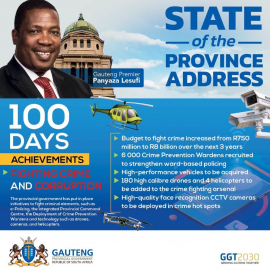
Gauteng Premier Panyaza Lesufi has placed crime fighting at the top of the provincial government’s agenda, announcing interventions aimed at strengthening efforts to deal with the high levels of crime.
“So the issue of fighting crime should be our apex priority. We should unleash all our resources at our disposal to tackle crime. To this end, we are increasing our budget of fighting crime from R750 million to multi-billion in the next three years,” Lesufi said on Monday in Johannesburg.
Delivering his State of the Province Address in the Gauteng Provincial Legislature, he said the interventions will be implemented from 1 April 2023 and 1 May 2023.
“We will start to connect suburbs, townships, business districts, schools and other public places with high tech, face and car recognition closed-circuit television (CCTV) cameras.
“We will arm our residents with e-Panic buttons that will be linked to our law enforcement agencies, CCTVs and our new state of the art Integrated Command Centre.
“We will unveil two new helicopters at the beginning of the next financial year and add four additional helicopters within the 2023/2024 budget cycle,” Lesufi said.
The private security industry has pledged to add theirs as well to the pool of helicopters for patrolling.
“To ensure that our police are not sacrificial lambs in the battles with criminals, we are at an advanced stage to procure 180 state of the art drones that will infiltrate areas that are difficult to patrol and police. These drones are equipped with technology that can capture the direction of a bullet and where they come from,” the Premier said.
The province has procured 400 new police cars, which means that from 1 May, every ward in communities will have a 24hr patrol car equipped with proper gadgets.
In addition, 6 000 young men and women have been recruited to monitor and police Gauteng 24/7 from 1 May 2023.
“The almost 10000 private security companies have agreed to combine their resources with ours under a joint command structure so that we can fight crime together in our province,” Lesufi said.
The Premier emphasised the importance of amending legislation on the registration of cars, since they are a common denominator in violent crimes; either stolen or get away vehicles, the elimination of illegal guns and the need to migrate the province to use less cash in business transactions.
“The current number plate system is running out of numerics and letters. We want to take advantage of this situation to introduce new, hard to copy and tamper with, number plates.
“As we speak, we have issued the Government Gazette on 17 February 2023 for consultation and comments on new security features. This new system will also assist in managing the abuse of temporary number plates,” the Premier said.
He called on the Southern African Development Community (SADC) to create a new database of all vehicles within the region so that a common verification platform can exist.
“We have also issued strict instructions to our law enforcement agencies to pull off those who continue to drive cars without number plates or fraudulent temporary permits. The abuse of fake blue lights are in the increase. A special unit to eliminate this phenomenon is being assembled.
“Those with illegal guns are now playing God. They decide who lives and who dies. Together with the private security industry, we have found a solution that will assist in tracking stolen guns and locate them wherever they are in our country. We will firstly migrate our law enforcement agencies guns in this system then members of the public,” Lesufi said.
In an effort to contribute towards using less cash in business transactions in the province, the Premier urged retailers and other businesses to join the hospitality industry in eliminating cash transactions.
“If we all do so, we will see less business robberies, cash heists and ATM bombings.”
Maternal air pollution exposure puts unborn babies at risk in SA

Pregnant mothers living in air pollution hotspots in South Africa risk bearing a child with a congenital birth anomaly; specifically orofacial cleft lip and palate (CLP).
This is according to research done by the South African Medical Research Council (SAMRC) in partnership with surgeons, researchers and Operation Smile.
The research was presented this month at the Climate Child Health Series: The Impact of Climate Change on Newborn Health Outcomes held online by the US Child Health Task Force and United Nations International Children’s Emergency Fund (UNICEF).
According to the SAMRC, the study draws together cases of patients with CLP from 2006 to 2020.
Drawing from two databases, 2 515 cases were studied about air pollution assessed at the mother’s residence.
“The research identifies an association between the increasing trend in CLP and a mother’s exposure during early pregnancy to particulate matter (PM) air pollution, PM10 and PM2.5,” the institution explained.
The experts defined the CLP as birth anomalies that typically affect a baby’s lip or mouth and nose because these parts do not form properly during pregnancy.
“This may happen during weeks four and seven of pregnancy. When a baby is developing, body tissue and special cells from each side of the head join to make the face.”
There are several possible causes of CLP, according to the SAMRC.
These include genes, what the mother eats and drinks, whether a mother smokes, uses a certain type of medication during pregnancy and the environment in which the pregnant woman lives.
According to scientists, the environment has been less explored, which is the reason research was conducted.
Chief Specialist Scientist at the SAMRC’s Environment and Health Research Unit, Dr Caradee Wright, said: “Air pollution levels are known to be high in South Africa, coming from coal-fired power stations, traffic, domestic fuel burning, mining, industry and other sources.”
“We wanted to explore whether a mother’s exposure to air pollution affected her baby’s cleft lip and palate risk in South Africa.”
Wright said the CLP birth hotspot clusters were found in district municipalities in Gauteng, Limpopo, North West, Mpumalanga, and Free State.
The findings emphasise the need for more stringent air quality management in South Africa to protect the health of unborn children.
Researchers have also called on the National Ambient Air Quality Standards and Air Pollution Priority Areas to manage the air quality strictly.
“Information needs to be provided to mothers regarding the risks that air pollution poses to their unborn child – especially in very early pregnancy so it’s important that if someone wants to fall pregnant, they try and limit air pollution exposure.”
According to the SAMRC, this can be done by avoiding making fires indoors without adequate ventilation, and not walking or exercising on busy roads during peak traffic hours.
According to the SAMRC, CLP patients experience a higher mortality risk and deal with the adverse effects of physical challenges such as speech impediments, physical deficiencies in appearance, and psychosocial issues.
“Added to the difficulties confronted by children with CLP are nutritional problems caused by the inability to consume food. The malnutrition that is a result of CLP is not properly recorded because the death certificates list these deaths as malnutrition.”
The research found that the use of a multidisciplinary approach, where multiple disciplines collaborate and share data on all maternal information and pollutant volumes in all provinces of South Africa can prevent CLP where possible.
It also can reduce suffering and financial burden on those affected.
OHS compliance key to decent workplaces
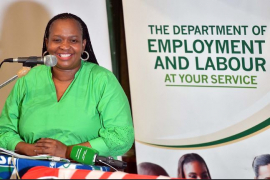
Employment and Labour Deputy Minister, Boitumelo Moloi, says organisations must develop mandatory systems of health and safety compliance in order to create decent workplaces post COVID-19.
Moloi was delivering the keynote address on Monday during the opening of the three-day Occupational Health and Safety (OHS) conference at Lagoon Beach Hotel in Cape Town.
The OHS Conference, which continues today, is held under the theme: “Decent work post the pandemic”.
Moloi told delegates that the COVID-19 pandemic has forced employers and workers to adapt quickly to new ways of working.
“Interestingly, many of these changes have brought unexpected benefits, such as improved productivity or working conditions. However, it is important that we not only focus on returning to work, but also take the lessons learned from the pandemic to re-strategize and prepare for future emergencies.
“We should not allow compliance to happen by accident. If you think compliance is exorbitant, try non-compliance,” Moloi said.
She said priority in the workplace should focus on the welfare of workers. Work delivery systems must also be designed to focus on outputs rather than activities.
“While the pandemic had presented us with difficult and challenging times, it has also brought some unexpected benefits, such as improvements in productivity or working conditions. In some ways, this has also improved the social aspects of workers and to enjoy a better work-life balance.
“In some cases, employers have also been able to reduce costs by adopting remote work arrangements or by introducing other new working practices,” Moloi said.
The Deputy Minister said one of the challenges brought about by the pandemic and work-from-home at policy level was the development of mechanisms to deal with an inadequate policy environment. She said the department is ill-equipped to enforce OHS in private households.
In the same breath, Moloi said the pandemic has also had a negative impact on the world of work, and it has disproportionately affected certain groups of workers in non-standard forms of employment such as those in low-paid, precarious or informal jobs.
She said during COVID-19, the department had to intervene and developed a COVID-19 Temporary Employee/Employer Relief Scheme (TERS) to provide financial relief to workers who had been affected by the pandemic.
“Overall, the post-COVID-19 labour market in South Africa remains challenging, with businesses and workers still facing a certain level of uncertainty and disruption. In the post-pandemic period, health and safety inspectors will likely play an important role in enforcing health and safety regulations and guidelines to prevent the spread of infectious diseases in the workplace.
“In addition to monitoring and enforcing health and safety regulations, health and safety inspectors can also contribute to the development of new regulations and guidelines that reflect the changing nature of work post-pandemic,” Moloi said.