
Maximum police resources deployed over festive season
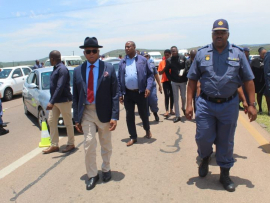
Police Deputy Minister, Cassel Mathale, says maximum resources have been deployed to prevent and combat all forms of criminality as the country ushers in the busy festive season period.
Together with National Police Commissioner, General Fannie Masemola, Mathale on Monday led a delegation of senior officers from the national headquarters to assess Limpopo’s safer festive season operational plan.
This followed the nationwide launch of the safer festive season campaign in November.
In a statement, SAPS spokesperson, Colonel Athlenda Mathe, said: “Heightened police visibility in the form of stop and search operations, vehicle checkpoints, crime awareness campaigns, patrols and compliance inspections at borders, liquor outlets and second hand goods dealers are among the police actions that are being undertaken to ensure that everyone in the country is safe during the busy festive season.”
In Limpopo, she said the focus was centred around preventing and combatting mob justice, GBVF, stock theft and rural safety in general.
She said in the previous quarter starting 1 July ending 31 October 2022, 51 murders emanating from mob justice were reported across the five districts of the province.
The Deputy Minister said while the SAPS management was implementing an all hands on deck operational approach to ensure a safer festive season for all people in South Africa, communities must also play their part.
“The efficiency of the police will be enhanced through community participation since crime itself happens in communities. The collaboration between communities and police is the key that will help us to fight and defeat criminality. We will continue to intensify our efforts to clamp down on criminality,” said Mathale.
Mathe said the nationwide assessment of Police operations will continue in all provinces to ensure the effectiveness and optimise the positive impact of the safer festive season operational plan.
The safer festive season operational plan focusses on six areas which include the prevention and combating of GBVF, armed robberies, enforcement of legislation, enhancement of border security and road safety.
Treasury publishes municipal operating, capital budgets

National Treasury has published on its website the operating and capital budgets of municipalities as adopted by their respective councils.
In a statement, the department said these budgets give an overview of expected revenue and expenditure trends in local government over the next three years, referred to as the 2022/23 Medium Term Revenue and Expenditure Framework (MTREF).
The revenue and expenditure numbers are aggregated from the annual budgets that municipal managers are legally required to submit to the National Treasury and the relevant provincial treasury.
“The published information is presented in a variety of ways, including aggregated municipal budget totals for the 2022/23 financial year and over the medium-term period. In addition, the information is presented per category of municipality and province,” said the Treasury.
Highlights include:
• The aggregated budgeted revenue for 2022/23 is R529.7 billion, which is expected to increase to R558.1 billion in 2023/24 and R593.9 billion in 2024/25;
• Total municipal expenditure in 2023/24 is estimated to be R557.4 billion, increasing to R582.1 billion in 2023/24 and R614.5 billion in 2024/25. Total expenditure for 2022/23 is 5.1 per cent higher than the adjusted budget for 2021/22 financial year;
• Municipalities will realise operating deficits on the operating budgets in the 2022/23 financial year as the total operating expenditure increases at a higher rate than the revenue projections. This is an indication that municipalities are living beyond their means and a first sign of financial challenges. However, the situation is projected to improve in the outer years of the 2022/23 MTREF as operating surpluses will be realised;
• A net deficit of R269.6 million is expected in the 2022/23 financial year, which improves to a surplus of R3.5 billion in 2023/24 and R7.3 billion in 2024/25;
• The main cost drivers are employee related costs and materials and bulk purchases representing 28.9 per cent and 32.7 per cent of the operating expenditure respectively.Municipalities are experiencing a two-fold impact of the high electricity and water tariff increases; lower sales levels owing to changes in consumption patterns and increased bad debt as a result of affordability pressures;
• Capital expenditure increased by 1 per cent to R69.7 billion in 2022/23 compared to the original budget for the 2021/22 financial year. Capital expenditure in aggregate represents 12.5 per cent in 2022/23, 11.7 per cent in 2023/24 and 11.4 per cent in2024/25 of the overall budget of municipalities;
Trading services (electricity, water, wastewater management and waste management) represents 49.7 per cent of the total capital expenditure of R69.7 billion in 2022/23 and slightly decreases to 49.1 per cent by 2024/25;
• The 2022/23 capital expenditure budget reflects a R43.8 billion investments in new infrastructure which is 62.8 per cent of the total aggregated capital budget. Investment in the renewal and upgrading of existing assets is much lower at R10.9 billion (15.6 per cent) and R15.1 billion (21.6 per cent) of the total capital budget respectively; and
• Reporting on operational repairs and maintenance figures has been institutionalised as part of Section 71 in-year reporting. Municipalities allocated R27.7 billion to repairs and maintenance of assets in 2022/23. This will increase to R29.2 billion in 2023/24 and to R30.9 billion in 2024/25.
National Treasury publishes local government MTREF information on an annual basis.
Regularly published budget information enables communities to hold their municipal councils to account. The information is also used by National Treasury as the basis for the In-year Management, Monitoring and Reporting System for Local Government (IYM).
The Section 71 reports published by the National Treasury give an account of actual revenue collection and spending by municipalities per quarter against their budgeted figures. All this information feeds into the Municipal Money open local government data portal and can be accessed on: www.municipalmoney.gov.za.
In addition, the Municipal Money time series data can be accessed directly from http://municipaldata.treasury.gov.za.
A new development that facilitate transparency is the GoMuni portal which can be accessed at https://lg.treasury.gov.za/ibi_apps/signin by clicking on the public access tab.
To improve the quality of reporting, the Municipal Budget and Reporting Regulations promulgated in 2009 prescribed new budget reporting formats for municipalities. In terms of the 2009 regulations, municipalities had to submit their 2022/23 MTREF budgets in the prescribed A1 Schedules as per the regulations.
In addition, with the implementation of the Municipal Standard Chart of Accounts (mSCOA) on 1 July 2017, municipalities must now prepare their budgets at the posting level over all segments as prescribed in the mSCOA classification framework.
All financial systems must have the facility to produce the A1 Schedule directly from their financial systems from the mSCOA classification framework.
Therefore, municipalities must put controls in place to ensure alignment of the adopted A1 Schedule to the financial system and the mSCOA data strings submitted to National Treasury. This publication is therefore based solely on the new regulated framework in terms of mSCOA.
Fight to recover ill-gotten gains gathering momentum
President Cyril Ramaphosa has lauded the country for being able to rebuild the supporting architecture to investigate and prosecute serious and other crimes within a short space of time.
This comes after the announcement by the National Prosecuting Authority (NPA) last week that it had reached a settlement with an international company implicated in corruption at Eskom.
In his weekly newsletter to the country, President Ramaphosa described this as a huge development in the country’s effort to hold those responsible for state capture to account.
The NPA Investigating Directorate finalised a landmark agreement with Swiss engineering company ABB Ltd to pay R2.5 billion in punitive reparations to South Africa. This in connection with bribes allegedly paid to obtain contracts with Eskom between 2014 and 2017.
This amount, which will be paid into the Criminal Asset Recovery Account, is in addition to R1.6 billion that ABB paid Eskom in 2020 to settle an investigation into allegedly criminal conduct involving contracts at the Kusile power station.
“Many of those involved in state capture and their enablers in the private sector saw nothing wrong with diverting public funds to private pockets. At the height of the state capture era, unscrupulous politicians repurposed state institutions for private enrichment and to cover their tracks.
“Today we have law enforcement authorities and a prosecuting authority devoted to investigating and prosecuting without fear or favour. We have state institutions committed to fulfilling their respective mandates regardless of the status or influence of any individual or a company,” the President said.
Now that progress is being made, the President said everyone must do everything they can to ensure that this work continues unhindered and that none of the gains that have been made are reversed.
He called on the nation to continue to support the agencies and people working in them with their full support and encouragement.
“We need to guard against any efforts to weaken these institutions or undermine their resolve. I have always said that the fight against corruption will not be won easily or quickly, given how many years it took for patronage and graft to become entrenched,” the President said.
Reflecting on the country’s fight against corruption in the last five years, President Ramaphosa said that government has worked hard to end the looting of resources meant for the benefit of South Africa’s people.
He said that this was evident in the prosecution of those responsible and the recovery of stolen funds.
“When we embarked on this journey, we understood that the results would not be felt overnight.
“We first had to rebuild state institutions that had been deliberately weakened, emptied of expertise and rendered incapable of preventing capture by criminal elements. We had to strengthen law enforcement institutions and shield them from outside interference,” President Ramaphosa said.
He said that one of the most important steps they took was to establish, in 2019, the Investigating Directorate in the NPA to deal with cases emanating from the state capture commission and other corruption-related offences.
“We recently announced plans to make the Investigating Directorate a permanent structure.
“We are now seeing the results of this work. The fight against state capture and corruption is gaining momentum,” he said.
In the last few months, several cases have been brought to court, with former executives of state-owned enterprises (SOEs) like Eskom and Transnet charged alongside business people for allegedly colluding to steal public funds.
In addition to the arrests of those implicated in wrongdoing and bringing the cases to court, the President said that progress is being made in other areas as well where there has been malfeasance.
KZN farmer fined over R1.7m for illegal water use

The Department of Water and Sanitation (DWS) is persisting in its course to ensure that water users involved in unauthorised and illegal use of water resources are brought to book.
A farmer in Escourt has been fined over R1.7 million by the department for illegally abstracting water from Wagendrift Dam to irrigate his crops without a water use licence.
The owner of Redlands Farm, Roy Clifford Braithwaite, was illegally taking water from Wagendrift Dam to irrigate crops that are on the Redlands Farm. The farm is situated upstream of Wagendrift Dam
The dam, which is under Bushmans River Government Water Scheme in the Pongola-Mtamvuma Catchment Management Area, provides water for domestic water supply, agriculture (irrigation) and industrial demands for Estcourt and Weenan.
A water use licence is a document that is issued by the department in terms of Chapter 4 of the National Water Act (Act 36 of 1998), which allows the user to undertake an activity triggered in terms of Section 21 of the Water Act.
Section 21 says a user is required to apply for authorisation to take water from a water resource to use for any commercial activity.
The department’s Director of Compliance, Monitoring and Enforcement, Thandi Mopai, said the farmer was found to have contravened Section 21 of the Water Act after the department uncovered an abstraction point on the bank of a dam with no flow meter and that it was illegally pumping water into Redlands Farm for irrigation of crops using centre pivots.
Mopai said a Notice of Intention and a directive instructing the farmer to halt operation of abstracting water was issued after it was found that the farmer did not have permission to use the water.
However, she said the farmer did not stop the activity, which necessitated the department to take legal steps, using court route to force compliance.
“The farmer, through his legal representation, approached the department and agreed to pay an admission of guilt administrative fine of R1 770 392.75 within 45 days to avoid criminal charges. Through the Escourt Magistrate Court, the farmer was issued with an order to pay the fine within the set period, counted from 24 November 2022.
“On 24 November 2022, the Estcourt Magistrate court issued the accused with an order to pay an administrative fine of R 1 770 392.75 to the department’s main account, which was provided. A mediation agreement was signed after receiving proof of payment and the order made by the magistrate on the same day,” Mopai said.
Mopai warned that the department will continue in its efforts to root out illegal and unauthorised water use, as it impacts negatively on the livelihood of the people in as far as water provision is concerned.
Post office hits 60 000 mark for online car licence renewal service
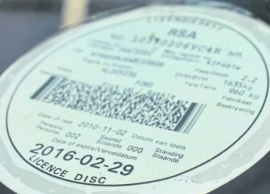
More than 60 000 vehicle licences have been renewed on the online platform of the South African Post Office (Sapo) since its launch at the beginning of the year.
Sapo attributed its success to the fact that vehicle licences can now be renewed 24/7 from any laptop or smartphone.
“This is a huge bonus for car owners who live in remote areas. It also saves you money. There is no charge if you collect the new licence from a nearby post office, and only R75 for delivery to your address,” the post office said on Monday.
The post office has encouraged vehicle owners to utilise the online renewal service.
“Avoid renewing the licence a day or three before month end. Should there be a slight problem with the paperwork, the month end might pass before the problem is sorted out, and the electronic national administration traffic information system (NaTIS) will automatically add the licensing fee for another month,” the post office said.
The applicant is required to upload the documents that are presented to the teller when a licence is renewed at a post office branch.
To ensure the process is seamless when the application is done online, the following documents should be readily available to be uploaded:
- ID copies must be certified (certification not older than three months).
- The application must be signed.
- Proof of address must not be older than 3 months.
To renew a company-owned vehicle, the following requirements apply:
- The proxy letter must be on the company letterhead and signed by the proxy.
- BRNC form must be attached (this is the Business Register Number form – essentially, it is an ID document for businesses).
- The ID of the proxy must be certified.
- Proof of address of the company must be submitted.
Payment is done safely and securely through Masterpass, which the user can download from the Google Play Store for Android devices and the Apple App Store for Apple devices.
Matric Exams to conclude this week with rewrites of some papers

The writing of the National Senior Certificate (NSC) examinations is set to conclude this week, with rewrite opportunities arising from disruptions in some parts of the country.
The NSC examination will conclude on 8 December 2022 with the Economics Paper 1 written in Gauteng only by 53 learners from Phandimfundo Secondary.
Today marks Day 28 of the 30-day examination, in which 215 of the 222 question papers have already been written.
In a statement on Sunday, the Department of Basic Education (DBE) said that during the writing of the examinations, it received reports requesting that some candidates be granted permission to rewrite examinations in selected subjects.
“Various reasons were provided to substantiate these requests. The DBE assessed the requests from Provincial Education Departments (PEDs) and in instances where valid reasons were presented, which were not of the learners’ doing, the DBE and Umalusi granted permission for rewrite opportunities,” the DBE said.
Rewrite opportunities have been granted in the following selected subjects:
- Mathematics Paper 2: Mpumalanga Department of Education
- Mathematical Literacy Paper 1: Eastern Cape Department of Education
- Mathematical Literacy P2: Mpumalanga Department of Education, Eastern Cape Department of Education and North West Department of Education
- Economics P1: Gauteng Department of Education
- English First Additional Language Paper 1: Limpopo Department of Education and Western Cape Department of Education
According to the department, some of the reasons for the missed examinations include:
- Candidates who experienced technical glitches during the writing of Computer Applications Technology Paper 1 and Information Technology Paper 1 or who, due to load shedding. could not complete the examination.
- 53 Economics P1 candidates from Phandimfundo Secondary Gauteng who missed the exam due to the principal’s actions.
- 1 127 candidates from seven schools in Witbank, Mpumalanga, who missed exams due to community protest actions.
- Two pregnant learners from the Western Cape and Limpopo, who were not allowed to write English P1.
- Three learners from the North West, who missed Maths Literacy Paper 2 due to flooding.
- Four learners from the Eastern Cape, who missed Maths Literacy P1 and P2 due to the principal’s actions.
The examinations in the selected subjects are scheduled to be written over two days from 7 to 8 December 2022.
“The matter regarding Mathematics Paper 2 has been resolved. Question 5.1 (worth seven marks) in the Mathematics P2 was found to be faulty.
“The question will be excluded from the marking process. The question paper will be marked out of 143 and the mark will be upscaled to 150,” the DBE said.
Marking sessions will commence on 10 December and conclude on 22 December 2022. The department said that all PEDs are on track with their marking preparations.
“Scripts are currently in storage. Scripts will be moved to marking centres from the 7/8 December 2022,” the department said.
Multi-disciplinary team intervenes in uMkhanyakude water issues
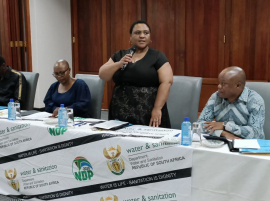
Agriculture, Land Reform and Rural Development Minister, Thoko Didiza, has led a multi-disciplinary team meeting with stakeholders from uMkhanyakude District Municipality in KwaZulu-Natal to discuss water challenges in the agriculture sector.
The meeting, held on Sunday, included Amakhosi and councillors. The multi-disciplinary team includes the Departments of Water and Sanitation; Agriculture, Land and Rural Development; KZN Cooperative Governance and Traditional Affairs; uMkhanyakude District and Mhlathuze Water.
It was also used as a platform to give an update on government’s interventions to ensure water provision for sustainable livelihoods.
“In consultation with my counterpart responsible for Water and Sanitation, Minister Senzo Mchunu, we agreed that at the same time as we focus on overcoming the domestic water challenges of this region, we also need to ensure that there is sufficient water to drive agriculture,” Didiza said.
She said the consistent outcry from the community of uMkhanyakude is the dearth of access to water for emerging farmers.
In this regard, Didiza said, senior officials from Water and Sanitation, and Agriculture, Land and Rural Development Departments have been tasked with working with the newly established Lower Pongola District Water User Association and Infrastructure to overcome the region’s water challenge and ensure equitable access to water.
The Water User Association consists of various stakeholders drawn from civil society.
The Department of Water and Sanitation recently appointed Mhlathuze Water to act as the implementing agent under section 63 of the Water Services Act.
Under the directive, Mhlathuze Water has already begun working with the uMkhanyakude District Municipality to improve water infrastructure in the district.
Collaboration needed to improve water, sanitation in eThekwini

Water and Sanitation (DWS) Minister, Senzo Mchunu, has called for collaboration from different stakeholders to expedite the improvement of water and sanitation infrastructure in eThekwini Metropolitan Municipality.
This follows a stakeholder engagement meeting with Cooperative Governance and Traditional Affairs (COGTA) Minister, Dr Nkosazana Dlamini-Zuma; KwaZulu-Natal COGTA (Member of the Executive Council) MEC, Sihle Zikalala; eThekwini Executive Mayor, Mxolisi Kaunda; uMgeni Water and other stakeholders to discuss interventions in water and sanitation challenges faced by the metro.
Mchunu visited KwaZulu-Natal from 2 – 4 December 2022, to meet with various stakeholders, including all three spheres of government, water entities and water service authorities to assess progress on projects currently being undertaken in the province, and to discuss ways to address the state of water and sanitation provision.
During the meeting, Mchunu emphasised that the stakeholders collectively need to find mechanisms to deal with the challenges faced by the city.
“We need to start embracing collaborations and partnerships with the private sector as soon as possible, as a new way of dealing with service delivery, because depending only on fiscus alone, it will take us years to adequately address these problems,” Mchunu said.
Mchunu also recommended the establishment of a strong technical team to enable the municipality to work with other role players to carry out the work going forward.
“The importance of partnership is very crucial because all of us have to work together to enhance the provision of services to the people of eThekwini. The establishment of a technical team is also equally important to assist in identifying sources of money, allocate specific timelines to the projects, and deliver within those timelines.
“The technical team should be service delivery oriented and work with various stakeholders to determine a way forward in addressing issues of infrastructure in the municipality,” the Minister said.
Following the floods in the province, Mchunu said there is a need to strengthen capacity at municipal level to be able to address the concerns of poor infrastructure, and to ensure equitable access to water in eThekwini.
“Funding for infrastructure was also highlighted as the main critical issue during the meeting, and it was recommended that funding and the implementation of infrastructure investment should be prioritised.
“Funding is an enabler and makes things happen, and as DWS we need to come up with a model that will encourage partnership with the public sector. With the establishment of a technical team, there will also be will also be engagements with Treasury to iron out issues of funding,” Mchunu said.
He said there are masses of people who still do not have access to water in the municipality, and “the narrative must change”.
He said the department is concerned about the state of the infrastructure that has caused pollution in eThekwini rivers.
Kaunda reiterated the call to facilitate funding with various stakeholders and private entities.
He said the municipality will be working with various stakeholders to ensure that funding is secured for infrastructure development in eThekwini.
“We are also planning to accelerate this process by signing a Memorandum of Understanding with the Department of Water and Sanitation,” Kaunda said.
Increase in non-revenue water remains a challenge
Meanwhile, Zikalala implored the city to prioritise the issue of Non-Revenue Water, which is also the main point of contention in eThekwini Municipality.
According to Zikalala, non-revenue water in the city is high at 57%, with only 40% of water that is purchased billed, and of that, less than 70% is paid.
“A factor contributing to high non-revenue water is [over] 80 000 customers that are illegally connected to the water network as well as leaks,” Zikalala said.
AFU seizes R37 million in assets held by corruption accused

The National Prosecuting Authority’s (NPA) Asset Forfeiture Unit has seized assets worth some R37 million from several accused charged with fraud and corruption in the Mhlatuze Water Board matter.
The assets include residences in Cape Town, Durban, Richard’s Bay and Pietermaritzburg and several luxury vehicles including a Range Rover, Mercedes Benz and a BMW.
Assets held in trusts and companies and cash in bank accounts has also been seized.
According to the NPA, the charges relate to R37 million in tenders awarded by the Water Board in which the Water Board’s CEO Mthokozisi Duze, Chief Financial Officer Babongile Mnyandu, and attorney Sithembelo Mhlanga allegedly “acted in concert with each other to circumvent the outcome of supply chain management protocols” in order to award tenders to Mhlanga Incorporated which is owned by Mhlanga.
“Mhlatuze Water Board undertook a SCM [supply chain management] process to appoint a panel of service providers to render legal services to the water board. The approved budget for the panel was unlawfully increased by 640%, by the CEO and CFO.
“They then unlawfully awarded tenders to the value of approximately R37 million to one law firm – Mhlanga Incorporated – and excluded 15 other law firms. It is alleged that the CEO and CFO also received undue benefits from the said law firm during the period that the CEO and CFO had processed/approved the award of tenders to the said firm,” the NPA said.
The matter against the accused is expected back in court on Tuesday.
President engaging stakeholders on course of action – Magwenya

Presidential spokesperson, Vincent Magwenya, says President Cyril Ramaphosa is still engaging stakeholders with regards to the way forward following findings by an Independent Section 89 panel that the President may have violated his oath of office.
The panel was formed to look into the circumstances around a robbery at the President’s Phala Phala game farm and found that President Ramaphosa may have seriously violated sections 96(2)(a) of the Constitution and Section 34(1) of the Prevention and Combating of Corrupt Activities (PRECCA) Act – allegations the President said he “categorically denies”.
At a media briefing last night, Magwenya said the President is cognisant of the urgency of addressing the nation in this regard.
“The President appreciates the urgency of this matter. The President appreciates the enormity of this issue… what it means for the country, the stability of government and as a result of that, he is still processing the report.
“But in that exercise, he’s also engaging a number of role players and stakeholders across the governing party, different levels of the governing party, different levels of the alliance and he’s engaging a broad range of stakeholders, and this is in appreciation of the enormity of the matter,” Magwenya said.
He assured that President Ramaphosa would address the nation in due course.
“We are in an unprecedented and extraordinary moment as a constitutional democracy as a result of the report and therefore, whatever [decision] the President makes, that decision has to be informed by the best interest of the country and that decision cannot be rushed and cannot be taken in haste.
“An announcement is imminent because the President will need to indicate to the country the course of action he will take going forward,” the spokesperson said.