
World Science Forum to tackle social justice
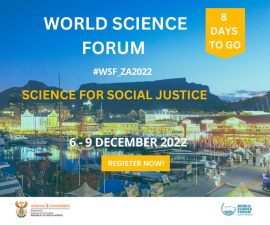
The Department of Science and Innovation (DSI) invites the media to the World Science Forum (WSF) 2022, to be hosted for the first time in Cape Town from 6 to 9 December, under the theme ‘Science for Social Justice’.
The DSI’s annual Science Forum South Africa will not take place this year, as it hosts the global forum.
Taking place in Africa for the first time, the WSF is among the most significant science gatherings worldwide. It takes place every two years and attracts scientists from all over the world.
Established by the Hungarian Academy of Sciences, in collaboration with the United Nations’ Educational, Scientific and Cultural Organization (UNESCO), the gathering deliberates on the social and economic relevance, influence and responsibilities of science.
A packed programme has been designed that includes 28 thematic sessions, which cover topics like climate change, science for human dignity, the Sustainable Development Goals, science for Africa and science diplomacy.
A series of pre-events have also been organised, including a Science Journalism Programme, discussions about the green hydrogen economy and an air quality fun run in Sea Point and Khayelitsha.
The event will also host excursions to scientific facilities in and around Cape Town, a robotics boot camp for learners, Women in Science film festival and breakfast with the international Square Kilometre Array Organisation.
South Africa is hoping to achieve three key goals by hosting the first WSF in Africa, namely, to promote a global debate that inspires action; to provide support for African leadership in global science policy discussions, and to promote South Africa as a strategic partner for global science collaboration in response to societal challenges.
The speakers include Higher Education, Science and Innovation Minister, Dr Blade Nzimande, Co-Chair of the Global Young Academy Professors Roula Inglesi-Lotz, President of the Hungarian Academy of Sciences Tamás Freund, President of the African Academy of Sciences Felix Dakora and President of the International Science Council Sir Peter Gluckman.
Other speakers are the Assistant Director-General for Natural Sciences at UNESCO, Dr Shamila Nair-Bedouelle and the President of Jordan’s Royal Scientific Society Princess Sumaya bint El Hassan.
The event will be a platform for more than 900 leading scientists and decision-makers from politics and industry, representatives of civil society, and the media to express their views on the new challenges facing science in the 21st century.
Alleged TERS fraudsters arrested
The Hawks’ persistence to apprehend the Temporary Employer/ Employee Relief Scheme (TERS) funds fraudsters led to the arrest of a total of 16 suspects in the early hours of Sunday.
Warrant Officer Bonnie Nxumalo said the suspects, aged between 23 and 57, were arrested in Gauteng and North West provinces respectively during an operation by the team of Hawks’ Serious Commercial Crime Investigation (SCCI) based in North West.
The operation was in conjunction with their counterparts in the Hawks’ Tactical Operations Management Section (TOMS) and Hawks’ Priority Crime Specialised Investigation (PCSI). They were assisted by the office of the Director of Public Prosecutions (DPP).
“It is alleged that in 2020 during the COVID-19 pandemic, three sole directors of different dormant entities applied for TERS funds from the Department of Employment and Labour for 47, 133 and 141 supposed employees,” said Nxumalo.
She said the department paid the funds to companies’ bank accounts.
“The funds were allegedly transferred to certain individuals for personal enrichment. The department suffered a total loss of more than R1.4 million due to siphoning activities. The Hawks investigated the matters and warrants of arrests were issued,” she said.
The suspects are expected to appear in the Mahikeng District Court on Monday, 28 November. They will face fraud charges.
Government notes Fitch’s SA ‘BB-’ rating

Government says it has noted Fitch’s decision to affirm South Africa’s long term foreign and local currency debt ratings at ‘BB-’ and maintained a stable outlook.
This comes after the rating agency on Friday had kept South Africa at sub-investment grade.
According to Fitch, the affirmation takes into account the recent over-performance of revenue and government’s strong efforts to control expenditure which, if continued successfully, could bring about debt stabilisation.
In a statement, the National Treasury said: “However, the agency assumes a substantial part of recent higher revenues to be temporary and sees current public sector wage demands pointing to increased upward pressure on spending.”
The department said government’s fiscal strategy reduces risks to the economy and public finances over the medium term.
“The higher-than-anticipated revenues will be used to reduce the gross borrowing requirement, support spending priorities and reduce risks to the fiscal outlook.
“Government is working to improve the efficiency of spending and remains committed to returning public finances on a sustainable path,” reads the statement.
According to the agency, South Africa’s ratings continue to be supported by a favourable debt structure with long maturities and mostly denominated in local currency as well as a credible monetary policy framework.
SA keen to attract investment
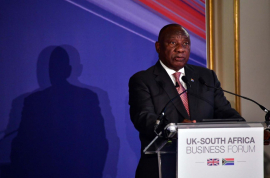
While the South African economy has experienced various challenges, including electricity shortages, work is underway to ensure that the country attracts investment.
“While there are many attractions and huge potential for investors in South Africa, there are a number of constraints on economic growth and social development. For more than a decade, South Africa has been confronted with a shortage of electricity,” said President Cyril Ramaphosa.
The President made these remarks at the SA-UK Business Roundtable in London on the second day of his two-day State Visit to the United Kingdom, on Wednesday.
“We have taken urgent steps to remedy this dire situation by significantly and rapidly increasing the construction of new generating capacity.
We have accelerated the procurement of renewable energy and have removed many of the regulatory hurdles to greater private investment in embedded generation,” he said adding that government is working closely with Eskom to improve the fleet of the utility’s power stations.
The UK is the largest foreign investor in South Africa while several South African companies have a presence in the UK.
He said that government is also undertaking far-reaching reforms to improve the capacity and competitiveness of railways and ports, to open up the telecommunications industry and to improve the supply and pricing of water.
Mechanisms like the Infrastructure Fund have been established to leverage funding from various sources, including the private sector, for substantial infrastructure investment.
In addition, decisive measures to tackle crime and corruption have been taken with law enforcement agencies being rebuilt and being provided with the resources needed to prosecute those responsible for the criminal capture of state institutions.
South Africa is also strengthening the ability of the police and other security services to respond to economic crimes, such as extortion and damage to infrastructure.
“It is important for the South African government to understand the issues, concerns and expectations of British companies and business leaders. We are therefore keen to hear from you on what we can do to encourage you to increase your investment in South Africa,” said the President.
Exports from South Africa to the UK are estimated to support 134,000 South African jobs.
“Bilateral trade is at its highest yet, with goods and services worth £10.7 billion being traded between the United Kingdom and South Africa in the 12 months ending in June this year,” he said.
Meanwhile, a number of UK companies have attended the annual South Africa Investment Conference that the country has held since 2018 – during which significant new investment commitments were made.
President Ramaphosa added that South Africa which has free trade agreements with the United Kingdom and European Union, has over the past four years, been putting in place an African Continental Free Trade Area that will connect 55 national economies and more than 1.3 billion people.
“The legal instruments have been completed and countries and customs unions are now finalising their tariff offers, with the intention that trade would commence next year.”
With the UK being the largest foreign investor in South Africa, “it is our intention and our ambition to substantially increase the value and diversify the composition of both trade and investment,” said President Ramaphosa.
Nearly 40 million children ‘dangerously’ susceptible to growing measles threat – WHO

Measles vaccination coverage has steadily declined since the beginning of the COVID-19 pandemic, the new World Health Organisation (WHO) and United States Centres for Disease Control and Prevention (CDC) reports revealed.
According to the joint publication, a record high of nearly 40 million children missed a measles vaccine dose, of which 25 million children missed their first dose and an additional 14.7 million children skipped their second dose in 2021.
“This decline is a significant setback in global progress towards achieving and maintaining measles elimination and leaves millions of children susceptible to infection.”
In 2021, according to the WHO and CDC, there were an estimated nine million cases and 128 000 deaths from measles worldwide.
Meanwhile, the research found that 22 countries experienced large and disruptive outbreaks.
Declines in vaccine coverage; weakened measles surveillance; continued interruptions and delays in immunisation activities due to COVID-19; as well as persistent large outbreaks in 2022 mean that measles is an imminent threat in every region of the world.
In South Africa, Limpopo recorded 52 cases since the beginning of the measles outbreak.
This comes after the National Institute For Communicable Diseases of South Africa declared a measles outbreak after three cases from two healthcare facilities were reported in the same district in October.
“The paradox of the pandemic is that while vaccines against COVID-19 were developed in record time and deployed in the largest vaccination campaign in history, routine immunisation programmes were badly disrupted, and millions of kids missed out on life-saving vaccinations against deadly diseases like measles,” said WHO Director-General, Dr Tedros Adhanom Ghebreyesus.
“Getting immunisation programmes back on track is critical. Behind every statistic in this report is a child at risk of a preventable disease.”
According to the two organisations, the situation is grave.
Measles is one of the most contagious human viruses but is almost entirely preventable through vaccination.
“Coverage of 95% or greater of two doses of measles-containing vaccine is needed to create herd immunity to protect communities and achieve and maintain measles elimination. The world is well under that, with only 81% of children receiving their first measles-containing vaccine dose, and only 71% of children receiving their second measles-containing vaccine dose.”
These figures, according to the institutions, are the lowest global coverage rates of the first dose of measles vaccination since 2008, although the coverage varies by country.
Meanwhile, no WHO region has achieved and sustained measles elimination.
Since 2016, 10 countries that had previously eliminated measles experienced outbreaks and re-established transmission.
“The record number of children under-immunised and susceptible to measles shows the profound damage immunisation systems have sustained during the COVID-19 pandemic,” said CDC Director, Dr Rochelle Walensky.
Delays increase the risk of measles outbreaks, so the time for public health officials to accelerate vaccination efforts and strengthen surveillance is now.
CDC and WHO urge coordinated and collaborative action from all partners at global, regional, national, and local levels to prioritise efforts to find and immunise all unprotected children, including those who were missed during the last two years.
Current administration gradually improving audit outcomes, says AG

In the third year of the current administration, Auditor-General, Tsakani Maluleke, says her office continues to see a gradual upward trend in the audit outcomes of national and provincial government.
However, she said, key service delivery portfolios and state-owned enterprises continue to receive poor audit outcomes.
Maluleke’s observation is contained in her executive summary in the Consolidated General Report on National and Provincial Audit Outcomes of the 2021/22 financial year. She released the report on Wednesday.
In the report, Maluleke said: “Through our expanded mandate, we have enriched our insights and strengthened our ability to influence and enforce accountability and consequence management. There has been a shift at departments and public entities from a slow response to our findings and recommendations over the years to attention now being paid to material irregularities.
“Auditees are taking action to resolve these by recovering losses, preventing further losses and harm through strengthening internal controls, and effecting consequences for transgressions.”
However, greater impact will be achieved if accounting officers and authorities resolve the material irregularities quicker,” she said.
“We continue to advocate for investment in good preventative controls, as preventing material irregularities is more effective than having to deal with the consequences thereof.
“Poor overall performance leads to poor service delivery – to the detriment of the people of South Africa. Much of this can be attributed to poor planning, insufficient intergovernmental coordination, execution without oversight, and lack of accountability for effective reporting and the achievement of planned service delivery.”
Over the past few years, the AGSA had highlighted the internal control deficiencies that led to government not deriving value from its spending because of inefficient and ineffective infrastructure delivery.
She said infrastructure continues to deteriorate because it is not properly maintained and protected against vandalism.
“This slows down service delivery and results in funds being wasted, which places further pressure on the fiscus. Auditees have not heeded our call to address these deficiencies, and infrastructure projects continue to face the same delivery challenges.
“We have also seen little improvement in the area of financial management, despite consistently reporting the same deficiencies. Non-compliance with legislation remains high, resulting in unfair and uncompetitive procurement processes and payments for goods and services not received. These are also the areas where the risk of fraud is highest, hence it is necessary for a culture of compliance and respect for the law to be re-enforced.”
In the report, the AGSA identified 179 material irregularities in the national and provincial spheres of government.
Over the three-year term of the current administration, auditees have disclosed fruitless and wasteful expenditure totalling R5.83 billion.
She said since 2019, the AGSA had also identified non-compliance and fraud resulting in an estimated R12 billion in financial loss through our material irregularity process.
The main reasons that money is being lost include:
• Poor payment practices to suppliers of goods and services;
• Unfair or uncompetitive procurement practices when procuring goods and services;
• No or limited benefits received for money spent and properties owned;
• Infrastructure not maintained and secured;
• Uneconomical practices for leasing properties; and
• Inadequate needs analysis and project management.
Gordhan denies claims about DA access to Kusile Power Station

The Department Public Enterprises Minister, Pravin Gordhan, is accusing the Democratic Alliance (DA) of “political grandstanding” over the electricity crisis by attempting an unplanned visit to the Kusile Power Station on Wednesday.
This comes after DA leader, John Steenhuisen, said he was disappointed with government after he was denied access to Eskom’s Kusile Power Station in Mpumalanga.
However, according to the department, once informed that Steenhuisen was en route to the power station for an unplanned visit, Gordhan called him as a matter of courtesy, to facilitate a constructive engagement.
“I explained to him that Eskom senior management is busy with important board engagements today. I am willing to make myself available to brief him,” explained Gordhan.
The Minister, according to the department, then suggested that arrangements could be made for such a visit with a full briefing and for the necessary protocols to be complied with.
“The DA Members of Parliament in various portfolio committees and the Standing Committee on Public Accounts (Scopa) have on several occasions undertaken visits to Kusile and Eskom facilities and are fully aware of the security arrangements and protocols to be followed prior to visiting national key points.”
The department has since denied claims that the Minister blocked Steenhuisen’s visit to the power station and that the assertions were “misleading and not true”.
Meanwhile, according to the department, normal parliamentary processes require a request to be sent to the Minister of Public Enterprises to inform Eskom timeously to make the necessary arrangements and ensure the safety of all people.
DA, according to the department, did not use normal procedures to request a visit to the Kusile Power Station in line with National Key Points Act and parliamentary protocols.
“It is quite clear that this is a DA grandstanding that has nothing to do with the energy crisis confronting the country, nor do they have any solutions for the energy crisis except criticism,” said Gordhan.
“We have previously debated with the DA indicating that the issue of electricity crisis must be treated as a national issue and should not be used as a party-political football in any shape or form,” the Minister added.
President Ramaphosa calls for SA, UK, partnership to tackle global challenges
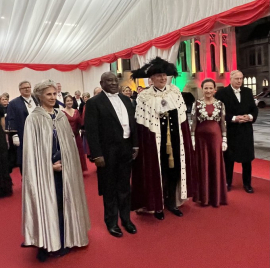
With the myriad of global challenges at this moment in history, President Cyril Ramaphosa says there is both a need and an opportunity for the United Kingdom and South Africa to think and act differently by exploring new opportunities.
Addressing a banquet hosted by the Lord Mayor of the City of London, at the Guildhall on Wednesday, the President said South Africa seeks a new partnership on investment, climate change and green industry, science, innovation and technology as well as trade in goods and services.
“In 2020, the stock of foreign direct investment from the United Kingdom into South Africa was larger than any other country. Four years ago, we embarked on an ambitious investment drive to attract some £60 billion in new investment in the South African economy over a five year period. We have already reached £55 billion in investment commitments, of which £6.5 billion has come from UK investors,” said President Ramaphosa.
South Africa will once again host the 5th South Africa Investment Conference in April next year.
“We look forward to welcoming many British companies to this important event to explore investment opportunities, joint ventures and industrial partnerships,” the President said.
He said South Africa is a gateway to a dynamic continent that is expanding its production, rapidly urbanising and has a young population.
“South Africa is a leading mining economy, with proven capabilities in advanced manufacturing, science and technology. South Africa has sophisticated financial systems and Africa’s deepest capital market, where the rule of law is strong and there is firm protection of contracts and property rights. South Africa hosts many leading multinational corporations,” the President said.
Climate change
President Ramaphosa noted that while climate change imposes costs on businesses, it also provides new opportunities.
“For South Africa, this opportunity lies in the effort to build a greener base to manufacturing and energy generation. There is potential for significant partnerships on electric vehicle production, on green hydrogen and on green steel production. Already we have built a large renewable energy generation sector and are rapidly growing it as a response to our energy challenges,” the President said.
He said South Africa sees a new partnership that will enable funding, know-how and technical support mobilised on a vast scale to help the country achieve a just transition from a carbon-intensive economy to industrialisation driven by renewable energy.
COVID-19
“The COVID-19 pandemic laid bare Africa’s vulnerability with respect to the supply of medicines, medical equipment and vaccines. We used all the ingenuity of South African manufacturers to create production capacity for medical-grade face masks, hand sanitisers, COVID-19 test kits and ventilators. Our excellent genome sequencing capacity was used to detect new variants of COVID-19. Given the strong research and innovation record of British companies, the new partnership can improve collaboration and unlock joint funding and investment in developing Africa’s medical supply hub,” President Ramaphosa said.
Bilateral trade
In 2021, bilateral trade between South Africa and Britain was valued at £17 000 a minute.
“That means that in the time it took the English football team to score their first three goals on Monday, our trade grew by about £200 000. While a large part of South Africa’s exports is still in minerals, there has been a significant increase in manufacturing exports, using South African industrial capabilities to meet the needs of British businesses and consumers. In the new partnership, we are keen to increase the volume and diversify the composition of trade so that we sell more manufacturing products to UK markets,” he said.
The President emphasised that trade in services is also important.
“South Africa is a large supplier of global business services, with call centres in our big cities providing round-the-clock services to the customers of businesses in the UK. We are looking to significantly expand tourism between our countries. South Africa receives more visitors from Britain than from any other country outside of Southern Africa. Visitors are attracted by the beauty of our landscape and wildlife, our long and rugged coastline, our music and culture, and the energy of our urban areas,” President Ramaphosa said.
He said the relationship between the United Kingdom and South Africa has changed over the course of history.
“This visit proves the strength and endurance of the ties between us. As this State Visit draws to a close, we are certain of a new era of partnership between the United Kingdom and South Africa,” the President said.
Former Elias Motsoaledi Municipality mayor, manager charged
Thursday, November 24, 2022
Former Elias Motsoaledi Municipality mayor, Julia Mathebe, as well as the council’s ex-municipal manager, Minah Maredi, are the latest two people to be nabbed in the ongoing VBS Bank investigation.
The two on Wednesday afternoon appeared before the Pretoria Specialised Commercial Crimes Court after they were arrested earlier in the day.
Mathebe is the current mayor of the Sekhukhune District Municipality.
Hawks spokesperson, Colonel Katlego Mogale, said the arrests were as a result of an ongoing investigation into the VBS Mutual Bank investments that were conducted by municipalities in contravention of the Municipal Finance Management Act.
“The municipal manager is said to have been instrumental in investing R190 million municipal funds into the VBS Mutual Bank wherein the mayor received over R300 000 in gratification which included cash, accommodation and flight tickets. These were channelled through a company belonging to her children,” she said.
Since 2020, the Hawks had made several arrests in relation to the case. Former municipal officials, businesspeople and former mayors were among those hauled before various courts.
Addressing the media in September, Hawks head, Lieutenant General Godfrey Lebeya, said the Directorate had put more than 20 investigators to deal with the VBS Bank investigation.
“More than 2 000 statements that need to be put together. We have already taken more than 1 000 and if you look at the charges, actually the 188 charges that suspects are facing, is equal to 188 dockets,” he said.
The case was postponed to 2 March 2023 after they were granted bail of R30 000 each.
Crime against women remains “worryingly high” – Cele

Police Minister Bheki Cele has once again raised concern at the country’s alarming rate of crimes against women and children.
This after Quarter 2 of 2022 crime statistics saw a double-digit percentage increase for murder, attempted murder and assault GBH [grievous bodily harm] against women. The Minister on Wednesday released the statistics, which reflected the country’s crime trends between July and September 2022.
Addressing media, Cele said the rate at which women are abused, violated and killed in South Africa remains worrying and unacceptable.
“Many are killed by the people they know, people they love and trust,” he said.
In the reporting period, Cele revealed that over 13 000 women were victims of assault with intent to cause grievous bodily harm.
While 1 277 women were victims of attempted murder, 989 women were murdered during this reporting period.
Rape
Over the three months, the Minister said over 10 000 rape cases were opened with the South African Police Service (SAPS).
“From a sample of 8 227 rape incidents that were perused, it was determined that 5 083, which is 62%, of these incidents occurred at the residence of the victims or perpetrators. [A total of] 1 651 of the rape incidents occurred at public places such as streets, parks and beaches,” the Minister said.
At least 69 people were raped at abandoned buildings.
The Minister said Mpumalanga was the only province to report a decrease in rape incidents.
“Inanda police station in KwaZulu-Natal, Mthatha in the Eastern Cape and Delft in the Western Cape are the three top stations with the highest rape cases.
“Buses, taxis, trains and other modes of public transport were the third most likely places of occurrence for rape incidents,” Cele said.
Women and children
The Minister said the statistics were indicative of communities that continue to fail to protect children.
Shockingly, in just six months, 558 children were killed in South Africa between April to September 2022.
In this regard, Cele said police were investigating 294 attempted murder dockets opened between July and September 2022.
A total of 1 895 assault GBH cases, with children as victims, were opened with the police during this reporting period.
“It is on this note that the SAPS continues to prioritise gender-based violence (GBV) related crimes,” said the Minister.
FCS cases
Between July and September this year, the FCS [Family Violence, Child Protection and Sexual Offences] unit arrested 4 375 perpetrators of crimes committed against women and children.
“Police traced and arrested 410 rapists during this reporting period. Sixty-eight of them have been sentenced to life behind bars,” Cele said.
The Minister said it was very encouraging that the Criminal Justice System continues to send a strong message of zero tolerance to rape through the stiff sentences handed out to rapists.
“It is clear that the broader civil society, religious organiaations and various community structures must sharply address the causes and preventative measures of crimes against women and children.”
Cele said the Ministry remains extremely concerned about rape at educational premises.
Over the three-month reporting period, 83 rapes occurred at educational facilities, including schools and tertiary institutions.
“One needs to take into cognizance that educational facilities refer to the scene of the crime and should not be interpreted to imply that all perpetrators and or victims were pupils or students,” he said.