
Komati Power Station heading for “exciting” new journey

The last generating unit of Eskom’s coal-fired Komati Power Station has officially been taken off the grid and the power station has been completely decommissioned after supplying electricity to South Africans since 1961.
According to Eskom, the move is in line with legislative requirements.
“Unit 9 was commissioned in March 1966, the last of the nine units that were built. Other units were shut down over the years as they reached the end of their operating life.
“Eskom has transferred the majority of Komati employees from the power station to support and augment the skills in other power stations and areas of the business in line with operational requirements. No Eskom employees will lose their jobs as a result of the closure,” Eskom said.
In August, Eskom announced that it would be embarking on a collaboration with the South African Renewable Energy Technology Centre (SARETEC) to train and upskill the former Komati employees.
A training facility is being developed in this regard.
“Funding for this facility, which will enable a just transition for the local community following the decommissioning of the power station, has already been received from one of the developmental finance institutions (DFIs) and Eskom will make an official announcement in due course,” Eskom said.
The power utility said the shutdown of Komati will not have a significant impact on the grid as it was only supplying some 121MW of energy.
“The decommissioning of the power station has followed a diligent process which comprised undertaking a socioeconomic impact study. Eskom has held extensive engagements with the employees, labour unions, the community and all affected stakeholders and communicated the requirement to shut down the plant timeously and clearly with everyone involved,” the electricity supplier said.
Eskom said it is now looking forward to an “exciting journey” for the power station as it will now be repurposed with the remaining employees taking part in the project.
“The power plant will be converted into a renewable generation site powered with 150MW of solar, 70MW of wind and 150MW of storage batteries thereby continuing to put the site and its associated transmission infrastructure into good use and to provide economic opportunities to the community. A containerised micro-grid assembly factory has already been established on site.
“The Komati Repowering and Repurposing project is one of the largest coal-fired power plant decommissioning, repowering and repurposing projects globally and will serve as a global reference on how to transition fossil fuel assets,” the power utility said.
Eskom implements Stage 2 load shedding

South Africans will endure more load shedding for at least the first three days of this week following an announcement by Eskom that Stage 2 load shedding will be returning from 5am this morning until 5am on Tuesday morning.
Following that, Stage 2 load shedding will be implemented from 4pm until midnight on Tuesday and Wednesday.
Citizens had experienced a brief respite from load shedding after the power utility lifted the rotational power cuts over the weekend due to lower demand on the system.
“Load shedding is implemented only as a last resort in view of the shortage of generation capacity and the need to attend to breakdowns,” Eskom said.
The power utility said that by Sunday afternoon, there was at least 13 792MW of capacity unavailable due to breakdowns, coupled with at least 4 886MW offline due to maintenance.
“Since yesterday afternoon, a unit each at Tutuka and Matimba power stations were taken offline for repairs. A unit each at Kendal, Kusile, Matla and Tutuka power stations were returned to service.
“Eskom will publish a further update on Wednesday afternoon, or as soon as there are any significant changes,” the power utility said.
President Ramaphosa appoints new Intelligence Inspector General

Imtiaz Fazel is expected to start his five year term as the new Inspector General of Intelligence on Tuesday, following his appointment by President Cyril Ramaphosa.
Fazel’s nomination for the position was approved by the National Assembly and he was appointed by the President in accordance with Section 210(b) of the Constitution, read in conjunction with Section 7(1) of the Intelligence Services Oversight Act of 1994.
According to a statement by the Presidency, the approval came after a 12 people were interviewed for the position by the Joint Standing Committee on Intelligence (JSCI).
“The Intelligence Services Oversight Act mandates the JSCI to recommend a candidate for approval by at least two thirds of National Assembly Members.
“Following National Assembly approval, the name of the candidate is submitted to the President to consider the nominee for appointment as Inspector General.
“The Inspector General monitors and reviews the operations of intelligence services, including the State Security Agency, the Defence Intelligence Division of the South African National Defence Force and the Crime Intelligence Division of the South African Police Service,” the statement read.
Some 25 people had applied for the job during a public process.
The Presidency said Fazel’s appointment is a “continuation of the attention President Ramaphosa is giving to strengthening the capability of the State, including the security sector”.
“Mr Fazel is a former Chief Operating Officer – at the level of Deputy Director General – in the Office of the Inspector General of Intelligence and a former Deputy Director General in the Office of the Director General of the State Security Agency.
“From 2015 to 2020, he served as Deputy Director General: Governance, Risk and Compliance in the Department of Public Works, following which he served as Acting Director General in the Department of Public Works and Infrastructure.
“Mr Fazel has obtained a Master’s Degree in Security Studies from the University of Pretoria and holds a Bachelor of Accounting Science Degree from the University of South Africa. He holds a Post-Graduate Diploma in Accounting from the University of the Western Cape and is a member of the South African Institute of Chartered Accountants, among other achievements.”
President Ramaphosa sent his well wishes to the new Inspector General.
“The President offers Mr Fazel his best wishes and support in his role as Inspector General of Intelligence, which is a critical function that contributes to making the country and the world a safer place, and advancing the country’s national interest,” the high office said.
Gauteng SAPS operations net over 1 000

South African Police Service (SAPS) operations have seen the arrest of over 1 750 suspects across Gauteng over the weekend.
Lieutenant Colonel Mavela Masondo said the suspects were arrested in all five districts during the tracing of wanted suspects, roadblocks, raiding of hotspots, and stops and searches.
He said police in Johannesburg District arrested 536 suspects for crimes ranging from murder, attempted murder, carjacking, business robbery, fraud, possession of suspected stolen property, including undocumented persons.
Meanwhile, 430 suspects were nabbed by the police in Tshwane for crimes that include business robbery, possession of an unlicensed firearm, driving under the influence of alcohol and dealing in drugs.
“Similar operations were conducted in Ekurhuleni District, where 397 suspects were arrested for murder, assault with intent to cause grievous bodily harm, possession of suspected stolen goods, armed robbery and undocumented foreign nationals,” said Masondo.
More than 390 suspects were arrested in the West Rand and Sedibeng Districts for crimes ranging from murder, rape, and possession of an unlicensed firearm, possession of drugs, assault and intimidation.
All arrested suspects will appear before different Magistrates’ Courts in Gauteng in due course.
Management of SAPS in Gauteng has urged the community to continue to help the police in the fight against crime by reporting criminal activities, by calling Crime Stop on 08600 10111.
Petrol price to increase
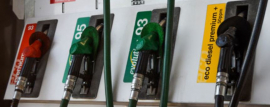
South Africans will be paying more at the pumps from Wednesday following the increase of all grades of fuel.
Illuminating paraffin and LP Gas prices are also expected to rise.
The increases are as follows:
- All grades of petrol will increase by at least 51c
- Diesel 0.05% sulphur will rise by some R1, 42
- On the other hand, diesel 0.005% will go up by R1,43
- Wholesale illuminating paraffin increases by 77c
- The Single Maximum National Retail Price for illuminating paraffin will go up by R1,03
- Maximum LP Gas Retail Price will increase by 98c
The adjustment means that a litre of 95 ULP, which currently costs 22.36 in Gauteng, will now cost R22.87 as of Wednesday.
In a statement, the Department of Mineral Resources and Energy (DMRE) explained that the prices are influenced by several local and international factors including importation costs and the cost of crude oil.
“The average Brent Crude oil price increased from $89.79 US Dollars (USD) per barrel to $92.41 USD per barrel during the period under review. The average international product prices of petrol, illuminating paraffin and diesel increased while LPG prices decreased during the period under review.
“The Rand depreciated on average against the USD, from R17.55 to R18.11 Rand per USD, during the period under review when compared to the previous one. The weaker Rand led to higher contributions to the Basic Fuel Prices of petrol, diesel and illuminating paraffin by 37c per litre, 52c per litre and 48c per litre respectively,” the statement read.
All systems go for King Misuzulu certificate of recognition handover
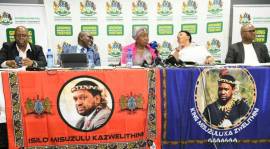
Government says it’s all systems go for Saturday’s certificate of recognition handover by President Cyril Ramaphosa to AmaZulu King Misuzulu KaZwelithini.
This was confirmed by KwaZulu-Natal Premier Nomusa Dube-Ncube during a press briefing on Thursday.
The historic event, themed “liphumile iLanga kwaZulu – the Sun has risen on the Zulu nation”, will be held at the Moses Mabhida Stadium.
The Premier said the province is ready to roll-out the royal carpet to all Royal Dignitaries, Heads of State and Government, Kings and Queens, International and national guests that will grace the auspicious occasion.
This event was organised under the tight oversight of the Inter-Ministerial Task Team, the KZN Provincial Executive Council and the eThekwini Metro and the Royal Family Committee, led by Cooperative Governance and Traditional Affairs (CoGTA) Minister Dr Nkosazana Dlamini Zuma.
“Such is the significance of this event, that even for many of us it will be the first time that in the history of the Zulu nation, we will be witnessing history unfolding before us. We have done all preparations to ensure that this becomes successful and will leave behind a legacy to be remembered by many generations to come,” said Dube-Ncube.
She said the theme was fitting, saying it has inspired a wave of hope across the length and breadth of society following the dark autumn of 2021. This was when the nation “was dealt a gaping wound that would take a lifetime to heal, as we witnessed the demise of His Majesty King Zwelithini and Regent Queen Mantfombi Dlamini Zulu in close succession”.
She said: “It will be indeed a celebration of Africanness, our way of life as people of Africa. Hence we are encouraging everyone to dress in their finest traditional gear in celebration of our African culture, regardless of race, colour or creed. We want to see amabheshu, amahawu, izidwaba and any other dress code that show case the tapestry of our beautiful traditions and culture as Africans. We expect the Moses Mabhida stadium to be clad in a symphony of traditional colour.
“We are expecting a capacity crowd of about 48000 to fill –up Moses Mabhida Stadium. These will include amabutho, oMama beSphithiphithi, Izintombi, ordinary people, etc. We are expecting over 2500 guests and dignitaries which includes Heads of State, former Presidents; Kings and Queens, the Judiciary; Legislatures; Diplomatic Corp and the business sector etc.”
Some of the confirmed foreign dignitaries are:
- His Majesty the King Mswati III from Eswatini;
- His Majesty King from Nigeria;
- His Majesty King from Zambia;
- His Majesty King from Zimbabwe;
- His Majesty King Gungunyane from the Province of Gaza from Mozambique;
- Prince and spouse from Lesotho representing His Majesty King Letsie III;
- Former President of Botswana, H.E. Ian Khama;
- Four ministers from Eswatini;
Logistics
The Premier said due to the magnitude and significance of the event, a lot of people are expected to attend.
“And as such an overflow venue has been arranged at the People’s Park both in the East and West wings and public viewing screens will be installed to accommodate as many people as possible,” she said.
Government has arranged over 80 buses and 200 minibus taxis to transport Amabutho, oMama and Izintombi to the event.
Respective municipalities in the province have been requested to, where feasible provide additional transport.
In this regard, she said eThekwini confirmed the procurement of 100 additional buses for its residents.
“Access to the stadium is open to all members of the public on a first come first serve basis. We encourage people to arrive on time and take their seats and enjoy the celebration. Once the 48000 capacity is reached inside the stadium, people will be accommodated in the overflow areas.
Gates will open from 7am and the programme of the day is segmented into three parts namely:
- Prelude, Musical Entertainment: 8:15–9:30
- Main Programme: 10:00–13:05
- Epilogue, Musical Entertainment: 13:05-13:35
She said paramount to the activities of this momentous day, is the opportunity it provides for the nation at large to share in the celebration of the AmaZulu Nation.
“To this effect an entertainment programme of cultural and contemporary dance, music and poetry galore will be a defining feature of the festivities,” she said.
Some of the artists that will constitute the line-up include:
- Drums and blowing of horns, Spectacular Choreography, Four groups with oMama Besigekle;
- Medley of Vumile Mngoma, Qadasi and MaQhinga;
- Zawadi and Madala: Princess Magogo Song;
- Mshunqisi the Poet;
- Mpumalanga White Birds;
- Medley of Khuzani, Ingcokama and Ntwencane;
- Traditional groups and Shembe Indlamu;
- Phuzekhemisi;
- Jumbo; and
- Sjava.
Academy to create jobs, skills development for KZN youth
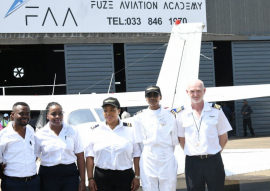
In a bold and historic first for the province, KwaZulu-Natal Premier Nomusa Dube-Ncube, has officiated the launch of the Fuze Aviation Academy Training Programme.
The programme is aimed at job creation, skills development and supporting young people in the aviation sector.
Speaking during the launch at the Oribi Airport in Pietermaritzburg on Thursday, Dube-Ncube described the event as a ground breaking initiative, marking the entry of Black men and women into what remains a white-dominated industry, 28 years into democracy.
“Today, we are launching the training programme for Private Pilot Licence, Commercial Pilot Licence, Aircraft Maintenance Engineers and Remotely Piloted Aircraft Systems Training. The Fuze Aviation Academy, which was opened in 2021 in KwaZulu-Natal, opens opportunities to the girls and boys of rural and urban areas to enter the exciting world of flight,” Dube-Ncube said.
The Premier commended the Transport Education Training Authority for guiding and supporting the Fuze Aviation Academy during the critical stages of its development path.
She announced that the academy has also entered into a partnership with the provincial government, through the Department of Economic Development, Tourism and Environmental Affairs.
“As the provincial government, we will continue to provide the necessary support to ensure the successful rollout of various programmes in the aviation sector.”
The Premier noted that the academy has entered the market at an opportune time, when capacity has been severely diminished by the withdrawal of Comair, which operated Kulula and British Airways in South Africa.
While other airlines including Lift and FlySafair have responded by adding more flights to their rosters, Dube-Ncube said, this has led to exorbitant ticket fees.
“At the same time the price of jet fuel has not assisted because it has risen globally following the geopolitical tensions in Eastern Europe. One of the concerns also raised by the airlines in South Africa is that they are struggling to get trained pilots and cabin crew on board quickly enough.
“So even as Fuze Aviation Academy mulls entering into full commercial operations, you should be content that there is indeed demand for the crew that you are training at the Oribi Airport,” the Premier said.
She also highlighted that with the holiday season fast approaching; there will be a demand for inward and outbound travel together with demand for human resources.
“The Fuze Aviation Academy, with its various elements – charter business, cargo, repair and maintenance, pilot and cabin attendant training is thus posed to take its place in this attractive, safe and growing sector of our economy.
“I wish to remind cadets and the graduates at the Fuze Academy that thanks to this strict, but necessary international and local governance of virtually every aspect of flying, there is no space for mistakes. There is no room for error because lack of attention to detail can cost lives,” she said.
Opportunities
Dube-Ncube reminded the trainees at the academy that they represent the hopes of millions over generations who are in awe of the wonders of flight.
“You are the realisation of dreams of the girls and boys of rural and urban areas of our province who want to enter this world of work that offers so many possibilities. Aviation offers you very rewarding possible careers as pilots, cabin attendants, air traffic controller, aeronautical engineer, aircraft mechanic, airport planner, airport security manager, airfield operations specialist, airline operations agent and airport manager, among others.
“In terms of employment opportunities, the world is your oyster as some of the biggest employers are aircraft and spacecraft manufacturers. There is no industry that is brimming with such opportunities and promise.”
She added that with air traffic set to double in the next 20 years, the African aviation market is one of the world’s most attractive with high profit and stable passenger growth prospects anchored on a fast-growing middle class.
“As drone pilots they will provide real time capture of accident scenes and take pictures first-hand before any interference can happen to conceal crucial information and evidence. The drones will also be used for monitoring the coastline for swimmers in distress and expedite the dispatch of rescue boats and medical assistance.
“It is also envisaged that they will play a crucial role in pest and disease control within agriculture, where drones will be dispatched to deliver medication especially in rural areas,” the Premier highlighted.
The trainees include 30 drone operators, 20 aviation engineers, and 10 private and commercial pilots.
Dube-Ncube said that upon exit, some of the students will be able to work with the Department of Transport and Health in identifying road accident monitoring and data collection especially during peak seasons and major events throughout the country.
Mchunu reiterates commitment to deliver water to communities

Water and Sanitation Minister, Senzo Mchunu, has reiterated the Ministry and department’s commitment towards the provision of water to the communities.
Mchunu made the commitment during the launch of Olifants Management Model Programme (OMM) on Thursday at the Ga-Malekana Tribal Authority, outside Burgersfort in Limpopo.
The OMM Programme aims to fast-track potable and bulk raw water infrastructure with a view of ensuring that the nearby communities and the surrounding mining, including agriculture and other companies in Sekhukhune District, Polokwane and Mogalakwena Local Municipalities are supplied with adequate water by 2030.
Delivering his keynote address, Mchunu said the OMM project is a huge milestone in the country’s democracy.
“This is a very good example of collective efforts; it is a three-dimensional partnership between government, the private sector and more importantly the people of this area. This is a huge investment to the current and future generations, and it needs to be maintained,” Mchunu said.
The Minister added that the programme, which is the result of a collaboration between Water and Sanitation and the Lebalelo Water Users Association (LWUA), epitomises the effectiveness of public – private partnerships and “will certainly go a long way in as far as addressing challenges in the water and sanitation sector is concerned.”
“Both the department and LWUA consider reliable access to good, safe water as essential to life, nature, and economic growth, hence it is important to embark on water access projects that help bring safe, clean drinking water to communities in need.
Over 130 villages to benefit from the programme
The project scope includes enabling water supply to Mogalakwena by moving a portion of the Lebalelo scheme’s current supply from Flag Boshielo Dam to De Hoop Dam, and developing reticulation and related infrastructure to benefit a total of 134 villages, amongst others.
The programme will also address pressing water needs to approximately 380 000 people in the defined areas in the Limpopo province, and will be able to create 42 000 jobs.
Programme funding estimated to reach R24 billion
Mchunu said the estimated cost of the programme is R24 billion and will be funded on a 50:50 contribution principle between government and the commercial users through the Lebalelo Water Users Association.
These include African Rainbow Minerals, Anglo American Platinum, Assore, Corridor Resources, Cheetah Chrome, Glencore-Merafe, Implats, Ivanplats, Northam, Tameng and other industrial users.
Both the department and Lebalelo agree that the partnership will among others, unlock the strategic mineral and industrial potential in the region, and more importantly it will provide a range of benefits, including much-needed water security, job creation and socio-economic development.
Measles outbreak cases increase to 11 in Limpopo
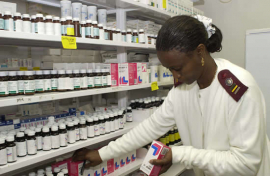
The National Institute for Communicable Diseases (NICD) announced on Friday that the number of measles infections has increased to 11 as of 27 October 2022 in the Greater Sekhukhune District, Limpopo.
This comes after the NICD declared a measles outbreak after three cases from two healthcare facilities were reported in the same district early this month.
“The ages of the measles confirmed cases ranged from nine months to 24 years, with four males and four females,” the public health institute’s statement read.
According to the data, of the latest infections, three children were fully vaccinated for measles, while two cases had unknown vaccination histories.
In addition, two children had not been jabbed against the viral infection.
“One measles case was hospitalised and another developed pneumonia without hospitalisation.”
Limpopo and Greater Sekhukhune District health officials have since started public health response activities with the support of the NICD and the World Health Organisation (WHO).
These activities, according to the NICD, include evaluating medical records to identify missing measles cases, contact tracing, screening for suspected measles and collecting blood and throat swabs for measles diagnostic tests.
The NICD has reminded citizens that measles patients present with fever, rash, and one or more of these symptoms, cough, red eyes, and runny nose.
In addition, complications of measles include pneumonia, diarrhoea, dehydration, encephalitis, blindness and death.
The NICD explained that measles complications are severe in malnourished children and those infants under the age of two.
People of any age who are unvaccinated can catch measles and develop the disease.
Meanwhile, the NICD said clinicians and caregivers should be on alert for anyone presenting with the above symptoms and signs and check children’s road-to-health booklets to ensure measles vaccinations are up to date.
Measles vaccines are given routinely at six and 12 months of age.
“It is never too late to vaccinate against measles.”
Eskom working to implement energy security plans
Eskom says it is focusing on implementing all projects in order to meet the required 53GW of new additional energy for the period up to 2032 which will ensure energy security.
The power utility said the new additional capacity needed will come particularly from renewable energy sources and takes into account the current energy deficit of between 4 000 and 6 000MW.
Eskom Transmission Managing Director, Segomoco Scheppers, described the next five years as “very critical” for energy supply security.
“If the TDP [Transmission Development Plan] 2022 requirements to deliver an adequate transmission network capacity by 2027 are to be met, a significant investment of R72.2 billion will be required to expand and strengthen the transmission grid over the next five years.
“Of this amount, R50.8 billion is required for new capacity expansion projects to meet the reliability requirements, connection of new generation capacity and loads, as well as to acquire servitudes. A further R21.4 billion is required to refurbish the existing asset base and procurement of production equipment,” he said.
In a statement, Eskom explained that the R72 billion will be used to build at least 2890km of extra high voltage lines and some 60 transformers by the 2027 financial year.
“Accommodating this increased generation capacity means that a reliable and adequate transmission system is required to integrate and dispatch this new capacity to the load centres across the country.
“Given uncertainty in the longer term and noting that the Integrated Resources Plan as a policy document is currently being updated, Eskom is placing a strong focus on the implementation of projects over the next five years.
“This requires that some challenges beyond Eskom’s full control, such as the lead time to obtain servitudes, among other relevant authorisations, as well as the resource capacity in the country, be urgently addressed,” the power utility said.