
HSRC calls on public to stop spreading fake news about its data collectors

The Human Sciences Research Council (HSRC) calls on members of the public to refrain from distributing and spreading false information about the organisation’s data collectors.
This follows a series of false Facebook posts and WhatsApp voice messages that have been circulating on social media for the past few weeks, particularly in the Free State, claiming that the HSRC data collectors are either defrauding or robbing communities.
The HSRC’s Acting CEO, Professor Leickness Simbayi, reassured members of the public that there was no truth in the circulating malicious messages.
He emphasised that community members’ safety was the organisation’s priority.
“We, therefore, encourage members of the public to report any suspicious activity to the police or to verify the authenticity of HSRC fieldworkers with the organisation whenever they are in doubt. Our field workers are often identifiable by their HSRC-marked bibs and identity cards,” Simbayi said.
In addition, the vehicles are also marked with various project logos on their doors.
“When our data collectors arrive at different households, they introduce themselves and provide an explanation for their study,” added Simbayi.
Although participation in HSRC surveys is voluntary, the institution said it was important that as many people living in South Africa as possible participate.
According to the HSRC, the data will generate an accurate and credible sample of the target population.
It will also inform the country’s response to various issues such as HIV/AIDS, COVID-19, food and nutrition security and service delivery to ensure lives and livelihoods are continually protected and improved.
The HSRC conducts large-scale, policy-relevant, social-sciences research for public sector users, non-governmental organisations and international development agencies.
Research activities and structures are aligned with South Africa’s national development priorities.
The HSRC is currently conducting several surveys across the country, including the sixth South African HIV Prevalence, Incidence, Behaviour and Communication Survey (SABSSM VI), The South African national survey on health, life experiences, and family relations (SANSHEF) and the National Food and Nutrition Security Survey (NFNSS).
The research institution said former President Nelson Mandela first commissioned the SABSSM VI in 2001. The study is a population-based, cross-sectional survey of households throughout South Africa.
It is conducted to understand the factors driving the HIV epidemic and its dynamics and is used to inform policies and strategies to tackle the epidemic and is repeated approximately every five years.
This year marks the 20th anniversary of the first round of the survey.
In addition, one important addition to the study year is that a sub-sample of participants will be randomly selected to test for SARS-Cov-2 antibodies and better understand the true impact of SARS-Cov-2 in South Africa.
For more information about HSRC surveys or if members of the public are in doubt, they can visit www.hsrc.ac.za or call 012 302 2000.
No unborn baby deserves to be fed alcohol – Bogopane-Zulu
Social Development Deputy-Minister, Hendrietta Bogopane-Zulu, is today taking the 9-9-9 Foetal Alcohol Syndrome Disorder (FASD) campaign to Delmas in Mpumalanga to educate about the dangers of consuming alcohol while pregnant.
The 9-9-9 Foetal Alcohol Syndrome Disorder (FASD) is a campaign which unfolds for a period of nine consecutive days, in nine provinces under the leadership of the Deputy Minister, to encourage community members and pregnant women to be responsible for their unborn babies during pregnancy.
On Tuesday, Bogopane-Zulu and her team took the 9-9-9 FASD campaign to the community of Thabazimbi, in Limpopo Province.
Speaking to community members who were in attendance, Bogopane-Zulu said that FASD is a hundred percent preventable.
“When you want a baby, make a right choice and stay away from taking alcohol when you are pregnant. Not any drop of alcohol is safe for your unborn baby. All we need to do as a society is to help and support expecting mothers to prevent disabilities,” Bogopane-Zulu said.
She added that South Africa is already known to have a drinking problem, with the country ranking among some of the worst in the world for its levels of alcohol consumption.
During the dialogues yesterday, it was highlighted that Thabanzimbi had a culture of drinking irresponsibly, binge drinking by all age groups which included pregnant women.
“While poverty and unemployment were raised as a concern, women still admitted to drinking, resorting to brewing their own alcohol concoction known as ‘gemmer’ when they could not afford to buy alcohol,” the Deputy-Minister said.
She said that experts have previously warned South Africans about the dangers associated with these homemade concoctions.
Sarah Mawe, a home-based care worker, spoke of how she witnessed women who brewed their own “gemmer” and when they were advised about the dangers of drinking alcohol while pregnant, they would simply ask: “whose child is this? And how is it any of your concern?”
According to the World Health Organisation (WHO), South Africa has the highest reported FASD prevalence rates high as 28% in some communities.
It is estimated that the country’s overall rate is at least at 6%.
Bogopane-Zulu added that there is no specific treatment for alcohol related disorders other than to avoid alcoholic beverages during pregnancy.
Police Ministry satisfied with improved safety and security in Krugersdorp
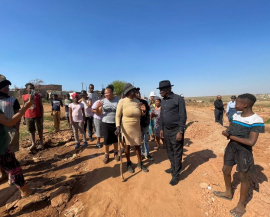
The Police Ministry says it is encouraged by the strides made in improving the safety and security of residents in Krugersdorp, West of Gauteng, since the deployment of specialised SAPS units to the area.
The West Rand is the epicentre of illegal mining activities in the Gauteng province and has seen an increase in crimes associated with illegal mining.
In July, eight women were raped allegedly by a group of armed men, believed to be illegal miners or so-called ‘zama zamas’, operating in the mining town of West Village.
On Sunday, the ministry and SAPS management – led by Police Minister, General Bheki Cele and National Police Commissioner, General Fannie Masemola – conducted a walkabout in West Village and Reitvallei in the West Rand, where they interacted with residents to assess police progress in addressing community safety concerns.
Police have arrested 14 people linked to the gang rape, including a minor and all suspects are going through court processes, facing multiple charges of rape, sexual assault, robbery with aggravating circumstances and the Contravention of the Immigration Act.
The suspects are expected back in court on 28 September 2022.
Many residents in both areas revealed that their safety has improved drastically since many illegal mining operations have been halted. At the same time, some members called for more police operations focusing on the areas where illegal miners are still operating.
Cele assured the communities that police deployments to improve their safety will remain indefinitely.
“We have come to listen to these communities and hear for ourselves about people’s lived experiences since we have put in the specialised units of the SAPS in the West Rand.
“What is important now is for the SAPS to sustain the momentum at which the operations started on, and this will ensure that illegal mining and general criminality is kept at a minimum and eventually stopped altogether,” Cele said.
The Police Ministry has welcomed the continued police operations targeting illegal mining in the West Rand, leading to the arrests of scores of suspects each week.
The arrests are related to, among other crimes, the Contravention of the Immigration Act and Contravention of the Precious Metal Act. This after some suspects were found in possession of gold bearing materials associated with illegal mining.
Home Affairs’ new digitization project underway
The Department of Home Affairs (DHA) has received over 85 000 applications and will soon interview candidates for its project to digitise civil documents.
The DHA working with the Department of Employment and Labour advertised job opportunities to recruit 10 000 unemployed young graduates to make digital copies of paper records.
According to the department, of the 85 820 applications received, 23 374 have qualified to be assessed and interviewed.
The new digitisation programme was first announced by President Cyril Ramaphosa during the State of the Nation Address (SONA) in February 2022, which forms part of his Presidential Employment Stimulus (PES).
“The Department of Home Affairs will recruit 10 000 unemployed young graduates for the digitisation of its civic paper records, enhancing their skills and contributing to the modernisation of citizens services,” the President said during SONA.
The DHA has collaborated with the Department of Employment and Labour to use its online recruitment platform, the Employment Services of South Africa (ESSA).
According to the Chief Director for Employer Services, Esther Tloane, several teams at Labour Centres and provincial offices are hard at work to screen, verify and ensure that qualifying candidates are shortlisted ahead of interviews expected to begin soon.
Launching the recruitment project on 11 August, Home Affairs Minister, Dr Aaron Motsoaledi, said the department has more than 350 million civic paper records relating to birth, marriage, deaths and amendments.
“The category of records date back to 1895, which necessitate care and reliable systems that will bear tolerance for the digitisation purposes,” the department said on Tuesday.
These records are in all provinces, the bulk of which are located in Gauteng, the North West and the Western Cape.
The venture is expected to run over three years, effective from November 2022 until October 2025.
According to the department, the recruitment drive will be divided into three phases:
Phase one – Recruitment of the first intake of 2 000 unemployed youth graduates. This cohort will assume duty on 1 November 2022.
Phase two – Recruitment of 4 000 unemployed youth graduates. This cohort will assume duty in January 2023.
Phase three – Recruitment of 4 000 unemployed youth graduates. This cohort will assume duty in April 2023.
According to the department, unemployed youth should be qualified in Information Technology or Document, Information and Records Management, obtained from institutions of higher learning such as universities, universities of technologies and Technical Vocational Education and Training (TVET).
Successful youth will be paid a stipend ranging from R5 000 for entry-level positions to R9 500 for technical support level positions and R14 250 for manager-level positions. This group will be required to sign a three-year contract linked to the duration of the project.
Tloane said the department was putting the final touches in the process leading to interviews and placements.
In addition, she said her department has received 7 739 enquiries relating to the digitisation project and 7 523 had been responded to.
“In the advancement of equity I am, however, worried that we are getting few candidates of people with disability,” she stressed.
Successfully candidates will be subjected to suitability checks including citizenship, credit, criminal and qualification verification.
How to apply
Prospective candidates, who meet the criteria, should register on the ESSA recruitment platform found on the department’s website at www.labour.gov.za and those that do not have internet access should visit their nearest Labour Centre.
Candidates that are already registered on ESSA do not have to visit the Labour Centres and can apply for these positions online.
Transnet ports expansion plans approved
Plans to expand the KwaZulu-Natal ports – which are expected to position KZN ports at the international forefront – have been approved by the Transnet National Ports Authority (TNPA) board.
According Transnet, the expansion will see some R100 billion spent on the Durban and Richards Bay ports.
“The expansion plans…seek to position the Durban Port as an international container hub that will boast an increased container capacity of 11.4 million TEUs [twenty-foot equivalent units] and automative capacity exceeding 900 000 units.
“The Richards Bay Port is being positioned as a dry bulk port and the plans are also aligned to the Department of Mineral Resources and Energy’s strategic plan 2020-2025, which features a new berth for handling Liquified Natural Gas as a cleaner alternative to coal for power generation.
“Some of the bulk dry terminals and mineral-handling facilities are also earmarked for relocation from the Port of Durban’s Island View and Maydon Wharf Precincts to the Port of Richards Bay,” the ports and rail company said.
Transnet said the approval of the expansion plans follows “two major milestones” that TNPA has passed over the past year.
“During the month of July, a detailed validation process of the Port of Durban by the KZN Logistics Hub programme was concluded. This process was carried out under the supervision of the World Bank by international independent consultants, Maritime and Transport Business Solutions and PDRW Consulting Port and Coastal Engineers.
“The validation process is done to confirm the feasibility of the plans by independent experts and determine whether the presented business case is indeed achievable. In both instances, the independent consultants have confirmed feasibility of both plans,” Transnet said.
Stress, financial woes linked to alcohol consumption during pregnancy

The lack of family support, high levels of poverty and the absence of partners are some of the leading reasons expressed by women who turn to drinking alcohol during pregnancy.
The women were speaking to Social Development Deputy Minister, Hendrietta Bogopane-Zulu, during her engagement with the community of Boitekong in the North West on Monday.
The Deputy Minister took the 9-9-9 Foetal Alcohol Syndrome Disorder (FASD) campaign to Boitekong township, which has been identified as one of the areas with a high consumption of alcohol.
Bogopane-Zulu was joined by the North West Social Development MEC, Boitumelo Moiloa and the North West Health MEC, Madoda Sambatha.
The 9-9-9 FASD campaign is an advocacy initiative that seeks to mobilise communities towards protecting unborn babies by educating people, especially women of childbearing age about the dangers of drinking alcohol while pregnant or breastfeeding.
Community members, who were engaging with the Deputy Minister during the dialogues, painted a grim picture of the scourge of alcohol abuse in the township – particularly among young pregnant women.
Although surrounded by several platinum mining companies, Biotekong is an area struggling with high numbers of unemployment and poverty.
“The prevalence of alcohol abuse in the township is said to be so bad such that even children as young as five years old can easily get access to alcohol with no parental supervision,” the department said.
A four-month pregnant woman and resident of Boitekong, Basetsana Tlalang (28), said there were situations where one finds a child as young as five years old in a tavern and the owners do not care to intervene.
Tlalang, who was drinking alcohol in the first few weeks of her pregnancy but has since stopped, urged other pregnant women to completely stop drinking alcohol and doing drugs immediately when they realise that they are pregnant.
“I stopped drinking alcohol entirely after I confirmed that I was pregnant, and I am attending antenatal and information sessions at the clinic,” she said, adding that most pregnant teenagers in her area are orphans without any adult support.
Bogopane-Zulu called on the young pregnant girls who came to the dialogue to look after themselves for the sake of their unborn babies.
“You can only help me to fight FASD in this community by staying away from alcohol when you are pregnant. No amount of alcohol is safe for an unborn child,” she said.
The 9-9-9 FASD campaign continues this week in Limpopo, Mpumalanga, Eastern Cape and KwaZulu-Natal.
Alleged bogus doctor denied bail in rape case

A 38-year-old man has been denied bail in the Kimberley Magistrate’s Court where he is facing charges of raping a 17-year-old girl.
According to National Prosecuting Authority (NPA) regional spokesperson, Mojalefa Senokoatsane, Ilunga Kalasa allegedly raped the victim when she went to his so-called medical practice for a medical examination.
“It is alleged that on 15 August, the 17-year-old victim went to the accused’s surgery for medical consultation and was raped during the medical examination. The victim left the surgery and the following morning, informed her aunt about the incident. A case was opened with the police and the accused was arrested and charged later,” he said.
During his bail application, it was revealed that Kalasa – who was at first thought to be a medical doctor – has another case pending against him with a similar modus operandi.
“The court heard that the accused was not registered with any medical council to operate as a medical practitioner, and he did not have legal papers to work in South Africa, as he entered the country on a Visitors Permit, and he is an illegal immigrant. The NPA opposed bail, given the seriousness of the charges against the accused.
“When presenting the bail judgment, the Magistrate informed the applicant that there were no circumstantial reasons that warranted him to be granted bail, and that it was in the best interest of justice that he is not granted bail. The prosecution requested that the matter in which Ilunga Kalasa is facing a charge of sexual assault be joined with the rape case,” Senokoatsane said.
That application to join the two cases was granted.
Kalasa is expected back in court on 26 September 2022 for the possible addition of more charges and a decision from the Director of Public Prosecution (DPP).
Meanwhile, the bail application of 45-year-old Jon Dimoso, who is suspected of smuggling some R2.2 million worth of cocaine into the country – has been postponed in the Zeerust Magistrates’ Court.
NPA Regional spokesperson, Henry Mamothame, said the matter has been postponed to 12 September.
“The matter was set for formal bail application, however, the State is yet to verify his residential address in Cape Town, as it intends to oppose bail owing to the serious nature of the offence. He was verified to be legal in the country.
“Dimoso was arrested in Mahikeng by members of the Hawks’ Serious Organised Crime Investigation and officials of the Swartkopfontein Port of Entry for allegedly smuggling cocaine worth approximately R2.2 million through the border between the North West province and Botswana on 28 August.
“The… multi-disciplinary team was conducting cross-border operations… which resulted in the arrest of the suspect in a taxi travelling from Botswana to South Africa. He was searched and three bags of cocaine were allegedly found hidden in false compartments of his two backpacks,” Mamothame said.
Dimoso will remain in police custody until his next court appearance.
Public Works comments on legal council building fire
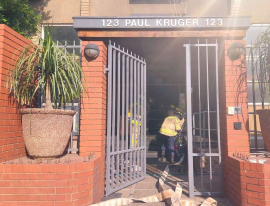
The Department of Public Works and Infrastructure (DPWI) says it is aware of a fire that broke out at the Legal Practice Council building located at 123 Paul Kruger Street in Pretoria.
According to the department, the fire started at approximately around 08:20 on Monday.
“It is worth noting that the fire did not spread over to the North Gauteng High Court building that is situated right next to the Legal Practice Council building. None of the buildings that are under the custodianship of DPWI were affected by the fire outbreak,” the department said in a statement.
It added that there was no evacuation that was conducted at the North Gauteng High Court and that court proceedings continued uninterrupted by the incident.
“As DPWI, we will, however, monitor the situation in order to prevent any flares to the properties under our custodianship,” the department said.
In a tweet, City of Tshwane Mayor, Randall Williams said firefighters speedily managed to put out the fire.
Job statistics cause for “cautious optimism” – President Ramaphosa

President Cyril Ramaphosa says the latest employment figures – which show a decline in the unemployment rate for the second quarter of 2021 – are cause for cautious optimism in the recovery of the economy.
The President was addressing the nation through his weekly newsletter on Monday morning.
The statistics show a decline in unemployment from 34.5% in the first quarter of 2022 to 33.9%.
“Over the last few years, South Africans have had to contend with slow growth and rising unemployment. This has been worsened by a devastating pandemic, an attempted insurrection unrest in July last year, and, earlier this year, severe floods in parts of KwaZulu-Natal, Eastern Cape and North West.
“Amidst all this, the energy crisis has loomed large, causing damage to the economy and hardship for households and businesses. Yet, even amidst these formidable challenges, our society and economy has proven to be resilient. And indications are that our economy is showing encouraging signs of recovery,” President Ramaphosa said.
The statistics also indicate some 648 000 job gains in that same period and according to the President while this is to be welcomed, “much more needs to be done” to slow unemployment even further.
The President added that employment gains show that government’s Economic Reconstruction and Recovery Plan – which focuses on mass public employment, economic reform and infrastructure development – is making headway in creating jobs.
“With infrastructure development and investment being one of the key priorities of our recovery plan, the growth in jobs in the construction area is particularly encouraging. The February budget outlined a 30% increase in spending on public infrastructure over the next three years to R812 billion, compared to R627 billion over the past three years.
“The Construction Industry Development Board recently noted that there has been an increase in infrastructure projects driven by state-owned enterprises like Transnet and Eskom, but also in the metros and through the Department of Public Works and Infrastructure,” he said.
The President emphasised that structural reform processes undertaken by government are “difficult but necessary” and that these reforms are yielding results in assisting the economy to grow.
He called on government, labour, business and civil society to forge consensus on these reforms and “trade-offs that are necessary to achieve our goals”.
“While our economy takes time to recover and our reform programme is implemented, we will continue to pursue a range of complementary interventions to support job creation. Alongside the measures that supports private sector growth, we will expand public employment and ensure social protection for the most vulnerable.
“The growth in employment, together with other promising signs of recovery, should encourage us to push ahead with the reforms and implement our Economic Reconstruction and Recovery Plan to unlock investment and growth. It should encourage all social partners to work more closely and with greater urgency and purpose to achieve faster growth and create more jobs,” President Ramaphosa said.
Economic sabotage ‘taking the country back’ – SOC chief executives
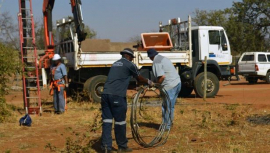
Four of South Africa’s State Owned Companies (SOCs) – Transnet, Telkom, Eskom and the Passenger Rail Agency of South Africa (Prasa), together with the South African Police Service, have announced an integrated approach towards combatting the scourge of cable theft, battery theft and infrastructure damage.
This was announced at an SOC Industry Roundtable on economic sabotage of critical infrastructure.
The roundtable was led by chief executives and acting chief executives of the four SOCs, Eskom’s Andre de Ruyter, Transnet’s Portia Derby, Telkom’s Serame Taukobong and Prasa’s Hishaam Emeran.
The CEOs and entities agreed on, amongst others, further integrating their security solutions, which collectively come to about R10 billion annually, supporting the SAPS and the National Prosecuting Authority on criminal cases related to incidents on their networks and working even closer with communities in protecting infrastructure.
An online web application has also been created to increase public awareness and allow stakeholders to receive live, detailed information on incidents in their networks.
Transnet
Transnet CEO Portia Derby told the roundtable discussion that the company experienced a spike in fuel pipeline hits, which cost at least R400 million to clean up, with incidents on its freight rail operations as well.
“Both have a very direct impact on the economy. Whenever we’re hit on the pipeline, it has a real possibility… [of drying] up the whole of Gauteng, which is the lifeblood of the South African economy. In 2022/23, to date, we’ve had 61 incidents and the spike [on these] came up with the fuel [price] increases… It has a R1 billion impact on the environment,” she said,
Derby revealed that cable theft has steadily increased, going from 1 598 incidents in 2017/18 to some 4 356 incidents in 2021/22.
Some 1 506km of cable had to be replaced during the same period, with an “erosion of about R30 billion to the economy” and R2.1 billion in revenue losses.
“When it comes to cable theft… it’s not the size of the cable that they steal. The fact that they’ve stolen [the cable] means that the train can’t move and when the train can’t move, it has an impact on the entire value chain. You end up having a situation where we’ve not been able to meet some of the customer demands. It is truly a damaging impact on the South African economy,” she said.
More than 1 269 suspects have been arrested in rail incidents, with 186 arrested in pipeline incidents.
Transnet security officials have now been granted peace officer status, which will allow them to make arrests, search premises, facilities and people, and complete dockets to ensure suspects are charged correctly.
Eskom
Eskom CEO Andre de Ruyter said infrastructure is “being stolen from under our feet” with cables, overhead lines, transformers and conductors coming in at a hefty cost of some R4 billion annually.
“We need to make sure that this is not another collation of noble intentions. We need to make sure that we start delivering and that we can, as State Owned Enterprises, protect ourselves from the scourge of infrastructure theft [and] more importantly protect the citizens of South Africa from the hugely negative consequences of that,” he said.
He said an integrated approach is in the best interests of all of society.
“The opportunity was there to integrate our security efforts even more and to identify areas where [the SOCs] have common infrastructure. It is in our interest to protect the railway line supplying coal to Majuba power station and if we can collaborate on that, there’s cost saving, there’s efficiency that we definitely need to pursue.
“We’ve received some very good messages of support from chief executives of companies listed on the JSE, who protect their assets and they have offered to make available and to extend the scope of their security patrols to also include some Eskom assets… because ultimately it is in their interest as well to maintain security of [energy] supply,” he said.
Telkom
Telkom CEO, Serame Taukobong, highlighted that for as long as cable and battery theft and damage to infrastructure continues, networks will struggle to bring down the cost of data in the country.
“What’s important for us is the billions that we spend every year to upgrade and maintain our investment in infrastructure. All these investments appeal to the livelihoods of South Africans, from transportation to communication.
“Battery theft, cable theft [and] vandalism of our critical infrastructure is really taking the economy back. [Mobile networks] are all equally challenged to try to reduce the cost of data in South Africa, but the cost on maintaining our infrastructure makes it almost impossible to achieve that,” he said.
Prasa
Acting CEO of the Passenger Rail Agency of South Africa (Prasa), Hishaam Emeran, told the roundtable that the current upward trend in theft and vandalism of infrastructure make it “very clear that we need to move with speed”.
The economic sabotage costs Prasa some R7 billion in direct costs, and between R15 billion to R20 billion annually.
He painted a devastating picture of the impact on Prasa, where thousands of incidents have left the rail network at “near total decimation”, with some 1 000km of electrical infrastructure and signalling cabling stolen out of a network of some 2 300km alone.
“One hundred kilometres of rail have been stolen… cut up and physically taken away. Our stations have also not been spared… Of our 590 stations, only 129 are functional as we speak, and we need to bring back those stations. In 2018/19, we were operating on 40 corridors. Today we are operating on 15… we are bringing back a number of those.
“The reality, unfortunately, is that because of this economic sabotage, we have taken a number of steps backward. As we speak today, passenger rail is not the backbone of the transport system and that is a problem,” he said.
The passenger rail company has now gone from – at its peak – transporting some 600 million commuters a year to transporting only 17 million.
However, Emeran said progress is being made to claw back its services.
“Prasa is working very hard to recover the rail service. We are bringing back the 10 priority corridors… many of them before the end of the year. The progress that we have made on the security front is also well documented.
“We have an approved integrated security plan. In essence, we are looking at the role of deployment of physical security personnel. We’ve already increased that by 3 100 and we are continuing to roll that out. That will be followed by a series of technological interventions as well to supplement that.
“We need to keep our foot on the peddle. We need to accelerate. We do not have the luxury of time. Commuters are suffering out there,” Emeran said.