

President saddened by deaths of 12 learners in road accident

President Cyril Ramaphosa is deeply saddened by the deaths of 12 learners from Rocklands Primary School and Laerskool Blyvooruitsig in Carletonville who were involved in a road incident in the Merafong City municipal area on Gauteng’s West Rand.
President Ramaphosa has in a statement sent his condolences to the families, friends, learners and educators of the deceased children.
The President has also wished a speedy and full recovery to the seven learners who suffered injuries in the incident that involved a scholar transport vehicle.
“The loss of such young lives at the start of a new school term touches all of us as a nation,” President Ramaphosa said.
“We wish the affected families and school communities the best as they mourn the passing of children who have been deprived of fulfilling their potential and spending their lives with families and friends.
“This tragedy, which regretfully is not the first of its kind to confront us, demands that we exercise our obligation to protect our children with the utmost care,” the President said.
Transport Minister Barbara Creecy and her Deputy Transport Minister Mkhuleko Hlengwa have also extended their deepest condolences to the families.
The Road Traffic Management Corporation (RTMC) is investigating the cause of the fatal accident, which occurred on the D92 at 06:42 on Wednesday morning.
The crash involved a minibus carrying school children and a light delivery van.
Speaking at the South African Transport Conference at the CSIR earlier this week, Minister Creecy said road safety will receive priority attention in the seventh administration.
Thousands left homeless as Western Cape braces for second cold front
As an intense cold front moves away from most parts of the country, the Western Cape is still at risk as it prepares for a second cold front, according to the South African Weather Service (SAWS).
“The Western Cape faces another cold front as the rest of the country gets a bit of a break from the hectic weather we’ve faced over the past few days. Strong interior winds are still forecast,” the SAWS said.
The Northern Cape, North West, Free State, Eastern Cape interior and Western Cape have been experiencing wet, cold, and windy conditions with light snow.
The series of cold fronts hitting the country also brought widespread and disruptive snowfall over the southern and western high ground.
This was accompanied by damaging winds over the interior and the coastline as well as high seas along coastal areas.
The Western Cape saw severe disruptions and damage, including loss of shelter in informal settlements, fallen trees, electricity outages and road closures due to snow or flooding.
The weather services has since upgraded the Western Cape’s weather warning from level 6 to 8.
According to reports, the inclement weather in the Western Cape affected 7 000 structures in informal settlements across Cape Town after 70 neighbourhoods were flooded.
The Liesbeek, Lotus and Eerste rivers in Cape Town have all begun to burst their banks.
“We’re still expecting a lot of strong wind and rain this week. Please stay safe. City teams are addressing each localised flooding situation,” said Cape Town Mayor Geordin Hill-Lewis.
The Western Cape Education Department (WCED) said the wet and cold conditions prevented five schools from re-opening yesterday as public schools began their third term across the country.
According to the WCED, the schools were closed due to either flooding, inaccessibility to access routes or damage to the school building.
In addition, 82 schools have reported damages, of which most cases were minor, with 31 cases regarded as more serious.
“This includes schools where roof sheeting was blown off,” the provincial department said, adding that repair work has already begun on some projects.
Western Cape Premier Alan Winde expressed his gratitude to the province’s disaster management teams and stakeholders who have worked tirelessly throughout this difficult period.
“Your steadfast dedication to serving the residents of this province is deeply appreciated,” said Winde.
KwaZulu-Natal
Meanwhile, KwaZulu-Natal has been dealing with extremely high fire danger conditions.
The KwaZulu-Natal department of Cooperative Governance and Traditional Affairs confirmed veld fires in uMlalazi Local Municipality in Eshowe where a 67-year-old was burnt to death when his house caught fire.
King Cetshwayo District is said to be one of the most affected areas, with uMfolozi, uMlalazi, Mthonjaneni and Nkandla being the hardest-hit municipalities.
According to the provincial department, 144 people in the district were affected, leaving 53 people homeless after 48 homes were partially damaged and 27 destroyed.
“The department is working closely with the municipality to ensure adequate support and relief for the affected families, with social partners setting up soup kitchens.”
Eastern Cape
Strong winds continue to wreak havoc in the Eastern Cape, damaging houses and disrupting the flow of traffic on the roads as vehicles have been toppled over, on the N2 near Dutywa.
“Road users, motorists in particular, are urged to be extra cautious or avoid being on the road completely if their travelling is not essential,” the Eastern Cape Transport Department said.
On Tuesday afternoon, the provincial department finally reopened the Barkly Pass on the R58 Road between Barkly East and Elliot to traffic, after it was closed for 30 hours, due to heavy snowfall, on the morning of Monday.
“Graders had to be used to clear off the thick blanket of snow that stubbornly covered the road surface.”

Gauteng online learner registration process to start on Thursday
Wednesday, July 10, 2024
The Gauteng Department of Education says online registration for the 2025 academic year for Grade 1 and Grade 8 admissions will begin on Thursday, 11 July 2024, at 8am and end on Monday, 12 August 2024, at midnight.
The department has stressed that as long as parents apply online and on time, their children are assured to be placed at a school in time for the 2025 academic year.
Gauteng Education spokesperson Steve Mabona appealed to parents to apply on time.
He said parents are allowed to choose a minimum of three schools and a maximum of five schools.
Placements for pupils will begin on 16 September.
Mabona said parents who have no access to internet services must use any of the department’s 80 centres across the province, and they will not be charged a fee.
The spokesperson said the online process has improved and is user-friendly.
“Our system has improved and we can assure parents that problems experienced in the past will not happen again,” Mabona said.
In the past, the system had experienced challenges and would remain offline due to high volumesof applications received.
Required documents for online applications
– SA parent ID or passport and child’s birth certificate or passport.
– Refugee permit.
– Asylum seeker permit.
– Permanent residence permit.
– Study permit.
– Proof of home address.
– Proof of work address.
– Latest Grade 7 school report (Grade 8 applicants only).
– Clinic card/immunisation report (Grade 1 applicants only).
Alleged illegal miners to appear in court
Thirty-five alleged illegal miners are expected to appear in court soon after they were arrested in the Northern Cape, said the South African Police Service (SAPS).
This follows Operation Vala Umgodi operations that got underway on Saturday.
“The team in the Namakwa District pounced on the Bontekoe informal settlement mining area and arrested 27 Lesotho and Zimbabwean nationals, aged between 20 and 49 years old, for illegal mining and contravention of the immigration statutes.”
The team was also alerted by mine security of intruders inside the Koingnaas mine premises where a 24-year-old Zimbabwean male who was found with unpolished diamonds in his possession, was arrested.
“In the Frances Baard District in Kimberley, the team arrested seven Malawian, Lesotho and Zimbabwean nationals aged between 24 and 54 years old for contravention of the illicit mining and immigration statute. Several illegal mining implements were confiscated,” said the SAPS.
Three wanted suspects were also arrested.
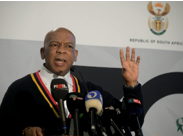
Municipalities’ R78 billion Eskom debt an ‘urgent task’ – Ramokgopa
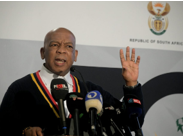
The R78 billion debt owed to Eskom by municipalities must be urgently addressed to protect the ability of the power utility to fulfil its mandate.
This is according to Minister of Electricity and Energy, Dr Kgosientsho Ramokgop,a who addressed the media on Monday.
“Collectively, municipalities are owing Eskom R78 billion and…a lot of this is irrecoverable. There’s no possibility under the sun that we are going to collect that R78 billion. It’s important that we resolve this picture.
“This picture presents problems for Eskom. Eskom needs this money for it to be able to reinvest back into its own infrastructure. Municipalities have to pay that money…but on an objective ground, they simply don’t have the means to be able to pay,” he said at the briefing held in Pretoria.
Ramokgopa said the current trajectory of the debt owed to Eskom poses a threat to the existence of the power utility in the future.
“To give you the magnitude of the problem, if we don’t resolve this problem, our projection is that at the current rate, by 2050, Eskom will be owed R3.1 trillion. Eskom will collapse. Generation capacity is going to be compromised. So, it’s important that we resolve this question.
“This is the most urgent task that is confronting us. It is municipality related but we can’t fold our arms, we need to help them from a technical point of view.”
He emphasised that continued non-payment is affecting Eskom’s ability to address distribution infrastructure needs – leading to the implementation of load reduction.
Load reduction is implemented in areas when the demand is higher than the infrastructure is able to handle.
“In the solution, we must protect the interests of Eskom as a going concern, ensure that municipalities are able to collect [revenue] but also protect the interests of the user. Because when that distribution infrastructure fails that is providing electricity to 50 houses, there’ll be 10 to 20 houses that have been paying diligently but they are collateral damage.
“The biggest victims of all of that is the end consumer and, by definition, is the South African economy,” he said.
The Minister said the department, together with municipal leaders will address the challenge of electricity affordability and access to allow municipalities to be able to collect revenue.
“It is important that we must review electricity tariff models to enhance affordability and expand access. Everyone must have access to electricity and once they have access…make sure that they can afford it. That’s something that is going to receive our attention.
“Distribution is our albatross…it’s on a mode of self-destruction and the casualties are the poor. They are the ones that are subjected to conditions of load reduction in the main and even those who are diligent payers are subjected to load reduction.
“This can’t continue any further. It’s important that we arrest it so that we are able to ensure that the country is able to achieve its developmental objectives,” he said.

Eskom marks 100 days of no load shedding

State power utility Eskom has reached 100 days without implementing load shedding for the first time since 2020.
“Considering the Intensity and the levels of load shedding in 2023, the ability to get to 100 days without load shedding is significant, while acknowledging that the risk of load shedding still exists.
“The 100 days milestone includes around a – R6.2 billion reduction in OCT [Open cycle gas turbines] diesel expenditure from 1 April 2024 to 30 June 2024, compared to the same period last year and if we maintain our trajectory on reduced diesel spend, it will be a strong driver in a possible return to profit in FY25,” Eskom’s Group Chief Executive Dan Marokane said.
The power utility’s Head of Generation, Bheki Nxumalo, highlighted that the 100 days is a result of the “tireless efforts” of those working to keep the lights on at the power utility.
“The achievement of 100 continuous days without load shedding is the outcome of diligent execution of recovery plans and the tireless efforts of our 40 000 dedicated and skilled Eskom employees.
“If we maintain a 70% Energy Availability Factor (EAF) and add significant capacity within the country we can ensure adequate available capacity to meet demand without a significant risk of load shedding,” Nxumalo said.
READ | Ramokgopa pleased with 100 days of no load shedding
Targeted initiatives
Eskom explained that the current upward trajectory stems from, amongst others, a “multi-dimensional Generation Operational Recovery Plan…and aggressive planned maintenance”.
The utility explained that these initiatives have led to a reduction in unplanned outages at power stations from some 18 000MW to an average of 12 000MW – marking an improvement of 6000MW since May 2023.
“This has contributed to a sustained improvement in the EAF, which has increased from 54.56% at the end of FY23/24 to a year-to-date achievement of 61.50%, an increase of 6.94% over the past three months.
“Our immediate focus remains on implementing the Generation Operational Recovery Plan, aiming to recover about 1600MW from the generation coal fleet following the successful commercial operation of Kusile Unit 5 and 930MW from Koeberg Unit 2 before the end of the calendar year. This will significantly improve the EAF by the end of March 2025,” the power utility said.
Eskom thanked government and the National Energy Crisis Committee (NECOM), and other stakeholders for their collaborative efforts, which have enabled the successful execution of its plans.
“We will persist in implementing the operational recovery plan, strengthening governance, and future-proofing the organisation to ensure energy security, growth, and long-term sustainability for the benefit of South Africa and sub-Saharan Africa.
“We remain committed to improving the current business while laying the groundwork for future opportunities and initiatives. We will continue to seize every opportunity presented by industry changes for the benefit of all our stakeholders.
“The pace of change is rapid, and we are prepared to deliver on the future through improved implementation and disciplined execution,” Eskom concluded.

GNU: A new era for SA
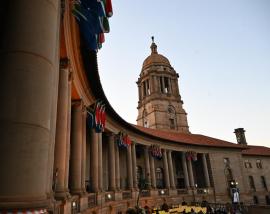
As the new Cabinet of the seventh administration gets to grips with the workings of their various portfolios – it has been advised to place ordinary South Africans at the heart of the administration.
“Show the ordinary South Africans that their well-being is the ultimate goal and at the heart of those running government and the administration,” Extraordinary Professor at the Department of Political Sciences at the University of Pretoria, Henning Melber, told SAnews.
Melber’s comments follow on the announcement on Sunday, 30 June 2024, of the new National Executive of the seventh administration by President Cyril Ramaphosa.
The much-anticipated announcement is the result of the National and Provincial Elections that were held on 29 May. For the first time in democratic South Africa’s history, that election did not result in an outright majority for a single party to lead the country for the next five years.
The will of the people
In those initial days following from the point where voting took place, up to the announcement of the results, ordinary citizens were wondering what would happen next. After all, we were accustomed to living in a country that since the advent of democracy, was led by a single majority party.
However, from the hotly contested elections themselves to the announcement of the election results, peace was the order of the day. This also extended to the period of the swearing in of Members of Parliament (MPs) and other MPs at a later stage, as well as the election of National Assembly (NA) Speaker Thoko Didiza and National Council of Provinces (NCOP) Chairperson Refilwe Mtsweni-Tsipane. The election and inauguration of Cyril Ramaphosa as President and head of government of the seventh administration was also peaceful.
An acceptance of the will of the people at the ballot box also played an important part in where the country finds itself today with the seventh administration’s Government of National Unity (GNU) starting to take shape.
This GNU, however, differs from the one that South Africa had, following the seminal elections of 1994 that saw the African National Congress (ANC) go into a GNU with two other political parties, despite having won an outright majority. The current GNU comprises 11parties across the political spectrum.
These parties are: the African National Congress (ANC), Democratic Alliance (DA), Patriotic Alliance, Inkatha Freedom Party, Good Party, Pan Africanist Congress of Azania, Freedom Front Plus, United Democratic Movement, Al Jama-ah, Rise Mzansi and the United Africans Transformation.
Collaboration
In an interview with SAnews, Melber further advised parties involved in the GNU to “collaborate with members of other parties based on trust; seeking to improve efficiency in service delivery.”
With this rather eventful week drawing to a close, South Africans not only witnessed the announcement of the new Cabinet, but also the swearing in of the new executive, including Deputy President Paul Mashatile as well as the induction programme of new MPS in the Western Cape.
And yes, it did take some time to get to where we are now as a country, but we must remember that Rome was not built in a day.
In his address to the nation on Sunday, President Ramaphosa acknowledged the length of time it took to put together the administration.
Confidence vs Time
However, Melber points out that given the different elements at play, the process in truth did not take too much time.
He said that given the rather unusual, if not complicated blend of parties who needed to secure common ground, and agreeing on an acceptable power sharing arrangement in terms of portfolios -, this process had actually not taken that long.
“And it was a necessary investment in building a minimum degree of confidence and trust as a point of departure. There are democracies who for months (among others The Netherlands, Sweden) if not years (Belgium) had not a proper government and were neither less politically stable. Many observers at least in the Western democracies were hoping for such a power-sharing arrangement and did not expect this to happen much faster. Building a reliable collaboration between political parties so different in their programmes needs time,” Melber explained.
A new era
In his inauguration address on 19 June 2024, President Ramaphosa described the GNU as “the beginning of a new era” adding that it requires a common mission, which is anchored in safeguarding national unity, peace, stability, inclusive economic growth, non-racialism and non-sexism.
Asked about his thoughts on the GNU, Melber said: “Under the given circumstances of the election result, the decision to form a GNU seemed to be a wise and considerate move, aiming to accommodate a broad middle for political stability in a government, in which the ANC remains the major party.”
The announcement of the new Cabinet also came with changes in government departments that involve the merger of the Ministries of Electricity and Energy as well as the announcement of a separate Ministry of Mineral and Petroleum Resources. The President also announced the separation of the Ministry of Agriculture from the Ministry of Land Reform and Rural Development, among others.
“This is a necessary adjustment to accommodate divergent interests seeking influence in governance. If in the end – despite some further bloating of the structures – it provides a reliable operational structure to make improvements in delivery – it is a well justified investment,” said the Professor.
South Africa’s future under a GNU is now underway with Minister in the Presidency Khumbudzo Ntshavheni having held the first media briefing of the seventh administration on Thursday, 4 July 2024.
At that briefing, the Minister outlined the process that would be followed to set government’s priorities and programme of action for the seventh administration. These said the Minister, will be articulated in the Medium-Term Strategic Framework (MTSF), which is normally guided by the election manifesto of the governing party. However, in this case of the GNU, a unique case for government, this will be guided by the election manifestoes of the 11 parties to the GNU.
To give effect to the signed Statement of Intent as signed by parties to the GNU, the Forum of South African Directors-General (FOSAD), chaired by the Director-General in The Presidency, has undertaken the work of analysing the manifestoes of parties to the GNU.
After thorough scrutiny, the Directors-General will then submit a proposal for consideration and adoption at the Cabinet Lekgotla scheduled for 11-12 July.
The two-day Lekgotla will deliberate on the proposals of the Directors-General, after which the programmes and priorities of government will be announced.
“The adopted programme of action (MTSF) will be announced by the President at the Opening of Parliament on Thursday, 18 July 2024. After the adoption of the MTSF, the individual departments will then develop their Strategic Plans linked to the MTSF and Annual Performance Plans for implementation of the MTSF targets,” explained Minister Ntshavheni.
Happiness trajectory
Following the elections and Sunday’s cabinet announcement, South Africa’s happiness trends have been on an upright trajectory.
This is according to the Gross National Happiness (GNH) index. The index is the brainchild of Professor Talita Greyling of the University of Johannesburg (UJ) and Prof Stephanie Rossouw of the Auckland University of Technology, with the technical support of AFSTEREO (Pty) Ltd.
According to UJ, the GNH is the first index of its kind and measures the real-time sentiment of the country.
“The much-anticipated announcement by President Cyril Ramaphosa of the new GNU Cabinet on 30 June 2024 is being experienced positively by the South African people, as shown by the near real-time Happiness Index of the GNH.today project.
“The happiness levels in South Africa have been trending upward since the election results were announced in June 2024, from 5.36 to 5.42,” the university said in a statement.
The GNH.today project measures happiness in near real-time based on specific emotion words used in Google searches.
“The GNU ensures a broad representation and a solid mandate to govern the country, contributing to higher levels of transparency, accountability, and trust in the government. It also explains the higher happiness levels, reflecting hope for a better future,” said the university.
In analysing the positive trend in the happiness index, the team found that positive emotion words used in South Africa increased, such as “hope”, “happiness”, and “joy”.
However, there was an increase in negative emotion words such as “bad” and “afraid”, but with a positive net effect.
“The increase in both positive and negative words is expected as it indicates the debate around the newly appointed cabinet. Different parties criticise the portfolio allocations and the ministers appointed. The increased size of the government is also critiqued. On the other hand, there is relief that the Cabinet was announced after almost a month of negotiations.
“This announcement implies an agreement about power-sharing,” said the university.
Asked about whether he thinks the GNU will stick, Professor Melber is hopeful.
“I’m afraid I have misplaced my crystal ball,” he chirps.
“More seriously [though,] one hopes for the sake of South African citizens that this GNU manages to operate and serve the best interest of the people. If this construction holds, it is a win-win situation for all the parties who were able to compromise for the sake of the people and the country’s stability,” he said.

Trio in court for R153 million VBS corruption matter

The former Municipal Manger and acting Chief Financial Officer of the Greater Giyani Local Municipality, together with a businessman, have appeared in court in connection with a VBS corruption matter in which the municipality suffered a loss of at least R153 million.
Former Municipal Manager Risimati Maluleke, the municipality’s Acting Chief Financial officer Nditshedzeni Mashau and businessman, Zwivhuya Goodness Tshishonga, appeared in the Polokwane Specialised Commercial Crimes Court.
The trio face charges of contravening the Municipal Finance Management Act (MFMA), corruption and money laundering.
According to the National Prosecuting Authority regional spokesperson, Mashudu Malabi-Dzhangi, the three are in the dock for their alleged role in “approving an unlawful investment to VBS Mutual Bank since VBS was not a bank as defined in the banks act” – costing the municipality a loss exceeding R153 million.
“It is alleged that the first investment of R100 million matured and yielded an interest amounting to over R4 million. Later, over R48 million was also invested. The investment and the interest were then not paid back to the municipality.
“The investigations revealed that the municipality had illegally invested over R153 million into VBS for 18 months. Furthermore, the Acting Chief Financial Officer (CFO) recommend that the money should be invested with VBS, instead of using authorised banks,” the NPA said in a statement Thursday.
Malabi-Dzhangi added that the accused allegedly acted in a “a grossly negligent way in contravention of MFMA” and “did not take reasonable steps to ensure that the resources of the municipality were used effectively, efficiently, and economically”.
“It is alleged that Tshishonga received substantial amounts of money into his business account of Real Consulting, in turn, Tshishonga [would] transfer a portion of the money to Maluleke thus disguising the nexus between VBS and Maluleke. In total Maluleke received R62 000 from Tshishonga,” she said.
The three are expected back in court in August.

Mpox cases rise to 20 with infections expected to increase

Four additional Mpox cases have been reported in KwaZulu-Natal and Gauteng, with infections expected to rise as contact tracing efforts are stepped up.
This pushes the total number of laboratory-confirmed cases of Mpox in South Africa to 20 since the outbreak in May 2024.
According to the Department of Health’s data, all cases involve males aged between 17 to 43 years old.
The recent infections include a 17-year-old man from Hillbrow in Johannesburg, a 37-year-old from Pretoria East, a 29-year-old from West Rand, and a 19-year-old from Durban in KwaZulu-Natal.
Of the 20 cases, 10 were recorded in Gauteng, nine cases in KwaZulu-Natal and one from Western Cape.
Meanwhile, the death toll has remained at three since the outbreak.
READ | Everything you need to know about Mpox disease
The department said outbreak response teams have been activated for the newly diagnosed cases.
“Another batch of Mpox-specific treatment is expected to arrive in the country in the next few weeks as the number of cases is also expected to rise due to intensified contact tracing, risk communication and community engagement activities in the affected communities.”
The National Institute for Communicable Diseases (NICD) has received over 130 test requests since the outbreak of Mpox in South Africa.
“The department appeals to all contacts of confirmed cases and suspected cases to cooperate with health workers during contact tracing, screening and 21-day monitoring period, to ensure no case is left undetected.”
According to the department, contact tracing is one of the critical tools available to effectively break the chains of local transmission and control the Mpox outbreak.
“All people with suspected symptoms are reminded to visit their nearest healthcare facility right away for clinical evaluation, diagnosis and treatment options, instead of self-diagnosing and isolation.”
The common symptoms of Mpox include a rash which may last for two to four weeks, fever, headache, muscle aches, back pain, low energy and swollen glands.
“The rash looks like blisters or sores, and can affect the face, palms of the hands, soles of the feet and so on,” the department explained.

Team to investigate child abuse allegation at KZN home

The newly appointed KwaZulu-Natal Social Development MEC, Mbali Shinga, has ordered a full investigation into the allegations of child abuse at the Aryan Benevolent Home Child and Youth Care Centre in Chatsworth, Durban.
Shinga visited the centre on Tuesday, following recent allegations of child abuse at the home.
According to the provincial department, reports suggest that workers at the facility have ignored children’s rights, with instances of children being assaulted with wet towels and belts.
Shinga said it was disappointing that management at the institution could not pick up any signs of the abuse.
“I believe that one person should have picked this up before it reached this stage because it has been happening for a long time.”
The centre’s General Manager, Ray Naguran, confirmed the abuse allegation and that 48 children had been abused.
The MEC has announced the formation of a dedicated team of investigators to thoroughly examine the grave concerns.
“The investigative team will work diligently to uncover the truth, provide support to any affected children, and ensure that appropriate actions are taken against any perpetrators.”
Shinga added that the team will also wait for the other 21 children residing at the home, who are currently away for the holidays to come back so that they can also hear their side of the story on the allegations.
The team which will be led by the department’s Head of Department has been given three weeks to complete its investigation and compile a report for her to review.
“The department remains steadfast in its mission to protect the most vulnerable members of society and uphold the highest standards of care within our child welfare institutions. The safety and well-being of our children are paramount, [and] any instances of child abuse will be met with swift and decisive action,” said Shinga.
Naguran said four child caregivers have since been dismissed.