
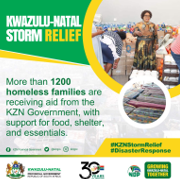
Mop up operations continue across KZN
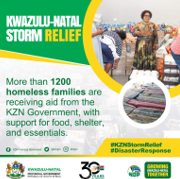
Mop up operations continue across KwaZulu-Natal following heavy rains, which wreaked havoc in various parts of the province.
Last Monday’s heavy rains, accompanied by strong winds, wreaked havoc in various parts of the province, affecting the districts of eThekwini Metro, Ilembe, King Cetshwayo, Umzinyathi, Amajuba and Umkhanyakude District Municipalities.
At least 11 people lost their lives, including seven people from uThongathi in the north of Durban, and four in Nquthu, Eshowe and KwaHlabisa, respectively.
Over 55 people were also reported to have suffered minor to moderate injuries and are receiving medical treatment in hospital.
The storm also left extensive damage to schools and power lines, leaving many parts of eThekwini without electricity.
The eThekwini Metro was hardest hit, with dozens of people treated for injuries in health care facilities.
The eThekwini Municipality said relief intervention in the form of food, blankets, mattresses and building material is underway to assist displaced residents in eMagwaveni, uThongathi.
“eThekwini teams and volunteers are working together to clear debris in preparation for rebuilding. Water standpipes and water tankers have been provided to ensure an interim water supply. The restoration of electricity is also in progress,” the municipality said.
The Department of Cooperative Governance and Traditional Affairs (CoGTA) has also deployed community works participants playing a crucial role in helping affected families.
KwaZulu-Natal Social Development MEC, Nonhlanhla Khoza and eThekwini Municipality Mayor, Mxolisi Kaunda, has also conducted an assessment on the restoration of basic services in eMagwaveni, uThongathi.
Khoza said social workers have been deployed to provide relief and support, including assistance with important documents and school uniforms for affected learners.
“Partnerships with organisations like the Hollywood Foundation and South African Social Security Agency (SASSA) ensured immediate aid, including meals and shelter in community halls.
“The government pledged to construct proper homes for victims and increase disaster relief coordination efforts. Despite ongoing relief efforts, more aid is needed for affected areas like uThongathi, Osizweni, and Eshowe,” Khoza said.
Other interventions include assessment of the families who have lost loved ones and construction of temporary residential units (TRUs) for displaced families. Debris and fallen trees on the roads has been cleared; and electricity supply has been restored to certain areas.
A command centre has also been established on site to assist community members, and Social Relief of Distress grants are being disbursed by SASSA and the Department of Social Development.
Relief, in the form of building material, food, blankets and mattresses is being provided to residents of uMgababa, Ward 98, who were also affected by the heavy rains and strong winds.
eThekwini Deputy Mayor, Zandile Myeni, and Chairperson of the Governance and Human Capital Committee, Nkosenhle Madlala, recently visited the area to assess the extent of the damage.
About 30 families from the area lost their homes to the storm. While injuries were reported, no deaths have been recorded in the area.
Myeni said eThekwini Municipality, including provincial government, non-profit and non-governmental organisations are working together to provide relief to the affected families, and work to restore services is also underway.
Jozini Municipality responds to tornado disaster
Meanwhile, Jozini Local Municipality Mayor, Mfananaye Mathe, visited the KwaJobe area in northern KwaZulu-Natal to address the aftermath of a devastating tornado that struck the area leaving more than 59 families displaced.
The Gumede family, where nine children aged between four and 10, along with their grandmother, saw their RDP house collapse while they were inside.
Two of the children are hospitalised, with one admitted at Obonjeni Hospital and the other at Ngwelezane Hospital in Mpangeni.
Mathe has provided essential supplies, including groceries, blankets, and sleeping sponges to support the affected families.
The Jozini Local Municipality Disaster Management Team has also supplied temporary tents to all those impacted by the tornado.
While acknowledging the challenges in providing immediate assistance to everyone, Mathe emphasised the municipality’s commitment to swiftly intervening where possible.
The mayor also expressed his gratitude to the Department of Community Services for its ongoing support during this crisis.

Trial date set for Richard Mdluli corruption case

The corruption case against former South African Police Service (SAPS) Crime Intelligence Head, Richard Mdluli, has been set down for trial in October.
Mdluli will be in the dock in the Pretoria High Court with co-accused, former SAPS Head of Supply Chain Management, Heine Barnard and former SAPS Crime Intelligence Chief Financial Officer, Solomon Lazarus.
According to National Prosecuting Authority Investigating Directorate spokesperson, Henry Mamothame, the court ordered that the “trial will commence on the set date regardless of the pending outcome on an application by Mdluli compelling the SAPS to pay for his legal fees”.
“Mdluli, together with…Barnard and…Lazarus, are facing charges of corruption, fraud and theft relating to the police’s secret slush fund from the time they were employed by the SAPS in the Crime Intelligence Services, between 2008 and 2012,” he said.
The three face a raft of charges, including:
- Payment of private trips to China and Singapore.
- Private use of a witness protection house in Boksburg and conversion of this property for his personal use.
- The leasing out of Mdluli’s private townhouse at Gordon Villas in Gordon’s Bay as a safe house to the State and using the monthly rental to pay his bond.
- Payment of Mdluli’s financing costs owing on his private BMW through an intricate scheme to the detriment of the SAPS.
- Coercing a SAPS supplier into giving Mdluli a special deal on the use and purchase price of a Honda Ballade.
- Paying transfer costs to an attorney on the purchase of a house in Cape Town.
- Having family members, without adequate qualifications or experience, appointed in crime intelligence as well as getting them on the payroll and paying their salaries, providing them with motor vehicles and cell phones.
The trial is expected to commence on 7 October this year.

Alleged coal thief apprehended at Arnot Power Station

A truck driver has been arrested on allegations of stealing coal at the Arnot Power Station in Mpumalanga.
This after a coal loaded truck was spotted by the Eskom Group Security Investigation’s tactical team entering a coal yard in Middelburg.
The coal was due to be delivered to the power station.
“The truck left the coal yard after about an hour and the members followed it as it then drove to Arnot Power Station. On arrival at Arnot Power Station, the truck joined the queue to offload coal.
“The Eskom Group Security Investigations team checked and discovered that the coal due to be offloaded was indeed discarded coal containing stones, which confirmed the suspected coal swapping witnessed earlier at the Middleburg coal yard,” Eskom said in a statement.
According to the power utility, the truck driver was questioned and admitted to selling the coal for some R6 000.
Eskom Acting General Manager for Security, Botse Sikhwitshi, praised the team for its work.
“We commend the Group Security Investigations and the Middelburg Hawks team for working tirelessly together in bringing coal thieves to book. There is tangible evidence to ensure successful prosecution of the suspect.
“The delivery of poor quality coal often leads to unit breakdowns and cannot be tolerated. We hope the perpetrator, once convicted, faces the harshest possible sentence, which shall serve as a deterrent to others,” he said.
The public is urged to report any information they may have on illegal electricity sales, fraud, the theft of coal, fuel oil and diesel, and all other electricity related crimes to the Eskom Crime Line on 0800 11 27 22.

New Catchment Management Agencies to ensure good water governance

In an effort to ensure the involvement of stakeholders in the management of water resources, the Department of Water and Sanitation is expected to launch four Catchment Management Agencies (CMAs).
They will be launched during the Water Institute of Southern Africa (WISA) conference set to take place in Durban this week.
The establishment of the Catchment Management Agencies is in line with the provisions of the National Water Act (NWA) and the National Water Policy for South Africa.
The purpose of Catchment Management Agencies is to enhance decentralised decision-making in managing water resources, in an integrated manner, at a local level.
The department said the CMAs will ensure participative management, good water governance and integrated planning and improving co-operative governance of the country’s water resources, in order to achieve the objectives of the National Water Act, equity, accessibility and government’s commitments to improving service delivery.
“A CMA manages all the water resources in a water management area at the catchment level. This means that a CMA is responsible for the protection, use, development, conservation, management and control of all the water resources in that particular water management area (WMA).
“This responsibility requires that all spheres of government, water users and communities in the water management area participate with CMAs as partners,” the department said in a statement.
Water and Sanitation Minister, Senzo Mchunu, finalised the appointment of Board Members of the Pongolo–Umzimkhulu and the Vaal-Orange Catchment Management Agencies, a decision concurred by Cabinet.
The Boards of Pongola-Umzimkhulu and Vaal-Orange CMAs appointments became effective from 1 December 2023.
The department has reconfigured the number of CMAs to six, including Limpopo-Olifants, Vaal-Orange, Pongola-Umzimkulu, Mzimvubu-Tsitsikamma, Breede-Olifants and Inkomati-Usuthu.
The boards, as the accounting authority, will operationalise the CMAs including developing the catchment management strategy, effective participation of stakeholders and management of water resources in the water management area.
“In addition, the CMA will be more responsive to water user needs and speedy decision-making around water resources management and create a customer-focused culture for water resources management,” the department explained.
The appointed board members for Pongolo–uMzimkhulu include Dr Thava Kelly (Chairperson), Sibusiso Makhanya (Deputy Chairperson), Hlengiwe Ndlovu, Bhekumuzi Gumbi, Dr Lembi William Mngoma, Snenhlanhla Mngadi, Professor Purshottama Reddy, Mdandla Myeni, and Nokuthula Khanyile.
This CMA is an amalgamation of the previous WMA areas within the KwaZulu-Natal province, such as half of the Pongola-Usuthu WMA, the Thukela WMA, and the Mvoti-Mzimkulu WMA. Interim Chief Executive, Swaswa Ntlhoro, was appointed for the transitional phase.
The appointed board members for the Vaal-Orange CMA, which operates in the Central North-eastern part of South Africa and extends from Ermelo in Mpumalanga to Kuruman in the Northern Cape, include Desmond Solomon Fransman (Chairperson), Tsakane Zwane (Deputy Chairperson), Hubert Thompson, Nontuthuzelo Njeza, Nakana Masoka, Ponatshego Mothibi, Doris Dondur, Dichikane Mashego, and Louis Van Oudtshoom. Interim Chief Executive, Solomon Mathebula, was appointed for the transitional phase.
“The Minister has finalised the appointment of Board members of Mzimvubu-Tsitsikamma and awaiting concurrence by Cabinet. Interim Chief Executive, Sibusiso Mjwara, was appointed for the transitional phase. This agency’s footprint covers the majority of the Eastern Cape, and includes portions of KwaZulu-Natal, Western Cape, and the Northern Cape.
“For the Limpopo-Olifants CMA, the Advisory Committee has concluded their recommendation for the appointment of the Board and is awaiting the vetting of candidates and concurrence by Cabinet,” the department said.
Water Institute of Southern Africa conference
Meanwhile, the three-day Water Institute of Southern Africa conference will take place at Inkosi Albert Luthuli International Convention Centre in Durban, KwaZulu Natal, from 12-14 June 2024.
WISA conferences provide a platform to discuss problems and solutions facing the water and related sectors. The conference is used to create mechanisms and collaborations, to ensure an enabling environment to set us on a path of implementation and impact.
Net closes in on illicit goods trade

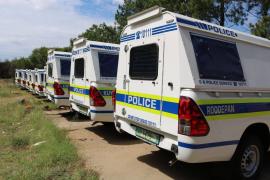
The South African Police Service (SAPS) says it remains relentless in its pursuit to dismantle the trade in counterfeit and illicit goods nationwide.
On Friday, the National Counterfeit Goods Unit led an operation in the Johannesburg CBD which resulted in the arrest of two Chinese nationals and the seizure of counterfeit goods with an estimated value of R5.8 million.
Police also arrested two Ethiopian nationals for contravening the Immigration Act No. 13 of 2002 during the operation.
Almost 7 000 counterfeit items imitating well-known brands were seized, which included sports apparel, clothing, shoes, perfumes, sunglasses, watches and bags.
The team comprised SAPS members from various specialised units, officials from the South African Revenue Service (SARS), Gauteng Traffic’s Saturation Unit, Brand Protectors, Crime Prevention Wardens and private security.
In the past eight months, the National Counterfeit Unit, in collaboration with its various crime fighting partners, seized over R400 million worth of counterfeit and illicit goods during various takedown operations in different parts of the country. The unit was established in November last year.

City Power implements load reduction

Johannesburg’s power utility, City Power, is expected to begin implementing load reduction in areas it says have “exceedingly high” electricity usage levels.
The load reduction is expected to be implemented from this morning.
More than 80 areas will be affected and grouped into six blocks for load reduction, which will not exceed 2.5 hours per block.
“The decision to initiate load reduction follows extensive efforts to encourage customers to use electricity wisely and efficiently in recent weeks.
“Despite warnings about the constrained electricity network in the city, residents have not reduced their electricity consumption, and energy demand has continued to rise,” the utility’s spokesperson, Isaac Mangena, said.
Mangena explained that consumption in the metro has reached “critical levels, forcing… City Power to embark on stringent measures to protect the grid from total collapse”.
“City Power has recorded an enormous increase in the average evening peak load in some areas, which went up by 65%, from 25MW during the summer months to 33MW between April and May 2024. In some instances, the load reaches 42MW, constituting a 110% increase in consumption levels in comparison with the warmer season.
“During January and March this year, the average off-peak consumption at some of our substations has been sitting at 20MW. Between April and May, consumption shot up by 50%, increasing the off-peak load to 30MW. With temperatures expected to drop even more between June and July, the consumption levels could have dire consequences on our network infrastructure if load reduction is not urgently implemented,” he said.
The power utility is also embarking on other measures to work in tandem with load reduction.
“Part of our measures to lighten the load on the grid through load reduction includes the installation of ripple relays. A ripple receiver is part of a load management system used to control the electricity supply to the geyser during peak hours.
“Geysers are among the biggest electricity guzzlers, accounting for up to 50% of monthly household energy costs. These ripple relay receivers at different households are connected to at least 69 of our substations, and we can monitor customers’ consumption load remotely. City Power will remotely switch off the customer geyser once they reach high consumption levels,” Mangena said.
Illegal connections
The spokesperson said illegal connections are also contributing to an already “severely strained” electricity network.
“City Power continues to intensify the removal of illegal connections and revenue collection operations across the City of Johannesburg this winter season. This seeks not only to alleviate pressure on the system but to recover the billions owed to it and send a strong message to non-paying customers to pay for the services they use daily or have their power supply cut off.
“From our observations, those who are illegally connected or tampered with meters, are amongst the highest consumers of electricity, because they do not experience the financial consequences of keeping high and irresponsible usage,” he said.
The schedule for load reduction is available on the City Power website.
Progress in payment of private student accommodation
The National Student Financial Aid Scheme (NSFAS) Administrator, Freeman Nomvalo, says a bulk payment of accommodation allowances was processed by the end of May 2024 and beginning of June 2024, with the next scheduled payment expected by mid-June 2024.
Nomvalo said NSFAS has been consulting with various stakeholders since his appointment as the Administrator, and one of the critical stakeholders consulted are the landlords for private student accommodation who raised concerns regarding the outstanding payment of student accommodation allowances.
Nomvalo has assured the stakeholders that a bulk payment of accommodation allowances has been processed by the end of May 2024.
“The next scheduled payment will be not later than 18 June 2024 to clear all legitimate claims. These interventions are intended to provide the much-needed relief to private student accommodation landlords,” Nomvalo said.
The Administrator has urged the landlords, who still have outstanding payments, not to evict students, as NSFAS is committed to ensuring that all legitimate claims are resolved not later than 18 June 2024.
He encouraged landlords who did not submit their claims for outstanding payments to refer their queries to NSFASAccomProv@nsfas.org.za.
Nomvalo reiterated his call to all Technical Vocational Education and Training (TVET) college students, who still do not have bank accounts, to open them with banks of their own choice and submit their bank accounts on the NSFAS established portal in order to avoid delays in their payment allowances.
“The banking details provided must belong to the student to enable NSFAS to verify these against the student’s details on our record and minimise potential risks,” Nomvalo said.
The Administrator also encouraged members of the public to only rely on official communication from NSFAS, as opposed to deliberate misinformation about the work of the scheme, which often appears in various social media platforms.
The Administrator further reiterated his commitment to constructively engage with all stakeholders to find workable solutions for the stability of the Post-School Education and Training in South Africa system and success of the students.
Gauteng police dismantle drug lab in Alberton

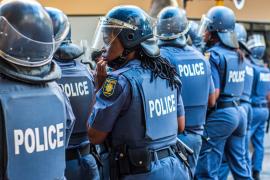
Gauteng Police Commissioner Lieutenant-General Tommy Mthombeni has commended South African Police Service (SAPS) members involved in dismantling an underground drug laboratory worth millions in Alberton on Friday.
The police also arrested eight suspects.
On 28 May 2024, Johannesburg K9 members received information regarding a suspected drug laboratory operating from certain premises in Alberton. Over the following days, police observed the premises and confirmed there was illegal activity happening within the premises.
The members approached the National Counter Narcotics for assistance and proceeded to the Palm Ridge Magistrate’s Court to apply for a search warrant, which was granted.
On Friday, at about 10:00 in the morning, the team comprising of the Johannesburg K9 and National Counter Narcotics units, executed the search warrant at the premises.
The police found massive quantities of precursor chemicals for manufacturing drugs, drug manufacturing equipment and actual drugs.
The members then withdrew from the house and called in Forensic Crime Scene Management as well as the Directorate for Priority Crime Investigation and the South African Health Products Regulatory Authority.
The police placed eight suspects found at the premises under arrest. They are facing possible charges of dealing in drugs and contravening Drugs and Drug Trafficking Act, Act 140 of 1992.
The Provincial Commissioner thanked the team for their due diligence, patience and execution of the search warrant.
“This discovery and subsequent arrest of these alleged drug dealers and traffickers will have a positive impact on the streets of Gauteng.
“These suspects’ criminal dealings have been disrupted and we have definitely hit them hard in the pockets,” said Mthombeni.

SIU notes High Court order on Mabuyane case
The Special Investigating Unit (SIU) says it is mulling its legal options after the Eastern Cape High Court in Bhisho struck the academic fraud case against Eastern Cape Premier Oscar Mabuyane off the roll.
The case against Mabuyane is related to his entry into the university’s Master’s in Public Administration programme, allegedly without meeting the requirements.
The case was triggered following the unit’s investigation into the university’s affairs.
“The High Court order… struck out the SIU’s defence in the matter brought by Premier Oscar Mabuyane. The merits of the case have not been ventilated.
“There was a miscommunication that occurred when there was a change of attorneys on record and the court was not informed on time, which resulted in this order. The SIU will investigate the issue relating to the miscommunication in this regard,” the unit said.
The corruption busting unit said it noted the judgement and will be exploring its options.
“The SIU wishes to assure the public that we will explore all legal options, including amending the Proclamation.
“The investigation into the University of Fort Hare’s affairs is ongoing, and we will communicate the outcomes at the appropriate time,” the SIU concluded.

SA records two more monkeypox disease cases
The Department of Health is appealing to citizens who have been in close contact with known or suspected patients of monkeypox disease, also known as Mpox, to go to their nearest health facility.
This is after the National Institute for Communicable Diseases (NICD) detected two more cases of Mpox this week at Addington and St Augustine Hospitals in Durban, KwaZulu-Natal.
“The preliminary case finding report has revealed that the two recent cases had contact with the other previously confirmed case in the province, and this suggests that there is a local transmission of the disease, which could potentially lead to a larger outbreak in the province,” the department said in a statement.
This brings the total number of laboratory-confirmed infections in the country to four, with three in KwaZulu-Natal and one in Gauteng.
READ | SA records second case of Mpox
According to the data, all the patients are South African males in their mid to late 30s.
The department said close contact with lesions, sexual contact, body fluids, respiratory droplets and contaminated materials such as bedding transmit the Mpox virus from one person to another.
The incubation period of Mpox is usually from six to 13 days but can range from five to 21 days.
“The health officials rely on transparency and cooperation from cases or patients for contact tracing and case finding to determine the rate of transmission of this infectious virus at community level.”
The department said they were pleased by the patients’ honesty and courage during the investigation process and thanked them for assisting officials in tracing suspected cases who also tested positive.
“It is through transparency of both confirmed and suspected cases that government can prevent further transmission and avoidable deaths.”
Meanwhile, the department in collaboration with various stakeholders in the sector is intensifying epidemiology and surveillance, and risk communication and community engagement (RCCE) activities.
“These will also help to address social stigma, which contributes to people’s decision not to openly speak out because they suspect communities will not accept them due to their health conditions.”
In most cases, the department said stigma contributes to the spread of the virus thereby making the outbreak and transmission worse.
Symptoms
Some of the common symptoms of Mpox include a rash, which may last for two to four weeks, fever, headache, muscle aches, back pain, low energy and swollen glands.
“The painful rash looks like blisters or sores, and can affect the face, palms of the hands, soles of the feet, groin, genital and/or anal regions,” the department explained.
However, the department has urged the public not to panic because the situation remains under control and that they will keep the public informed of the situation.