
SIU to probe corruption at KZN Film Commission
The Special Investigating Unit (SIU) is expected to launch a probe into allegations of serious maladministration, malpractice, corruption and fraud at the KwaZulu-Natal Film Commission (KZNFC).
President Cyril Ramaphosa has signed Proclamation R.4539 of 22 March 2024 authorising an investigation into “the procurement of and contracting for suitably qualified companies to partner and invest” with KZNFC in the development and operation of the KZN Studios including the commission’s investment in KZN Studios.
“The SIU will also investigate any unauthorised, irregular, or fruitless and wasteful expenditure incurred by KZNFC or the State. The scope of the investigation also covers any unlawful or improper conduct by officials or employees of KZNFC, the applicable suppliers or service providers or any other person or entity.
“The Proclamation covers allegations of unlawful and improper conduct that took place between 1 July 2017 and 22 March 2024, the date of the publication of the Proclamation or before 1 July 2017 and after the date of the Proclamation that are relevant to, connected with, and incidental to the matters or involve the same persons, entities or contracts investigated,” an SIU statement explained.
The SIU said it will also “identify system failures and make systematic recommendations” for the commission.
“In line with the Special Investigating Units and Special Tribunals Act 74 of 1996 (SIU Act), the SIU will refer any evidence pointing to criminal conduct it uncovers during its investigations to the National Prosecuting Authority (NPA) for further action.
“The SIU is empowered by the SIU Act to institute a civil action in the High Court or a Special Tribunal in its name to correct any wrongdoing uncovered during its investigation caused by acts of corruption, fraud, or maladministration,” the statement concluded.

20-year sentence for July 2021unrest killing
A 38-year-old man, Joel Pillay, has been sentenced to 20 years imprisonment for a murder he committed during the KwaZulu-Natal public unrest in July 2021.
Pillay was sentenced in the Scottburgh High Court.
National Prosecuting Authority (NPA) spokesperson, Natasha Ramkisson-Kara, said Pillay was found guilty of murdering Lindani Mthethwa while he was walking down a street in Verulam when Pillay drove past him.
“Pillay, who was driving a marked vehicle owned by a security company, turned his vehicle around and drove back towards Mthethwa. When he was alongside Mthethwa he lowered the window of his vehicle and shot him in the head. Mthethwa died on the scene.
“The NPA commends the work done by the prosecution and other stakeholders in securing the conviction,” Ramkisson-Kara said.
The state’s case was led by Advocate Thabani Buthelezi who led evidence from two eyewitnesses.
“Buthelezi also submitted a Victim Impact Statement compiled by Mthethwa’s sister and facilitated by Court Preparation Officer Thandeka Mofokeng. In her statement the woman said Mthethwa was a responsible and hardworking person. She said that her family has been financially and emotionally affected. She added that the incident was traumatic, as she still has flashbacks.
“In sentencing Pillay, the court deviated from the minimum sentence of life imprisonment, citing that he was a first offender when he committed the offence. Pillay was sentenced accordingly, and the court found him unfit to possess a firearm,” Ramkisson-Kara said.
Some 350 people lost their lives during the July 2021 unrest that unfolded in Gauteng and KwaZulu-Natal.
The violence and destruction also caused damage to infrastructure and businesses costing South Africa’s economy some R50 billion, with a further two million jobs being lost or affected.
Social Development to monitor children’s safety at borders this Easter weekend
The Department of Social Development says it is working closely with the Border Management Authority (BMA) to ensure the protection of children as they move across the border between South Africa and Zimbabwe during the Easter long weekend.
The department held its cross-border quarterly meeting with its counterparts from Zimbabwe to discuss the protection and care of children.
The meeting held on Tuesday was attended by officials from the National Department of Social Development, Musina and Vhembe District Offices, the Limpopo provincial office as well as the Red Cross and Save the Children.
“Officials from the Department of Social Development will be on-site in Beitbridge and Groblersbridge over Easter to make sure that the processing of children is in accordance with the law,” the department said.
The department said it is obligated to make sure that all children within its borders get the necessary care and protection.
“South Africa is obligated through the Children’s Act, the United Nations Convention on the Rights of the Child (UNRC), and the African Charter on the rights and welfare of the child [that] any child found to be undocumented and/or unaccompanied must receive the necessary care and protection. This includes a thorough assessment before they can be safely integrated with families in their home countries,” the department said.
During the meeting on Tuesday, officials agreed on the mechanisms to be implemented to strengthen the safety of children. These include referral mechanisms, fast tracking of family tracing and re-unification, and after care and support post repatriation to the families to avoid recurrence of children crossing over again to South Africa.
The department said it has a cross-border Memorandum of Understanding (MOU) with Zimbabwe and Lesotho on children. The MOU is about cooperation in relation to the provision of social services between the two countries.
In the realisation of this cooperation, the countries convene cross-border meetings held quarterly to discuss issues faced by unaccompanied and separated children on the move and seek solutions and unblocking challenges that are in the best interest of the child.
“The department continues to engage the respective country authorities through the MoU to intensify their efforts during every holiday season to make sure all children are documented and accompanied before entry into South Africa,” the department said.
It further works with international organisations like Save the Children and UNICEF to make sure that the rights of children on the move are protected.
The department will also send officials who work in the Directorate of Trafficking in Person and Victim Empowerment Programme to the borders to monitor and prevent any person from being trafficked.
The department is the custodian of the Trafficking in Persons Act and leads Pillar 4 of the Gender-Based Violence and Femicide National Strategic Plan (NSP on GBVF).
“The role of the Department of Social Development is the protection, care, and support of victims of trafficking. Trafficking victims are accommodated soon after identification and receive psychosocial support with focus on dealing with the trauma they experienced during exploitation by traffickers,” the department said.
President welcomes UNSC resolution on Gaza ceasefire
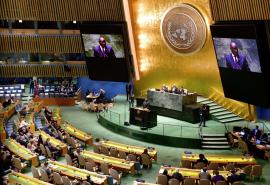
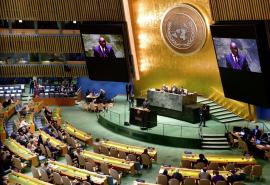
President Cyril Ramaphosa is the latest world leader to back the United Nations Security Council (UNSC) decision which demands an “immediate ceasefire” between Israel and the Palestinian group Hamas in Gaza.
This follows the UNSC’s adoption of Resolution 2728 (2024) on Monday, which demands an immediate ceasefire in the Gaza Strip for the duration of the Muslim holy month of Ramadan, ending in two weeks.
The United States abstained from the vote, with the 14 other council members all voting in favour to none against the Security Council ceasefire resolution.
“We must seize the opportunity presented by this Security Council resolution to create a firm foundation for a permanent ceasefire and the resumption of negotiations. We need to stop the carnage and begin walking a path to peace,” said President Ramaphosa in a statement.
READ | SA welcomes adoption of the UNSC resolution on Gaza ceasefire
The recent passing of this resolution marks the first of its kind in the nearly six-month-long war.
Resolution 2728 also notes an “urgent need to expand the flow of humanitarian assistance and to reinforce the protection of civilians in the entire Gaza Strip”.
The Council also demands lifting all barriers to providing humanitarian assistance in line with international humanitarian law, as well as Resolution 2712 (2023) and 2720 (2023).
The first citizen has since called on the UNSC to ensure compliance with the resolution binding on the parties.
Meanwhile, he said South Africa remains concerned that in over five months since the escalation of the conflict, thousands have lost their lives, including over 13 000 children.
As per a Reuters article, at least 32 333 Palestinians have been killed in Israel’s retaliatory military campaign in Gaza, with thousands more feared buried under rubble.
“It is, therefore, vital that the parties comply with the Security Council,” the President added.
Have your say in eThekwini service delivery plan
Residents of eThekwini are invited to submit their comments on the draft Integrated Development Plan (IDP) for the 2024/2025 financial year – a key city strategy that informs and guides all service delivery and development in the region.
All planning, including budgeting, management and decision-making related to delivering services and development in the municipal area, is considered in this important city business plan.
“The IDP considers the challenges facing the city and the strategic approach to resolving these as underpinned by city’s long-term development plan and informed by global, national and provincial policies such as the Sustainable Development Goals (SDGs), the National Development Plan (NDP) and the provincial Growth and Development Strategy,” the municipality said in a statement.
The IDP consists of eight plans that will help the city achieve its vision of becoming Africa’s most caring and liveable city.
“These plans are all inter-related and include actions to develop and sustain our spatial, natural and built environment; develop a prosperous, diverse economy and create employment; and creating a quality living environment.
“The IDP also takes into consideration building a socially cohesive environment, developing the skills of our communities, fostering good governance, ensuring a financially accountable and sustainable city,” the municipality highlighted.
The municipality added that each plan has a set of deliverables which informs the city’s budget and with which its performance is monitored.
“A Service Delivery Budget Implementation Plan (SDBIP) is thereafter compiled to monitor the implementation of the various programmes and projects contained within each plan. The SDBIP provides both financial as well as non-financial performance indicators which are used to monitor and evaluate quarterly and yearly service delivery targets,” the municipality said, adding the document also forms part of the IDP.
The municipality said public consultations on the draft plan will be taking place together with the draft budget.
“It is a critical opportunity for the public to provide input into the future development of the city and make sure that their community needs are raised.”
The draft IDP is available on the municipality’s website: durban.gov.za.
Comments can be sent to comments2021@durban.gov.za
The closing date for comments submission is 23 April 2023.
Independent and political party candidates lists available for inspection
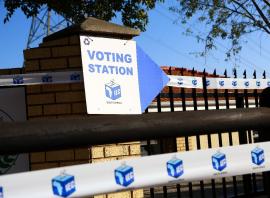
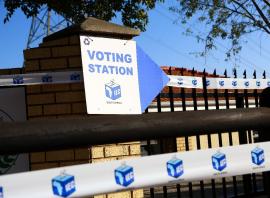
The Electoral Commission (IEC) will today and tomorrow between 09:00 and 17:00 make the lists with the names of independent and political party candidates available for inspection at its national office, at all its nine provincial offices and at local municipal offices.
Parties intending to contest the elections had until 17:00 on Monday to revise their lists and inform the commission if they had nominated candidates who also appeared on the list of another party or who were nominated as independent candidates.
In all, there were 42 candidates appearing on more than one party list implicating 39 parties. Furthermore, one candidate was nominated as an independent candidate and also appeared on a list of a party.
“The focus in the evolving candidate nomination process shifts to a period within which interested persons may inspect the lists of candidates and raise objections against candidates.
“To this end, the Commission will today and tomorrow, between 09:00 and 17:00 make the lists with the names of independent and political party candidates available for inspection at its national office, and in all its nine provincial offices and in local municipal offices.
“Copies of the documents accompanying the lists are available for inspection at the commission’s national office between 09:00 and 17:00,” said the commission in a statement.
In all, 14 662 candidates have been nominated to contest the 887 seats available in the National Assembly and the nine legislatures. The spread of the candidates is as follows:
- 4 323 candidates have been nominated to contest the compensatory seats in the National Assembly (contested by parties only),
- 3 596 candidates have been nominated to contest the regional seats in the National Assembly (contested by party candidates and independents) and
- 6 743 candidates have been nominated to contested seats in the provincial legislatures (contested by party candidates and independents).
The biggest ballot paper will contain 56 contestants. This is the ballot for the compensatory seats in the National Assembly. The biggest regional election ballot will be in the Gauteng region with 40 political parties and 2 independent candidates.
Similarly, the biggest ballot in respect of provincial legislature elections will be in Gauteng with 42 political parties and 2 independent candidates.
Seven independent candidates will contest the regional elections and six will contest the provincial legislature elections. The region with the most number of independent candidates is the Limpopo region with three candidates.
Any person may object to the nomination of a candidate. Such objections must be lodged with the commission by 17:00 on 27 March 2024.
An objection may be raised on the basis that an independent candidate or nominating party has failed to submit the signed prescribed acceptance of nomination or that there is no signed prescribed undertaking, that the candidate is bound by the electoral code of conduct, the commission said.
An objection may be on the basis that a candidate is not qualified to stand in the election. In this regard section 47 and 106 of the Constitution are instructive.
The sections provide that every citizen who is qualified to vote for the National Assembly is eligible to be a member of the Assembly, except:
(a) Anyone who is appointed by, or is in the service of the state and receives remuneration for that appointment or service
(b) Permanent delegates to the National Council of Provinces or members of a provincial legislature or a Municipal Council
(c) Unrehabilitated insolvents
(d) Anyone declared to be of unsound mind by a court of the Republic or,
(e) Anyone who, after this section took effect, is convicted of an offence and sentenced to more than 12 months imprisonment without the option of a fine, either in the Republic, or outside the Republic if the conduct constituting the offence would have been an offence in the Republic, but no one may be regarded as having been sentenced until an appeal against the conviction or sentence has been determined, or until the time for an appeal has expired. A disqualification under this paragraph ends five years after the sentence has been completed.
The commission will decide the objections by 28 March 2024. The objector, registered party or nominated candidate may appeal against the decision of the Commission to the Electoral Court by 2 April 2024.
The final list of candidates contesting the elections will be published by the Commission on 10 April 2024.
Voters are reminded that they may only vote at a voting station in which they are registered.
Voters who will unavoidably be away from their voting districts on Election Day may give notice of their intention to vote at another identified voting station by 17 May 2024.

Former Steinhoff director appears in court for fraud, racketeering

Former Steinhoff director Stephanus Grobler has appeared in court on charges of racketeering, three counts of fraud worth R21 billion, manipulation of financial statements and failure to report fraudulent activities.
Grobler appeared in the Pretoria Specialised Commercial Crimes Court on Monday where he was granted bail of R150 000.
National Prosecuting Authority (NPA) spokesperson Lumka Mahanjana explained that Grobler and then Steinhoff Chief Executive Officer, Markus Jooste – who has since been reported dead – allegedly committed acts of racketeering between 2014 and 2016 within the company.
“During that period, it is alleged that Jooste played a major role in the management of the criminal enterprise. Furthermore, it is alleged that Grobler created documentation of transactions that supported the fraudulent transactions used to inflate and falsify the annual financial statement of the Steinhoff Group.
“In court, using an affidavit, Grobler told the court that he intended to plead not guilty to the charges, and would prove his innocence. He further asked the court to release him on bail,” Mahanjana said.
According to the spokesperson, the prosecution opposed the bail application on account of the seriousness of the crime and indicated that Grobler is a flight risk.
“In delivering the judgement, Magistrate Nicca Setshogoe granted him bail with conditions that he should report to Brooklyn police station twice a week, Monday and Friday. He should hand over his two passports to the investigating officer and is not allowed to apply for a new one.
“He should hand over his two firearms to the police. He is not allowed to leave Gauteng province without informing the investigation officer. [He] must not interfere with state witnesses,” Mahanjana said.
The matter is expected back in the court on 26 June 2024.

Dagga worth over R600 000 seized at the border

Members of the South African Police Service’s border policing unit have arrested a 43-year-old truck driver from the Kingdom of Eswatini for allegedly attempting to smuggle dagga into South Africa.
In a statement on Friday, the SAPS said the male suspect was apprehended at the Oshoek Port of Entry in the early hours of Thursday morning.
According to police, at around 00:30am, the suspect was searched by members of the SAPS on the arrivals side of the port of entry.
“It was during this search that the astute members discovered the dagga concealed under a load of timber. As a result, the driver was detained and charged accordingly,” the statement said.
A total of 150kgs of dagga with an estimated street value of R630 840 was seized.
The truck, with number plates from the Kingdom of Eswatini, was confiscated together with the seized dagga for further investigation.
The suspect is expected to appear at the Elukwatini Magistrate’s Court today.
Mpumalanga Provincial Commissioner of the Police, Lieutenant General Semakaleng Daphney Manamela, has applauded the members for their dedication.
“The continuous arrests and successes witnessed at the borders prove that indeed the members are working with diligence. They are doing an excellent work on daily basis,” General Manamela said.

Employment programmes make a difference

The Presidential Employment Stimulus (PES) and the Presidential Youth Employment Intervention (PYEI) have made a difference in the lives of the 1.7 million people reached through the two programmes.
This is according to President Cyril Ramaphosa, who was addressing the National Assembly during the Questions for Oral Reply session held in the house on Tuesday.
“Between October 2020 and December 2023, the Presidential Employment Stimulus has created work and livelihood opportunities for over 1.7 million people. Of the participants in the various programmes, 65% are women and 85% are young people.
“The Presidential Employment Stimulus and the Presidential Youth Employment Intervention have made a real difference in the lives of millions of young people,” the President said.
President Ramaphosa said although the PES has “built an institutional architecture that is able to scale rapidly”, fiscal constraints have slowed its ability to expand although it has been expanded to March next year.
“The focus in the coming year is therefore on taking the quality of outcomes to the next level, focusing on enhancing the work experience for participants as well as on the quality of the social value they create for communities.
“This includes skills development – both ‘soft’ skills derived from work experience as well as more formal skills development,” he said.
The PYEI initiative was announced in 2020, and in February 2024, the President held a presidential youth engagement in Cape Town reflecting on the three years since the initiation of the Presidential Employment Stimulus (PES) and PYEI.
Honing in further on skills development on Tuesday, President Ramaphosa highlighted that government driven programmes such as the Social Employment Fund and the Basic Education Employment Initiative also serve the same skills development objective in different ways.
“The Presidential Youth Employment Intervention’s approach to skills development focuses on demand-led skilling, which is about increasing the relevance and delivery of interventions that address current skills gaps and emerging needs.
“To take forward this work, the Department of Higher Education and Training, with the support of the Presidency, has established demand-led skilling workstreams in priority growth sectors. This is to ensure that skilling interventions respond to demand and encourage inclusive hiring for young people and marginalised communities.
“The Presidential Youth Employment Intervention, in partnership with the National Skills Fund, has also launched [the] Jobs Boost, a R300 million outcomes fund that will fund implementing organisations to skill 4 500 marginalised young people and place them in sustainable, quality job[s],” he said.
President Ramaphosa said the work done through these initiatives has “established a firm foundation for these initiatives to make an even greater contribution to addressing poverty, unemployment and inequality in our country”.
eThekwini Municipality tackles hijacked, unsafe buildings
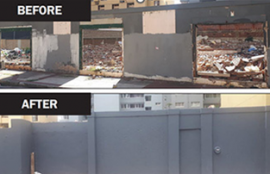
The eThekwini Metropolitan Municipality has intensified its collaboration with property owners in a bid to eradicate unsafe buildings within the inner city.
This comes after the establishment of a new unit, the Problem Buildings Division, which is dedicated to tackling unsafe buildings.
“Problem buildings” are defined as derelict, abandoned, hijacked, structurally unsound and unlawfully erected, among other things.
Through the Problem Buildings Division, the city’s vision is to create a vibrant inner city, underpinned by well-managed buildings.
The division encourages property owners, whose buildings have been deemed unsafe for occupation, to contact them or face future closure.
Deputy City Manager of Economic Development, Lihle Phewa, said these buildings present social issues, which include homelessness, crime and drugs, which are often found in such buildings.
Phewa said the division has already identified approximately 40 buildings within the city and has started the process to serve relevant notices.
This is done in accordance with the National Building Regulations and Standards Act, and the Problem Building by-laws.
“If there is non-compliance by the property owner after the notice period has expired, the municipality will approach the High Court to carry out remedial work, apply for a demolition order, request for the appointment of a judicial administrator, request for a sale in execution, or expropriate the property and building.
“All costs incurred will be to the owner’s account. Owners can however, partner with the municipality to put together an action plan with time frames on how to turn the problem building around,” Phewa said.
Phewa highlighted the recent eviction of illegal occupants from Crieff Place Building, South Beach, as among the division’s successes.
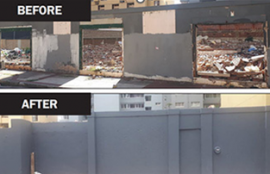
Following a court process, the owner of the property was able to evict the illegal occupants and proceeded to demolish the vacant building. However, the owner left a portion of the superstructure and did not fully secure the property.
The owner had also left rubble from the demolition process on site to ensure that the site was not occupied again, but the sheltered portion of the remaining superstructure was occupied shortly after.
“The Problem Building Division engaged unsuccessfully with the owner to secure the property. The division took the decision to remedy the works on site by removing the rubble, repairing, and closing all the openings to the site, and installing barbed wire to the tops of the boundary wall to prevent any person from occupying the site,” Phewa said.