
Comprehensive intervention to address Johannesburg water challenges
The City of Johannesburg has presented a comprehensive intervention plan to address ongoing water supply challenges in the city.
Water and Sanitation Minister, Senzo Mchunu, together with his Deputy Ministers, David Mahlobo and Judith Tshabalala, met with Johannesburg City officials, led by Executive Mayor Kabelo Gwamanda, to receive an update on the city’s plans to deal with the current water challenges and future water supply sustainability plans for the metro.
The meeting held this week was a follow-up to a meeting held on 5 March 2024, where the department presented a comprehensive assessment report on the state of water provision in the city amid regular water supply interruptions experienced by residents.
At the meeting held on 5 March, the city was requested to come back with an action plan to address all the issues raised in the report, including how it will deal with the infrastructure challenges and non-revenue water, which is contributing to the water supply challenges.
During this week’s meeting, the city presented a wide-ranging plan on immediate, medium- and long-term measures to ensure a sustainable water supply. These include infrastructure projects to refurbish, upgrade and construct new storage reservoirs and pump stations, as well as associated infrastructure to augment storage capacity.
The plan also includes addressing non-revenue water through the implementation of water conservation and demand management technical interventions to reduce demand.
The city also presented technical interventions, which include repairing leaking reservoirs and tower infrastructure; replacing water pipes, domestic and large consumer meters; retrofitting and removal of wasteful devices, and enforcement of by-laws, including removal of illegal connections and customer bypass connections.
Gwamanda said these projects are at various stages of implementation, while others still require funding.
The meeting also heard that the city infrastructure backlog is estimated at around R27 billion but agreed that focus should be on what can be done with the current and upcoming budget in July.
Gwamanda commended the support from Water and Sanitation Ministry, saying that the city is looking at various options to mitigate water supply interruptions.
“We have set aside about R100 million for the electricity supply entity, City Power, to put alternative power supply infrastructure to key infrastructure that contributes to the water supply network,” Gwamanda said.
Mchunu acknowledged the efforts of the city’s water entity, Johannesburg Water, to deal with infrastructure backlogs, and various interventions implemented to deal with the current recurring water outages.
Mchunu urged the city to work on its turnaround time in responding to pipe bursts and leaks in their distribution network, as this contributes to the high physical water losses.
“It is clear that the city requires serious interventions and funding to deal with its water infrastructure renewal programme, and the department will work with Joburg Water in packaging some of their key infrastructure projects that require blended finance, including from the private sector.
“We have agreed, collectively, that over and above the technical interventions to address non-revenue water, there is a serious need for a compressive public awareness campaign to conscientise residents on the importance of water conservation and water use efficiency as part of the Water Conservation and Water Demand Management Strategy,” Mchunu said.
The metro’s non-revenue water currently sits at 46.1%, while the consumption rate is at 280 litres per capita per day.

Government has acted decisively to respond to State Capture recommendations – President Ramaphosa
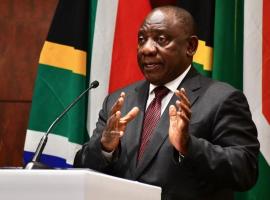
President Cyril Ramaphosa has told Members of Parliament that the recommendations made in the State Capture report are currently receiving attention from law enforcement agencies and the other bodies.
The President was speaking in the National Assembly during his oral replies to questions on Tuesday.
He said that his administration has acted decisively and with purpose to respond to the findings and recommendations of the State Capture Commission.
“As has been reported on several occasions to this Parliament and to the public more broadly, these recommendations are currently receiving attention from law enforcement agencies and the other bodies.
“Therefore, with regards to the recommendations in respect of criminal investigation and possible prosecution and other actions against individuals, the President has fully acted upon the recommendations of the Commission.
“As I indicated in a written reply to this House on 17 November 2022, any actions that I take with respect to members of the Executive about whom the Commission made findings will be informed by the outcomes of the processes undertaken by the relevant entities,” the President said.
On 22 October 2022, the President submitted to Parliament his intentions with regards to the implementation of the recommendations of the State Capture Commission.
Among other things, the State Capture Commission made over 200 recommendations with respect to criminal investigation and possible prosecution of individuals, entities and named groups of people.
The President highlighted that these recommendations were directed by the Commission to law enforcement agencies. The Commission also made recommendations with respect to further investigation of and possible action by the relevant bodies against individuals and entities for disciplinary offences, tax offences, delinquency of directors and other activities.
“The Presidency provided each of the bodies to which such recommendations were directed with copies of each part of the State Capture Commission Report as they were received by the Commission, so that they may act on the recommendations in line with their respective mandates.
“The extensive actions that this administration has taken on the recommendations of the State Capture Commission, including the introduction of draft legislative changes that are currently before this House – have been detailed in several public reports,” he said.
President Ramaphosa told the House that the most recent comprehensive report was published in November 2023, and there is a searchable online database that enables members of the public and indeed Members of Parliament to track progress.
The report and the database may be found at: www.stateofthenation.gov.za.

Optimum Coal Mine pays back R6.9m

Optimum Coal Mine – formerly owned by the infamous Gupta brothers – has paid back some R6.9 million in outstanding motor licensing fees and penalties as part of its Acknowledgement of Debt (AoD) signed with the Special Investigating Unit (SIU).
The AoD stems from an SIU investigation into allegations of corruption and maladministration in the affairs of the national and provincial Departments of Transport.
READ | Optimum Coal Mine acknowledges R6m vehicle licensing debt
“The SIU’s investigation focused on any conduct by officials or agents of the department or any other person which relates to the registration of motor vehicle ownership and licensing details and non-payments of motor vehicle licensing fees, arrears and penalties.
“The SIU analysed the information obtained from the Department of Transport and Road Traffic Management Centre, as well as the eNatis data. After sifting through the eNatis data, the SIU established that the Department is owed the sum of R6 914 304.52 in respect of the trucks and smaller vehicles owned by Optimum,” the SIU said in a statement.
The corruption-busting unit said the recovery of the funds from Optimum “does not exempt other legal processes from being actioned”.
“The SIU is empowered to institute civil action in the High Court or a Special Tribunal in its name, to correct any wrongdoing uncovered during its investigations caused by acts of corruption, fraud, or maladministration.
“In line with the Special Investigating Units and Special Tribunals Act 74 of 1996, the SIU refers any evidence pointing to criminal conduct to the National Prosecuting Authority (NPA) for further action,” the SIU said.
Planned maintenance to affect water supply in parts of Benoni
The City of Ekurhuleni has reminded customers in Benoni of the planned seven-hour water shutdown to be undertaken on Tuesday.
The shutdown will affect customers in parts of Benoni. It will be implemented from 9am to 4pm to make way for the replacement of faulty valves.
The areas to be affected by shutdown include Airfield, Farrarmere, Farrarmere Gardens and Lakefield.
“To mitigate the effect of the supply interruption, water tankers will supply water to the affected areas. Updates on any development will be communicated through the city’s digital platforms,” the city said in a statement.
Meanwhile, water supply has finally been restored to all the areas in Region 7 following weeks of water outage caused by the breakdown of a pump at the Bronkhorstspruit Water Treatment Plant in Tshwane.
The City of Tshwane said a new pump and motor were successfully installed at the plant last Friday, and pumping started in earnest at around 4pm.
“Full supply has been restored in Ekangala and Rethabiseng, except in Rethabiseng Extension 4, due to the infrastructure network connection. The section will start receiving water once there is enough water pressure in the whole area.
“The high lying area are also receiving water. There are indications that water is gradually trickling in at Ekandustria since this morning. The city apologises profusely to the residents for the inconvenience caused,” the city said on Tuesday.

Extradition request sent to Eswatini for alleged AKA killers
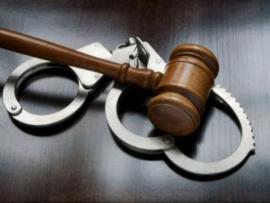
Minister of Justice and Correctional Services Ronald Lamola has transmitted a request by South Africa for the extradition of brothers Siyabonga and Malusi Ndimande from the Kingdom of Eswatini.
The two are wanted back in South Africa because of their alleged involvement in the murder of South African musician Kiernan ‘AKA’ Forbes.
Forbes was slain in a brazen attack outside a Durban restaurant in February last year.
“The request is made in terms of the Extradition Treaty between South Africa and Eswatini, dated 4 October 1968, and in terms of the SADC Protocol on Extradition dated 3 October 2002, to which both countries are signatories. The Ministry stands ready to give its highest level of co-operation to its counterparts in the Kingdom of Eswatini,” the department said in a statement.
Meanwhile, the Department of Correctional Services (DSC) says it is investigating a case of assault filed by controversial doctor Nandipha Magudumana.
Magudumana is currently being held at the women’s section of the Bizzah Makhate Correctional Centre in Kroonstad in connection with the escape of convicted rapist and murderer Thabo Bester.
“DCS is investigating the circumstances following what was said to be a prayer meeting in a different cell from Magudamana’s. Reports of an alleged altercation and a push against the grills can be confirmed.
“DCS officials advised Magudumana to open a criminal case when she reported that she was allegedly assaulted, but she opted to discuss it with her lawyers first. Furthermore, DCS Healthcare officials conducted an examination on her and found no visible injuries.
“The safety and well-being of inmates is our utmost priority, and we take such allegations seriously. Hence, this incident is under investigation,” the DCS said.
Emphasis placed on investing in climate-resilient infrastructure projects
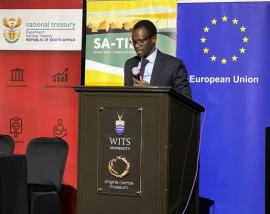
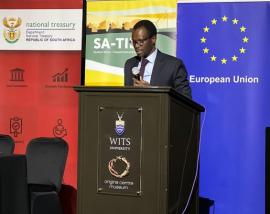
While South Africa has taken meaningful steps to invest in infrastructure projects, Deputy Minister of Finance, Dr David Masondo, says the fiscus cannot afford to financially support the amount of investment required for climate-resilient infrastructure.
“We therefore need to discuss other innovative financing mechanisms such as green bonds and carbon credit to fund these climate-resilient infrastructure projects,” Masondo said on Monday in Johannesburg.
He made these remarks during the second in a series of Southern Africa – Towards Inclusive Economic Development (SA-TIED) policy dialogues entitled “Financing infrastructure development in the context of climate change”.
“In South Africa, we feel the negative impact of climate change in important sectors such as agriculture, water, and energy. The frequency of natural disasters and the results thereof are felt every day in our country.
“Investments in renewable energy sources, water conservation systems, and sustainable urban development are key to mitigating and adapting to climate impacts,” the Deputy Minister said.
Masondo said the Infrastructure Fund is a testament to South Africa’s commitment to stimulating infrastructure investment and blending public and private financing to build a better, more sustainable future.
“The Infrastructure Fund stands out as a pivotal move, designed to stimulate investment across various critical sectors. This approach seeks to mobilise public and private resources, mitigate risks for private investors and foster an environment where collaborative financing models can thrive.
“Such measures are part of a broader effort to ensure that infrastructure development not only supports South Africa’s immediate economic needs but also lays the groundwork for long-term resilience and progress.
“Yes, challenges exist such as securing funding. However, ensuring sustainability, and integrating the latest technologies are other additional challenges. These challenges should be treated as opportunities for innovation and forging robust public-private partnerships. This is also an opportunity for leveraging the power of technology in our infrastructure development goals,” Masondo said.
He said the groundbreaking research produced by the SA-TIED program has shed light on critical areas like water, and energy, and the broader connections between them.
“It is this type of research that directly shapes our infrastructure strategies, informing decisions to maximise impact and create the conditions for sustainable growth. The research informs our policy decision-making. It is this type of research that directly shapes our infrastructure strategies, informing decisions to maximize impact and create the conditions for sustainable growth,” the Deputy Minister said.
He said infrastructure development is the cornerstone of any thriving economy.
“Infrastructure fuels productivity (e.g. people arrive late to work because public transport is poor). Infrastructure also enhances the quality of life for our citizens (clean air, and clean water are important for our health) and lays the foundation for long-term growth.
“Our government recognises this. We have made significant investments in critical infrastructure. These investments are not just about roads and bridges. They are also about creating jobs, reducing poverty, and making South Africa a competitive player in the global economy,” the Deputy Minister said.
SAA, Takatso deal collapses
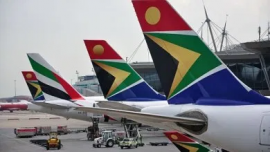
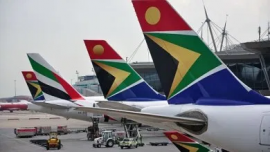
Following three years of negotiation, Minister of Public Enterprises Pravin Gordhan has announced the termination of negotiations for the transaction to sell 51% of South African Airways (SAA) to the Takatso Consortium.
The collapse of the negotiations – which put an end to the sale to the equity partner – was announced during a media briefing by the Minister in Cape Town on Wednesday evening.
Gordhan explained that while three years ago, a valuation of SAA’s business and assets had been reached, circumstances have now changed – prompting a disagreement on the revised transaction structure.
Three years ago, the airline had undergone business rescue, battled through being grounded and was facing serious challenges following the COVID-19 pandemic.
“Late last year, clearly, we had a different market, we had a different economy, and we had a different flying public in terms of numbers of people that were flying and a new valuation was done.
“And the new valuation…the business came out now at a value of R1 billion and the property went up to about R5.5 billion which meant that any negotiations on this transaction would have to take into account the new valuations that have emerged,” he said.
The Minister revealed that negotiations continued “for the latter part of last year” and since this year began.
“However, we came to a point where whilst there was meeting of minds…on some of the issues, there were other issues on which there was no meeting of minds.
“So late last week, there was agreement that in terms of a clause in the old sale and purchase agreement, whereby mutual consent, this transaction could be terminated. That clause was put into action and both parties have agreed – after we enquired about the status of the negotiation – that there was no clear path forward as far as the transaction with Takatso is concerned.”
Gordhan insisted that because SAA remains a public entity:
- Cognisance must be placed on its growth over the past five years;
- Fair value must be placed on the sale of the 51% stake in the airline;
- and the process to sell the shares must ensure that SAA is left in a “more sustainable condition than it was in 2019”.
He added that despite the collapse of the deal, the future remains bright for the airline and dismissed any notions that it will rely on government bailouts going forward.
“We are convinced, in terms of the numbers available to us, that it can sustain itself for the next year to 18 months and there are various, other ways in which immediate financing can be obtained.
“But at no stage, in the course of the months that come, will SAA get money from the fiscus. It must run its operations as efficiently as it can and as profitably as it can and sustain itself,” he said.
READ | Strategic Equity Partnership for SAA aimed at saving airline: Gordhan
Moving forward
Gordhan assured employees of the state-owned airline that their jobs are currently not in danger as a result of the collapse of the deal.
“So the message to the SAA staff…is that you don’t worry about your jobs, you don’t worry about the future of your families, that we will ensure that we work with the board and management…to continue to support the sustainability of SAA and to ensure that the corporate plan that has been developed by SAA is further strengthened,” he said.
READ | SAA officially relaunched
The Minister added that the corporate plan is well fleshed out and projects a growth in the airline.
“That corporate plan actually entails the gradual growth in the number of routes that SAA will take up in the course of the next few years. Currently, it has about 19 routes and that will grow up to 40 routes in a five year period.
“Similarly, it will have the capacity to lease more aircraft, both for domestic use, use within the continent and for inter-continental flights as well.
“All of these plans will be rigorously examined with the necessary aviation expertise to ensure that jobs are secure, that the airline is secure and that there is a future for SAA and its flag to be seen continuously within the country, within the continent and across continents as well,” Gordhan said.
More than 2 million benefit from land reform programme
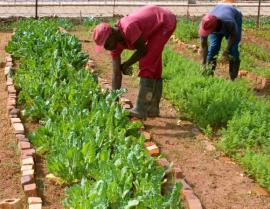
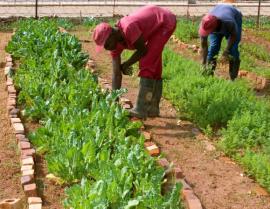
As government continues to fast track the pace of land reform, so far 2 345 547 individual beneficiaries, who are members of 460 952 households, have benefited from the Acceleration of Land Reform programme.
“Of these households, 177 504 are female-headed households and 1 266 are households headed by persons with disabilities,” Minister in The Presidency Khumbudzo Ntshavheni said on Thursday in Cape Town.
During its meeting on Wednesday, Cabinet was briefed on the implementation and progress of the Acceleration of Land Reform programme.
The Acceleration of Land Reform programme is an outcome of the accepted Recommendations of the Presidential Advisory Panel on Land Reform and Agriculture that presented its Report and Recommendations to Cabinet in 2019.
Through the provisions of the Transformation of Certain Rural Areas Act of 1998, a total of 593 167 hectares have been transferred, while the Rapid Release of State Land has been completed, with the release and allocation of 659 602 agricultural State land.
“The Land Claims Commission has settled 83 056 claims as at December 2023, a total of 3 889 701 hectares of land were acquired at a cost of R25 billion, and financial compensation of R23 billion was awarded to beneficiaries,” Ntshavheni said.
In addition, Cabinet received a progress report on the Development of the Cannabis and Hemp Sector and the Cannabis Master Plan as part of government’s strategy to industrialise the Cannabis Sector.
The aim is to provide a framework for the establishment, growth and development of the Cannabis and Hemp industry in South Africa in order to contribute to economic growth, poverty alleviation and job creation.
“In 2020, the Minister of Health approved changes to the scheduling of Cannabis plants under the Medicines and Related Substances Act and the Minister of Agriculture, Land Reform and Rural Development declared hemp as an agricultural crop in terms of the Plant Improvement Act of 1976.
“The Agricultural Research Council continues to develop hemp varieties, with the support of the Department of Agriculture, Land Reform and Rural Development (DALRRD), to make the seeds available for the 2025 planting season,” the Minister said.
The Department of Health through the South African Health Products Regulatory Authority is currently consulting on further changes to the Schedules of the Medicines and Related Substances Act.
The purpose of the consultation is to allow the Department of Health to regulate Cannabis for all medicinal uses, whilst the DALRRD will regulate the cultivation and processing of Cannabis and hemp for all other legitimate uses, such as industrial, cosmetic, human and food product applications.
Tsepho portable power brings light to informal settlements
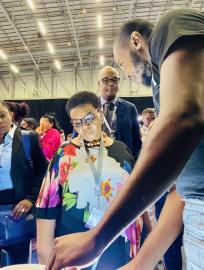
A youth-led enterprise from Vrygrond in the Western Cape, is switching on lights, plugs and lives through its portable power stations solution.
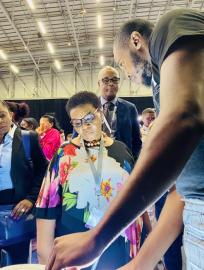
Fuelled by a desire to make an impactful change, three young entrepreneurs, Vincent Mosebe, who is the founder and CEO of Mosebe Enterprise (ME); Leandro Antonio, Marketing Director; and Donovan Pedzai, Chief Operations Officer, set out to revolutionise the energy sector.
They used recycled materials to create the power stations for underserved and rural communities in the Western Cape and beyond.
Their pilot flagship power station “Tsepho – The Power of Hope” is an innovative 10Ah [amp-hour] solar charge energy solution that targets informal settlement households who would otherwise utilise unsafe power methods, including candles and illegal connections, that often lead to settlement fires – and those at the mercy of constant and pro-longed power outages and cable theft.
The trio are exhibiting alongside other start-ups, Small, Medium and Micro Enterprises (SMMEs), investors and policy makers at the Global Entrepreneurship Congress+Africa.
The congress is a gathering of entrepreneurs and leaders from 43 African countries, which is currently underway at the Cape Town International Convention Centre in the Western Cape.
Through the organisations funded to implement development entrepreneurial programmes for youth not-in-education-employment-or-training (NEET), the National Development Agency (NDA) extended the invitation to 23 entrepreneurs to afford them a linkage opportunity to showcase their businesses, network and participate as delegates at the conference.
The NDA is an agency of government that reports to the National Assembly. It was formed in 1999 as government’s response to the challenge of poverty and its causes in South Africa.
Mosebe said their power stations address safety and electrification problems experienced by residents in informal settlements.
“Currently, statistics report that an average of 10 shacks catch fire per day in South Africa. We have first-hand experience and have lost personal belongings and community lives to shack fires, having grown up in Vrygrond.
“Tsepho offers a sustainable, affordable, reliable, and eco-friendly power solution that has features, including multiple USB ports, a powerful lithium-ion battery with solar compatibility and 1 12v LED light bulb. Tsepho is not just a device; it is a catalyst for change – a beacon of hope that will bring about a brighter sustainable future,” Mosebe said.
The entrepreneurs have leveraged personal funds to scale production and conduct on-the-ground research.
Mosebe said their immediate plans include expanding production capacity, extending reach to new communities, and fostering more collaborations for future social impact and export.
He said the power station range also includes a bigger version “2 Tsepho” with similar capabilities including an additional feature of a bug-repellent UV light that exterminates insects and bugs (pest control).
“With this power station, we are targeting campers and the caravan community who need extended power. Our next goal is to extend the products further into African countries that struggle with Malaria cases. Additionally, there are two more ranges with extended power capabilities to power up a single power socket that can power up a fridge or microwave.
“The largest, ‘version 3’, packs up a 20.8Ah battery and a 300W inverter offering increased power capacity. This would be a useful tool for students – they can charge laptops and keep WIFI going during outages, promoting a consistent learning experience.
“The starter pack retails from R1 500 without the solar panel. We also offer warranty up to a year for any technical faults,” Mosebe said.
Godongwana announces increase in R350 grant
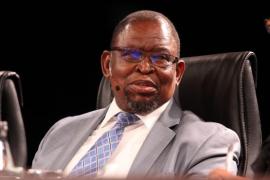
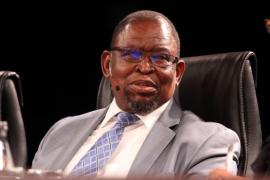
The Social Relief of Distress (SRD) grant – popularly known as the R350 grant – is expected to be raised to R370 from April this year.
This was announced by Finance Minister Enoch Godongwana in the National Assembly on Wednesday.
“His Excellency, the President, in his State of the Nation Address, said that the [SRD grant] is going to continue, and the R350 will be improved. My colleague, the Minister of Social Development, is going to publish for comments a comprehensive social security programme and that… will define a better platform and a future for the social security net in South Africa.
“I am pleased to say that we have found consensus that in between, subject to the finalisation of the comprehensive social security [programme], we’ll increase the R350 to R370 by the 1st of April this year. That is part of the progressive realisation of the basic rights of our people,” he said.
In the Budget Speech delivered in February, Godongwana had announced that social grants across the board are set to increase over the course of 2024.
The increases to be implemented during this year are as follows:
- An increase of R100 to the old age, war veterans, disability and care dependency grants. This amount will be divided into R90 effective from April, and R10 effective October;
- A R50 increase to the foster care grant; and
- A R20 increase to the child support grant.
“We are sensitive to the increase in the cost of living for the nearly 19 million South Africans who rely on these grants to make ends meet. In this regard, we have done as much as the fiscal envelope allows,” Godongwana said at the time.