
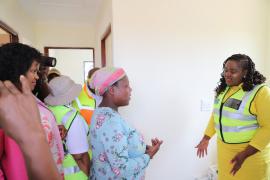
Kubayi orders improved services in Nelson Mandela Bay informal settlements
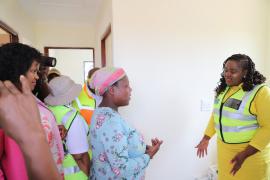
Human Settlements Minister Mmamoloko Kubayi has given the Nelson Mandela Bay Metropolitan a directive to provide informal settlement dwellers with adequate human rights services, including water and sanitation — in compliance with norms and standards — within seven days.
Kubayi gave the directive during an outreach programme, which saw the handing over of keys to newly built government-subsidised homes and title deeds to beneficiaries in Motherwell in Nelson Mandela Bay, Eastern Cape.
The visit on Wednesday formed part of the coordinated effort amongst the three spheres of government to effect province-wide interventions to accelerate the delivery of sustainable human settlements.
Kubayi said the three spheres of government and relevant agencies should present tangible responses to improve living conditions of various communities by the end of January 2024.
Responding to various concerns raised by the community during an imbizo, Kubayi said the three spheres of government must find solutions to the inhumane conditions under which people live.
“We cannot have instances where people live in Temporary Residential Units (TRUs) with inadequate ablution facilities. We can’t sit and watch injustice happen… we must intervene urgently,” the Minister said.
She noted some progress in the in-situ upgrading project in the metro, and acknowledged that more work needs to be done.
This includes proper verification processes, as “some people who demand housing in the projects may not necessarily qualify for fully subsidised government housing”.
“There cannot be repeat benefits, as the system automatically disqualifies anyone who owned a property before,” Kubayi reminded the applicants.
She said the Eastern Cape province has about 53 000 houses that require rectification.
“These are homes that predate democracy and also from the early days before the set norms and standards by the National Home Builders’ Registration Council (NHBRC). Due to limited financial constraints, the rectification programme will be undertaken in a phased manner,” Kubayi explained.
Warning against sale of government-subsidised houses
The Minister reiterated the warning to beneficiaries not to sell government-subsidised houses.
“The current Human Settlements policy is very clear on who should benefit from subsidised housing, and it does not include foreign nationals. It takes R350 000 to build each house and you sell them for R15 000, and three months down the line you come back demanding housing from the government,” the Minister said.
The Minister also announced that she and Deputy Minister Pam Tshwete will conduct a verification programme, called Operation Ziveze, aimed at ascertaining that government-subsidised homes are occupied by their rightful owners.
Echoing the Minister’s sentiments, Tshwete warned residents about giving away their title deeds to loan sharks in exchange for quick, unsecured loans.
“I urge you to take care of your title deeds we are giving you today. This is not just proof of ownership, but also an asset for your children.”
The imbizo was part of a series of outreach programmes the Minister and Deputy Minister are embarking on to unlock challenges within the Human Settlements value chain.
Limpopo houses handover
Meanwhile, Kubayi and Tshwete will on Thursday hand over government-subsidised houses to the qualifying beneficiaries in Bela Bela Ext 25 in the Waterberg District Municipality, Limpopo.
The project is one of the informal settlements upgrading projects aimed at restoring the dignity of people living in informal settlements.
Bela Bela Extension 25 is expected to deliver over 1 000 housing units on completion.
The housing handover will precede the last meeting for this calendar year between the Ministry and MECs of Human Settlements (MINMEC) to reflect on the performance of the sector since the beginning of the 2023/24 financial year.
Discussions will include the release of land parcels for human settlement development, an update on government’s efforts to upgrade informal settlements across the country and the delivery of housing units, and progress on the title deeds campaign.
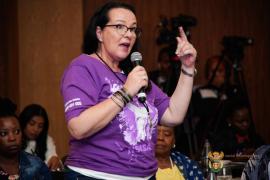
Urgent call to address gaps in shelters supporting victims of gender-based violence
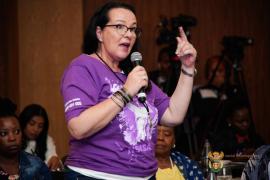
Lack of sufficient funding, transportation for victims of gender-based violence, lack of social workers in some facilities, shelters’ compliance with the norms and standards were some of the gaps identified on the first day of the two-day National Shelter Indaba currently underway in Sandton.
Delegates heard that half of the shelters’ allocated budget was spent on salaries and this stretched the finances of shelters that require more funding to efficiently render services to victims of gender-based violence.
One of the shelter managers, Sindisiwe Msimango from Mpumalanga, indicated that most shelters struggle with transport.
“Transport is a problem for shelters, as victims must be transported to and from police stations and health facilities. Nowadays, perpetrators of GBV are using sophisticated ways to track their victims and this poses a risk for both the victims and social workers,” she said.
She said the lack of security and delays in the payment of subsidies from government also posed a huge threat to the safety of persons working and living in the shelters.
Rose Bailey, from a shelter in the Northern Cape province, asked for shelters to be treated with dignity and not be seen as charities, as they play an important role in saving lives and restoring women’s mental health. She appealed for more attention to be given to the work provided by shelters.
Joining the Indaba virtually, former Deputy President of South Africa, Dr Phumzile Mlambo-Ngcuka, reminded delegates that GBVF was declared a pandemic and said that it should be treated the same way as COVID-19 where everyone, including governments, were playing their part.
She indicated that more often than not, women continue to be failed by the system because when they report abuse “their cases are not efficiently prosecuted, and this discourages them”.
Providing solutions to some of the challenges by shelters, Uber SA shared that they partnered with the National Shelter Movement of South Africa to provide safe transportation for victims of gender-based violence and women in general.
Uber SA senior operations manager, Collen Mphabantshi, told the summit the safety of women is at the centre of their business.
“Uber SA strives to ensure that Uber users can travel under safe conditions with, amongst others, access to pre-onboarding applications such as Driver Screening, Vehicle Inspection and Driver Profile,” he said.
He revealed that to date, Uber South Africa has successfully transported 6 715 women and their children to places of safety through the National Shelter Movement of South Africa.
Social Development Minister Lindiwe Zulu appealed to the private sector to come to the table and assist in supporting the work that is done by government through shelters.
“Often in these gatherings, the private sector is not sitting around the table. We call upon the private sector to play a role by availing suitable buildings and infrastructure which can be used as shelters for victims and survivors of gender-based violence and femicide,” Zulu said.
The Minister said that shelters for victims of violence and crime have been a central and a critical resource providing care, safety, support, opportunities for healing and an understanding of the dynamics of abuse to South African women and children.
“Shelters have provided a much-needed refuge where women cannot only be safe but take stock of their lives and receive the emotional support needed to make critical decisions. They also play a significant role in interrupting and breaking the cycle of violence,” she said.
The Department of Social Development has allocated more than R211 million for a period of four years towards 134 shelters rendering victim support services across the country.
The Minister reported to the Indaba what the department had done since last year’s gathering, including the development of an inter-sectoral shelter policy for victims of violence and crime.
She revealed that during the 16 Days of Activism for No Violence against Women and Children, the department will launch another shelter in the North West province.

South Africa signs loan agreements to support Just Energy Transition

National Treasury has announced that South Africa has signed bilateral loan agreements with the World Bank, German state-owned development and investment bank Kreditanstalt für Wiederaufbau (KfW) and the African Development Bank (AfDB) to support South Africa’s Just Energy Transition.
The concessional financing includes a loan of some $1 billion from the World Bank, some €500 million from KfW and a further $300 million from the AfDB.
“The loans provided by [KfW] and the [AfDB] follow their partnership with the World Bank on the second Development Policy Operation DPO to support South Africa’s commitment to the just transition for a low-carbon and resilient economy. These are sovereign loans provided directly to the National Treasury for general budget expenditure purposes.
“The financing facilities from the three development institutions are in line with the National Treasury’s funding strategy to diversify its funding mix for international borrowing and access concessional financing instruments offered by the development partners to support government’s key reforms under climate change and the electricity sector.
“These facilities also enable the National Treasury to raise funding at very affordable rates which help to reduce the government public debt,” Treasury said in a statement.
The department expressed its gratitude to the three institutions.
“These agreements signify and reinforce the excellent collaborative efforts between the Government of Germany, World Bank and AfDB and our government, that has ensured the successful conclusion of the loans,” the statement concluded.

Nzimande speaks out on violence against women at universities
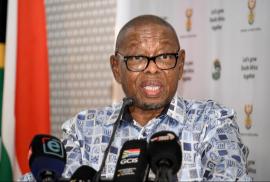
Universities and colleges have been urged to continue to implement programmes towards addressing sexual and gender-based violence (GBV) within the Post School Education and Training (PSET) system.
Higher Education and Training Minister, Dr Blade Nzimande, made this call during a media briefing on Tuesday after a video of a university student stabbing his wife at a private student residence in Belhar, Cape Town, circulated on social media.
“This kind of barbaric behaviour by males against women must be condemned and perpetrators must face the full might of the law. We cannot continue like this in our society, where as many as 38% of murders are committed against women, often by their intimate partners,” Nzimande said.
He urged both the government and the PSET sector to intensify campaigns to confront and defeat the scourge of GBV in society and at post school education and training and higher learning institutions.
“I launched the Transforming MENtalities initiative, which is a multi-stakeholder partnership within the PSET, with a particular focus on mobilising men in our sector to be part of championing a world free of gender biases, stereotypes, violence and discrimination.”
He commended the arrest of a senior Fort Hare University employee for the alleged murder and attempted murder of employees at the university.
The accused, including nine men and a woman, appeared in the Alice Magistrate’s Court on Tuesday on charges of murder and attempted murder of Fort Hare Fleet Manager, Petrus Roets and Mboneli Vesele, who was the bodyguard to Vice-Chancellor Professor Sakhela Buhlungu.
The case was postponed to 13 December 2023 for the finalisation of pending bail applications for three of the accused.
“We had indicated to Minister Cele (Police Minister) that indeed, no stone must be left unturned in going to the reasons for the killings at Fort Hare. Without prejudging the situation, as Minister, I am deeply concerned about the latest arrest of someone inside the Vice-Chancellor’s office and ostensibly responsible for the security in the institution.
“This may point to the fact that the problems at UFH may be deeper than meets the eye. I will be further engaging with Council on the latest developments, particularly given the fact that complaints have been raised with me about alleged illegal surveillance of Council and staff members,” Nzimande said.

NPA determined to re-enrol Eskom corruption matter

The National Prosecuting Authority’s Investigating Directorate (ID) says it is confident that the Eskom Kusile R2.2 billion tender matter related to former Eskom interim CEO Matšhela Koko will be re-enrolled as soon as outstanding aspects of the investigation are completed.
The case against Koko and some 18 other accused was struck off the roll in the Middelburg Specialised Commercial Crimes Court because the court deemed there to be an undue delay in the completion of investigations.
It is alleged that at the height of state capture, Swiss company Asea Brown Boveri (ABB) was allegedly irregularly awarded a control and instrumentation contract at Eskom’s Kusile Power Station in 2015 after allegedly colluding with Eskom officials in exchange for kickbacks.
NPA ID spokesperson Sindisiwe Seboka highlighted that the court’s decision “is not tantamount to an acquittal or withdrawal of the charges”.
“The ID will continue investigating the case in line with the original case strategy that it developed for this complex matter. The issues raised by the court have been noted.
“The delays were not anticipated at the time of the arrest of the accused; due to the complex nature of the case, the extent and the sheer volume, and the digital nature, of the evidence seized, in particular subsequent to the arrest and enrolment. Work on the compilation of the outstanding reports is ongoing. The ID will re-apply for the matter to be re-enrolled within a reasonable period of time, and as soon as the outstanding aspects of the investigation have been completed,” she said.

Expectant moms urged to access antenatal care early

The Department of Health has urged all pregnant women to access antenatal care as early as possible and to follow a healthy lifestyle including avoiding smoking, drinking alcohol or using illegal drugs during pregnancy.
This, according to the department, will reduce the risk of preterm labour and premature birth, which is the leading cause of death in children under the age of five.
November is World Prematurity Month, a global movement to raise awareness of premature birth and the devastating impact it can have on families.
The department, in collaboration with various stakeholders, will host a hybrid event on Wednesday as part of sustained efforts to end preventable preterm births by ensuring pregnant women have full-term pregnancies and healthy babies.
Statistics show that about 15 million or one in 10 children babies globally are born preterm each year.
In South Africa, the department said an average of 15% or one in seven babies of all births are born prematurely annually.
Approximately 84 000 preterm infants are born in South Africa each year and 10% of premature infants are at increased risk of death and various other complications including respiratory, neurological and eye morbidities compared with full-term infants.
Pre-term is defined as babies born alive before 37 weeks of pregnancy are completed.
There are sub-categories of preterm birth, based on gestational age, and these include extreme cases of infants born less than 28 weeks and very pre-term of 28 to less than 32 weeks.
“It is recommended that pregnant women should attend all antenatal care visits or appointments throughout their pregnancy periods to enable the health professionals to monitor and assess the state of health of both the mother and unborn child to identify early signs and symptoms of manageable and life-threatening complications,” the department said.
These, according to the department, include pre-eclampsia, urinary tract infections and gestational diabetes.
The data shows that South Africa ranks 24th out of 184 countries with a high number of newborn deaths around the world due to complications from preterm birth.
The department, working with various stakeholders has developed strategies, programmes and other interventions to effectively manage complications and prevent avoidable deaths linked to prematurity in the country as part of a broader under-five child mortality prevention plan.
These comprise award-winning MomConnect – a cellphone-based technology with over 4.5 million subscribers, developed to create a platform to support pregnant women with health promotion messages translated into official languages to improve their health and that of their infants.
The other intervention is an early childhood development radio campaign called Side-by-Side, which reaches about 5.7 million audiences weekly through 11 SABC African language radio stations and social media platforms.
The recommendations as outlined in the Saving Mothers and Babies reports, include guidance on the management of conditions such as hypertensive disorders of pregnancy and infections, as well as management of preterm delivery for the mother-baby pair.
“The country will continue to implement programmes and initiatives to protect children against vaccine-preventable diseases including improvement of the Integrated Management of Childhood Illnesses (IMCI) services.”
Meanwhile, the country made a declaration of exclusive breastfeeding for all mothers including those living with HIV to exclusively breastfeed their babies for six months and to continue breastfeeding for at least 24 months.
Although the under-five mortality rate has declined from 74.7 per 1 000 live births in 2002 to 30.7 per 1000 live births in 2022, and infant mortality from 55.2 per 1 000 live births to in 2002 and 24.3, the department believes more still needs to be done to ensure that children reach their full potential in the country.
“The department has also intensified sexual reproductive health to improve access to effective contraception methods to reduce unintended pregnancies, unsafe abortions, and reproductive health complications, especially amongst girls and young women.”
NSFAS opens bursary application for 2024 academic year
Higher Education and Training Minister, Dr Blade Nzimande, has urged all learners who wish to enter the post-school system and students, who do not have financial assistance to continue their studies, to submit their applications for 2024 funding.
Nzimande made the call as the National Student Financial Aid Scheme (NSFAS) officially opened the bursary application season for the 2024 academic year.
The bursary application season, which opened on 21 November 2023, will close on 31 January 2024.
Nzimande said the reason for opening the applications period now is that NSFAS was awaiting South African Revenue Service (SARS) completion of the tax period, which is important to enable NSFAS to have the necessary and updated information available during the application season.
“Furthermore, this is done to afford the beneficiaries shorter turnaround times for decision making which is aligned to NSFAS financial eligibility assessment which requires updated SARS information,” Nzimande explained.
Nzimande urged all students who wish to study in any of the public universities and Technical Vocational Education and Training (TVET) colleges to apply timeously and not to wait until the last day.
Nzimande emphasised that students do not have to wait for matric in order to apply for NSFAS.
The Minister reiterated that NSFAS is mandated to make funding available to poor and working-class families, and in adhering to this mandate, the scheme will continue to make immediate funding decisions for South African Social Security Agency (SASSA) First Time Entering (FTEN) students.
As part of improving the services to students, Nzimande said this application period, there will be no supporting documents required at time of application.
“The reason for this is due to our improve third party relations, including SASSA, SARS and the Department of Home Affairs. They will be providing NSFAS with information to verify what the student would have declared in the application.
“The only time supporting documents will be required, is when prompted by NSFAS in case where they cannot verify the parental relationship. Communication will be sent directly by NSFAS to a student to initiate this process,” Nzimande explained.
In the case where a student is submitting an appeal, documents required will be based on the NSFAS declaration form available on the NSFAS website.
In addition, disabled students will be required to submit the disability annexure form, as they are assessed at R600 000 threshold.
“All these improvements will ensure that funding decisions are confirmed timeously,” the Minister said.
The Minister also urged students to provide accurate information, particularly parental information, when applying so that when validations occur with Home Affairs, students can be funded timeously.
He said NSFAS will reject or request additional supporting documentation, where validations with third parties have failed, and all the first-time applicants will be able to appeal, as soon as they are rejected.
However, the Minister noted that the returning students and continuing students will only be able to appeal from the end of November, as NSFAS is still improving the processes so that students have multiple reject reasons and appeal at once, instead of the current process where they have been rejected at different points in the funding value chain.
Nzimande added that the scheme continues to improve its controls in ensuring that those who do not qualify do not access the funding, noting this is done in collaboration with other public entities, including SARS and the Department of Home Affairs.
In preparation for the 2024 funding cycle, NSFAS has already engaged the Department of Basic Education and a number of students who are in matric are SASSA beneficiaries.
Nzimande reminded the students that applying does not mean the applicants have been confirmed for funding.
“You still need to be registered first, in a public university or TVET College for a funded qualification to be confirmed.”
Among the new features for the 2024 application period include the NSFAS mobile application which will be rolled out initially for iPhone operating system (IOs), Android, and in due course of HUAWEI devices.
The student app will include a biometric capability, which will be rolled out later in the year.
The entity is also planning to roll out a strategy that would improve its query handling processes.
“The intention is to provide additional services on the WhatsApp functionality, USSD, and introduce additional solutions such as chatbots. The introduction of these applications will enable students to receive responses directly and reduce the reliance on calls,” Nzimande said.

Asset Forfeiture Unit scores R1.5bn seizure order

The National Prosecuting Authority’s Asset Forfeiture Unit, in collaboration with a special illegal mining unit in the South African Police Service, has obtained a provisional preservation of property order for the seizure of assets to the estimated value of more than R1.5 billion.
The frozen assets include a farm in Carolina, coal, cars and heavy duty machinery used at an alleged illegal mine in Mpumalanga.
National Prosecuting Authority regional spokesperson Monica Nyuswa said an estimated 270 000 tons of coal was allegedly mined illegally at on two portions of the farm over a two year period by a company named GNJ Mining.
“At a minimum estimated market value price of R980 per ton, the estimated 270 000 tons that were illegally mined amounted to about R264 million worth of coal, that was illegally mined at the farm during the 2 years.
“GNJ Mining never had lawful authorisation/permit from the DMRE [Department of Mineral Resources] and/or the DARDLEA [Mpumalanga Department of Agriculture, Rural Development, Land and Environmental Affairs] to mine coal at the farm. The illicit coal that was mined at the farm was taken to Droogvalley Barrel Plant (Droogvalley) in the Carolina area, where the coal was processed and “washed” to prepare it for sale to GNJ Mining’s coal-using clients,” she said.
Nyuswa explained that the seizure comes after a man was arrested following a raid on a farm.
“Following credible information, the SAPS held an operation at the farm on Tuesday 19 September 2023, where they saw the magnitude of the illegal coal mining operation at the farm and Droogvalley. On the day, the SAPS arrested the illegal Mine Manager Paul Boshoff (Boshoff) and seized most of the mentioned assets at the farm and Droogvalley.
“Boshoff was arrested on 19 September 2023 and appeared in court the following day,” she said.
The criminal case is expected to be heard on 16 February 2024 in the Carolina Magistrates’ Court.
Footballers urged to plan for future
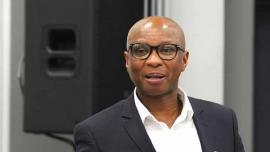
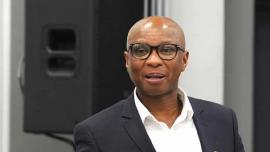
With football being a relatively short career, Minister of Sport, Arts and Culture Minister Zizi Kodwa has encouraged athletes to learn the business of football and its supporting eco systems while still active in their playing careers so they can participate in the industry.
Addressing the International Federation of Professional Footballers (FIFPRO) General Assembly in Cape Town on Tuesday, the Minister expressed concerns about what happens to footballers when they retire from playing.
“Some players may face challenges during the transition from a playing career to a post-playing career, and there is an increasing recognition of the importance of supporting athletes in this transition phase.
“This is where the role of FIFPRO becomes important. Your members need to be empowered; therefore, capacity building should be high in your list of priorities. It should not be by coincidence rather it must be a deliberate and guided process.
“We have seen examples of some top clubs around the world bringing in former players to their coaching and management structures. This is how we have seen former players emerge as top coaches. Yet, many players retire and have nowhere to turn to,” the Minister said.
He emphasised the importance of finding ways for former players, especially those outside the capital centres of football in Europe and Asia, to make a living and to contribute to the sport when their playing careers are over.
“Many former players transition into coaching or management roles within the world of football. They may become youth coaches, assistant coaches, or even head coaches at various levels. Some also take on administrative roles within football clubs or organizations.
“Several retired football players find success in the media industry. They become analysts or commentators for television and radio broadcasts, providing insights and commentary on games and events.
“Some also contribute to print or online publications as sports writers, bloggers, or content creators, sharing their perspectives and experiences in written form. A few players venture into entrepreneurship, starting their own businesses or investing in various ventures,” the Minister said.
Racism in football continues to be a challenge
The Minister called on FIFPRO to think about how it can contribute to uprooting racism in football following a report noting that racism is the most reported form of discrimination reported.
“Players, coaches, officials, and fans continue to be abused because of the colour of their skin. Despite interventions by football authorities, this abuse is continuing, meaning more should be done.
Kick It Out, the organisation dedicated to stamping out discrimination in football, states that in the 2022 – 2023 season, it received 1 007 reports of discriminatory behaviour in football from grassroots level, professional level, and across social media.
“This is a 65 percent increase in incidents reported to the organisation in the 2021 – 2022 season. Kick It Out found that racism is the most reported form of discrimination reported, accounting for nearly half (49 percent) of all cases reported.
“Kick It Out also observed increasing reports of online abuse. The Federation Internationale de Football Association (FIFA) reports that during the 2022 Men’s World Cup, almost 20 000 abusive social media posts were aimed at players, coaches, and officials. Kick It Out has also observed increasing reports of sexist behaviour or misogyny. If anything, Sport should contribute towards Social Cohesion instead of being a source of division,” the Minister said.
Kick It Out was established to fight racism in football in 1993. Then in 1997, it expanded its mandate to tackle all forms of discrimination.

Urgent interventions implemented to address port delays

Transnet says it is implementing a number of urgent interventions to address the backlogs at the Port of Durban and to ease the congestion at Richards Bay.
According to Transnet, the backlog at the port is being caused by factors including inclement weather conditions and equipment availability.
Transnet Board Chairperson, Andile Sangqu, said: “The problem of port congestion is a complex one and it is something that was due to happen at some point, as a result of many years of underinvestment in equipment and its maintenance.
“We are working on a number of measures to turn the situation around. We need to caution that this is going to take some time as the lead times for some of the equipment is anything from 12 to 18 months. The team is working around the clock to procure this important equipment, to ensure our port facilities are in line with global best practice”.
Transnet explained the urgent interventions that are currently in place to address “slow turnaround times affecting the docking and offloading of containers at the port”.
“At Pier 2, the plan is to ramp up the tempo from 2 500 – 4 000 containers a day over the next three months. Under normal conditions, the container handling tempo at Pier 2 is 3 300 containers a day. However, over the past four weeks, this has reduced to 2 500 due to inclement weather and equipment challenges. At Pier 1, the tempo will increase from 1 200 to 1 500 containers a day.
“Initiatives on the cards to ensure that the recovery plan to clear the backlog succeeds include the acquisition of 16 rubber tyred gantry cranes for Pier 1 by the second half of 2025 and acquisition of four ship-to-shore cranes for South Quay for Pier 2in FY2025/26. Work is also underway to refurbish and maintain critical port equipment to improve asset utilisation at Pier 1 and Pier 2 and this will be completed by August 2024,” Transnet said.
The company’s acting CEO Michelle Phillips said management at the port terminals are “working around the clock with industrial engineers from the task team to maximise berth performance”.
“With all these initiatives in place, we expect it will take a maximum of seven weeks to clear the backlog at Pier 1 and 15 weeks for Pier 2. This will make a significant difference to the flow of container traffic through the port.
“It is crucial that we stabilise our operations through these short-term interventions while we continue with the broad Recovery Plan to improve Transnet operations. The plan is exactly what is says it is: a plan to turnaround the business and ensure significant and sustainable improvements in all our operations, and in particular in rail and ports,” she said.
An emergency meeting with stakeholders to find solutions to road congestion at the Port of Richard’s Bay.