
Innovation key to thriving in a changing world, says Minister Patel
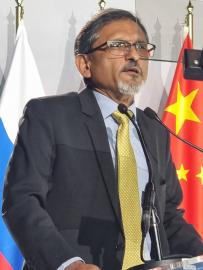
Business as usual is no longer an option, and the ability to innovate and adapt in a world characterised by volatility and fractiousness is the key to thriving, says Trade, Industry and Competition Minister, Ebrahim Patel.
“Today, the world is more polarised, climate change is more pressing and the speed of technological innovation is increasing rapidly.
“These trends in turn are reshaping our economies and societies in more profound ways than many could project,” Patel said on Tuesday.
The Minister officially opened the BRICS Business Forum as South Africa hosts the leaders of Brazil, Russia, India and China at the 15th BRICS Summit.
The event, which kicked off on Tuesday, will wrap up on Thursday. The summit brings together 1 200 delegates from South Africa, Brazil, Russia, India, China, and several African nations.
Patel used the platform to draw attention to the collective economic might of the BRICS nations, which together account for over a quarter of the world’s economic output.
Highlighting South Africa’s remarkable achievements in exports, Patel acknowledged the large contingent of exporting firms, noting that South Africa exported goods worth R2 trillion last year, constituting nearly one third of the nation’s gross domestic product.
He praised the establishment of significant institutions like the New Development Bank, emphasising the importance of networks for policy exchanges and knowledge-sharing.
He underscored the BRICS countries’ commitment to a worldview founded on the right to develop independently without relying on others.
Acknowledging the transformative power of industrialisation, trade and technological development, Patel hailed the African Continental Free Trade Area, which unites 54 nations and offers a platform to spur African industrialisation and innovation.
He stressed that Africa is no longer just a raw material supplier but an “emerging force of innovation and industrialisation in the global arena”.
He called on the BRICS Business Forum to explore how companies and firms in BRICS economies can grow and prosper through collaboration and partnership.
He urged investment and trade practices that support the industrialisation and welfare enhancement of developing nations.
This forum meeting, Patel said, provides the framework for forging valuable business-to-business partnerships and contributing to the world’s shared prosperity.
Notable figures such as Dilma Rousseff, the President of the New Development Bank; Fernando Haddad, the Minister of Finance of Brazil; Mozambican Industry and Commerce Minister Silvino Augusto José Moreno, and the leaders of the respective BRICS Business Council Chapters attended the meeting.

Mason Greenwood to leave Man United after charges dropped
Manchester United forward Mason Greenwood will leave Old Trafford, he and the Premier League club said on Monday, to avoid being a “distraction” despite being cleared of allegations of assault and attempted rape.
Greenwood, who was suspended by United in January 2022 when accusations against him surfaced on social media, was charged with attempted rape, controlling behaviour and assault last October.
He had been due to stand trial on November 27, but all criminal charges against him were dropped in February, with the Crown Prosecution Service saying it was due to “the withdrawal of key witnesses and new material that came to light”.
United said their investigation began once charges were dropped.
“Based on the evidence available to us, we have concluded that the material posted online did not provide a full picture and that Mason did not commit the offences in respect of which he was originally charged,” the club said in a statement.
But it said “all those involved, including Mason” recognised the difficulties with him recommencing his career at Manchester United.
“It has therefore been mutually agreed that it would be most appropriate for him to do so away from Old Trafford, and we will now work with Mason to achieve that outcome,” it said.
‘Best decision’
In a statement to British media, Greenwood said he had “made mistakes”, adding: “I did not do the things I was accused of.
“Today’s decision has been part of a collaborative process between Manchester United, my family and me.
“The best decision for us all is for me to continue my football career away from Old Trafford, where my presence will not be a distraction for the club.”
Greenwood came through United’s youth academy and made his first-team debut in 2019 aged 17. He was a key member of the side in the 2021-22 season, making 18 Premier League appearances before being suspended.
“I thank the club for their support since I joined aged seven. There will always be a part of me which is United,” added Greenwood, who also played once for England in 2020.
“I intend to be a better footballer, but most importantly a good father, a better person, and to use my talents in a positive way on and off the pitch.”
Last week, British media reported that United were considering Greenwood’s return to the squad, after which a group of fans staged a protest outside Old Trafford ahead of United’s season-opening win over Wolverhampton Wanderers.
In an open letter addressed to the club’s fans, CEO Richard Arnold said the club had considered several outcomes, one of which was Greenwood’s reintegration into the squad, before coming to their decision.
“This case has provoked strong opinions, and it is my responsibility to minimise any distraction to the unity we are seeking within the club,” Arnold said.
“Though we have decided that Mason will seek to rebuild his career away from Manchester United, that does not signal the end of this matter.
“The club will continue to offer its support both to the alleged victim and Mason to help them rebuild and move forward positively with their lives.”
Domestic violence charity Women’s Aid said United’s decision to part ways with Greenwood will be a “relief for many survivors of domestic and sexual abuse”.
“The way that alleged domestic abuse cases are treated in clubs has a huge impact on public understanding about what is accepted and tolerated in society,” a spokesperson for the charity said.
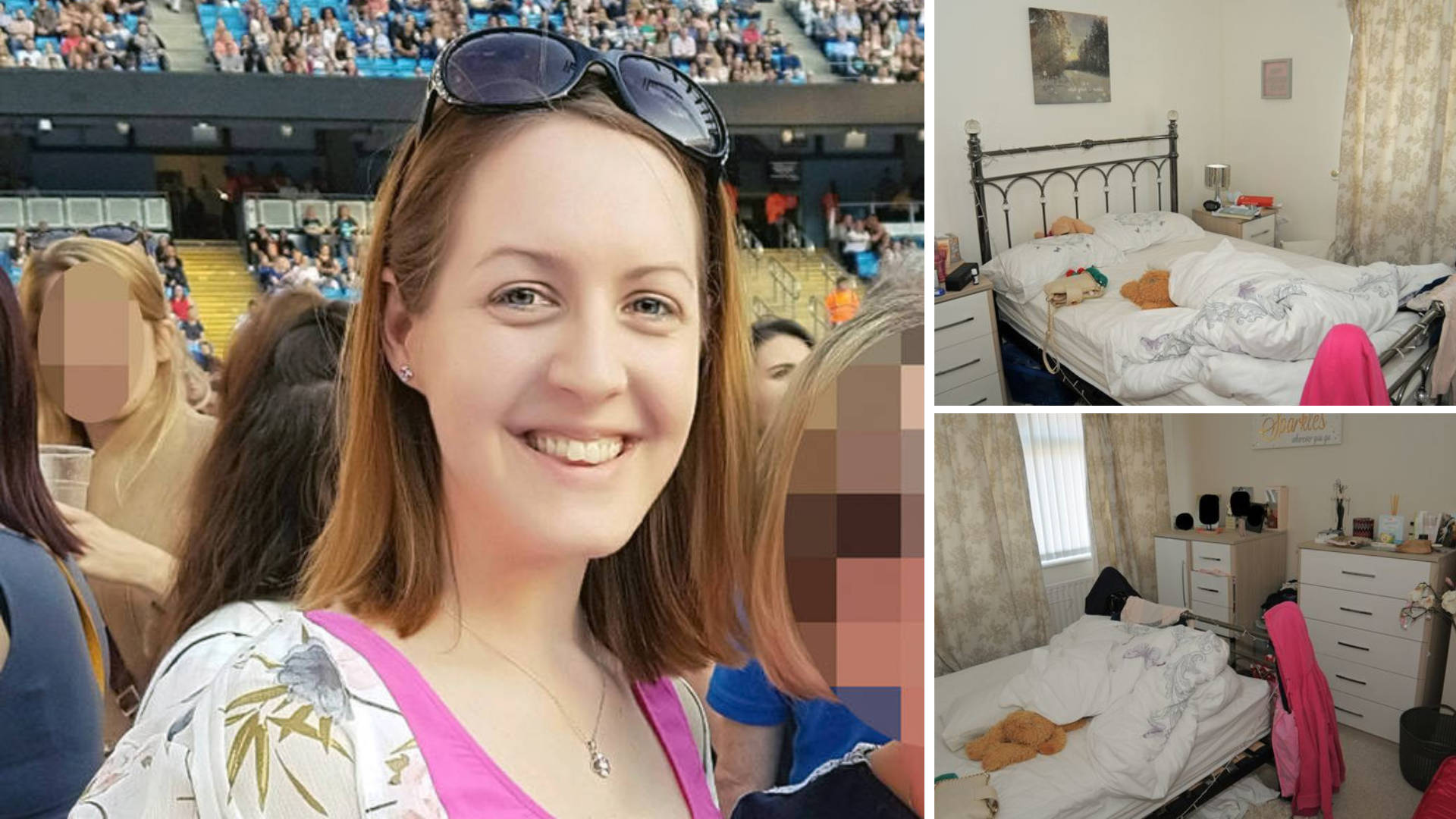
What the babies’ parents told Lucy Letby as she was sentenced

Families of the babies who were murdered and attacked by Lucy Letby have told Manchester Crown Court of the horrific impact the serial killer has had on their lives.
The former nurse will spend the rest of her life in prison, with no chance of parole, for murdering seven babies and trying to kill six others. Their parents gave victim impact statements before she was sentenced. Some of the surviving babies have been left with disabilities, they said.
In court, families of the babies sat in the public gallery, some crying quietly. Members of the jury were also visibly upset as they listened to the statements. Letby refused to attend court to hear the suffering she had caused.
Reporting restrictions protect the identities of the babies and their families, so they are referred to as babies A to P.
Warning: This article contains details some readers may find upsetting

Mother of Baby A and B
“You thought it was your right to play God with our children’s lives.”
The twins were attacked in June 2015 – Baby A was murdered on 8 June and Letby attempted to kill his sister 28 hours later.
“Our minds are so traumatised it won’t let us remember the night you killed our child,” their mother said in a statement. “After losing (Baby A) we were riddled with fear for his sister (Baby B). We are so thankful that we had that fear for her, as it saved her life… there was always a member of our family at her side watching.”
“Little did we know you were waiting for us to leave so you could attack,” she added.
“You thought you could enter our lives and turn it upside down but you will never win. We hope you live a very long life and spend every day suffering for what you’ve done.”
Mother of Baby C
“Knowing his murderer was watching us was like something out of a horror story.”
The mother of Baby C remembered the “overwhelming wave of emotion” she felt when she first held Baby C, whom she called “my tiny feisty boy”. He was murdered on 14 June, 2015.
She wore her first-born’s hand and footprints around her neck after his death. But when Letby was arrested she felt “so conflicted” – the nurse had been the one to take those prints.
She cried as she spoke of the impact Letby has had on her family: “There is no sentence that will ever compare to the excruciating agony that we have suffered as a consequence of your actions.”
Mother of Baby D
“I was desperate to feel her, smell her, cuddle her.”
The mother of Baby D held a toy rabbit as she spoke from the witness box. After her daughter was murdered on 22 June 2015, she pushed for answers, but she was initially told it was not a police matter.
“I missed (Baby D) so much. I was desperate to feel her, smell her, cuddle her. I was desperate to keep her safe.”
She said she lost confidence “as a woman, as a friend, as a wife”, and said her marriage suffered. “It has been hard to keep strong together at times.”
“Since (Baby D) passed away I live behind my own shadow.”
Mother of Baby E and F
“Our worlds were shattered when we encountered evil disguised as a caring nurse.”
Letby murdered Baby E on 4 August 2015. She attempted to murder his brother 24 hours later.
The mother of the twin boys said the family had been “living with a life sentence because of Letby’s crimes”. She said her surviving son had been left with complex needs after the attack. She is still frightened to leave him alone.
When Letby was first identified as a murder suspect, she and her husband felt “cheated, deceived and utterly heartbroken”. She described Letby’s absence from court as “just one final act of wickedness from a coward”.
Father of Baby G
“Her condition affects every aspect of our lives.”
Baby G was left severely disabled by Letby. The nurse was found guilty of attempting to murder her twice, in September 2015.
“Every day I would sit there and pray. I would pray for God to save her. He did. He saved her, but the devil found her,” her father said of their time in hospital.
The court heard Baby G is now registered blind, has cerebral palsy and progressive scoliosis. Her father said she needs substantial care and that her mother only gets about two hours of sleep a night.
“We see other families and their children fishing, playing football, other things we can’t do. She will never have a sleepover, go to high school, have a boyfriend, get married.”
Mother of Baby I
“A part of us died with her.”
Baby I was alert, content and feeding well before she died, her mother said. The family was planning to bring their daughter home when they were told she’d had another collapse, on 23 October 2015. Letby was found guilty of murdering her.
“She was our gorgeous little princess and I can’t even begin to explain the pain when we lost her.”
The mother said her whole body was shaking when she was told someone had been arrested for murder. “We were both absolutely broken that someone could do something so evil to our precious little girl.”
She has had therapy and taken medication over the past six years to cope with her daughter’s death. “We have been in some very dark places mentally.”
After the death of Baby I, they had another daughter who was born prematurely and with sepsis, but she said she found it incredibly hard to be back on a neonatal unit. She refused to leave her daughter’s side until she came home.
“We struggle with trust. I won’t leave my kids in a hospital. We will never give anyone that type of trust with our kids again. I don’t think we will ever get over the fact that our daughter was tortured until she had no fight left in her.”
Father of Babies L and M
“Letby kept looking over at me.”
The serial killer attempted to murder the twin boys in early April 2016. Their father said the image of his son collapsing was “forever etched” in his mind.
The family was initially told by doctors that the events were “normal for premature babies”, he said in a statement. “Little did we know that a year or so after their birth the police would come knocking on the door and break the news that this could be an attempted murder case.”
He said he had been prescribed anti-depressants but “even though they have helped, they can never take away the feelings I have as a parent”.
During the trial, he said he had to sit in Letby’s line of view one day, saying the nurse kept looking over at him. “That made me feel quite uncomfortable and uneasy and I had to move in the afternoon, so I was out of her view.”
Mother of Baby N
“We believe Baby N has lasting damage as a result of the injuries he sustained.”
Letby attempted to murder the baby boy in June 2016. “The day we were called to the neonatal unit was the worst day of our lives,” his mother said in a statement.
She said she always knew her son had been deliberately harmed: “I don’t know if it was a mother’s instinct, but I just knew.” She added: “We just questioned why a healthy baby boy was fine one minute and bleeding from the mouth and needing CPR the next.”
“We both relive this every day.”
She said she felt “happy and relieved” when the police contacted them to say they were investigating Letby. “We felt like we were being listened to.”
The family still has a camera in their now seven-year-old’s bedroom so they can check on him while he sleeps. “We are extremely protective,” she said. “We wanted him to be home-schooled as we didn’t want anybody else looking after him.”
Parents of Baby O and P
“It has destroyed me as a man and as a father.”
The parents had triplets, all boys. Two of the brothers were murdered on 23 and 24 June 2016 respectively.
Their parents gave statements via a pre-recorded video, played in court. “Going through the ‘firsts’ with the surviving triplet is very hard,” said the mother. “I started to blame myself. I thought I’d passed on an illness to all three of the boys – an infection.”
After the death of Baby P Letby seemed “inconsolable” said the mother, who thanked the nurse at the time. She said she hates the fact Letby was the last person to hold her son.
The boys’ father spoke about watching Baby O deteriorate and die. “It was horrific to see – it is an image that I’ll never forget,” he said. He sobbed throughout his statement and many in court were in tears.
He said he had suffered mental breakdowns and struggled with alcohol and suicidal feelings. He is still classed as long-term sick.
“The anger and the hatred I have towards [Letby] will never go away,” he said. “It will continue to haunt us and will always have an impact on our lives.”
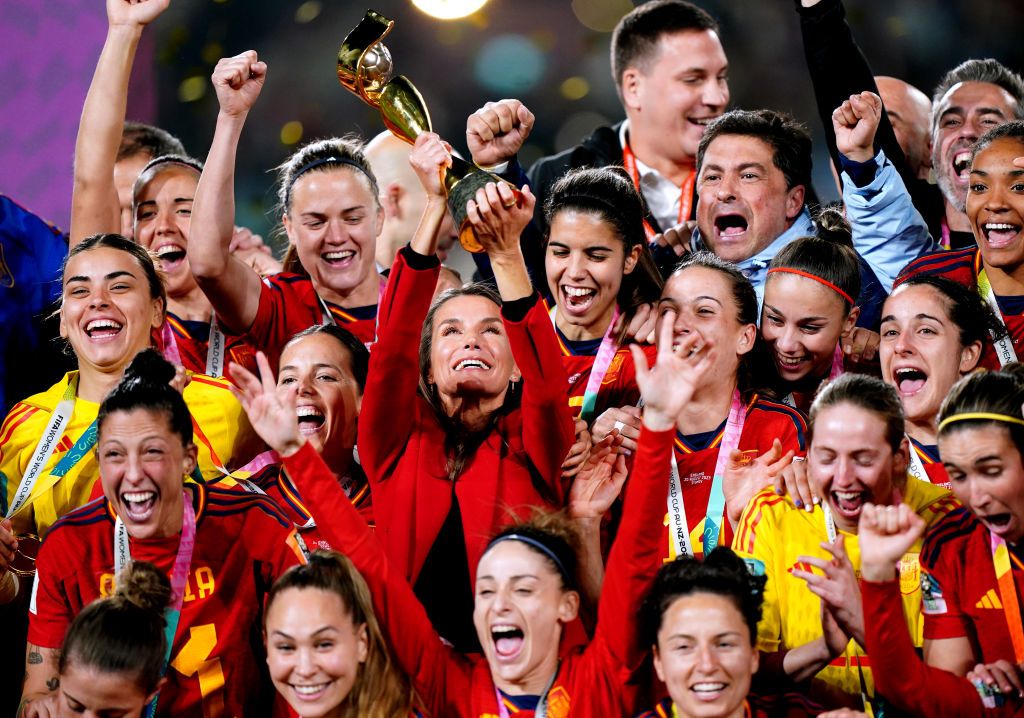
Queen Letizia Join in the Celebrations as Spain Wins the World Cup
Spain’s Queen Letizia and her daughter, Princess Sofía, were in the stands yesterday to watch Spain defeat England 1-0 to win the Women’s World Cup. After the match ended, the royal women took to the field to celebrate with La Roja, the Spanish women’s national football team.
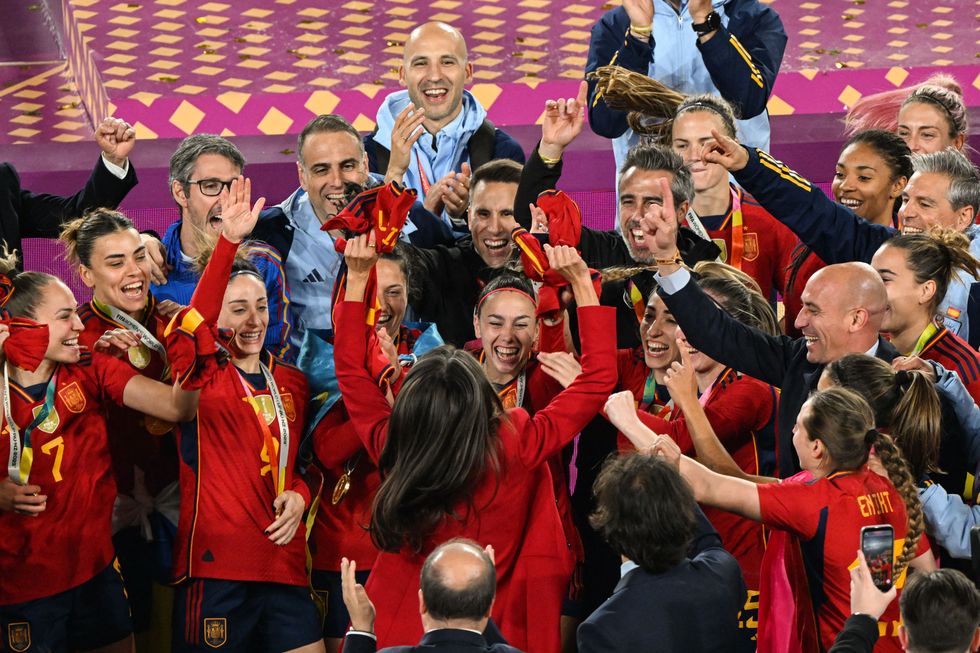
With the team, Letizia ended up in front of many of the players and coaching staff, holding a jersey they gifted her. Soon, they began to chant “que bote la Reina,” which translates roughly to “Bounce/Jump Queen!” and the Spanish Queen complied happily, and began to jump up and down with the athletes. She was wearing a red pansuit that was the same color as their jerseys, and Letizia fit right in with the team.
Photographers also captured the moment Letizia was jumping with the team, and the joy on the players’ faces is clear:
SAEED KHAN//GETTY IMAGES
The Spanish team’s social media even recognized the special significance of this moment, tweeting “Que Bote La Reina!!” in all caps.
Afterwards, the team begin chanting, “Sofía, Sofía!” in reference to Infanta Sofía, who was standing by her mom with a Spanish flag wrapped around her shoulders. During the trophy ceremony, Letizia hugged every player after they were presented with their gold medals.
Letizia and Sofía also joined the team in lifting up the trophy, and afterwards, they went to the locker room of the Spanish team and congratulated the players and the coaching staff, “highlighting the brilliant performance carried out throughout the tournament,” according to the Spanish royal family.
Messi leads Inter Miami to claim first trophy
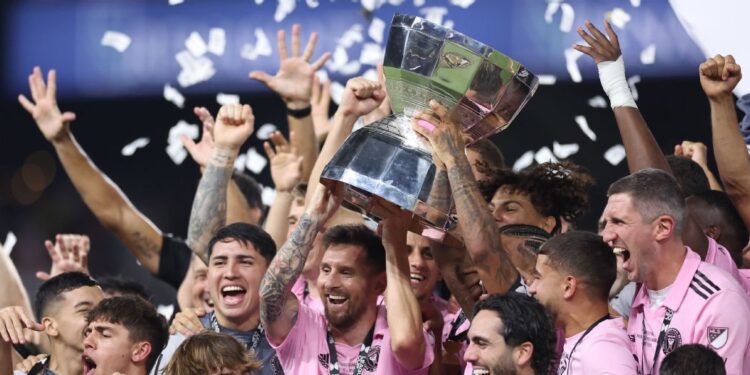
Lionel Messi scored early in regulation and converted the first shot in penalty kicks as Inter Miami beat Nashville SC 10-9 on penalties in the Leagues Cup final on Saturday night (Aug. 19).
Messi scored midway through the first half, his 10th goal in seven games since joining Inter Miami — all in the Leagues Cup competition — as his new team claimed its first trophy.
Messi also opened the penalties by converting his shot. The penalty kicks ended in the 11th round in a showdown between the goalkeepers. Drake Callender scored his penalty for Miami and then made the title-clinching stop on a shot by Nashville’s Elliot Pannico.
Miami players hoisted Messi on their shoulders and had an extended celebration on the field long after the trophies had been handed out.
Miami Coach Tata Martino credited the new group of newcomers like Messi, Sergio Busquets, and Jordi Alba, quickly gelling with the team.
“We had to incorporate a lot of new players but I’m very impressed how it came together,” Martino said through a translator.
“I remember the first days (in charge),” Martino continued. “We needed to do more trainings to give shape to the team and I was thinking, how convenient it is to move on in this tournament because we can take advantage of this month to play more. But after this month, we are champions”
Martino’s postgame press conference ended when Miami players burst into the room, singing and spraying champagne on the coach. But the team won’t have long to celebrate. Miami faces Cincinnati in the U.S. Open Cup final on Wednesday (Aug. 23) .
Nashville coach Gary Smith tipped his hat to Messi.
“You’re looking at a game with the greatest player on the planet possibly being the difference in what went on today,” Smith said.
Callender was proud of the role he played in helping Inter Miami claim the tourney crown.
“It’s a huge honor to play a role in our first win in a final,” Callender said. “It’s pretty surreal. Very emotional. This team works so hard day-in, day-out to be able to perform like this on a night like this. And to have it come down to the very end, it was amazing to see the grit, just the belief of what we’re capable of. It’s something special and I’m just blessed to be a part of it.”
Callender said he tried to stay as calm as possible through the numerous kicks.
“I just had to stay focused, breathe through it, stay as calm as possible,” he said. “I mean, this atmosphere here tonight is electric. So I embraced the moment and I just believed in the work that I put in and the repetitions I put in leading up to that moment and it just ended up going our way.”
Messi opened the scoring in the 23rd minute. The ball landed at his feet after a pass from teammate Robert Taylor was blocked. Messi dribbled past Nashville defender Walker Zimmerman and unleashed a bending shot from just outside the penalty box into the top left corner of the goal. A diving Panicco had no chance at playing the ball.
“It’s one of those things where the bounces don’t go your way and his ability to put it in the top corner is what makes him a special player,” Zimmerman said. “No mistakes were made on that play. It was a good challenge and a little unfortunate bounce there.”
Messi wasn’t particularly influential before he scored the goal, and the crowd showered him with boos each time he touched the ball. But the stadium erupted in cheers when the seven-time Ballon d’Or winner who led Argentina to the World Cup crown last year scored.
Nashville tied the game in the 56th minute when Fafa Picault’s header off a corner kick ricocheted off Miami’s Benjamin Cremaschi and into the net off goalkeeper Callender.
Messi had a shot from the area he had scored from earlier in the 71st minute, but hit the post as the teams played to a 1-1 draw in regulation.
Miami striker Leonardo Campana had a chance to win the game in the last play in regulation, but his sliding shot on an open goal hit the post. Messi held his head in his hands when the ball trickled out of play.
Messi mania had gripped Music City after Nashville SC advanced to the final against Miami with a win against Monterrey of the Mexican league on Tuesday. Ticket prices skyrocketed after they went on sale the following day but eased somewhat in the days before the game. The cheapest seats still cost several hundred dollars. A capacity crowd of 30,109 filled Geodis Park.
Nashville native Reese Witherspoon brought out the game ball and two-time NBA MVP Giannis Antetokounmpo took some shots on goal before the game. Both are minority owners of Nashville SC.
Inter Miami’s Argentine forward Lionel Messi and teammates celebrate with the trophy after Inter Miami won the Leagues Cup final, on Aug.19, 2023.
SA records a decrease in murder rate
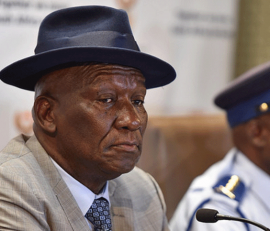
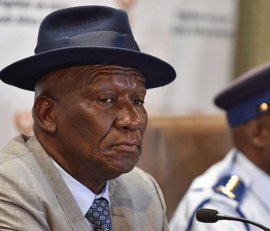
Police Minister Bheki Cele says while there are still unacceptably high crime levels, violent crime levels are starting to show a decrease.
“We have analysed these recent figures and this Ministry remains persuaded, that the decision to aggressively and strategically confront crime, was the right one,” Cele said at a media briefing to announce the first quarter of the 2023/2024 crime statistics.
He said the statistics give a sober assessment of the state of crime in the country and the progress made by law enforcement to safeguard the nation and its people.
Cele said for the first time since the COVID-19 pandemic in 2020, the murder rate had declined in a single quarter.
Between April and June this year, police recorded 6 228 counts of murder. This was 196 less people killed compared to the same time last year. Out of the 6 228 people killed during April to June, 1 188 were women and children.
Apart from Mpumalanga and the Northern Cape, all provinces recorded decreases for murder in this quarter.
The Northern Cape recorded a 11.1% increase in murders, while double-digit percentage declines were noted in the Limpopo and North West provinces. Murders for April to June 2023 in those two provinces dropped by 10.0% and 11.5% respectively.
Apart from the drop in murder counts, notable decreases in other crime categories have also been observed during April to June this year.
These include decreases in sexual offences by 1.9%, trio crimes (car hijackings, house robberies and business robberies) declined by 5.2%.
Meanwhile, property-related crimes decreased by 4.5% and contact related crimes decreased by 1.6%.
Further declines have also been noted in rape and sexual assault counts reported to the police, in the three months of reporting. These crime categories recorded 2.8% and 3.8% decreases respectively.
“All property related crimes such as burglaries residential, burglary non-residential, stock theft, theft of motor vehicles and theft out of motor vehicles recorded significant declines.”
The Minister was pleased with the decline in contact-related crimes, particularly common and street robberies as well as hijackings which declined by 6.4%.
“There were over 1000 less counts of car jackings and robberies at non-residential areas in the three months of reporting. However, it does remain concerning that robberies at people’s homes are still stubbornly high.
“We must strengthen policing efforts and work closer with the private security sector and community patrollers to prevent such home invasions where people are meant to be the safest,” Cele said at the briefing held in Pretoria on Friday.
Despite the reduction, police together with society must do more to protect the country’s women and children.
“The crime figures show that the majority of sexual assaults are still taking place between people that are familiar with each other. Sexual assaults are taking place in the homes of victims and perpetrators,” Cele said.
China in favour of BRICS expansion ahead of Summit
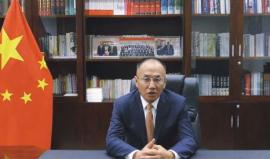
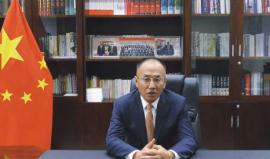
The upcoming BRICS Summit will usher new steps towards expanding the membership of BRICS countries, says Chinese Ambassador to South Africa Chen Xiaodong.
Xiaodong confirmed on Friday that Chinese President Xi Jinping will be attending the upcoming 15th BRICS Summit, which will get underway next week.
The BRICS grouping of major emerging economies – Brazil, India, China, South Africa and Russia, is holding its 15th summit at the Sandton Convention Centre in Johannesburg from 22-24 August 2023 under the Chairship of South Africa.
He told the media that China was actively pushing for the strengthening of partnerships with other nations.
“As the world faces rising exclusiveness and protectionism, President Xi Jinping pointed out that BRICS is not an exclusive club or small circle, but a big family of good partners that is based on mutual assistance for a win-win cooperation.”
This is after, according to the ambassador, the BRICS leaders reached a consensus on the bloc’s expansion.
“The leaders supported discussions on the criteria and procedure for expansion.”
The ambassador said the international community voted in strong favour of BRICS cooperation, countries that have formally applied to join the five-country bloc.
“BRICS expansion has become the top trending issue at the moment. Expansion is key to enhancing [the] BRICS mechanism’s vitality. I believe that this year’s summit will witness a new and solid step on this front,” he stressed.
Cooperation
He also touched on BRICS cooperation, which he is of the view that this year’s summit will send signals for solidarity and its commitment to make the world a better place.
“Over the past 17 years, BRICS countries have focused on shared development. BRICS continues to advance cooperation in areas such as trade and investment, energy and resources, as well as finance and monetary matters.”
In addition, they are looking to grow in other areas. These include supply chain, logistics, agriculture, food security, local settlement and cross-border payment, vaccines and public health.
“President Xi Jinping put forward four major goals of building an integrated big market, ensuring sound circulation and transport connectivity at all levels and strengthening cultural exchanges for BRICS.”
He told the media that the leaders would also draw a sharp focus on the youth and people with disabilities.
State Visit
According to a Presidency media advisory, South African President Cyril Ramaphosa is expected to host President Xi on a State Visit on Tuesday, 22 August 2023, at the Union Buildings in Pretoria.
The ambassador said it would be his President’s fourth Official Visit to South Africa after five years.
He described the visit as significant as China and South Africa celebrate 25 years of diplomatic relations this year.
He told the guests that both countries had built a “comrade plus brothers special bond”.
The ambassador also reflected on the partnership that the two nations enjoy.
“China-South Africa ties have set a fine example for China-Africa relations and South-South cooperation.”
Xiaodong said under Presidents Xi and Ramaphosa, the Comprehensive Strategic Partnership has moved to greater heights.
“On the political front, the two countries have strong mutual respect and trust. We firmly support each other on issues of our respective core interest and major concerns.”
In addition, he said on the economic and trade front, the relationship is mutually beneficial.
During the State Visit, he said both Presidents would have wide-ranging and in-depth exchanges on China-South Africa and China-Africa relations, BRICS cooperation, and international and regional issues of common interest.
They are also expected to witness the signing of bilateral cooperation documents and hold a press briefing.
The two Heads of State will also co-chair the China-Africa Leaders’ Dialogue.
“All eyes will be on how stronger BRICS cooperation, China-South Africa relations and China-Africa relations will continue to contribute to regional and global peace and development.”
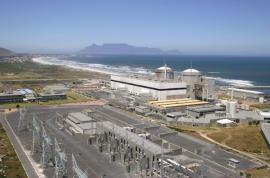
Koeberg units expected to return in November
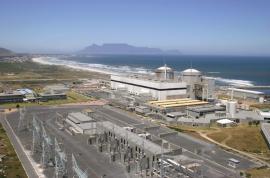
Eskom’s generation capacity is expected to receive a boost by some 1 860MW when units 1 and 2 at Koeberg Power Station return to commercial availability on November 3 and November 7.
The two units have been offline on a planned refuelling and maintenance outage since late last year.
The power utility said the maintenance project is to make the nuclear power station more efficient and add a further 27MW to the power station’s output.
“The replacement of the steam generators was a first of its kind complex nuclear project to be performed at Koeberg and is the last major plant component out of the three to be replaced at the unit as part of the Long-Term Operation (LTO) project.
“The other two components, namely the replacement of the Refuelling Water Storage Tanks and the Reactor Vessel Closure Heads, have been replaced in previous years on both Units 1 and 2. The replacement of the steam generators is the last of the large components that Eskom deemed necessary to be replaced in support of its application to operate the Koeberg units for another 20 years,” the power utility said.
Eskom explained its decision to apply to the National Nuclear Regulator (NNR) for an extension to operate the power station for a further 20 years.
The power utility said the delay in returning the two units to service will not have an effect on its application.
“The conservative design of the station, the investment that Eskom has made in continuously improving safety standards, the rigorous maintenance, as well as the testing programme over its operating lifespan, give merit to Eskom’s decision to apply for the licence to operate the plant for an additional 20 years.
“The Koeberg units have operated safely and reliably for almost 40 years. The amendment of the operating licence will enable Koeberg to continue providing safe, clean, and reliable power to the grid, and playing the essential role of stabilising supply in the Western Cape, which Unit 2 has safely continued to do with an excellent energy availability factor of 94.87%, while Unit 1 was on outage,” Eskom said.
Government pays out more than R330m to Marikana victims
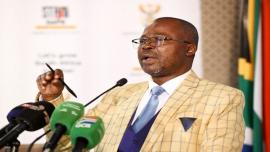
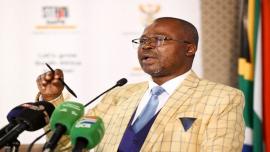
Government has paid more than R330 million in claims related to the Marikana tragedy.
This was revealed by Solicitor-General Fhedzisani Pandelani during a media briefing on Thursday.
Claims payments have been disbursed to claimants through their legal representatives, including the Wits Law Clinic, as well as the Socio Economic Rights Institute of South Africa (SERI).
The tragedy occurred in 2011 at the North West town when police officials shot and killed some 34 miners during a labour-related strike at Lonmin Mine.
Some 78 others were injured, with a further 10 people – including law enforcement officials – dying in clashes before the tragedy.
“The Marikana incident of 16 August 2012 is a painful and significant and solemn chapter in our nation’s history. It is something that we cannot downplay because people are still impacted emotionally and it casts a sombre shadow over the tragic clash between striking miners and law enforcement, resulting in multiple fatalities.
“As a result of which, we, as government lawyers, are now seized with having to meet the lawful demands that have been lodged with us. These funds have served to address a spectrum of claims that relate to legal consideration stemming from the Marikana incident,” Pandelani said.
In relation to the 10 people who died in earlier clashes, Pandelani said that no claim has been laid against government.
“There is always a narrative of confining the fatalities to only 34 individuals. In our book, it’s actually 34 plus another 10 who are never accounted for. We also need to take that into account. In relation to the 10 who died before the other miners, we’ve got no claim that has been lodged against government.
“The other 10 people who died, there was no causation on the death itself that was attributable to government or the State. Their settlements might have been settled by other individuals,” Pandelani said.
Constitutional damages
Turning to the potential constitutional law damages that may be lodged against the state, Pandelani said the Solicitor-General’s office currently does not have the mandate to deal with those matters.
He said upon instruction to do so, “it is an issue that we are prepared to explore”.
“Where a new concept… is introduced, such as constitutional litigation, which was not existing at the time of incident, you find a situation where you are applying the law retrospectively. We need to get instructions from the South African Police Service and everybody else.
“We are having to deal with the… concept of constitutional litigation. Why was it not pleaded as and when the matters started? And as creatures of instruction, where do you then derive the powers to settle on an aspect using taxpayers’ money on an issue which has not been ventilated in court? Until and unless there are new developments and there is cogent argument that is presented before any court of law about any novel or new issue that arises out of the Marikana litigation, I think we have done enough.
“Remarkable strides have been realised in the strategic orchestration and harmonisation of the Marikana litigation. The resolution of numerous claims stands as a testament to our unwavering commitment to justice and due process,” he said.
Marikana Massacre
On 16 August 2012, the South African Police Service (SAPS) opened fire on a crowd of striking mineworkers at Marikana, in the North West Province. The police killed 34 mineworkers, and left 78 seriously injured. Following the open fire assault – 250 of the miners were arrested.
This event culminated after an intense week-long protest in which the miners were demanding a wage increase at the Lonmin platinum mine in a wildcat strike. A wildcat strike, or ‘unofficial industrial action’, is strike action undertaken by unionised workers without the union-leadership’s authorisation, support, or approval. On 9 August about three thousand miners went on strike to demand a living wage. On 10 August, a large group of the striking miners approached the National Union for Miners (NUM) local office in order to demand support from their union, and were instead met with the firing of live ammunition, fatally wounding two miners.
This fatal breakdown in communication between the miners and their union further aggravated a volatile situation, in which the miners and their families were desperately trying to have their voices heard and their needs met. The miners were unable to attain a meeting with NUM or Lonmin representatives and events became increasingly militaristic following the death of the two protesting miners.
Between 12- 14 August at least four miners, two police officers and two security guards died in the ensuing violence. On 13 August, 30 miners were delegated to cross the veld (field) that separated them from another Lonmin platinum mine, Karee, where miners were also undergoing a wildcat strike. The 30 miners were forced by security to turn back without being allowed to meet with miners on the other side. On their way back they were met with a contingent of police. Eye-witness reports say there were about 10 nyalas (military police vans) and two police trucks. The police barred their way and told them to lay down their weapons (machetes also known as pangas), to which the workers refused, saying they needed the pangas for everyday living in the ‘bush’.
The police allowed the miners to continue, but once they were about 10 metres away, the police allegedly began to open gun fire (rubber bullets and later live ammunition) on them, and the miners retaliated. Two policemen and two miners were killed in this battle, and one miner injured severely.
The strike continued despite gaining no support from NUM and receiving no official commitment from Lonmin management to enter into negotiations. The strike was for a wage increase and to address the poor living and work conditions of miners and their families in Marikana. These issues were not formally addressed by the NUM or by Lonmin during the protest. Many of the strikers instead began losing their jobs and the protesters were met with unrelenting hostility by security, the police, and union personnel and management.
Despite having no legal protection or union support, thousands of miners continued to strike in solidarity for their common goal – a better quality life and the dignity it affords. The families of the striking miners were also in general solidarity with the protest and worked to support the movement, joining in protest action and bringing supplies when necessary.
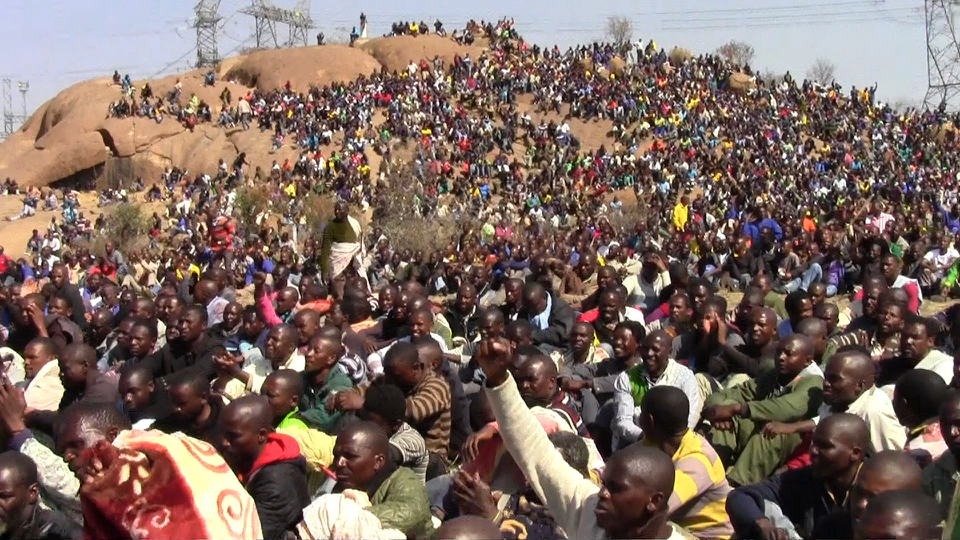 Striking mine workers gather on hill on 16 August 2012, before massacre occurs.
On 14 August Lonmin officially halted production at the Marikana platinum mine.
The miners set up camp on a hill called Wonderkop near the Lonmin mine. Police and miners occasionally entered into discussions however the miners remained steadfast in their strike action, and on 16 August a full frontal attack was launched on them.
More than 400 police were deployed, most in camouflage military gear and armed with R5s, a licensed replica of the Israeli Galil SAR, or LM5 assault rifles, designed for infantry and tactical police use. A barb wire fence was set along the outside perimeter to close the miners in, and military police vehicles and helicopters were deployed on the scene. The police were deployed in a manner that caused concern among the strikers. Despite statements that the police were acting in self defence, it is considered by many that they were not in any real danger. About a dozen miners were caught on camera being shot at directly, and this footage has received global attention and outrage. However most of the miners who were killed and injured were not caught on camera, with some of the miner’s bodies reportedly discovered behind boulders and in retreat. Many of the slain and injured had gunshots in their backs and there were miners who were found with injuries of being ridden over by nyalas.
Not a single policeman was killed or severely on 16 August 2012.
Addressing a press conference, SAPS authorities claimed its officers opened fire on the miners in self-defence, after the miners attempted to attack them using machetes, spears and clubs. The official number of people killed was confirmed by National Police Commissioner General Riah Phiyega, weeks after the incident.
Among the miners killed, was Mgacineni “Mambush” Noki, Bongani Nqongophele, Janaveke Raphael, Van Wyk Sagalala, security guard Matlhomola Mabelane, Andries Ntshenyeho, Xolani Nduzuzu, Telang Mohai, Thabile Mpumza, Stelega Gadlela, Thabiso Thelejane, Thabiso Mosebetsane, Jackson Lehupa and many others.
The Marikana Commission of Inquiry was set up to investigate the massacre of miners at Marikana. The commission’s first seating was on 1 October 2012, its final sitting was on 14 November 2014, and its report was submitted by President Zuma on 31 March 2015.
The report absolved the key political figures who were accused of having a hand in the events leading to the massacre, including Deputy State President Cyril Ramaphosa who at the time of the massacre was a non-executive director at Lomnin, former Police Minister Nathi Mthethwa, former Mineral Resource Minister Susan Shabangu and the National Police Commissioner Ria Phiyega. It also found that Lonmin had failed to engage with workers and the trade unions operating in that sector, NUM and AMCU, were found not to have had full control of its members who embarked on the unprotected strike.
South Africa is world’s third biggest producer of platinum, one of the highest trading resources on the market. Lonmin had 28 000 miners in its employ and has since retrenched thousands of its workers. Families of the miners slain and injured are still seeking reparations.
 Police advance after shooting striking workers with live ammunition on 16 August 2012