
More resources for prevention of disasters at informal settlements

Human Settlements Minister Mmamoloko Kubayi and Members of the Executive Council (MINMEC) have agreed to allocate more resources for the prevention of disasters in informal settlements across the country.
The decision was taken during a meeting between the MINMEC of Human Settlements, Members of the Mayoral Councils (MMCs) of Human Settlements and Executive Mayors.
The meeting was held in Ermelo, Mpumalanga.
The MINMEC has agreed to reprioritise 5% of the Informal Settlements Upgrading Partnership Grant to specifically go towards a community-led process of repositioning densely built informal settlement into clusters, instead of the current improvised order of these ever-growing settlements.
“These resources will help open pathways and roads for emergency vehicles and other services, including the provision of water, electricity and sewerage,” Kubayi said.
On emergency and disaster interventions in informal settlements, the meeting agreed that reblocking (reconfiguration) will help to proactively deal with disastrous fire emergencies in provinces and municipalities, which often lead to loss of lives and the complete destruction of property.
The meeting also expressed a need for more stringent measures to deal with land invasion across the provinces, as it impacts on development efforts by all three spheres of government.
“The meeting recommitted to finding ways to speed up more land acquisition to relocate people, including those affected by disasters, amidst government’s decision against the use of Temporary Residential Units for emergency interventions in favour of more permanent solutions, like Alternative Building Technology (ABT).
“In addition to informal settlements upgrading as one of the priorities for the Human Settlements sector, the meeting reemphasised the rapid rollout of the title deeds programme as a priority to ensure that South Africans become the rightful owners of their own homes – as part of reforms by government to significantly unlock economic benefits,” Kubayi said.
The MINMEC also reflected on other sector priorities, including the expansion of First Home Finance; the provision of service sites, elimination of mud houses or informal dwellings in rural areas, as well as the removal of asbestos from homes.
It further undertook to find urgent solutions to address housing needs of communities, collaborating with other sister departments, like Co-Operative Governance and Traditional Affairs (COGTA), to provide support packages for metros to resolve challenges related to bulk infrastructure and procurement delays affecting service delivery and delays in the proclamation of township.
The MINMEC received input from the COGTA Minister, Thembi Nkadimeng, and her team on the work done on secondary cities and metros.
“A joint submission is expected to be made to Treasury with a view of initiating a process to address funding needs of secondary cities, which often act as catalysts for development in their regions, alleviating demographic pressure from a country’s metropolitan areas,” Kubayi said.
The alignment and improvement of business plans of Metros came into sharp focus to resolve existing housing delivery, as well as delays in proclamation of townships.
The MINMEC recommitment to combine efforts to strengthen internal controls, project planning, management, and implementation – which are key elements to ensure that projects are completed timeously, with achievable set targets and improved performance on the Medium-Term Strategic Framework (MTSF).
Challenges in grants performance
Meanwhile, Kubayi said an analysis of the Human Settlements Grants Performance, for the period ending 30 June 2023, has flagged challenges in procurement, skills capacity and contract management.
The Minister said due to this, a team from the department will at the end of this month embark on consultations with various provinces and municipalities to discuss noncompliance and performance improvement strategies to ensure that funds are utilised for the intended purposes.
She said the team will conduct assessments of projects to close gaps early and avoid under-expenditure, which leads to loss of money from the sector.
“In that regard, MINMEC resolved there must be transparency before any considerations to withhold or reallocate unspent funds for noncompliant provinces found to have substantially underspent during the end of the second quarter, in accordance with the Division of Revenue Act. In instances of overspending, a process will be undertaken to determine value for money,” the Minister said.
Operation Shanela secures 161 arrests in N Cape
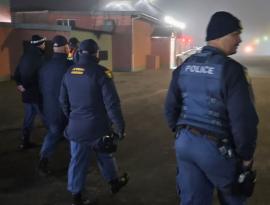
One hundred and sixty-one suspects have been arrested in the Northern Cape under the South African Police Service’s Operation Shanela.
The arrests were executed between last Monday and Sunday, 23 July.
The arrests were made during stop and searches, vehicle checkpoints, cordon and searches, high visibility patrols, compliance inspections at liquor outlets, tracing operations by detectives, visits to businesses and second-hand goods dealers.
Teams across the Northern Cape conducted numerous operations, which included 11 roadblocks and 36 vehicle control Points (VCPs), during which 1 981 vehicles and 4 365 persons were searched, with fines being issued for contravention of the law.
These actions were also enhanced by 1 206 high visibility blue light and 1 972 foot patrols throughout the Northern Cape.
In total, 3 109 compliance inspections were conducted at second-hand dealers, scrapyards, shebeens, taverns, liquor outlets, firearm dealers, farms and informal businesses.
On Monday, 17 July, the police followed up on information and found a substantial amount of copper cable stashed next to a power station in Peter Mokaba Street in Kagisho in Galeshewe, while another male was also arrested with copper worth R1 000 in the Kimberley CBD.
Colesburg SAPS members confiscated a large amount of diesel concealed in containers in a Toyota bakkie and the vehicle owner could not account for the goods.
Police in Hopetown also confiscated a substantial amount of tik, mandrax and dagga, while another team seized a large amount of dagga in Galeshewe.
SAPS all over the province made routine visits at ATMs, business premises, national key points, post offices and tuckshops.
Provincial Commissioner, Lt Gen Koliswa Otola, said SAPS members and external stakeholders will continue with the high density crime prevention operations.
Explosion rocks Johannesburg CBD
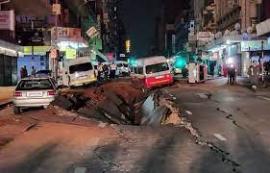
At least one person has died and 48 others injured following an explosion on Wednesday evening at Bree Street in the Johannesburg CBD.
Some 12 people still remain hospitalised.
Briefing the media on Thursday morning, Gauteng Premier Panyaza Lesufi said although there is a suspicion that the explosion was caused by gas, all relevant stakeholders who provide services in the area have been brought in to determine the cause.
“We have now formally brought all institutions that deal with gas. We now have EGoli Gas; we have brought Sasol and we are bringing anyone that has either underground pipes or caballing. Telkom, water and any institution that will assist us just to determine the cause of the impact and also give us the necessary advice.
“City Power…have since taken a decision to switch off the Bree Street substation so that the team can go in there and identify the cause and also assist us to identify areas that need our immediate intervention,” he said.
Lesufi added that government agencies, including law enforcement, have moved quickly to secure the scene and keep residents safe.
“There are 10 teams representing both the SAPS [South African Police Service], JMPD [Johannesburg Metro Police Department] and POPs [Public Order Policing] and more members are being mobilised so that we can protect the scene and ensure that everything is fine.
“The Department of Human Settlements was assigned the big task of identifying the homeless and also those that have been asked to leave the area. We identified 3 Kotze Street…to be the area where we’ll house everyone that needed housing.
“The provincial government and local government have started to set up a disaster process of identifying how quick can we rehabilitate the affected areas, especially those that will have a severe impact on the economic activity of the city,” he said.
Investigating cause
Egoli Gas has denied culpability in the explosion, however Lesufi said “it is common knowledge that there is a high smell of gas in the entire area”.
“Egoli Gas remains the centre of our focus because all of us agree that the cause of this explosion or impact is gas. So that we can isolate all institutions that have the legal mandate to deal with gas. We now know that Egoli has a blueline…that cuts across Eloff and Lillian Ngoyi [Bree] Street but we are told it’s a low pressure facility.
“We have asked them to identify all their pipes…and they’ve given us this information and then we’ll handover to those that are experts and they’ll advise us on how to take this process forward,” he said.
Traffic diversion
Lesufi said because Bree Street is one of the busiest in the city, diverting and directing traffic away from the scene has become “a headache”.
“The teams are trying extremely hard because we have closed major roads. Bree Street is one of the busiest roads in the CBD…there are lots of taxi ranks, there are lots of drop offs and there are lots of people that indicated their frustrations about the signage and the movement of areas where taxis are now stationed.
“But we are assured…that as soon as we get the cause of the explosion, they will move with speed to release some of the roads. But because we have to be cautious, majority of the roads remain closed.
“They will keep the area sterile until it is rehabilitated. Road closures and diversions will remain in place until further notice,” he said.
Meanwhile, government has urged citizens to exercise caution when near the area.
“Government notes with sadness the explosion in the Johannesburg CBD and sympathises with everyone who was affected by the explosion.
“While the cause of the explosion is being investigated, we urge members of the public to use alternative routes, allowing space for the relevant authorities to complete their work on the scene,” government said in a tweet this morning.
R26 million tender fraud accused in court

A Saldanha Bay businesswoman has appeared in the Vredenburg Magistrates’ Court on fraud charges relating to a R26 million Saldanha Bay Local Municipality security tender.
According to the National Prosecuting Authority (NPA) regional spokesperson Eric Ntabazalla, businesswoman Wanda McCarthy allegedly misrepresented her company when bidding for the tender some five years ago.
“The winning company was required to provide 77 security guards to the towns, inclusive of day and night shifts. The security guards were required to be qualified to level-C and possess legitimate PSIRA certificates. The company was also required to provide labour and transportation, with 10 vehicles registered in the service provider’s name at the time of bidding.
“Scrutiny of the company found that the accused had made misrepresentations, stating that her company had a workforce of between 400 to 600 employees and a registered fleet of over 10 vehicles.
“Between February and March 2018, the company’s bank statements reflected payments to 27 employees for February 2018, 90 employees for March 2018 and 90 employees for April 2018, with a total of R357 273.00. This meant that the company had an average of 69 employees between March and April 2018,” Ntabazalla said.
He added that further investigations found that she had also allegedly misrepresented the number of vehicles that the company owned.
The tender was subsequently cancelled two years after it was awarded having already paid some R13.8 million to McCarthy.
“The State alleges that the accused’s actions were both unlawful and intentional to the extent that the unsuccessful service providers were prejudiced, and incurred a substantial amount of money to pursue the appeal which was fraudulently awarded to the company. As a result, other prospective tenderers and the municipality suffered actual loss and prejudiced in the amount of R13.8,” Ntabazalla said.
She was released on R20 000 bail and is expected back in court on 21 August.
Meanwhile, two suspects have appeared in the Rustenburg Magistrates’ Court also on charges related to fraud in a tender for high mast lights awarded by the Rustenburg Local Municipality.
NPA regional spokesperson Henry Mamothame said the two, Obakeng Mokgale and Orebotse Tlale, are former employees of the municipality and were arrested and face four counts of fraud.
The two have since been dismissed from the municipality.
“All procurement processes were duly followed for the tender to be awarded. Investigations reveal that the tender was awarded to a company that was not compliant, owing to the fraudulent documents that were submitted in order to be awarded the tender. The two were notified of the noncompliance but continued to recommend for the tender to be awarded to the said company.
“The company is said to have also submitted fraudulent invoices amounting to more than R1.7 million for a service that was not rendered. The accused continued to sign the procurement documents, pretending to have seen the service that was rendered, for payment to be processed,” he said.
The two were granted R30 000 bail and are expected back in court on 15 August.
Safety programme launched targeting 1700 Gauteng schools
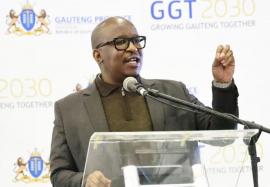
Following the high incidents of stabbing, violence and gangsterism in and around schools in the province, Gauteng Education MEC Matome Chiloane has launched a school safety programme called “Operation Kgutla Molao”.
Addressing learners at the Qalabotjha Secondary School in Vlakfontein on Thursday, the MEC said the school safety programme is aimed at protecting learners and safeguarding their future.
“We are here to ensure that we are going to protect your future with you. Today we are launching a school safety programme that we will be running across our schools in the province,” he said.
Operation Kgutla Molao has been developed to ensure that the majority of schools are relatively stable, peaceful and disruption-free.
The department considers school safety a top priority in education, said the MEC.
“It’s painful when learners fight among themselves when they are supposed to be protecting each other because the future out there will require you to work together and live together.
“The school safety programme that we are launching will encompass a number of set interventions. Among them are random search and seizures in these schools. This will be done randomly and regularly,” Chiloane said.
The MEC said the Gauteng Department of Education will continue to work closely with communities, other government departments such as the Gauteng Department of Community Safety and law enforcement agencies.
Parents have been urged to play an active role to ensure discipline and regularly check on their children to determine if they are not involved in illegal activities.
“We have developed Operation Kgutla Molao to safeguard the wellbeing and future of learners from destructive behaviour and social ills.
“With integrated support from various law enforcement and community safety structures, we will be able to diminish acts of misconduct and pave way to focus on providing effective learning and teaching at schools across the province,” Chiloane said.
Operation Kgutla Molao aims to create safer schools by promoting social cohesion through non-violence and focusing on delivering effective learning and teaching.
It will target 1700 Gauteng schools, including 275 schools classified as high-risk.
Under Operation Kgutla Molao, the following actions will take place:
- Suspension of learners involved in violence and/or sexual harassment. Learners will face disciplinary action by the school and those who are apprehended by the police will face trial.
- Disciplinary action will be taken against educators and non-education staff alleged to be involved in sexual harassment and/or violence and also face trial.
- Swift intervention by the MEC and GDE officials to understand the causes of this behavior, as well as the implementation of corrective action.
- Regular reporting of threats and incidents to law enforcement agencies, especially the South African Police Services.
- Meeting with community stakeholders on issues of school safety and protests that also disrupt learning and education.
The campaign will also see the deployment of 5 000 patrollers to schools in the townships in collaboration with the Gauteng Department of Community Safety and Community Policing Forum.
A new cohort of patrollers will be deployed to assist with access control and will be provided with E-Panic buttons.
A holiday school safety pilot programme was implemented in December 2022 and has reduced burglaries at some identified schools.
The programme included regular patrol by professional guards and community awareness campaigns to report incidents to a call centre linked to the police and emergency services.
Children’s Parliament welcomes signing of the Sign Language Bill into law
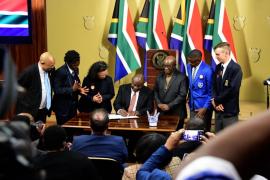
The President of the Nelson Mandela Children’s Parliament, Dikgang Morudu, has welcomed the signing of the Sign Language Bill into law by President Cyril Ramaphosa as the 12th official language.
Members of the Children’s Parliament have been advocating for the recognition of sign language as an official language to accommodate children who are deaf or hard of hearing.
The President hosted a signing ceremony of the South African Sign Language Bill at the Union Buildings in Pretoria on Wednesday,
During their 10th sitting in 2021, the members of the Children’s Parliament appointed Hamza Muhammad as their President, a deaf boy from the Dominican School in the Western Cape.
Upon receiving the news, Hamza said the signing of the bill into law “was good news for deaf people”.
“As a deaf person and former President of the Children’s Parliament, I have always wanted South Africa to make sign language official. I am happy to hear that President Cyril Ramaphosa has recognised it as an official language,” Hamza said.
He added that the signing of the bill showed there are no two separate worlds in the country.
“We are all human beings who live in one world and deaf people also have rights. I would like to thank the President for supporting deaf people in the country,” he said.
On 14 July 2023, members of the Children’s Parliament continued to raise their voices regarding the recognition of sign language during their 11th sitting in Bisho, in the Eastern Cape.
Morudu, the current President, said the signing of the bill means that someone is starting to listen to the voices of the children.
The Children’s Parliament is held bi-annually by the Department of Social Development in collaboration with the Department of Basic Education, the Nelson Mandela Children’s Fund, United Nations Children’s Fund and Save Children South Africa.
The new sign language legislation seeks to:
– Advance the cultural acceptance of sign language
– Ensure the realisation of the rights of persons who are deaf and hard of hearing to equal protection and benefit of the law and human dignity, and
– promote inclusive and substantive equality and prevent or eliminate unfair discrimination on the grounds of disability, as guaranteed by section 9 of the Constitution.
South Africa is now the 4th country on the African continent to recognise sign language as an official language after Zimbabwe, Kenya and Uganda.
Life sentence for former KZN school principal
Investigations by the Vryheid Family Violence, Child Protection and Sexual Offences Unit (FCS) secured a life imprisonment sentence for a 39-year-old former high school principal found guilty of raping a 15-year-old schoolboy.
According to the South African Police Service (SAPS) in KwaZulu-Natal, Mduduzi Ndlovu was sentenced on Tuesday.
The court heard of how Ndlovu manipulated and violated the 15-year-old who trusted and believed in him as his teacher.
Investigations proved that on one afternoon in 2018, the principal requested the boy to assist him in his office and while inside the office, Ndlovu became aggressive and raped the victim.He threated to harm the boy if he told anyone about the incident.
He also gave him money and stationery in exchange for his silence.
“Ndlovu raped the victim on several occasions and he would sometimes fetch him from home and drove with him to his place of residence in Bhekuzulu area where he would rape him. In 2022, a church member noticed a strange behaviour from the boy and questioned him. The teenager broke his silence and a rape case was duly opened,” Colonel Robert Netshiunda said on Wednesday.
The former school principal made several court appearances before he was convicted and sentenced to life imprisonment for rape. He was also declared unfit to possess a firearm.
“His name will also be engraved in the National Register for Sex Offenders,” said Netshiunda.
In a separate matter, Mhloli Ndlovu was also sentenced to life in prison after he was found guilty of raping his 19-year-old niece.
On the night of 23 July 2022, Ndlovu took the victim to Nodwengu area where he raped her. He also drove to Mahlabathini where he continued raping her.
On both occasions he raped the victim inside his vehicle. His life imprisonment sentenced was handed down earlier this month in the Verulam Regional Court.
Gauteng urges operators to renew expired operating licenses

The Gauteng Department of Roads and Transport has called on public transport operators in possession of expired Operating Licenses to take advantage of the Department’s window of opportunity to renew their operating licenses by the end of the month.
“To date, the Department has identified over 6000 operating licenses that need to be renewed however less than 500 applications have been received and processed,”’ the Department said on Wednesday.
Sections 25 of the National Land Transport Regulations requires that an Operating License that was issued for more than 30 days must be renewed not later than 30 days before expiry.
The regulations further state that if the Provincial Regulatory Entity (PRE) has not issued an Operating License by the expiry date, the Operating License will remain valid until a renewed license has been issued on condition that the operator keeps in the vehicle the receipt issued by the PRE as proof that such an application was made.
“The Department, therefore, is making a plea to the industry leaders to impress upon affected members to respond to the call by submitting applications by 31 July. The receipt and the expired Operating License must always remain attached.”
Requirements for renewal of Operating License are as follows:
- Completed application form
- Certified ID copy/ Company Registration Certificate (CC)
- (Letter of appointment for persons submitting applications for companies)
- Renewed Contract (Contracted Services)
- Letter from Association (Minibus Taxi mode)
- Original Tax Clearance Certificate (SARS)
- Original Operating license/ permit or certified copy + Affidavit
- Certified Vehicle certificate of fitness & Roadworthy Certificate
- Certified copies of Vehicle certificate of Registration (COR)
- Fee of R300.00 per vehicle (cash or bank guaranteed cheque)
Applicants should also submit a list with the operator’s and their expired licenses details through their respective associations by 31 July 2023.
Operators can visit TOLAB offices.
Tshwane Office:
Cnr. Eskia Mphahlele and Johannes Ramokhoase Streets. (opp. Marabastad Home Affairs), Pretoria
Tel: (012) 327 3611/3738
Manager: Ms Sarah Malele – 082 615 5556 /(011) 344 2686
Email: Sarah.malele@gauteng.gov.za
Operating times: Monday – Friday 8am -4pm.
Johannesburg Office:
45 Commissioner Street, Life Centre Building, Marshalltown –
Johannesburg
Tel: (011) 227 8341/45/46 or (011) 355 7332
Manager: Mr Sechaba Tumelo – 063 697 2568 / (011) 227 833
Email: Sechaba.tumelo@gauteng.gov.za
Operating times: Monday – Friday 8am -4pm.
West Rand Office:
(Relocated to Kagiso DLTC -Umdeni & Kagiso Avenue, Kagiso)
Manager: Ms Eunice Maphanga – 079 877 7726/ (010) 345 0761/5
Email: Eunice.maphanga@gauteng.gov.za
Operating times: Monday – Friday 8am -4pm.
Ekurhuleni Offices:
No. 1 Hardach Street (opp Germiston Magistrate’s Offices),
Germiston
Tel: (011) 437 5932 / (011) 876 3800
Manager: Ms Wona Mosala – 082 324 7777/ (011) 876 3820
Email: Wona.mosala@gauteng.gov.za
Operating times: Monday – Friday 8am -4pm.
Gauteng consumers urged to use electricity sparingly

State power utility Eskom has urged Gauteng residents to use electricity efficiently as a cold front moves into the province.
This after the South African Weather Service (SAWS) warned of a “dramatic drop in temperature” with daytime temperatures expected to barely reach 20°C in parts of the province.
“Gauteng is experiencing severe cold weather conditions. Customers are urged to use electricity wisely. Use alternative methods to keep warm, such as wearing more layers of clothing, using a throw or a hot water bottle instead of a heater,” the power utility said.
Meanwhile, Eskom has announced that load shedding has been ramped up due to breakdowns at eight generating units on Tuesday evening.
“The breakdowns … have put a severe strain on the power generation system. The delay in returning to service a generating unit each at Kendal, Kriel, Matla [power stations] and two generating units at Tutuka power station is contributing to the current capacity constraints. Eskom teams are working tirelessly to return these generating units to service,” the power utility said.
From 5am today (Thursday), Stage 3 load shedding will be implemented with Stage 4 kicking in from 4pm, lasting until 5am on Friday morning.
Load shedding will then drop to Stage 2 until 4pm and will be tailed by Stage 4 also until 5am. This pattern will repeat until further notice.
Breakdowns at power stations have rendered some 19 127MW of generation capacity offline, coupled with a further 2 313MW out of service due to maintenance.
“Demand of electricity is expected to increase towards the weekend. Therefore, we appeal to the members of the public to assist in reducing demand by switching off non-essential appliances.
“We would like to thank those who do heed the call to use electricity sparingly and efficiently, including switching off geysers and pool pumps from 5pm to 9pm as this lowers demand and helps in alleviating the pressure on the power system and contributes to lower stages of load shedding,” Eskom said.
Sign language officially the 12th official language
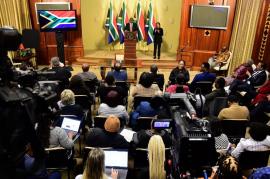
By making sign language the 12th official language of South Africa, government aims to advance the rights of citizens living with disabilities by ensuring that their rights to substantive equality, dignity and social inclusion are recognised.
Addressing the signing ceremony of the South African Sign Language Bill, President Cyril Ramaphosa said it also affirms the humanity of people who communicate with sign language.
“Having sign language recognised as an official language will address access to education, economic and other social opportunities as well as public participation. People with hearing impairments will be able to also access more services, public information and a host of other opportunities,” the President said on Wednesday at the Union Buildings.
The signing of the Bill into law follows an intensive and extensive public consultation process. A substantial number of submissions were made and considered carefully to ensure that all issues were appropriately ventilated.
Parliament voted for the Constitution Eighteenth Amendment Bill that amends Section 6 (1) of the Constitution of the Republic of South Africa on 2 May 2023.
“Our Constitution enjoins on the state to take practical and positive measures to elevate the status and advance the use of the indigenous languages of the South African people. It further notes that all official languages must enjoy parity of esteem and must be treated equitably.
“We are also giving effect to the provision of the Bill of Rights that prohibits unfair discrimination on grounds such as disability, culture, race and gender. South African Sign Language has served as an essential communication tool for our citizens living with disabilities, and this step will further empower the community,” the President said.
He acknowledged that the official recognition is just the beginning, as much more work still needs to be done to support the language.
“It has to be standardised to collapse various geographical dialects into one standard official version which is the remit of the Pan South African Language Board. The fact that the first comprehensive electronic sign language dictionary has already been developed demonstrates the enthusiasm to develop this language.
“The Pan South African Language Board (PanSALB) has already convened its first workshop on lexical and grammatical standardisation and the recommendations of the report produced are currently being enacted. The next standardisation workshop will convene in the last quarter of this financial year and will again include all relevant stakeholders,” the President said.
He said it was reassuring that even prior to the signing ceremony, processes to institutionalise sign language had already begun.
The Department of Basic Education already provides teaching and learning for deaf learners.
“Educators in schools are regularly undergoing training on sign language and we have learners who have completed matric using sign language. Specialised schools for the deaf have to be increased in the country, factoring in geographic spread and need. They also have to be provided with qualified personnel.
“It is also crucial that there are sign language interpreters to enable access to services for people who cannot hear properly.
“For many years, lack of sign language interpreters at the courts, police stations, hospitals, clinics and many service centres or points has been compromising access to justice for victims of violence, including victims of gender-based violence and many other crimes,” the President said.
Policies with fully resourced implementation plans are required to realise the Constitutional ideal of multilingualism.
Dr Bruno Dragone described the signing of the South African Sign Language Bill into law as a historic moment for the deaf and hard of hearing people.
“The signing of the South African Sign Language into law today is going to change deaf people’s lives. It is a very emotional for me today and for those that are still struggling out there. Today is a glorious day.
“We hope our government will welcome them into the courts, into the schools and universities. Do not be afraid of communicating with deaf people,” Dragone said.