Hawks member released on bail for corruption charges

Hawks member Kgaugelo Aubrey Mogale (47), a police sergeant, was on Tuesday released on bail by the Nelspruit District Court after having been arrested by the Hawks’ Nelspruit-based Serious Corruption Investigation unit for corruption, fraud and defeating the ends of justice.
The arrest followed a financial investigation that was carried out by auditing firm KPMG during the Project Blood Orange investigation.
It was discovered that Mogale, one of the team members involved in the investigation, unduly received an amount of R6 000, deposited by the main suspect in the case, into his account over a period of time.
An internal investigation was conducted, which also established that the member did not disclose the financial benefit of R6 000.
A case docket was registered and the investigation was finalised. The matter was referred to Public Prosecutor, who decided that there is a prima facie case against Mogale.
A warrant of arrest was authorised and executed on Tuesday 4, June 2024. Mogale was released on R1 000 bail and his case postponed to 27 June 2024.
The Provincial Head of the Hawks, Major General Gerber, said he is deeply concerned that a member of the Directorate for Priority Crime Investigation (DPCI) was arrested on these serious charges.
“The DPCI strives in all aspects to employ members whose integrity is beyond reproach. We strive to be a crime and corruption fighting entity, which is not tainted by allegations of corruption within our own ranks,” Gerber said.
Gerber commended the DPCI for acting against one of their own.
“This shows a commitment to be a directorate that will, without fear or favour, apply the law, irrespective of your standing in society.
“No form of criminality or corruption will be condoned. This must send a clear message to all that as DPCI Mpumalanga, we endeavour to run a clean ship,” he said.
SIU welcomes court appearances of alleged TERS fraudsters

The Special Investigating Unit (SIU) has welcomed the arrests by the Hawks and subsequent start of the prosecution of four people linked to the alleged defrauding of the Temporary Employer/Employee Relief Scheme (TERS) in the Eastern Cape.
The scheme, which was administered by the Unemployment Insurance Fund (UIF), was created by government to assist employers and employees that were distressed during the COVID-19 pandemic.
According to the SIU, the four accused allegedly claimed benefits that were not due to them and were exposed following an investigation by the unit.
The four accused are Nomvuzo Melody Kupiso, Tlotliso Molaba, Lehlohonolo Class Motaung and Lelokonyana Isak Letseng.
The corruption busting unit said Kupiso, through her company, Khayathi, unlawfully applied for TERS benefits on behalf of individuals who were no longer employed at Khayathi “through misrepresentation and intending to defraud the UIF”.
“Khayathi and Kupiso unlawfully and falsely made or created the proof of payments, which appeared to have been signed by the ’employees’ on receipt of the TERS benefit at the height of the COVID-19 pandemic. The individuals have not been employed at Khayathi since 2015. The UIF released the total payment in the amount of R216 905.95 to Khayathi.
“On 23 January 2024, the SIU referred the matter to the relevant prosecuting authority. On 18 April 2024, Kupiso was arrested and appeared on the same day before the King Wiliams Magistrates Court, Eastern Cape, on fraud, forgery, and uttering allegations. Kupiso was released on R1 500 bail,” the SIU said.
In the case of Molaba, Motaung and Letseng, the SIU alleges that the three – through their companies, Afrikhan Source (Pty) Ltd owned by Molaba and Motaung and Izuz Gibbor (Pty) Ltd owned by Letseng, “applied for the COVID–19 TERS online during two different periods”.
“Between March 2020 and October 2020, Afrikhan Source applied for COVID–19 TERS on behalf of individuals allegedly affected by the COVID–19 pandemic. The UIF made nine payments amounting to approximately R1 396,053,40 to the company’s account between September 2020 and December 2020.
“Between July 2020 and October 2021, Izuz Gibbor made applications for COVID-19 TERS on behalf of certain individuals who claimed to be affected by the pandemic. The company received nine payments from UIF, amounting to an estimated total of R101 555.92, in this period. However, it was discovered that the applicants never worked for either of the two companies.
“The SIU referred the matter to the prosecuting authority. The suspects were arrested in Bloemfontein and Phuthaditjhaba, Free State, on 25 April 2024. They were granted R10 000 bail each and the matter has been postponed to 11 June 2024,” the SIU said.
E Cape introduces technology to fight stock theft

Eastern Cape Premier Oscar Mabuyane has stated that the widespread stock theft in the province has led government to introduce a technology-based system to help combat the scourge.
This crime has been causing emerging rural farmers to lose millions of rands.
Mabuyane made these comments during the launch of the Livestock Identification and Traceability System (LITS) in Tsolo on Tuesday.
The Premier was joined by the Rural Development and Agrarian Reform (DRDAR) MEC Nonkqubela Pieters and Transport, Community Safety and Liaison MEC, Xolile Nqatha.
LITS is a technology-based ear tag device that the government is distributing to 120 cattle farming enterprises, benefiting 30 000 cattle across the province.
Mabuyane reported that more than 18 000 animals, valued at over R58 million, have been stolen in the province recently.
“You can imagine what that is doing to the economy. When you talk about the province being the home of livestock, you are talking about subsistence rural farmers. We have a problem of livestock theft, and it has been with us for some time now. We are trying to tackle that,” Mabuyane said.
He believes the electronic ear tag device will also ensure that animals are not only branded but their origins would be traced.
“We are trying to introduce a more organised and commercial way of handling these animals. This is part of us trying to fight and curb livestock theft. We are sending a message to all the thieves out there that we will go after you in a better and more organised manner. You cannot sleep today and wake up with a kraal full of cows that you can’t account for,” he stressed, adding that the system will be rolled out across the province.
The Premier stated that government wants to see all animal populations being branded properly and given the ear tag to make sure they are monitored better.
Pieters said LITS will assist farmers in Tsolo, which is one of the municipalities with a high rate of stock theft and assist the police to identify the rightful owner of the cattle.
“Even if you sell the animal to somebody else, you will be able to trace the origin. If there are diseases, you can trace the origin of the cow. Farmers are going to be trained to keep records of their cattle to make sure that if it was sick, when was it sick, what type of medication has been used, how many times have you dipped your herd of cattle,” Pieters explained.
Nqatha said the launch adds the instruments needed in the fight against crime and government will ensure that all those who are responsible are held accountable.
Arrests
“Already we have been able to recover the stolen livestock, we have already been able to effect arrests. One of the things we were able to do was to assess our stock theft unit and its location between Qumbu and Sulenkama so that the capacity of the police is located nearer to the hotspot to facilitate our responsiveness,” said Nqatha.
According to the MEC, the community should work with the police to fight against stock theft, adding that animal branding and ear tagging will assist in this collaboration.
One of the farmers whose animals were ear-tagged and branded, Sabatha Mnjunju said he hoped the system would be able to track livestock and they would be easily identified when stolen.
Another farmer, Mzimeli Yelo, who even though was sceptical about the LITS, welcomed the system.
“It will help us but the chances of it helping are small because ear tags can be removed. Thieves know how to remove them. But where I think it can help is if you lose animals today when they had not succeeded in removing the tags and you report it on time, it can help trace the animals that way,” said Yelo.
Collaboration and training
According to the province, all the ear-tagged animals and the identities of their owners are registered into a central database where animal movement is recorded to make it easy to trace the animal back to the owner.
DRDAR is implementing this national policy through collaboration with the Agricultural Research Council (ARC).
Currently, the department trained and registered more than 250 veterinarians, scientists, animal health technicians and extension advisors to lead the implementation of the system.
Pandor condemns killing and silencing of journalists in Palestine

The capacity of journalists to report on events in real-time is crucial, and intimidating or killing members of the media must not be permitted to persist without consequences.
This is according to International Relations and Cooperation Minister, Dr Naledi Pandor, who spoke at the second Shireen Abu Akleh Memorial Lecture at the University of Johannesburg (UJ) on Wednesday.
Abu Akleh was a prominent Palestinian-American journalist, who worked as a reporter for Al Jazeera. She was killed by an Israeli soldier while wearing a blue press vest and covering a raid on the Jenin refugee camp in the Israeli-occupied West Bank.
The lecture, organised by the Faculty of Humanities at UJ, centred on the role of academic institutions during periods of genocide.
WATCH |
Pandor said the lecture occurs against a “troubling” backdrop of an evident decline in media freedom.
She is of the view that academics and institutions must allocate more time to address the decline and the escalating threat to free expression.
“In the past, journalists knew they would enjoy robust and active protection from fearless colleagues, who would risk their lives to protect them. The decline we are witnessing cannot simply be explained away by citing wireless, social media or other technologies.”
This week marks two years since the assassination of Abu Akleh, who Pandor described as a beloved veteran journalist, who dedicated her life to the pursuit of justice and truth.
“To date, no one has been held accountable for her death despite the global outrage, and there has been no reported progress in the investigation at the International Criminal Court (ICC) and silence with regards to any other investigation,” the Minister said.
She cited the United Nations (UN) Independent International Commission of Inquiry on the Occupied Palestinian Territory, which “concluded on reasonable grounds that Israeli forces used lethal force without justification under international human rights law” when they shot and killed the journalist, violating her right to life.
Pandor bemoaned the situation for journalists in the Occupied Palestinian Territories, which she said has become increasingly grave over the past seven months.
She cited Committee to Protect Journalists data which revealed that as of 23 April this year, at least 97 journalists and media workers are among the 35 000 that have been killed in Gaza since 7 October 2023.
Pandor is of the view that the targeting of journalists in the Occupied Territories is part of a pattern of silencing the free press and is an outright contravention of international law.
“International human rights law obligates an occupying power to allow for freedom of expression and protests. The ability of journalists to cover events as they take place is essential, and efforts to intimidate and assassinate members of the media should not be allowed to continue with impunity.”
International human rights law, Pandor said, obligates an occupying power to allow for freedom of expression and protests.
“If Shireen were alive today, she would have been in the trenches in Gaza, reporting day and night on the atrocities taking place in the hopes that the world would take notice and show their solidarity with the Palestinian people.”
Pandor believes that Abu Akleh would have been devastated by the destruction of civilian life in Gaza and the global tolerance of the unending suffering of the Palestinian people, many of whom have died agonising deaths trapped under rubble.
“She would have been reporting on the immense suffering of survivors in Gaza, who are now battling unprecedented hunger and starvation, as well as continuous military assaults by the Occupying Forces.”
Despite the International Court of Justice ruling, the Minister said the Israeli state has continued its murderous assault on the people of Gaza with impunity, killing more civilians, injuring thousands, the continued bombing of homes and other buildings and infrastructure, affecting every possible avenue of life of the residents of Gaza.
“The lack of accountability by Israel is increasingly clear.”
Crimes against humanity
The Minister said the evidence of the mass killings of civilians points to the perpetration of war crimes, crimes against humanity.
International humanitarian law prohibits attacks on civilians and non-combatants, underlining the need to protect human life during times of war, Pandor said.
She stressed that South Africa continues to call on the ICC to prosecute these war crimes and to issue arrest warrants for those leaders in Israel who have ordered and presided over these crimes.
“The slowness to investigate and prosecute those responsible for these war crimes necessitates greater mobilisation among the youth and civil society around the globe to ensure that justice for the Palestinians is realised.
“It is time for collective action and for us to champion the call for the implementation of UN resolutions and rulings of the world’s highest court. We owe this to the people of Palestine and the memory of Shireen Abu Akleh,” Pandor said.
Court orders “stolen land” to be transferred back to provincial department
Monday, May 6, 2024
The Special Investigating Unit (SIU) has welcomed a forfeiture order by the High Court of South Africa: Gauteng Division, in Pretoria, to the SIU and Asset Forfeiture Unit (AFU) linked to the fraudulent transfer of government land to private entities and individuals.
The total value of the recovery is R53 million, the investigative unit said in a statement on Monday.
The order, dated 18 April 2024, orders that Farm 33 Zuurfontein, in Ekurhuleni, Gauteng, must be transferred to the Gauteng Department of Infrastructure Development as the original title deed owner and RIC Development to pay that department R12 million.
“The order follows an SIU investigation which revealed that a syndicate of individuals and private entities defrauded the Department of Rural Development and Land Reform and the respective Deeds Registries in Vryburg, Johannesburg and Pretoria by fraudulently transferring government property to individuals and private entities for their benefit.
“The SIU’s investigation looked into fraud and corruption committed between January 2008 and February 2022.
“As part of the investigation, numerous affidavits were obtained by the SIU from internal Rural Development and Land Reform Department and Deeds Registry staff members, external witnesses and/or transferring attorneys,” said the unit.
The SIU was, in terms of Proclamation R 7 of 2014 as amended by Proclamation R 599 of 2015 and Proclamation R 32 of 2017, authorised by the President to investigate allegations of corruption and maladministration relating to the transfer of government land to individuals and private entities and to recover the loss the state has suffered.
“In line with the SIU Act, the SIU referred evidence pointing to criminal conduct to the National Prosecuting Authority (NPA) for further action.
“The referral resulted in a criminal case being registered with the Directorate of Priority Crime Investigations (Hawks),” it said.
The forfeiture order is for the following:
- Farm 33 Zuurfontein which was meant for the development of low-income housing and a school in the community. The land is worth R41 million.
- A payment of R12 million representing the property known as Holding Beverley Agricultural Holdings, which was bought by RIC Development from the government land theft syndicate.
The unit said RIC Development bought land from the “land thieves” and developed it without knowing that it was stolen.
“This forfeiture order is part of the implementation of the National Anti-Corruption Strategy by law enforcement agencies to strengthen its fight against corruption,” said the SIU.
Suspect arrested for allegedly transporting cocaine

The South African Police Service (SAPS) in Mpumalanga has made a major breakthrough with the apprehending of a 23-year-old man with about R4 583 370 worth of suspected cocaine on the N4 freeway during a minor accident in Valencia near Nelspruit on Thursday afternoon.
According to a police report, a white KIA bakkie pulling a trailer was traveling on the N4 road when the trailer somehow broke from the truck, resulting in a slight accident.
The police from Nelspruit SAPS attended the accident scene and on arrival discovered that the courier vehicle had spilled about eight crates of a white powder.
As members were suspicious, they called their counterparts from the K9 Unit of the police as well as members from Directorate for Priority Crime Investigative (DPCI) Unit.
Substances found, weighing at about 11 kilograms and suspected to be cocaine, became subject to a police investigation.
An inquiry was opened and the confiscated substances will undergo tests while the driver was taken in for further questioning.
Police believe the consignment could have been on its way to places in the Gauteng province, however, investigators will share more light as the probe continues.
Provincial Commissioner of the SAPS in Mpumalanga, Lieutenant General Semakaleng Daphney Manamela, commended members for their vigilance and reiterated a call for members of the public to work hand in hand with the police in the fight against crime.
Public warned against SIU impersonation scam

The Special Investigating Unit (SIU) has warned the public not to fall for a scam involving the impersonation of SIU head, Advocate Andy Mothibi, and other members of the unit.
“The scammers are trying to solicit funds from members of the public in the name of Advocate Mothibi and the SIU.
“The SIU has taken steps to investigate and determine who these people are and their motives. We urge the public to be cautious and not fall prey to these scammers,” the unit said.
The unit said it will take legal action against those impersonating its members.
“Adv. Mothibi and the SIU staff members will never ask any member of the public for funds, especially for bribery or to make investigations disappear.
“The SIU will not hesitate to take legal action against anyone impersonating the SIU and its staff members,” the SIU said.
N Cape police arrest 525 suspects through Operation Shanela

The South African Police Service (SAPS) in the Northern Cape has executed several operations, including numerous compliance inspections at second-hand dealers, scrapyards, recyclers, private security, firearm dealers, formal and informal businesses, farms and mines.
Operation Shanela, the weekly multi-disciplinary, high-density operation, commenced on Monday, 15 April to Sunday, 21 April 2024.
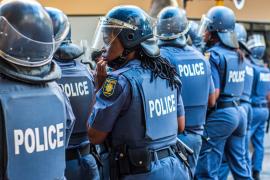
According to the police, the focus was on the reduction of contact and violent crimes in crime hotspots and the operation led to 525 arrests.
“Actions and police activities executed during the disruptive actions included, vehicle check points (VCPs), stop and searches, foot and vehicle patrols, compliance inspections, smuggling of drugs and other commodities,” the SAPS explained.
READ | 297 suspects arrested in N Cape
The police said VCPs and roadblocks were conducted across the province leading to 2 270 vehicles and 4 617 people stopped and searched.
Meanwhile, 382 suspects were arrested for murder, attempted murder, rape robbery, assault, burglary, malicious property damage, dealing and possession of drugs, illicit mining and possession of counterfeit goods.
Others who were detained included those who had suspected stolen stock, undocumented illegal immigrants, possession of precious metals as well as illegal dealing in liquor that resulted in the closure of 10 liquor outlets.
In addition, 143 wanted suspects were traced and arrested by detectives for evading court appearances and contravening court orders.
“The police confiscated large volumes of alcoholic beverages and non-ferrous metal items during inspections.”
Police also seized a large amount of drugs and cash believed to be the proceeds of drug dealing during different raids and operations across the province.
VIEW | Police carry out crime reduction duties in the Northern Cape
![]() |
![]() |
![]() |
The Provincial Commissioner of the Northern Cape, Lieutenant General Koliswa Otola, indicated that the success of Operation Shanela is due to the support of various communities and the multi-disciplinary approach with several roleplayers.
The Commissioner said the police will continue to combat any unlawful actions and ensure that victims of gender-based violence and femicide (GBVF) are given special care and attention.
“The SAPS invites the public to rate the police efforts in fighting contact crimes by participating in the ‘rate our service’ online survey to assist the police in improving services,” Otola added.
Three people die due to illegal electricity connections in Gqeberha

Police are urging residents to refrain from illegally connecting electricity because of the serious danger it poses and possibly death.
This after three people lost their lives at the weekend in Gqeberha, Eastern Cape.
According to the South African Police Service (SAPS), a property owner from Greenbushes in Gqeberha found her tenant’s lifeless body clutching on to wires on Saturday at around 2am.
The police believe that the 26-year-old man was attempting to connect electricity to his flatlet when he was electrocuted.
An inquest docket was opened and is being investigated by SAPS Kabega Park.
Meanwhile, later that evening around 9pm, a 24-year-old female in Rabie Village, Wells Estate, allegedly touched an illegal connection while crouching and died.
“An inquest docket was opened and is being investigated by SAPS Swartkops,” the SAPS statement read.
On Sunday, 21 April 2024, an 18-year-old girl allegedly stepped on an illegal connection and was electrocuted to death around 4:30am.
The police said the teenager and her friends were walking through an open space on Auburn Street, Booysens Park, when the incident occurred.
“One of the male friends attempted to help her, but after he was also shocked, he moved away.”
The police are currently probing the matter.
Trinity International Bible University unauthorised to issue honorary degrees

The Department of Higher Education and Training has warned that Trinity International Bible University is not a registered private higher education institution and not authorised to offer any qualifications, including honorary degrees.
In a statement, Higher Education, Science and Innovation Minister, Professor Blade Nzimande, said he has become aware of reports on social media of honorary doctorates that have been awarded to some of the country’s top celebrities by Trinity International Bible University.
Nzimande said the Department of Higher Education and Training has written to Trinity International University before and warned them about continuing to operate illegally and for them to regularise their operations.
He said the department has also asked the Council on Higher Education (CHE) for guidance on how honorary qualifications should be offered, and by who.
“As the department, we have nothing against Trinity International Bible University or the celebrities they have chosen to honour. We are, however, deeply disturbed by the persistent disregard for the department’s regulations by the management of Trinity International Bible University.
“The department is considering more comprehensive and decisive action against Trinity International Bible University and all other individuals or institutions, who continue to undermine the department’s regulations,” Nzimande said.
The Minister said the department is willing to engage with Trinity International Bible University and the celebrities they have honoured to better explain their position.
“Most importantly, as the Department of Higher Education and Training, we have a legal responsibility to protect the integrity of our qualifications and that of our post school education and training system,” Nzimande said.