
Progress made in restoring water supply to KZN
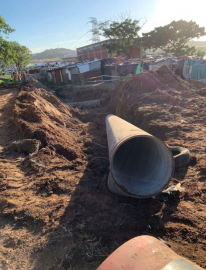
Water and Sanitation Minister, Senzo Mchunu, says the department has made progress in restoring water supply to areas that were severely impacted by the recent devastating floods in KwaZulu-Natal.
Mchunu said this when he tabled his maiden budget vote to a mini-plenary of the National Assembly on Friday.
“Good progress has been made with regards to the restoration of water supply but there has been immense damage to water and sanitation infrastructure.
“Together with the municipalities, we completed the costing of this damage and submitted an application to the Department of Cooperative Governance for national disaster funding.
Once funding is allocated, we will continue to be involved in the planning and monitoring of implementation of the reconstruction projects, with a stern focus of building back better,” he said.
Mchunu also used his budget vote speech to convey his sincere condolences to the families of those who lost loved ones in the floods.
“We would also like to express empathy for all those who are still without water and sanitation services due to the floods, and to assure them that we are working as fast as possible to restore these services.
Mchunu said immediately after the floods, the department established a water and sanitation war room, together with the worst affected municipalities.
“Our department quickly hired water tankers to supplement those available in the municipalities and we seconded a team of engineers and other specialists to the war room to assist with the implementation of emergency repair work and to assess and quantify the damage,” he said.
Phase 2 Lesotho Highlands Water Project to start delivering water by 2027
Mchunu said, meanwhile, that the R36 billion Phase 2 Lesotho Highlands Water Project is aimed at ensuring an adequate long-term water supply for Gauteng and the Vaal River System.
The project is funded through finance raised by the Trans-Caledon Tunnel Authority and is being implemented jointly by the governments of Lesotho and South Africa, through the Lesotho Highlands Water Commission and the Lesotho Highlands Development Authority. “To date, 14% of the budget has been spent and the project is due to start delivering water to Gauteng in November 2027,” he said.
Call to intensify fight against GBVF

Cabinet has welcomed the swift response by law enforcement officers in arresting suspects in connection with the murder of Hillary Gardee of Kwamagugu in Mpumalanga recently.
Minister in the Presidency, Mondli Gungubele, said Cabinet in its meeting this week continued to condemn the senseless killing of women.
The 28-year-old’s lifeless body was found abandoned outside Nelspruit after she went missing on 29 April.
During a post-Cabinet meeting media briefing on Thusday, Gungubele said Cabinet further condemned the killing of six people in Khayelitsha in Cape Town at the weekend.
“These senseless murders are a reminder that we must do more as a society to end violence and gender-based violence and femicide (GBVF).
Cabinet, he said, also urged all people in the country to work with the government in the fight against GBVF.
“Together we can ensure that our communities and spreads are safer for all,” he said.
Jet fuel supply at OR Tambo airport stabilized
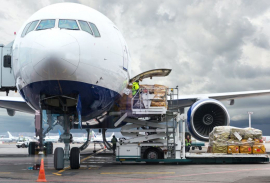
Government has worked tirelessly to resolve the jet fuel shortage experienced at OR Tambo International Airport.
This challenge was a consequence of the recent floods in KwaZulu-Natal that affected transport infrastructure and disrupted supply chains.
“We are pleased that the Airports Company South Africa (ACSA) has worked tirelessly to resolve this challenge, working with relevant stakeholders and other organs of state. The jet fuel supply to OR Tambo International has now been stabilised,” Minister of Transport Fikile Mbalula said on Wednesday.
The matter was resolved after Mbalula’s engagements with the Minister of Mineral Resources and Energy and ACSA. These entities, including the Department of Transport, were mandated to put measures in place to address the jet fuel shortage matter.
“We also welcome the Notice to Airmen (NOTAM) issued by ACSA, advising all airlines, both international and domestic, on measures being implemented to obviate disruptions to air services. The aviation sector is a critical enabler of economic activity which requires our support in ensuring that it makes its contribution to economic recovery in the aftermath of the COVID-19 devastation,” Mbalula said.
The Minister has assured the aviation sector that there is adequate fuel at OR Tambo International Airport and at all national airports.
“ACSA is doing everything within its power working closely with oil suppliers to ensure there is adequate fuel stock at all times. We further encourage the airlines to communicate with ACSA, in order to clear any uncertainty on this matter, rather than resorting to drastic measures such as cancelling flights,” he said.
Cost recovery for KZN floods estimated in the billions

The Passenger Rail Agency of South Africa’s (PRASA) preliminary assessment of the rail infrastructure that was damaged during the floods in parts of KwaZulu-Natal has been estimated at between R2.6 billion and R2.9 billion.
“A multidisciplinary Disaster Management Response Team comprising of various divisional heads, senior managers and PRASA’s engineering team was set up to assess the extent of the damage to the rail network and develop a recovery plan,” PRASA said on Tuesday in a statement.
This was after recent floods affected several parts of the province, wreaking havoc and causing extensive damage to the PRASA rail infrastructure leading to the suspension of train services.
Metrorail in the province has experienced substantial damage to its facilities, rail infrastructure as well as rolling stock.
“Under difficult circumstances, the team concluded its initial investigations. According to the collated data and photographic evidence of inaccessible areas, the direct cost of the recovery in the region is estimated to be between R2.6 billion and R2.9 billion,” PRASA said.
The preliminary investigation identified about nine sections that have been severely affected by the floods.
Restoring services will require rehabilitation and replacement of perway (tracks); repair of electrical infrastructure and substations damaged by the floods; replacement of signalling equipment; replacement of damaged fibre cables and Uninterruptible Power Supply (UPS) equipment; and repair of the drainage system and Illovo Bridge.
However, some areas are still inaccessible, and a geotechnical and detailed design assessment and costing must be conducted once water levels have decreased and weather permits.
“As part of the team’s recovery efforts, the team has divided the work into two phases: Phase 1 concerns work that needs to be performed to ensure trains are able to travel safely through the flood-affected sections, while Phase 2 focuses on the overall rehabilitation of the infrastructure.
“Additionally, the loss of fare revenue due to the suspension of train services is estimated at R50 million. This highlights the importance of the teams working quickly to restore services,” PRASA said.
The work of the Disaster Management Response Team has begun in earnest.
Last week, mud, rubble, debris, water, and sewage were removed from 14 affected stations in the region as part of a clean-up campaign.
“As a consequence of the damage, commuters who rely on affordable rail transport are inconvenienced greatly, and the suspension of train services is a blow to people trying to rebuild their lives.
“Ultimately, the safety of commuters is our top priority, and services can only be resumed once all repairs have been completed and trains can run again.
“In KwaZulu-Natal, the safety of PRASA employees remains paramount, and all work will be conducted within the confines of occupational health and safety regulations,” PRASA said.
UN team visits KZN to offer assistance in areas affected by floods

A technical team of the United Nations (UN) in South Africa is currently in KwaZulu-Natal to assess the damage in the parts of the province that were affected by the recent floods.
“We have been supporting the province following the floods in 2019 and the civil unrest of 2021. We will continue to support rebuilding efforts to ensure that no-one is left behind as part of the Memorandum of Understanding that we have in place with the provincial leadership in that province,” Acting Resident Coordinator for the UN in South Africa Ayodele Odusola said in a statement.
Represented by a technical team comprising of members from various UN agencies, the technical team, commenced with its assessment on Monday and its work will be concluded on Thursday.
The technical team is expected to meet with the Provincial Disaster Management Centre and the eThekwini Municipality to assess the areas of support by the United Nations Development System.
“We stand committed and ready to assist where needed,” Odusola said.
Eskom “cautiously optimistic” about lifting load shedding on Friday evening

Eskom says after making some ground in recovering generation capacity, it may lift all stages of load shedding on Friday evening.
The power utility has been battling generation unit failures throughout the past week, which have tipped the country into the more stringent stage four load shedding – dropping down to stage three on Wednesday evening.
Eskom CEO Andre de Ruyter said the power utility is recovering some of the lost capacity back into the system.
“We were sitting way in excess of 16 000MW of unplanned losses earlier in the week, so the system is recovering. We are seeing some big units coming back as planned. Demand for this evening’s peak is 30 011MW and our available capacity is 28 022MW. [This] therefore explains why we have to maintain load shedding stage three until after evening peak tonight.
“We intend to drop [load shedding] to stage two and then by after evening peak on Friday, we will be hopefully in a position to lift load shedding in its entirety, depending how the system performs. We will continue to return units to service over the next two days so that we will be in a position – if all goes well, given the risks – that we can then lift load shedding by the weekend,” he said.
The generation units that the power utility has been able to reconnect to the system are Arnot power station unit two and six, Kendal power station unit three, Matimba power station unit five and Majuba power station unit three.
De Ruyter said reserve generation capacity at the power utility’s open cycle gas turbines is also recovering sufficiently.
Despite progress in the recovery of generation units, De Ruyter reported that there were other unplanned breakdowns and an enforced outage from Mozambique’s Cahora Bassa Hydroelectric power station, which feeds into Eskom.
“We did lose Grootvlei [power station unit] two… due to a boiler tube leak. There is a loss of 270MW due to maintenance done on the line from Cahora Bassa. This maintenance is being conducted in Mozambique by our partners on that line, so we are doing everything we can to assist them in order to complete that maintenance.
“We unfortunately did lose Tutuka six this morning… due to a submerged scraper chain that got stuck. This chain clears the ash at the bottom of the boiler and when we cannot clear the ash, we have challenges running the boiler. That leads to a loss of about 365MW,” he said.
The week ahead
De Ruyter was cautiously optimistic about a low forecast for load shedding next week.
“At the moment… we don’t anticipate load shedding for next week. However, that is dependent on the stability of our generating units. We are all aware that there are risks in the system that are difficult to forecast and predict.
“Depending on how we perform over the weekend and depending on rain that is forecast for the Mpumalanga area… where the majority of our coal plants are located, we may potentially see further impacts and that may have an impact on availability of generating capacity particularly for Monday next week.
“But after that, if we can bring those units back that are currently planned to return to service and if we can get additional reduction in partial load losses, we should be okay. So we don’t plan for load shedding next week but we must emphasise that there is always a residual risk,” he said.
Department: Shongweni Dam in KZN has not collapsed
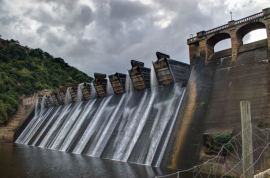
The Department of Water and Sanitation has reiterated that the Shongweni Dam, located west of Pinetown, in KwaZulu-Natal, has not collapsed.
This follows a video making the rounds on social media, alleging that Shongweni Dam has collapsed due to flooding in the province.
The department has denounced the report as untrue, and an “unnecessary ploy” by reckless social media users meant to cause panic amid a tragedy affecting KwaZulu-Natal residents.
Director in the Dam Safety Regulation Unit within the department, Wally Ramokopa, said the dam is equipped with 10 hydroplus fuse gates, which are designed to “tip” and fail in sequence to avoid catastrophic failure of the entire dam.
“Gate 1 on the far-left and Gate 2 on the far-right started tipping when the dam reached a specific level; this is part of the design and is therefore a safety measure. Had this not occurred, the dam was going to be subjected to more pressure, which would threaten the stability of the concrete wall and possible overtopping of the non-overspill crest.
“So, it is behaving as it should during flooding conditions as presently experienced in parts of KZN. A team of experienced dam safety office engineers is on high alert to monitor the situation at the dam, there is absolutely no need to be alarmed,” Ramokopa said.
Ramokopa said the rest of the eight gates would fail should the water level rise higher than 2.4 metres above the full supply level at intervals of 0.1 metres until the last gate fuses, and this should happen in a specific sequence.
He, however, admitted that the dam’s storage capacity would unfortunately be reduced if such an eventuality occurs until the fuse gates are restored.
The department reiterated its plea to residents to steer away from riverbanks and overflowing dams as persistent rains are still forecast in the province and some parts of the country during the Easter Weekend.
Government working together to relieve disaster-affected KZN

President Cyril Ramaphosa has described the loss of life and damage to infrastructure that occurred during flooding in KwaZulu-Natal as a disaster of “enormous proportions”.
The President visited the area on Wednesday following torrential rains which battered the eThekweni Municipality – leaving at least ten districts needing humanitarian and other relief.
At least 306 people have lost their lives during the flooding.
President Ramaphosa assured residents of affected areas that all spheres of government are working hand in hand to bring relief and aid to them.
“We are dealing with a calamity of enormous proportions here but our government is getting into gear [and] the [South African] Defence Force is also going to be here. We are going to roll out as much assistance to our people as we possibly can.
“This calls for working together as government and…our other provinces have already pledged support and assistance…. personnel, experts, food stuffs and all that. There is solidarity and we are working as a team.
“Right now we are dealing with the immediate situation of ensuring that those who have lost loved ones are comforted, accommodated and they are well cared for and that we should also ensure that we help them bury their loved ones and also to find their loved ones because some of their loved ones were washed away by the water through the river system so the search is still going on,” the President said.
On Wednesday evening, the national Department of Cooperative Governance and Traditional Affairs (COGTA) declared a provincial state of disaster in KZN.
This, the President said, would allow for more financial resources to be ploughed into the provision of relief and to count the cost of the floods.
“We are going to lay out professionals and engineers to look at exactly what the extent of the damage is and we will also look at the cost that it is going to take. But I have said we are going to spare nothing. We are going to do everything that is to do with this disaster and the economic part of the issue that we have to address,” he said.
The President said the disaster is an indication of the devastating effects that climate change can have.
“This disaster is obviously part of climate change. It is telling us that climate change is serious; it is here. We no longer can postpone what we need to do [and] the measures we need to take to deal with climate change. It is here and our disaster management capability needs to be at a higher level,” he said.
KZN floods declared a provincial disaster

National Disaster Management Centre head, Dr Mmaphaka Tau, has classified this week’s KwaZulu-Natal floods as a provincial disaster.
The classification, done in terms of Section 23 of the Disaster Management Act: Impact of Severe Weather Events, was gazetted on Wednesday.
Tau said the move came after having deliberations with sector Departments and the KwaZulu-Natal Provincial Disaster Management Centre.
He said the disaster management centre also assessed the magnitude and severity of the impact of the severe weather events occurring in various municipal areas of the province. These have resulted in the loss of life and damage to property, infrastructure and the environment caused by heavy rain, flooding, strong winds and landslides.
The devastating floods had claimed over 300 lives by Thursday.
“The Disaster Management Act, Section 40 read with section 23(8), designates the primary responsibility to coordinate and manage this disaster, in terms of existing legislation and contingency arrangements to the provincial executive,” said the Department of Cooperative Governance and Traditional Affairs in a statement.
Accordingly, the Department urged all state organs to further strengthen support to existing structures to implement contingency arrangements and ensure that measures are put in place to enable the province to effectively deal with the effects of this disaster.
SA has no current plans to discontinue use of coal

There are currently no plans to discontinue the use of coal as part of the country’s energy mix, says Deputy President David Mabuza.
The Deputy President said this when he responded to oral questions in the National Assembly on Thursday.
He said the country’s energy generation is guided by the Integrated Resource Plan (IRP) 2019, which provides for the use of all energy resources available, including, among others, coal, gas and renewable energy sources.
“Currently, there are no plans for the discontinuation of the use of coal as 99% of South Africa’s electricity supply is derived from coal and 30% of liquid fuels are derived from the same commodity.
“Coal remains one of our largest natural endowments that will continue to form part of our energy mix in terms of the IRP 2019,” he said.
He said, however, that despite this, the country is committed to forging a low-carbon growth path that prioritises environmental sustainability.
“We need to ensure that we deploy new infrastructure, technologies and solutions that enable us to adhere to ambient air quality standards, and protect the lives of communities from negative environmental externalities.
“Going forward, the IRP 2019 proposes the use of high efficiency, low emissions coal technologies. Government is currently working on other measures such as the Gas Utilisation Master Plan and the Renewable Energy Master Plan.”
The Deputy President said government is exploring the development of the Nuclear Procurement Framework as proposed in the IRP 2019.
He said these are part of the medium to long-term plans in ensuring security of energy supply.
“Having said that, it is important to point out that, out of the entire fleet, there are planned optimised plant shutdowns that is aligned with the Integrated Resource Plan, to balance capacity, environmental, social and economic considerations.
“This is inevitable because, in the main, these plants are approaching the end of their lifespan, and have become uneconomical, unpredictable and costly to run.
“Nine coal-fired power stations will be shut down by 2035, thereby impacting significantly on the reduction of generation capacity,” he said.