


Latest information from the the National Institute for Communicable Diseases (NICD)
This morning we had received results of the direct contact of the first patient, his wife. She had also travelled with him to Italy as part of the group of ten. I now wish to advise the public that she has tested positive for COVID-19 and is therefore the third confirmed case in South Africa. (https://www.gov.za/speeches/minister-zweli-mkhize-confirms-third-case-coronavirus-covid-19-south-africa-8-mar-2020-0000)
The Minister of Health wishes to advise all South Africans that a second case of COVID-19 has now been confirmed in South Africa. The 39 year old lady who is from Gauteng is a direct contact to the first case from KwaZulu-Natal. She was part of the group of 10 that had travelled to Italy. (https://www.gov.za/speeches/minister-zweli-mkhize-confirms-second-case-c…)
On Thursday March 5, the National Institute for Communicable Diseases confirmed that a suspected case of COVID-19 has tested positive. The patient is a 38-year-old male who travelled to Italy with his wife. They were part of a group of 10 people and they arrived back in South Africa on March 1, 2020. (https://www.gov.za/speeches/health-reports-first-case-covid-19-coronavirus-5-mar-2020-0000)
The Minister of Health, on 05 March 2020, made an official announcement of a local confirmed COVID-19 case in South Africa, of a 38-year old man from KwaZulu-Natal who travelled to Italy. The National Institute for Communicable Diseases (NICD), a division of the National Health Laboratory Service, wishes to clarify that the COVID-19 indicates the strength of our surveillance and South Africa’s health systems to be able to detect and rapidly identify cases.
The case has been isolated and containment measures are ongoing including the monitoring of contacts. It is important to note that the identification of a single imported case in a traveller from an area with widespread community transmission does not mean that COVID-19 is currently spreading in South African communities. The risk to the general community of acquiring COVID-19 remains low. (http://www.nicd.ac.za/first-case-of-covid-19-announced-an-update/)
For daily updates of countries, territories or areas with reported laboratory confirmed COVID-19 cases, please refer to:
- World Health Organisation COVID-19 situation reports https://www.who.int/emergencies/diseases/novel-coronavirus-2019/situation-reports
- Coronavirus COVID-19 Global Cases by Johns Hopkins CSSE https://gisanddata.maps.arcgis.com/apps/opsdashboard/index.html#/bda7594740fd40299423467b48e9ecf6
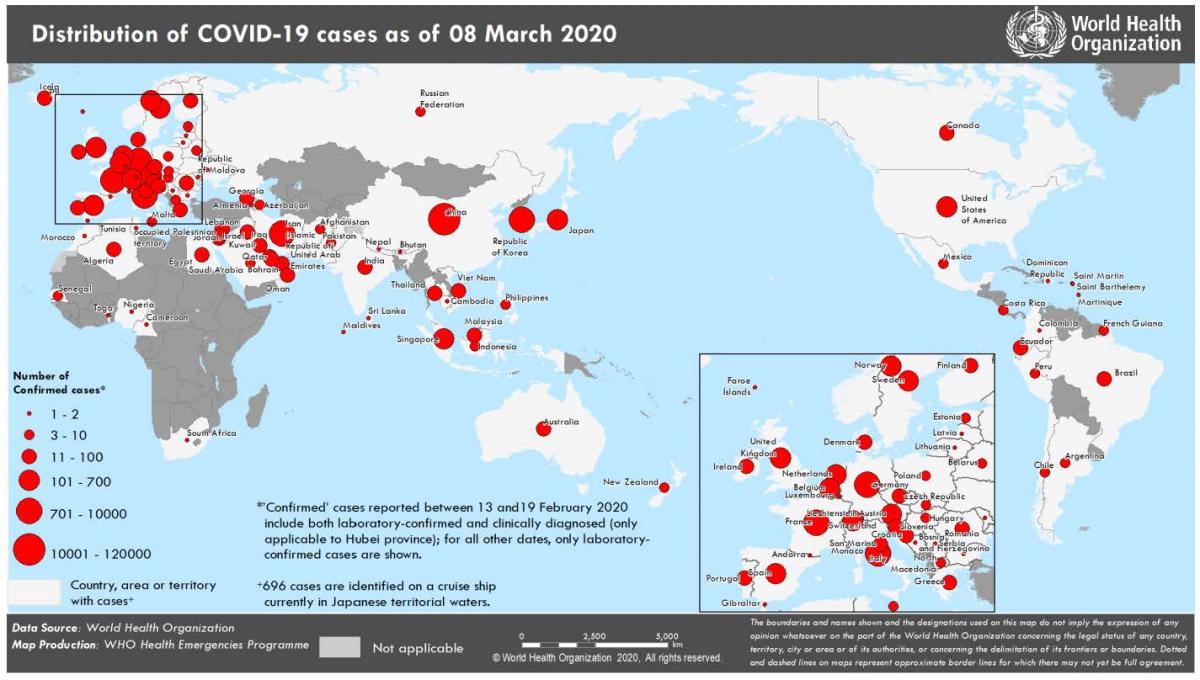
Source: World Health Organistion https://www.who.int/docs/default-source/coronaviruse/situation-reports/2…
Hotline number
National Institute for Communicable Diseases 0800 029 999
The Department of International Relations and Cooperation has set up a 24-hour hotline number for South African citizens based in Wuhan City, China.
South African Embassy in Beijing
Hotline: +86 135 0105 9041
Ms Lesego Pelompe
Mr Siyabonga Ponco
South African Consulate General in Shanghai
Hotline: +86 159 0045 4282
Ms Grace Motloutzi
Family members who require more information about their loved ones who will be repatriated can contact the Department of International Relations and Corporation (DIRCO) on the following contact details:
Email address: cicc1@dirco.gov.za or cicc2@dirco.gov.za
Telephone number: 012 351 1754.
Coronavirus / COVID-19
On 31 December 2019, the World Health Organization (WHO) was alerted to several cases of pneumonia in Wuhan City, Hubei Province of China. On 7 January identified the new virus as a coronavirus, which is a family of viruses that include the common cold, and viruses such as SARS and MERS. This new virus was temporarily named “COVID-19.”
On 30 January the WHO declared the Novel Coronavirus a Public Health Emergency of International Concern and on the same day South Africa activated its Emergency Operations Centre (EOC).
WHO has been working with Chinese authorities and global experts to learn more about the virus, how it affects the people who are sick with it, how they can be treated, and what countries can do to respond.
The situation around the COVID-19 is still evolving. You will be updated as new information becomes available.
The attached communication toolkit serves to educate and create awareness on the emerging coronavirus.
Frequently asked questions
What is 2019 Novel Coronavirus?
The 2019 Novel Coronavirus, or COVID-19, is a new respiratory virus first identified in Wuhan, Hubei Province, China.
What is a novel coronavirus?
A novel coronavirus (CoV) is a new coronavirus that has not been previously identified.
What is the source of COVID-19?
Public health officials and partners are working hard to identify the source of the COVID-19. Coronaviruses are a large family of viruses, some causing illness in people and others that circulate among animals, including camels, cats and bats. Analysis of the genetic tree of this virus is ongoing to know the specific source of the virus. SARS, another coronavirus that emerged to infect people, came from civet cats, while MERS, another coronavirus that emerged to infect people, came from camels.
How does the virus spread?
This virus probably originally emerged from an animal source but now seems to be spreading from person- to-person. It is important to note that person-to-person spread can happen on a continuum. Some viruses are highly contagious (like measles), while other viruses are less so. At this time, it is unclear how easily or sustainably this virus is spreading between people.
Is COVID-19 the same as the MERS-CoV or SARS virus?
No. Coronaviruses are a large family of viruses, some causing illness in people and others that circulate among animals, including camels, cats and bats. The recently emerged COVID-19 is not the same as the coronavirus that causes Middle East Respiratory Syndrome (MERS) or the coronavirus that causes Severe Acute Respiratory Syndrome (SARS). However, genetic analyses suggest this virus emerged from a virus related to SARS. There are ongoing investigations to learn more. This is a rapidly evolving situation and information will be updated as it becomes available.
Prevention
How can I help protect myself?
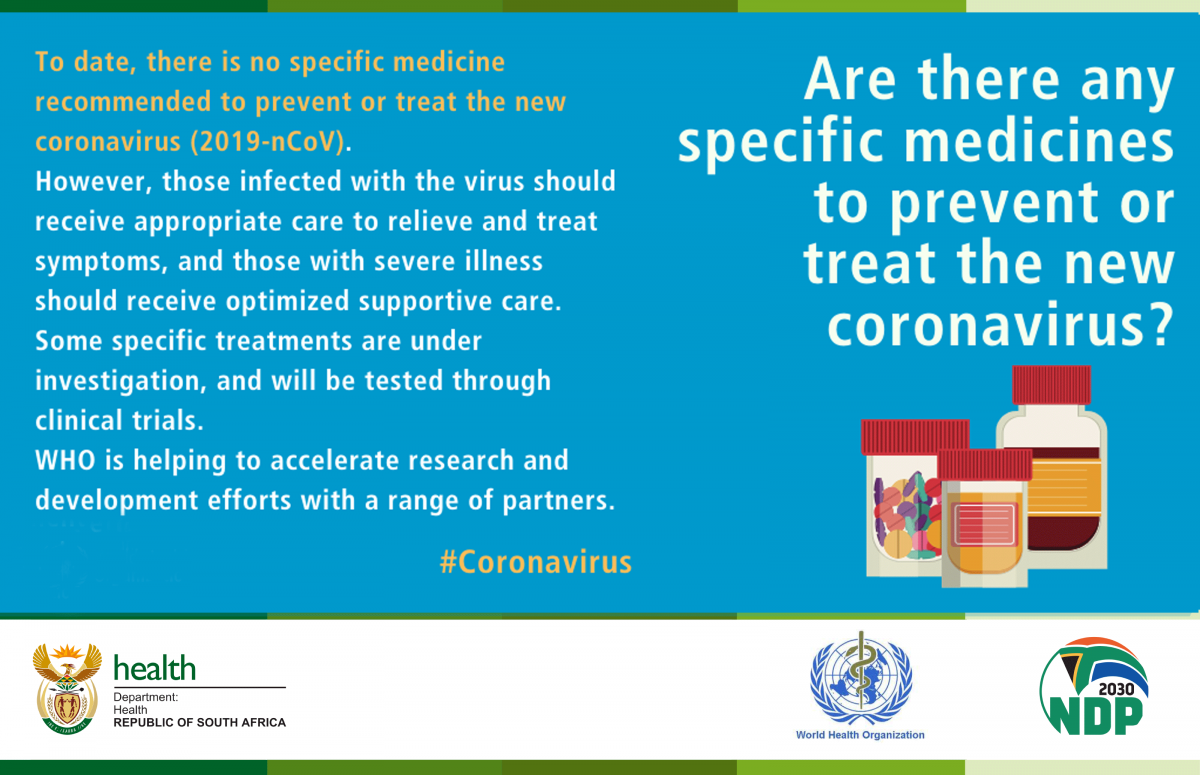
There is currently no vaccine to prevent COVID-19 infection. The best way to prevent infection is to avoid being exposed to this virus. Everyday preventive actions to help prevent the spread of respiratory viruses, includes:
- wash your hands often with soap and water for at least 20 seconds. If soap and water are not available, use an alcohol-based hand sanitiser
- avoid touching your eyes, nose, and mouth with unwashed hands
- avoid close contact with people who are sick
- stay home when you are sick
- cover your cough or sneeze with a tissue, then throw the tissue in the trash
- clean and disinfect frequently touched objects and surfaces
What should I do if I had close contact with someone who has COVID-19?
If you have had close contact with someone who is confirmed to have, or being evaluated for, COVID-19 infection, you should:
- monitor your health starting from the day you first had close contact with the person and continue for 14 days after you last had close contact with the person. Watch for these signs and symptoms:
- fever. Take your temperature twice a day
- coughing
- shortness of breath or difficulty breathing
- other early symptoms to watch for are chills, body aches, sore throat, headache, diarrhoea, nausea/vomiting, and runny nose
- if you develop fever or any of these symptoms, call your healthcare provider right away
- before going to your medical appointment, be sure to tell your healthcare provider about your close contact with someone who is confirmed to have, or being evaluated for, COVID-19 infection. This will help the healthcare provider’s office take steps to keep other people from getting infected. Ask your healthcare provider to call the health department or National Institute for Communicable Diseases (NICD)
- if you do not have any symptoms, you can continue with your daily activities, such as going to work, school, or other public areas
Medical information
What are the symptoms and complications that COVID-19 can cause?
Current symptoms reported for patients with COVID-19 have included mild to severe respiratory illness with fever, cough, and difficulty breathing.
Should I be tested for COVID-19?
If you develop a fever and symptoms of respiratory illness, such as cough or shortness of breath, within 14 days after travel from China, you should call ahead to a healthcare professional and mention your recent travel or close contact. If you have had close contact with someone showing these symptoms who has recently travelled from this area, you should call ahead to a healthcare professional and mention your close contact and their recent travel. Your healthcare professional will work with the health department and NICD to determine if you need to be tested for COVID-19.
Am I at risk for COVID-19 infection in South Africa?
There are currently no reported cases of COVID-19 in South Africa. This is however a rapidly evolving situation and the risk may change daily. Regular updates will be provided by the Department of Health and NICD.
Has anyone in South Africa been infected?
A: Yes, on Thursday March 5, the National Institute for Communicable Diseases confirmed that a suspected case of COVID-19 has tested positive. The patient is a 38-year-old male who travelled to Italy with his wife. They were part of a group of 10 people and they arrived back in South Africa on March 1, 2020. (https://www.gov.za/speeches/health-reports-first-case-covid-19-coronavirus-5-mar-2020-0000).
Am I at risk for novel coronavirus from a package or products shipping from China?
There is still a lot that is unknown about the newly emerged 2019 novel coronavirus (COVID-19) and how it spreads. Two other coronaviruses have emerged previously to cause severe illness in people (MERS and SARS). COVID-19 is more genetically related to SARS than MERS, but both are betacoronaviruses with their origins in bats. While we do not know for sure that this virus will behave the same way as SARS and MERS, we can use the information from both of these earlier coronaviruses to guide us. In general, because of poor survivability of these coronaviruses on surfaces, there is likely very low risk of spread from products or packaging that are shipped over a period of days or weeks at ambient temperatures. Coronaviruses are generally thought to be spread most often by respiratory droplets. Currently there is no evidence to support transmission of COVID-19 associated with imported goods and there have not been any cases of COVID-19 associated with imported goods.
Travel
Is it safe to travel to China or other countries where COVID-19 cases have occurred?
Travellers should avoid all non-essential travel to China.
- There is an ongoing outbreak of respiratory illness caused by a novel (new) coronavirus that can be spread from person-to-person.
- Chinese officials have closed transport within and out of Wuhan and other cities in Hubei Province, including buses, subways, trains, and the international airport. Other locations may be affected.
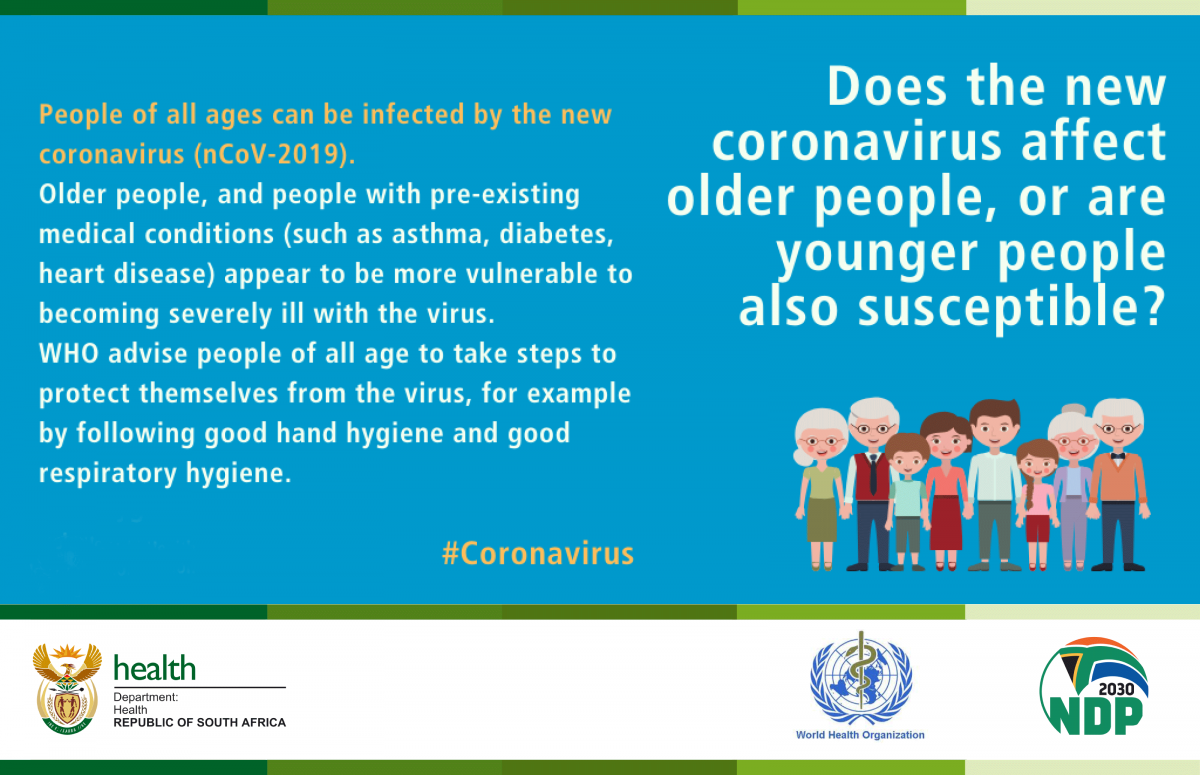
- Preliminary information suggests that older adults and people with underlying health conditions may be at increased risk for severe disease from this virus.
The situation is evolving. This notice will be updated as more information becomes available.
What if I recently traveled to China and got sick?
If you were in China and feel sick with fever, cough, or difficulty breathing, within 14 days after you left, you should:
- seek medical care right away. Before you go to a clinic, doctor’s office or emergency room, call ahead and tell them about your recent travel and your symptoms
- avoid contact with others
- not travel while sick
- cover your mouth and nose with a tissue or your sleeve (not your hands) when coughing or sneezing
- wash hands often with soap and water for at least 20 seconds to avoid spreading the virus to others. Use an alcohol-based hand sanitiser if soap and water are not available
2019-nCoV and animals
What about animals or animal products imported from China?
There is no evidence to suggest that animals or animal products imported from China pose a risk for spreading COVID-19 in South Africa. This is a rapidly evolving situation and information will be updated as it becomes available.
Should I be concerned about pets or other animals and COVID-19?
While this virus seems to have emerged from an animal source, it is now spreading from person-to-person. It is recommended that people traveling to China avoid animals both live and dead, but there is no reason to think that any animals or pets in South Africa might be a source of infection with this new coronavirus.
Should I avoid contact with pets or other animals if I am sick?
Do not handle pets or other animals while sick. Although there have not been reports of pets or other animals becoming sick with COVID-19, several types of coronaviruses can cause illness in animals and spread between animals and people. Until we know more, avoid contact with animals and wear a facemask if you must be around animals or care for a pet.
Disaster Management Act Guidelines
- Guideline on classification of a disaster and the declaration of a state of disaster
- Guideline on conducting an initial on-site assessment
- Guideline on contingency planning and arrangements
Statements
- Minister Zweli Mkhize confirms third case of Coronavirus Covid-19 in South Africa, 8 Mar 2020
- Government is identifying accommodation facilities to accommodate South Africa nationals to be evacuated from China, 7 Mar 2020
- Confirmation of second case of Covid-19 in South Africa, 7 Mar 2020
- Government dismisses M&G allegations as misleading, 6 Mar 2020
- Minister Zweli Mkhize reports first case of Covid-19 Coronavirus, 5 Mar 2020
- NATJOINTS update on repatriation process of South African citizens in Wuhan, 4 Mar 2020
- Defence on joint inter-departmental evacuation of South African citizens from Wuhan, 3 Mar 2020
- Minister Zweli Mkhize: Evacuation of citizens from Wuhan, 1 Mar 2020
- President Cyril Ramaphosa directs evacuation of South Africans from China following Coronavirus outbreak, 27 Feb 2020
- China commends South Africa for successful efforts in keeping Novel Coronavirus out of the country, 25 Feb 2020
- Minister Zweli Mkhize on Coronavirus monitoring, 1 Feb 2020