
Law enforcement to enforce legal compliance for foreign truck operators
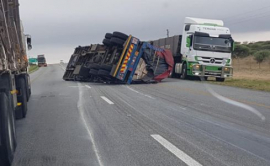
A NATJOINTS communique has been issued on Monday night directing deployment of multi-disciplinary law enforcement teams to enforce compliance of the law and ensure foreign operators driving trucks have the requisite papers and meet all the requirements of the law.
This was among the resolutions reached on Monday after Transport Minister Fikile Mbalula, alongside his Employment and Labour counterpart, Minister Thulas Nxesi, engaged protesting truck drivers and small truck operators who had blockaded the N9 and the N10 highways outside Middleburg, in the Eastern Cape. Eastern Cape Transport & Community Safety MEC Weziwe Tikana-Gxothiwe and Inxuba Yethemba Municipality Mayor Noncedo Zonke accompanied the Ministers.
In a joint statement, the Ministries said Nxesi and Mbalula accepted a memorandum of demands, “which entails legitimate demands that affect workers in the sector negatively”.
In the statement, the Ministries said the engagements with the protesting drivers and operators acknowledged that the employment of foreign nationals affects job opportunities for South African citizens.
“All the parties, being government, truck drivers and small truck operators are committed to a lasting solution within the ambit of the law,” it reads.
During the engagement, it was agreed that truck drivers and small truck operators would set up a small technical team that will engage with government on the issues.
The Technical Team was expected to report within seven working days from the date of signature.
On signature of the Agreement, the blockade of the roads will be lifted no later than 6am on 26 October 2021.
Minister Mbalula thanked the drivers for the peaceful manner they conducted their protest and for honouring the agreement to clear the blockade on the road within the time frame agreed to.
“We are pleased that the road has been cleared to allow free passage of freight on this important artery road which contributes immensely to our economy. We are committed to ensuring that the interventions we had previously agreed to, which affects other sectors in a similar manner, will be given the necessary impetus within the confines of the law,” said Mbalula.
Mpumalanga rapist, murderer handed three life sentences

Mpumalanga Police Commissioner, Lieutenant General Semakaleng Manamela, has welcomed the triple life sentence and 53 years handed down to a rapist and murderer in Mbombela.
Mfanasibili Cornelius Mnisi, aged 29, was sentenced by the Mpumalanga Division of the High Court in Mbombela on Thursday.
Mnisi is said to have terrorised defenceless women between December 2011 and November 2015.
Provincial police spokesperson, Colonel Donald Mdhluli, said: “The court heard how in December 2011, the accused took advantage of an 18-year-old woman after she lost contact with her friends at a certain tavern in Matsulu. Mnisi offered to take her home but detoured along the way and drove to his house with her and upon arrival, held her hostage and raped her at knifepoint.”
He said the matter was reported to the police in Matsulu, where a case was opened and the docket was assigned to the Family Violence, Child Protection and Sexual Offences Unit (FCS) in Kanyamazane for further investigation.
Mnisi preyed on another woman, aged 29, in October 2014.
Mdhluli said the woman was on her way to catch a bus to work in the morning when Mnisi offered to give her a lift to the bus stop.
“He instead took her to a secluded area where she was raped and strangled to death.
“The accused then dumped her body in a river thereafter. Her body was later recovered by a member of the public, who alerted the police and a case was opened. [An] investigation [was] instituted, where a manhunt was launched for the suspect,” he said.
In November 2015, the accused preyed on a 20-year-old woman when he invited her to visit him at Matsulu. Mnisi introduced the victim to one of his family members but later took her to a secluded area where he raped and strangled her until she was unconscious.
The accused thought that the woman was dead and as a result, dumped her in the Kruger National Park.
Mdhluli said the woman, however, later regained consciousness and found an opening in the fence where she got help from people at the nearby houses.
“Police were informed about the incident and a case was opened,” he said.
A team of detectives from the FCS Unit at Kanyamazane worked tirelessly to locate and arrest the suspect.
A breakthrough was made when they cornered Mnisi at Matsulu in November 2015, where he was charged accordingly.
Mnisi was given three life sentences on two counts of rape and on one count of murder. He was also sentenced to 10 years’ imprisonment for another separate count of rape. He was further handed 15 years’ imprisonment for robbery, plus an extra 15 years for another separate robbery.
For defeating the ends of justice, the accused was sentenced to three years imprisonment. Meanwhile, he received 10 years imprisonment for a count of attempted murder.
The accused was also found to be unfit to possess a firearm and his name will be entered into the Register of Sexual Offenders. The Provincial Commissioner further indicated that the police are elated with the collaborative effort made by the investigating team, the prosecution and the judiciary.
Over 700 arrests in latest O Kae Molao operation

Over 700 suspects were arrested across Gauteng during an O kae Molao Operation this past week.
The weekly operation is integrated with different law enforcement agencies such as the South African Police Service (SAPS), the Traffic Department, Metro Police Department, Immigration from the Department of Home Affairs, Tracker, Fidelity, and Community Police Forums, among others.
Police Minister Bheki Cele, Gauteng Premier David Makhura and MEC for Community Safety, Faith Mazibuko at the weekend joined Gauteng SAPS Commissioner Lieutenant General Elias Mawela at an operation in Tshwane.
During the operation, the Minister, Premier and MEC assisted in stopping and searching vehicles at a roadblock and interacted with motorists.
“The operation saw over 700 people being arrested throughout the province for various crimes such as theft of motor vehicles, possession of illegal firearms, possession, car breaking,drunk driving, murder, rape and undocumented persons,” said the SAPS in a statement.
The Provincial Commissioner expressed appreciation to stakeholders for agreeing to join forces with Gauteng SAPS in ensuring the safety and security of the people of Gauteng. The public was also urged to continue adhering to lockdown level one regulations in order to minimise the spread of COVID-19.
Fight to combat GBVF is a societal one

Justice and Constitutional Development Deputy Minister John Jeffery says the fight against gender- based violence and femicide (GBVF) is not one that government can win alone.
He was speaking during the presentation of Social Change Assistance Trust’s (SCAT) research into GBVF.
The research aimed to identify and understand how community based advice organisations are dealing with GBVF and its impact in rural areas.
Jeffery highlighted that government has taken strides through legislation and other measures to fight the scourge but, communities also need to become involved.
“Over the past two years, South Africa has had to ask itself some tough questions in relation to GBV. Our country has some of the most advanced legislation in the world in dealing with GBV matters, so why are levels of GBV so high? What can be done to improve under-reporting?
“We cannot rely on legislation only in trying to combat and prevent GBVF – communities, civil society and religious institutions all have a role to play,” the Deputy Minister said on Wednesday.
Jeffery emphasised that addressing the root cause of GBV lies in engaging men and fighting the patriarchal systems that still exist.
“We have to talk to men and boys, because men have been the dominant perpetrators of GBVF. Men are often the problem – and therefore men have to be part of the solution.
“Studies have shown that patriarchal value systems are still prevalent in South African families and communities. Some men believe that male dominance and male entitlement is the norm. Some men believe that domestic violence is a private matter that happens behind closed doors and is therefore acceptable. These are the attitudes that we must change,” Jeffrey said.
He said the recognition of the need for dialogue has led to the department establishing “Under the Tree Dialogues” in communities.
“The aim is…to vigorously engage with men and boys to change the toxic attitudes and beliefs around masculinity and patriarchy that lead to violence against women and children.
“This is also where our schools, our religious institutions and our communities have a fundamental role to play and if a particular [community based advice organisation] identifies a need for such a dialogue to take place in a specific area or community, [they] should feel free to engage with us in order to make these dialogues a reality.”
Jeffery listed some key interventions that government has installed to fight GBVF and to “offer enhanced services and protection” to the survivors and victims of GBV. These include:
- Three anti-GBV Bills which were recently passed by Parliament to strengthen the response to GBV and to offer further protection to survivors of GBV.
- The establishment of Sexual Offences Courts, which offer victim-support services.
- The use of in-camera testifying services for children, persons with mental disabilities, and all traumatised victims.
- The approval of regulations, which set out a catalogue of support services and resources that must constitute a section 55A Sexual Offences Court. These services include court support, court preparation, emotional containment, trauma debriefing, counselling, private testifying service, intermediary services and information services.
Victims and survivors of GBVF can call the Gender-Based Violence Command Centre toll-free on 0800 428 428 for assistance or send a “please call me” at *120*7867# with a request that a social worker contact them or they can also sms the word “help” to 31531.
Presidency condemns criminal attacks on journalists

Minister in the Presidency Mondli Gungubele has joined the South African National Editors’ Forum (SANEF), in condemning criminal attacks on journalists while out on assignments in various communities.
This comes after a news reporter and camera operator from eTV were robbed at gunpoint, by armed robbers on Monday in Khayelitsha, Cape Town.
In a statement on Wednesday, Gungubele noted with concern reports of an attack on eTV journalist Natalie Malgas and camera operator Lance Manjoro who were robbed outside a Khayelitsha Primary School while covering the build-up to the local government elections.
The Minister has wished the eTV crew a speedy recovery from the traumatic incident in which they were physically unscathed but were robbed of personal possessions and professional equipment.
Gungubele said that it is particularly deplorable and noteworthy that this incident occurred in a week in which our country observes Black Wednesday – the day in 1977 in which the apartheid state cracked down on the media and freedom of expression.
“The media are an important factor in our democratic order and in the lives of citizens. Criminals who victimise journalists are victimising communities for whom access to information is a right and an important form of empowerment.
“Communities suffer when journalists are unable to perform their assignments which often includes a focus on improving the living conditions of communities or giving a voice to people who would otherwise not be heard.”
The Minister also shared SANEF’s concern about cyber-bullying and the abuse of social media targeting journalists.
“We fought long and hard for media freedom and we will not take lightly opportunistic or targeted crime or abuse perpetrated against journalists,” he said.
Comply with COVID-19 directions or face fines

The Department of Employment and Labour’s Inspection and Enforcement Services has appealed to employers, supported by employees and organised labour to comply with the COVID-19 occupational health and safety direction or face fines.
Published on 11 June 2021, the minimum requirements of the 4th Direction, “Occupational health and safety measures in workplaces, COVID-19, 2021,” applies to employers and workers in workplaces who are permitted to continue or commence operations under the Disaster Management Regulations.
These Directions apply for the duration of the national state of disaster and are subject to the employer’s obligations under the OHSA to conduct a risk assessment, while employers with less than 10 employees need only to apply Section 12 of Directions.
In a statement, the department’s Chief Inspector Tibor Szana said that if the employer employs more than 50 employees, that employer must submit a record of its risk assessment, to its health and safety committee and retain a written copy of that risk assessment, plan and policy.
“In addition to the other duties placed on the employer, an employer who employs more than 50 employees in a workplace must submit the following categories of data to the NIOH in the manner set out in the National Department of Health Guidelines,” Szana said.
The department says the employer must submit the data referred to hereunder in the following manner: Only once in respect of each employee’s status, for example, each employee’s vulnerability status for serious outcomes of a COVID -19 infection.
Before Tuesday of each week in respect of the data referred to hereunder for the previous calendar week commencing on Sunday, that is:
- details of the COVID -19 screening of employees who are symptomatic;
- details of employees who test positive in terms of a positive laboratory test;
- the number of employees identified as high risk contacts within the workplace if a worker has been confirmed as being positive; and
- details on the post-infection outcomes of those testing positive, including the return to work assessment outcome.
The Chief Inspector said that the employer must inform its employees of the submission made to the National Institute for Occupational Health (NIOH) or Department of Health and advise them of its adherence to the PoPI Act, 2013 (Act No.4 of 2013).
“The employer may submit the indicated data to an employer association if the association has entered into an agreement with the NIOH to receive, process and submit the data to the Institute; and undertaken to submit the data on behalf of the employer,” he said.
In relation to Section 16 of the Direction, the department said that the following should be taken cognisance of:
- If a person fails to comply with this direction, an inspector may perform any of the functions in section 29 of the OHSA and exercise any of the powers listed in section 30 of the OHSA in order to monitor compliance with this Direction.
- In so far as any contravention of these Directions constitutes a contravention of an obligation or prohibition under the OHSA, the offences and penalties provided for in section 38 of the OHSA apply.
“It is therefore a contravention not to comply with the Direction published by the Minister of Employment and Labour and is punishable by up to R100 000 or two years’ imprisonment or both in the case where an employee becomes injured or dies,” Szana said.
The data indicated above can be sent to the following:
For the data collection and transfer to commence, the business or organisation would need to be registered using the Occupational Health Surveillance Systems Web Portal (available through this link: https://ohss.nioh.ac.za/ ) so that a Unique Business ID is allocated to the business. This unique business identity would need to be provided in every data submission transaction to the NIOH.
For data reporting, the OHSS support desk can be contacted via email: OHSworkplace@nioh.ac.za or telephone: 0713981169 or 0723215503 and for technical queries, the IT support desk can be contacted via email: ohssupport@nioh.ac.za
Templates and more information on the OHSS can be found at: https://www.nioh.ac.za/covid-19/occupational-health-surveillance-system-ohss-business-portal/
Forty-two military veterans get bail

Forty-two of the 53 members of the military veterans accused of kidnapping two Cabinet Ministers and a Deputy Minister have been released on R500 bail.
The 42 received bail at the Kgosi Mampuru II Correctional Facility in Tshwane on Tuesday.
In a statement, the South African Police Service (SAPS) said the hearing was conducted with the 13 of the 52, who are first offenders and their addresses have been verified.
The group were arrested after allegedly holding Minister in the Presidency Mondli Gungubele, Defence and Military Veterans Minister Thandi Modise and her Deputy Thabang Makwetla hostage at St Georges Hotel in Irene, Centurion, last week. They were rescued by members of the Special Task Force team.
“Bail was set at R500 for them and the case postponed to the 1 February 2022 at Pretoria Central Magistrates Court,” said the SAPS.
The 13 are: Sizwe Maphumulo (50), Joseph Mthembu(50), Aaron Magooa(55), Abel Sekele(61), Johannes Modise(47), Nontyatyambo Samuel (female) (54), Thabiso Mashiya (47), Sibusiso Mazibuko (51), Kleinbooi Madontsela(51), Joseph Simelane(49), Dumisani Thwayo (49) and Alfred Seatlakgame (47).
After the court came back from recess, bail of R500 was also granted for the 27 accused who have previous convictions outstanding on minor cases but their addresses have not been verified. They also will appear in the Pretoria Magistrates Court on 1 February 2022.
The remaining 11 accused have relevant previous convictions on serious offences, which include murder, kidnapping, armed robbery and rape. These accused were remanded in custody and will appear again on Friday in the same court.
Education bolsters inmate rehabilitation

The Department of Correctional Services says education remains a key element in the rehabilitation of inmates at facilities.
This as 211 inmates prepare to sit for this year’s National Senior Certificate or final Grade 12 examinations.
“Access to education remains the pillar of rehabilitation and formal education ensures that offenders remain focused amid their circumstances as they strive for new beginnings.
“Education is regarded as an essential component of the reconstruction, development and transformation of South African society. Hence, formal education in DCS cannot only respond to the rehabilitation needs of inmates but be viewed as a tool that can radically transform our society and advance the development of the country,” the department said.
The department runs at least 17 Correctional Schools which offer basic education in line with the national curriculum.
Those sitting for examinations at correctional facilities have beaten the national pass average and recorded improved pass rates for the past two years.
The department said although preparations for this year’s examinations have faced “challenges brought by COVID-19”, inmates are well prepared.
“DCS educators…put in extra support classes and went beyond the allocated hours in a day’s work in an effort to ensure that inmates are not just ready but do achieve the best possible results.
“Working together with the Department of Basic Education, DCS can guarantee yet another credible examination process as all examination centres will be invigilated as per the rules governing exam procedures,” the department said.
KwaZulu-Natal Task Team secures conviction for multiple murderer

A man suspected to be involved in the murder of Orlando Pirates goalkeeper Senzo Meyiwa has been convicted for a reign of terror that claimed the lives of six people in 2016.
The Esikhaleni Regional Court, in KwaZulu-Natal, on Monday found Fisokuhle Ntuli guilty of the murders of Councillor Thami Goodwill Nyembe, Butiza Sandisa Mahlobo, Sphamandla Zungu and brothers Phiwayinkosi Mcebisi and Sibusiso Zulu.
Ntuli also shot and critically wounded Nolwazi Nyembe, the wife of Thami Nyembe, which resulted in the case of attempted murder.
He was further convicted of four counts of unlawful possession of a firearm and ammunition where one of the firearms stolen was from a policeman in Ezibeleni in Queenstown in 2011.
In a statement, the South African Police Service (SAPS) who welcomed the conviction, said that at the sentencing hearing the defence team requested that a pre-sentencing report from a parole officer and a social worker be presented to the court before sentencing is passed.
The judge granted the request and Ntuli is expected reappear in court on 9 Decemeber 2021 for sentencing.
A multidisciplinary integrated Political Task Team in KwaZulu-Natal began investigating Ntuli on one count of murder and another of attempted murder following the shooting of the Nyembe couple in KwaNongoma, KwaZulu-Natal in 2016. The Task Team comprised of Senior Public Prosecutors, SAPS Detectives, Directorate for Priority Crime Investigations (Hawks), Forensic Experts and Crime Intelligence
“Following intensive investigations by the team, Ntuli was linked to the other five murders.
The SAPS said Ntuli’s reign of power was not only carried out in the northern parts of the province, he is also a person of interest in several other cases in Gauteng, many of which are murders, including that of Senzo Meyiwa.
“The outcome of this case is expected to send out a clear message to potential anarchists of the seriousness with which the Criminal Justice System deals with serious and violent crimes throughout the country,” said the police.
NERSA, Eskom head to court over pricing

The National Energy Regulator of South Africa (NERSA) says it is studying a court application by Eskom, which seeks to compel the energy regulator to reconsider Eskom’s tariff increase application.
This as NERSA rejected Eskom’s multi-year electricity tariff increase application at the end of September.
On Monday, the power utility said it had filed an application in the High Court to review NERSA’s decision to reject the tariff increase, citing the move as its only option.
“Regrettably, this is the only available option to avoid extremely serious and negative consequences for Eskom and by necessary consequence, to National Treasury. The urgent High Court review requires NERSA to urgently process the Eskom revenue application for at least one year, as required by law.
“The proposed timeframe allows for a decision to be made in time for implementation by 1 April 2022,” Eskom said.
At the end of September, NERSA announced that it had rejected Eskom’s price application and had published a consultation paper on principles to be used when determining pricing.
“The new price determination approach will also take into consideration the rapid transformation of South Africa’s electricity sector, respond to the transformation of the Electricity Industry and associated energy security concerns, rising electricity prices as well as the increase in self and private sector electricity generation,” NERSA said at the time
Now Eskom says Nersa’s approach to price determination is “impossible” to apply.
“NERSA… requires Eskom to make a new application based on a methodology yet to be developed. This is impossible both from a legal process and timing point of view. It is hoped that NERSA will respond in a manner that allows for the stability of the country’s economy and the electricity industry,” the power utility said.