
Higher Education unable to clear all student debt
Higher Education and Training Minister, Dr Blade Nzimande, says the department is not in a financial position to be able to support institutions to clear all the debt of fee-paying students.
Responding to the South African Union of Students (SAUS) letter of demands, Nzimande acknowledged that there are many students whose families struggle to keep up with fee payments, and many families who have also been negatively affected by the COVID-19 pandemic.
However, given the difficult fiscal situation, the Minister said all government departments, including Higher Education and Training, have been subject to budget reductions in 2020 and 2021.
“I am aware that many institutions are doing what they can to assist students in need, and to allow them to make payment arrangements to be able to register, where this is possible.
“However, institutions also have to remain financially sustainable in order to continue to operate effectively, and financial decisions are made at the level of university councils.
“The historic debt of National Student Financial Aid Scheme (NSFAS) qualifying students is being addressed through a process between NSFAS and institutions.
“NSFAS-qualifying students with historic debt are able to register when they sign an Acknowledgement of Debt (AOD) form, while the process is underway,” Nzimande said.
Postgraduate funding to be addressed in policy review
Regarding the immediate provision of post-graduate funding, the Minister said the department is advocating for advanced diploma qualifications to be included in the funding framework.
Nzimande acknowledged that postgraduate funding is an issue that requires attention, as there is limited funding available from the National Research Foundation (NRF).
However, he noted that in 2021, the new NRF policy considers funding of students who were NSFAS recipients.
“This is an important matter that needs to be addressed in the policy review process that will be undertaken in 2021 by the department, as outlined in my media statement on 11 March 2021,” Nzimande said.
The Minister reiterated that all first-time entering students will be able to register following the commitment to reprioritise funding from the department to address the NSFAS shortfall for 2021.
First laptop deliveries to be made in April
On the provision of laptops for students, the Minister said that NSFAS has placed a first order for laptops, and these will be made available to students, in line with the agreed processes, as soon as they are available.
NSFAS has indicated that the first deliveries will be made in April 2021.
Nzimande has also ordered that all student allowances be provided in March when the academic year starts, and landlords are already harassing students for payment.
“These processes are being managed by individual universities, in line with their registration dates. However, NSFAS funding to students is only released once students are registered and confirmed for funding.
“It is also important to note that NSFAS will receive its first tranche from the fiscus on 1 April 2021, in line with National Treasury’s processes.”
Institutions reminded to adhere to enrolment plan
The Minister said the department works together with institutions to agree on an enrolment plan.
The current enrolment plan covers the period 2020 to 2025.
Nzimande reminded institutions to adhere as closely as possible to their enrolment plans, as they guide both the funding of the system, as well as ensure that they have the capacity to support quality education for their students.
“Should the system expand beyond the agreed enrolments it will be unable to provide effective teaching and learning. The matter relating to UNISA’s [University of South Africa] decision to reduce its enrolments based on over enrolments in 2020 is currently in the courts,” he said.
Academic records
Nzimande emphasised that students must be provided with their academic records and certificates, even those who owe the universities.
He said all institutions have confirmed that they have mechanisms in place to ensure that students with debt are able to receive academic records and certificates of completion for the purposes of further study and accessing employment opportunities.
“The department works directly with institutions, where necessary, to facilitate queries on these matters. I agree that no student should be prevented from accessing employment or other opportunities because they have outstanding fees,” the Minister said.
SA records 1 006 new COVID-19 cases
South Africa now has 1 529 420 confirmed COVID-19 cases after 1 006 people were confirmed to have contracted the virus in the last 24 hours.
According to the latest data, the new infections represent a 4% positivity rate.
Health Minister, Dr Zweli Mkhize, confirmed that 65 patients lost the battle to the respiratory disease, pushing the death toll to 51 326 since the outbreak.
The Free State recorded the highest number of deaths after 27 more people lost their lives in the last 24 hours.
The province is followed by KwaZulu-Natal with 20 fatalities, 12 in Gauteng, five in the Western Cape and one in the Eastern Cape.
“We convey our condolences to the loved ones of the departed and thank the healthcare workers who treated the deceased,” the Minister said.
The recovery rate is holding steady at 95% after 454 290 people recovered.
“The cumulative total of tests conducted is 9 450 492, with 23 903 tests completed since the last report,” the Minister said, adding that active cases now stand at 23 804.
In addition, the number of health workers vaccinated is 145 544.
Global perspective
According to the World Health Organisation (WHO), there are 119 220 681 confirmed global cases, including 2 642 826 deaths.
“As of 10 March 2021, a total of 300 002 228 vaccine doses have been administered,” the WHO said.
On Friday, WHO added the Johnson & Johnson vaccine to the list of safe and emergency use in all countries and for COVAX rollout.
This comes on the back of the European Medicines Agency (EMA) authorisation announced last Thursday.
“Every new, safe and effective tool against COVID-19 is another step closer to controlling the pandemic. But the hope offered by these tools will not materialise unless they are made available to all people in all countries.
“I urge governments and companies to live up to their commitments and to use all solutions at their disposal to ramp up production so that these tools become truly global public goods, available and affordable to all, and a shared solution to the global crisis,” said WHO Director-General, Dr Tedros Adhanom Ghebreyesus.
This vaccine is the first to be listed by WHO as a single dose regimen.
The agency also listed the Pfizer/BioNTech, AstraZeneca-SK Bio and Serum Institute of India vaccines for emergency use.
Committee to assess progress on North West Section 100 intervention
Parliament’s Ad Hoc Committee on section 100 Intervention in the North West will visit the province this week to assess progress and the impact of the intervention.
In a statement on Sunday, the committee said central to its visit, is to assess if the intervention has had a direct impact on service delivery and the lives of the people of the province.
Cabinet in May 2018 placed the province under administration following several governance lapses.
According to Section 100 of the Constitution, national government interventions in a provincial administration may take place when a province cannot or does not fulfil an executive obligation in terms of the Constitution or legislation.
“The visit is constitutionally mandated as Section 100 (2) (c) prescribes that if the national executive intervenes in a province, the Council must, ‘while the intervention continues, review the intervention regularly and may make any appropriate recommendations to the national executive’. The visit follows extensive engagements that the committee had with the Inter-Ministerial Task Team (IMTT), National Treasury, the Office of the Auditor-General and law enforcement agencies,” said the Committee.
Some of the issues raised that still needed attention was the high vacancy rate in senior management, especially heads of departments within the province.
“Also, the slow pace of consequence management was raised as a serious issue that had the potential of undermining confidence the people of the province had in the intervention.”
The Committee said another matter of concern was the reported hostility in the intervention team which impacted its ability to implement intervention strategies to turn things around in the province.
“The committee will use this visit to assess if those issues of concern have improved and if the intervention is making an impact on the lives of the people of the North West Province,” the Committee said.
The committee has also raised concerns about the pace of investigations that may lead to prosecution of wrongdoers.
“While we remain cognisant that investigation must be meticulous and sometimes lengthy in efforts to ensure watertight legal processes, we remain concerned that some cases have dragged since 2018 with no set timeframe for conclusion of the investigation,” said China Dodovu, Committee chairperson.
As part of the visit, the committee will interact with the North West Provincial Executive, the IMTT, the National Prosecuting Authority, administrators, labour organisations, Department of Health, and the Department of Basic Education.
The committee will also visit various sites, including Mahikeng hospitals, schools and Madibogo-Pan Bridge and road to assess service delivery.
Employers urged to prepare for filing season
The South African Revenue Service (SARS) is calling on employers to prepare data for the annual employers filing season.
“SARS calls on employers to ensure that they are ready to submit their annual reconciliation declarations with the latest and most accurate payroll information about their employees and the tax they have deducted,” said the revenue service.
The revenue service said it is committed to providing certainty and clarity to all taxpayers and traders regarding their tax and customs obligations so that they can remain compliant and to ensure that transacting with the organisation is as simple and easy as possible.
However, the ease and simplicity of transactions with SARS depends on each segment of taxpayers, traders and third parties fulfilling their legal obligations to ensure a seamless service offering by SARS.
“At the same time, SARS expects that providers of third party information from institutions who administer medical aid schemes, retirement annuities and others also provide the latest and accurate information to make it easy for taxpayers who are required to file an income tax return,” said the revenue service in a statement on Friday.
The data that must be submitted to SARS from employers should cover the Monthly Employer Declarations submitted, payments made and Tax Certificates (IRP5/IT3) (a)s generated, covering the full tax year from 1 March to 28/28 February.
Information submitted by third parties should cover the same tax period.
“From the side of employers, their payroll data is of vital importance to SARS. Firstly, it gives a reconciled account of what amounts of tax the employer deducted from the taxable remuneration of each of its employees.
“Secondly, it shows what amount of tax the employer has paid to SARS on behalf of the employee. It also records other allowances that an employer pays to an employee as part of their remuneration benefits,” said the revenue service.
Based on this payroll information and data from third parties, SARS will be able to issue an income tax return to taxpayers that is pre-populated with the relevant information for the ease and convenience of taxpayers who do not have complex tax affairs.
“For these taxpayers, filing a return becomes a simple matter of checking that all the information pre-populated on the return is correct and then submitting the return to SARS.”
Employers and third parties have from 1 April to 31 May to submit their data to SARS.
COVID-19
In the context of the COVID-19 pandemic and the relief offered to individuals, employees and employers in distress, SARS is determined to ensure that the compliance rate among employers increases substantially this year.
Employers who fail to submit payroll data on time may become liable for late submission penalties of up to 10% of the value of their payroll.
SARS highlighted that during the challenging period of COVID-19, it is incumbent on every taxpayer and trader to remain compliant.
“Such compliance and revenue contributions enables government to provide the important social goods and services to vulnerable South Africans and to employ our heroic frontline workers in the fight against COVID-19.
These contributions have also enabled government to begin a vaccination programme to create a herd immunity against the virus.”
Meanwhile, the revenue service has thanked compliant employers who have remained compliant every year by filing their declarations and making the necessary payments on time.
“In the interests of their employers and a seamless and hassle-free filing season, we urge all employers to now prepare accurate and up-to-date information that should be submitted to SARS. “
For more details on the submission of payroll data and the online platforms available for submission, employers can visit the PAYE page on the SARS website www.sars.gov.za
SA records 31 COVID-19 deaths
Government on Sunday announced a further 31 Coronavirus-related deaths and 862 cases.
The latest numbers are down from the 1 227 new cases and 81 deaths reported on Saturday.
Of the latest fatalities, 12 occurred in Gauteng, 11 in the Western Cape, four in Mpumalanga and two each in the Free State and KwaZulu-Natal.
“We convey our condolences to the loved ones of the departed and thank the healthcare workers who treated the deceased patients,” said Health Minister, Dr Zweli Mkhize.
This pushes the death toll to 50 678, while the cumulative number of COVID-19 cases has now peaked to 1 521 068.
“Our recoveries now stand at 1 440 874, representing a recovery rate of 94.7%,” the Minister said, adding that there are currently 29 516 active cases.
The information is based on the 9 255 492 tests conducted, 18 989 of which were performed since the last report.
Meanwhile, the number of healthcare workers vaccinated has risen to 101 841.
Globally, the World Health Organisation (WHO) is reporting 116 135 492 confirmed cases, including 2 581 976 deaths.
In addition, 249 160 837 vaccine doses have been administered as of 8 March, WHO said.
15 to appear in court for drunk driving
Fifteen men are expected to appear in the Kliptown Magistrates Court on Monday on charges of driving under the influence of alcohol.
The men, aged between 20 and 40, were arrested on Saturday in Eldorado Park, Johannesburg.
“This kind of behaviour is highly regrettable and will not be tolerated, as it undermines our efforts to promote road safety.
“We call upon drivers to be responsible and resist the temptation of drinking and driving on our roads, especially since we approach the Easter season period,” Gauteng Traffic Police spokesperson, Sello Maremane, said.
He said the majority of road traffic crashes are as a result of road user behaviour, which includes driving under the influence of alcohol.
“Anyone found drinking and driving could face up to six years in custody, if convicted in a court of law. The consequences are dire for young people, since they will acquire a criminal record, denting their chances of employment, especially within the public sector,’’ Maremane said.
Gauteng Traffic Police will continue to enforce compliance with road safety rules and regulations in an effort to save the lives of road users.
President Ramaphosa accepts resignation of Advocate Noko
President Cyril Ramaphosa has agreed to a request by the North West Director of Public Prosecutions, Advocate Moipone Noko, to resign from the National Prosecuting Authority (NPA) with effect from 1 March 2021.
In November 2020, National Director of Public Prosecutions Advocate Shamila Batohi – with the support of Minister of Justice and Correctional Services Ronald Lamola – requested the President to institute an inquiry into Advocate Noko’s fitness to hold office and to suspend the advocate pending the outcome of the inquiry.
“Having considered this request, the President agreed that an inquiry be held. In a communication dated 9 February 2021 and channelled through the Minister of Justice and Correctional Services, the President requested Advocate Noko to provide written reasons why she should not be suspended pending the institution and finalisation of an inquiry into her fitness to hold office,” the Presidency said.
As a matter of courtesy, on 11 February 2021, the National Prosecuting Authority, as the employer, informed Advocate Noko that she should expect to receive the letter from the President.
On 14 February 2021, Advocate Noko requested permission to vacate her office.
“The National Director of Public Prosecutions (NDPP) forwarded Advocate Noko’s request to resign, via the Minister and with his support, to the President with the recommendation that Advocate Noko be allowed to vacate her position,” the Presidency said.
The National Director’s request to the President in November 2020, to institute an inquiry into Advocate Noko’s fitness to hold office, followed the publication of what has become known as the De Kock Report.
“This report was compiled by an expert panel in the context of the NDPP’s review of the authorisations of Advocates Jiba and Abrahams to institute a racketeering prosecution, in terms of the Prevention of Organised Crime Act, against General Johan Booysen, former head of the KwaZulu-Natal Directorate for Priority Crimes Investigation (the Hawks), and other police officials.
“Concerns arose with regard to the conduct of certain NPA officials, including Advocate Noko,” the Presidency said.
The National Director evaluated the findings made in the De Kock report, as well as certain High Court judgments.
“Legal opinion was also sought from private counsel who, after evaluation, advised that the matter be referred to the President to consider instituting an inquiry.
“The National Director subsequently recommended to the President that an inquiry be held into the fitness of Advocate Noko to hold the office of Director of Public Prosecutions,” the Presidency said.
NSFAS clarifies confusion on funding for R350 grant beneficiaries
The CEO of the National Student Financial Aid Scheme (NSFAS), Andile Nongogo, has clarified incorrect information posted on Twitter, stating that those who are currently receiving the R350 grant do not qualify for NSFAS funding.
“NSFAS would like to clarify that it is factually incorrect to say that a person who receives the R350 grant will not be funded. The NSFAS funding criteria looks at the combined total household income of R350 000,” said NSFAS.
The R350 social relief of distress grant is a temporary grant meant to help the unemployed in the wake of the COVID-19 pandemic.
Nongogo said NSFAS takes full accountability for the incorrect information that was shared as “this was erroneously sent by an uninformed employee”.
“It is important to note that all SASSA [South African Social Security Agency] grant recipients are funded automatically. NSFAS apologises for any inconvenience this might have caused,” Nongogo said.
SA marks one year of COVID-19 pandemic
Today marks exactly a year to the day that South Africa confirmed its first COVID-19 case.
On 5 March 2020, Health Minister, Dr Zweli Mkhize, announced the news of a 38-year-old COVID-19 patient from KwaZulu-Natal.
The man tested positive after a ski trip in Italy with his wife and eight others, sending shock waves through the nation.
Since then, the country’s COVID-19 caseload has topped 1.5 million, with over 50 000 people succumbing to illnesses related to the infectious disease.
Last year when the number of cases reached 61, President Cyril Ramaphosa announced the National State of Disaster on 15 March. This saw government banning travellers from the most affected countries.
A week later, government imposed a 21-day lockdown – alert level 5. This would see a cessation of the sale of non-essential items including alcohol, tobacco and clothing, and the ban of social gatherings and restrictions for the conduct of funerals.
Cases continued to climb, threatening to put the country’s healthcare system under enormous strain.
South Africa had to act fast to prevent an unmanageable rise of cases.
Government was forced to close off South Africa by cancelling flights, suspending public transport and shutting non-essential shops, businesses and schools.
“All South Africans will have to stay at home,” President Ramaphosa announced on 23 March.
26 March marked the beginning of life in lockdown and the use of facemasks in public.
The lockdown would result in havoc for businesses whose doors were forced to shut. Job losses ensued for many citizens, further depressing an economy that was already under strain.
Government pledged a R500 billion stimulus package to support the vulnerable and respond to the devastating effects of the lockdown on workers and businesses.
The relief fund, amounting to about 10% of Gross Domestic Pproduct (GDP), also helped to secure personal protective equipment (PPE) for the health workers, who faced great danger as cases and hospital admissions soared.
The public purse suffered a huge contraction over the months of April, May and June, when the country operated under widespread restrictions, Statistics South Africa revealed.
Almost 340 local State healthcare workers were reported to have died of COVID-19 related illness between March and November 2020.
As the public health benefits of the harsh lockdown began to pay off, with the infection rate somewhat slowing, President Ramaphosa would over time adjust downwards the lockdown levels, allowing commerce to resume under the new, albeit restricted, normal.
As the pace of economic activity gained momentum and social interaction resumed between people, infections would begin to climb again, leading the President to institute level 3 lockdown in December, which included the clamping of alcohol sales.
By December, the country was racing against time to acquire vaccines. South Africa was using its diplomatic channels, having secured a place in the COVAX Facility, which was set up to ensure equitable access to vaccines.
New variant and vaccination
A spanner in the works, however, was the emergence of the new 501Y.V2 variant, which was first discovered in South Africa.
Infections were more aggressive, increasing rapidly and causing many healthcare workers to fall ill. Young people, who were thought of as less vulnerable to COVID-19 infection, were now susceptible to illness.
In February 2021, there was a ray of hope as the first shipment of one million Oxford-AstraZeneca vaccine doses arrived from the Serum Institute of India.
However, the country’s vaccination rollout programme suffered a setback when disappointing studies showed that the vaccine was less effective against the 501Y.V2 variant, which was dominant in South Africa.
Despite this, South Africa remained resolute, and secured the single-dose Johnson & Johnson vaccine last month, which has been shown to be highly effective against the 501Y.V2 variant, preventing severe illness and death.
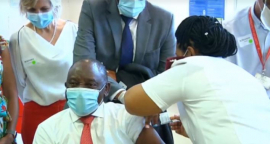
The first vaccinations against COVID-19 took place on 17 February, with Cape Town nurse Zoliswa Gidi-Dyosi becoming the first South African to receive the Johnson & Johnson vaccine at Khayelitsha Hospital.
To date, over 90 000 healthcare workers have been vaccinated under the Sisonke Vaccine Programme.
While healthcare workers are top priority in the vaccination programme, other sectors of the population, including those with comorbidities and essential service workers, will be prioritised in subsequent phases of the programme.
A slight form of reprieve has also come in the form of research results from the KwaZulu-Natal Research Informatics and Sequencing Programme (KRISP), which found that people who were infected with the 501Y.V2 variant are immune from reinfection and possibly other circulating variants.
A word from the experts
Reflecting on the year that was, Professor Salim Abdool Karim, said: “March last year feels like a world away and these last 12 months have felt more like 12 years.”
Karim, who speaking during a webinar at the Centre for the Aids Programme of Research in South Africa (Caprisa), recalled how he was asked to go to St Augustine’s Hospital to evaluate the scenario unfolding from “patient zero” early on in the pandemic.
“In a period of uncertainty, I learnt a lot about this virus and its initial outbreak, and will be returning there [to St Augustine Hospital] to get vaccinated,” he said on Thursday [4 March].
Karim, who is the Ministerial Advisory Committee (MAC) on COVID-19 Chair and Caprisa Director, said they could not have anticipated that the second wave would be so brutal.
“Our first wave was like Mount Kilimanjaro, and our second more like Everest. We could not have anticipated that it would hit us that hard and now we are again in the throes of low transmission,” he said.
Despite the hurdles along the way, the State is committed to inoculate 40 million South Africans to reach the heard immunity it needs to fight COVID-19.
Addressing the nation on 28 February, the President said South Africa is expecting millions of vaccines from Johnson & Johnson, Pfizer and the COVAX Facility.
As South Africa works its way back to economic stability, with the country having been placed on lockdown level 1 from 1 March, the First Citizen warned about the threat of a third wave and new variants.
“This pandemic has taken much from us, but it has not taken our strength, our courage or our sense of solidarity as a people. It has not dampened our spirit or weakened our resolve,” he said, calling on everyone to remain hopeful.
Government launches Human Rights Month
Transforming the country’s heritage landscape is part of government’s efforts to restore human rights, says Minister of Sport, Arts and Culture Minister, Nathi Mthethwa.
“The transformation of the heritage landscape is part of the process of restoring the human rights to our people. The renaming of the East London Airport to King Phalo Airport is part of those efforts,” Mthethwa said on Friday.
He was addressing the launch of Human Rights Month at the Moses Tswede Community hall in Dimbaza, East London in the Eastern Cape.
The Minister launched Human Rights Month with Minister of Justice and Correctional Services Ronald Lamola under the theme: “The year of Charlotte Maxeke: Promoting Human Rights in the Age of COVID-19”.
This years’ theme pays tribute to the 150th anniversary of the liberation struggle heroin and human rights campaigner, Charlotte Maxeke.
“She witnessed in her lifetime events that had an impact on her live, the lives of others and Africans across the globe. It is these events which made Maxeke a heroic we celebrate today,” the Minister said.
She witnessed the 1878-1879 last Frontier war, the battle of Isandlwana in 1879, the battle of Adwa in Ethiopia, 1896, the Pan African Congress and the Bhambatha Rebellion of 1906.
“These battles and many others left us with a heritage whose spirit of no surrender, of sacrifice and discipline, inspires and guides the African determination in the battles to come, a heritage which is a challenge to all of us.
“The struggles of Maxeke has left us a legacy of never allow your circumstances to determine your destiny. Throughout her life, she has fought for the restoration of human rights to Africans both at home and across the globe. She understood the nexus of race, class and gender in our struggles both at home and elsewhere in the world,” the Minister said.
He said when there was no government for the people, Maxeke and others were able to fight for human rights.
“She is an important historical figure in that she seemed well ahead of her generation. She is the first woman of African descent to be conferred with the degree for science from the United States.
“Celebrating Maxeke is also part of our liberation heritage, transformation agenda, noting that the narrative remains patriarchal and male dominated. Therefore, this honour is in sync with our transformation agenda, thereby ensuring that the liberation heritage narrative is all inclusive and that women who have earned their titles become front and centre of this narrative,” Mthethwa said.
Minister Lamola said the nation needs to work together to fight any form of racism, tribalism and xenophobia.
“It is within our collective responsibility to do so that we can build a better future for our children, for one nation united in our diversity.
“In our democracy, there are still rogue elements hell-bent on undermining the struggles of Maxeke and her heroic generations. These acts are done through acts of domestic violence and femicide…of violating the rights of women and children,” Lamola said.
Minister Lamola also spoke of the need to defeat domestic violence and femicide.
“As we launch the Human Rights Month 2021, let every citizen be concerned about entrenching human rights in the country. Let each of us say as long there are still those rights are violated and undermined the struggle continues,” Lamola said.