
Fish deaths at Hartbeespoort Dam caused by lack of oxygen
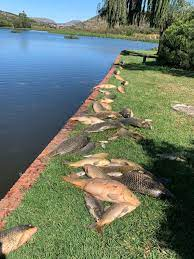
Investigations conducted by the Department of Water and Sanitation (DWS) has revealed that the fish that died on 11 April at the Hartbeespoort Dam, was due to extremely low oxygen levels in the dam.
This comes after thousands of dead fish among the hyacinth were discovered closer to the shore by the Ifafi Aquatic Club and the Schoemansville Oewer Club members.
The department’s probe involved taking samples at four different sites of the dam. These include the dam edge near the overgrown hyacinth, 60 metres away from the edges, Ifafi Aquatic Club jetty and near the Ifafi Aquatic Club.
The results, the department said, revealed that excessive algal growth caused by high nutrients, that is the phosphorus and nitrogen content levels in the water, led to oxygen depletion and fish mortality.
“The occurrence of low oxygen concentration in water is typical in sewage-contaminated systems with high organic matter and could not be attributed to high water temperatures given the average temperature of 22 degrees Celsius at the time of sampling.”
To address the hyacinth and algal growth at the dam, the DWS has recently appointed Magalies Water for three years to develop and implement a programme that will deal with the invasive plant and the algae that are infesting the dam.
“The entity is expected to develop a resource management and remediation plan to address the poor water quality, minimise and control the plant and algal growth in the dam and the upstream catchment, which lead to its pollution and compromises water quality and use of the dam,” the department explained.
The team has also been tasked to develop a short-term intervention plan to remove the hyacinth, review the algal management strategy and develop a catchment management plan to address the receiving of water into the dam from the upper catchment.
“The plan will also involve the repurposing and readapting of the Metsi a Me programme to focus on the upper catchment which is contributing to the eutrophication of the dam.”
The programme is expected to start by mid-May and will incorporate the Biological Control Programme managed by the Department of Forestry, Fisheries and Environment (DFFE).
Police arrest two suspects for murders of Soweto children

Police have arrested a 50-year-old woman and her 39-year-old partner in connection with the murders of two children, Nqobile Zulu and Tshiamo Rabanye, in Soweto.
Their mutilated bodies were found last Thursday morning, after they went missing on the Wednesday night.
“The duo has since been charged with murder. They will appear before the Protea Magistrates Court on Friday, 28 April 2023,” Police Ministry Spokesperson Lirandzu Themba said on Wednesday.
SA driving reforms in electricity sector
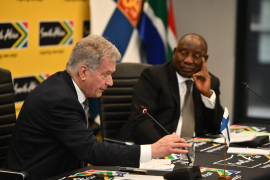
President Cyril Ramaphosa says South Africa is driving reforms in the electricity sector to enable private investment in electricity generation and accelerate the procurement of new generation capacity, including solar, wind, gas and battery storage.
“We are implementing the national Energy Action Plan to increase the current supply of energy and to achieve energy security in the long-term,” President Ramaphosa said.
Speaking at the South Africa–Finland Roundtable Business Forum held in Menlyn, east of Pretoria, on Tuesday, President Ramaphosa said South Africa is in the grip of an energy crisis.
The Business Forum was attended by government representatives and business leaders from the two countries.
“Even as we work to improve the performance and efficiency of our existing coal-fired power stations to address energy shortages, we remain committed to a just energy transition, and to our target of achieving net zero emissions by 2050.
“A just transition to a low carbon, climate-resilient, greener economy forms part of South Africa’s global climate change commitments. We believe that there is alignment between our objectives and Finland’s goals,” President Ramaphosa said.
On the economic front, President Ramaphosa said South Africa is ready for a partnership with Finnish companies willing to do business in South Africa.
“Our team at InvestSA would be very keen to have discussions with yourselves to see how we can support Finnish companies with projects in South Africa to enable greater levels of funding for Finnfund. South Africa’s value proposition is the diversity and sophistication of our economy.
“We have also noted, in terms of Finland’s Africa strategy, that at least 50% of the value of Finnfund’s new funding decision is geared towards investments in Africa,” President Ramaphosa said.
President Ramaphosa said Finland intends to double trade with Africa.
“Furthermore, [Finland is] committed to increasing investments from Finnish companies into Africa between 2020 and 2030.
“Finnish companies have a presence in South Africa in the packaging, industrial cranes, metals, digitisation, green finance, energy, fleet management and mining equipment sectors, amongst others.
“Finnish business can also support Africa’s economic integration and intra-African trade,” the President said.
Finland is an important partner to South Africa and despite its small population and territory, it is amongst the most developed countries in the world and provides valuable trade, investment and development cooperation to South Africa.
Finland is also a strong international partner in areas of various global issues such as strengthening multilateralism, international law, peacebuilding and mediation, the advancement of gender and human rights as well as around issues of renewable energy.
Since 2010, Finland has been supportive of South Africa’s national priorities and continues to be a reliable partner in various sectors, including maritime, science and technology, ICT and digitalisation, environment, energy, education, skills development, agriculture and water.
SA citizens stranded in Sudan safely cross into Egypt – Dirco
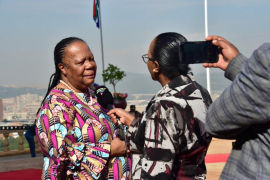
International Relations and Cooperation Minister, Dr Naledi Pandor, confirmed on Tuesday that South Africans who were stranded in Sudan have now safely crossed into Egypt after a 72-hour ceasefire was agreed.
“We evacuated not only South Africans,” Pandor said, speaking on the sidelines of the Finland State Visit at the Union Buildings in Pretoria.
According to Pandor, South Africa was also asked to assist with Angola, Namibia, Zimbabwe and some Brazilian citizens.
“So, they have crossed successfully and safely. The task now is to get them to South Africa and that lies in the capable hands of the South African National Defence Force (SANDF),” she explained, adding that government is still awaiting the final details on when they will land on home soil.
On Sunday, the SABC stated that the SANDF team was on its way to the warring country to evacuate local citizens.
SAnews on Monday reported that 77 South Africans were stuck in Sudan following the conflict that broke out last week between the Sudanese Armed Forces (SAF) and the Rapid Support Forces (RSF).
According to reports, tensions erupted on 15 April during negotiations to integrate the RSF into the country’s military as part of plans to restore civil rule and over 420 people have since been killed.
Pandor said it is in the global interest for the conflict to end and that the leaders will continue with their broad efforts to engage and draw the two parties together.
According to the department’s spokesperson, Clayson Monyela, two buses have safely arrived at the border with Egypt.
“We have officials from the SA Embassy in Egypt to receive them and facilitate their entry into Egypt. The South African government will pay for their flights back to South Africa,” he tweeted.
He also thanked everyone for their support, including the Gift of the Givers and the Egyptian government.
Meanwhile, he said there are 12 more nationals that will leave Sudan today.
The Minister raised concerns about lives being lost and the capital city Khartoum that is being battered, while citizens continue to bear the brunt.
United States Secretary of State, Antony Blinken, tweeted: “Following intense negotiations, the SAF and RSF have agreed to implement and uphold a 72-hour nationwide ceasefire starting midnight, 24 April.
“We welcome their commitment to work with partners and stakeholders for permanent cessation of hostilities and humanitarian arrangements.”
Eskom stepping up initiative to curb peak electricy demand

Eskom says it will be ramping up its demand side management (DSM) initiatives in order to better manage the supply and demand of electricity in South Africa.
The power utility held its first national Demand Side Management Indaba in Gauteng on Monday.
During the Indaba, the power utility’s board chairperson, Mpho Makwana, said the DSM initiatives assist the power utility to reduce pressure on the system during peak hour as well as give consumers the opportunity to save on electricity bills.
“The effective implementation of the DSM programmes could create a win-win situation – reducing pressure on the power system and enabling consumers to realise cost savings by being more energy conscious and reducing their consumption without affecting business productivity or quality of life,” he said.
The power utility has embarked on several initiatives such as energy saving through promoting the use of compact fluorescent lights, energy efficiency, demand response, distributed generation and energy storage.
Makwana highlighted that demand side initiatives have been implemented all over the world and produced results.
“DSM is not a South African concept. It is global phenomenon with the best-in-class countries already using technology to manage demand. The array of policy measures to incentivise demand-side participation, promote energy conservation and reduce peak demand can be replicated in our country,” Makwana said.
He called on all South Africans and those doing business in South Africa to implement power saving initiatives in order to assist the power utility to reduce the strain on the power grid.
“DSM programmes can be more effective through a collaborative approach. I’d like to acknowledge and thank our large customers who are participating in the Eskom’s DSM initiatives. We’d like to encourage and invite all stakeholders from businesses, industries to residential customers to come on board. I also thank South Africans for heeding the call to use electricity sparingly and efficiently to help alleviate the pressure on the power system.
“Eskom is grateful to the National Energy Crisis Committee (NECOM) for coordinating the National Demand Side Management Indaba. It is through initiatives such as these that we can partner and strive for a sustainable future,” Makwana said.
Higher Education Department invests in the future
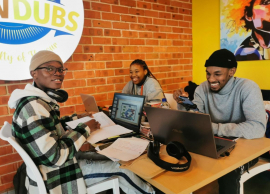
The Department of Higher Education, Science and Innovation is investing in infrastructure to provide quality teaching, learning, research and innovation spaces in the post-school education and training (PSET) sector.
This is according to Higher Education, Science and Innovation Minister, Dr Blade Nzimande, who on Monday opened the University of the Western Cape Education Facility precinct and the Unibell Residence at the Bellville Campus in the Western Cape.
Nzimande said his department will continue to prioritise infrastructure development at historically disadvantaged universities to ensure that maintenance backlogs are addressed and the quality of infrastructure delivery management is improved at these institutions.
“This is among the reasons that we have reviewed our current existing model of cooperation with the Development Bank of Southern Africa (DBSA) to make it more effective and in line with our plans of using our PSET infrastructure to stimulate local economic development and inclusion.
“Our determination to strengthen and grow the PSET system is of late being demonstrated by our investments in the feasibility studies of the new universities of Science and Innovation, and a new Crime Detection University through the Infrastructure and Efficiency Grant (IEG) to the value of R6 million,” he said.
The Minister said both the University of the Western Cape’s projects are significant in scale and will certainly add tremendous value to the university, its academic focus and the living and learning experience of students.
The University Master Development Plan 2014, focusing on precinct development, introduced the Faculty of Education Precinct.
The Minister mentioned that this is also in line with their new designed model of education precincts, which he launched in a pilot project in KwaZulu Natal, called the Imbali Education and Innovation Precinct.
This project is aimed at exploring and testing an alternative modality of education delivery, based on closer multi-educational institutional co-operation, closer articulation, with strong science and innovation linkages.
“Such integration through precincts… will ensure that we produce well- rounded students who are ready to take up their positions within our economy and society. Our next similar precinct to be established will be in Giyani in Limpopo, where we have already started to set up a university campus as well.
“This is the reason why I am pleased … to launch another precinct which signifies a substantial next phase in the university’s focus on precinct development on its main campus, and the adaptive re-use of existing infrastructure to give new life to older buildings,” Nzimande said.
The Minister added that he was pleased that progress with this strategy was largely driven by the rate at which the science precinct is being developed. This includes the Life and Chemical Sciences buildings, the South African Institute for Advanced Materials Chemistry building as well as the Computer and Mathematical Sciences (CAMS) building.
The Unibell student accommodation is part of the Phase 1 of the Student Housing Infrastructure Programme (SHIP), of which the University of the Western Cape is allocated 2720 beds.
The project is also significant as it demonstrates the Department of Higher Education and Training’s commitment towards its partnership with universities and the Development Finance Institutions (DFIs) in the provision of quality student housing infrastructure facilities.
It is also a practical demonstration that government is committed to addressing student housing backlogs.
The Minister highlighted that a wide range of partners including the Development Bank of Southern Africa (DBSA), National Treasury (NT) and EU through its Infrastructure Investment Programme for South Africa (IIPSA) committed to supporting the Department’s Student Housing Infrastructure Programme by providing financial support for the development of student housing projects on universities and college campuses.
“Many public universities and TVET colleges have not been able to make sufficient investments in the maintenance and expansion of their student housing portfolios, largely due to financial constraints.
“In order to assist them, my Department established the SHIP project which was aimed at addressing student housing backlog through the implementation of large student housing projects that deliver more than 1000 student beds each across universities and TVET Colleges,” he said.
From the onset, SHIP was established to ensure that a minimum of 60% of the student beds it delivers are for campuses in rural and peri-urban areas.
The Minister said that one critical element of ensuring access to quality higher education and training, and success in the system, is investment in student housing infrastructure to ensure quality teaching, learning and a conducive student living and learning environment.
Umalusi clarifies procedure for replacement certificates

The council for quality assurance in general and further education and training, Umalusi, has called on potential applicants who want to replace their lost Matric certificates to apply directly on the Umalusi website.
In a statement on Wednesday, Umalusi said that it wishes to clarify the procedure to be followed by interested applicants to access the service, following the media statement released on 31 March 2023 regarding the new Online Application System for Replacement Certificates.
“Since the launch of the system, Umalusi has been inundated with calls and emails from potential applicants wanting to apply either telephonically or via email. Process wise, interested applicants should apply directly online (on the website) by visiting the Umalusi website https://www.umalusi-online.org.za/ReplacementCertificate/,” Umalusi said.
The quality assurer said that this online service is meant only for lost or damaged certificates issued by Umalusi or its predecessor, SAFCERT, since 1992.
These are the Senior Certificate (SC), National Senior Certificate (NSC), National Certificate Vocational (NCV) Levels 2-4, General Education and Training Certificate (GETC) and N3 Certificate.
An applicant will need to pay R137.00 if the certificate is to be collected from Umalusi or R202.00 (R137.00 for the certificate and R65.00 for courier fees) if the certificate is to be couriered to a physical address within the borders of South Africa.
Applicants who experience any challenges with the system are urged to send an email to: Replacement.Support@umalusi.org.za.
Cabinet briefed on the state of electricity

Cabinet has been briefed about the current state of the electricity system as well as progress on the Energy Action Plan.
“The meeting discussed short and medium-term measures to ensure energy security, taking into account our immediate energy needs,” said Government acting spokesperson, Michael Currin, on Wednesday.
Cabinet noted the presentation by Electricity Minister Kgosientsho Ramakgopa and directed that a further assessment of the electricity situation and measures to be taken and be addressed at the next NECOM meeting that will be convened as speedily as possible.
Government continues to implement the country’s Energy Action Plan in earnest, with the long-term goal of securing continuous, credible energy supply.
To respond to the severe impact of load shedding on households, small businesses and the economy as a whole, President Cyril Ramaphosa announced a range of measures in July 2022 to improve the performance of existing power stations and add new generation capacity as quickly as possible.
The Energy Action Plan was developed through extensive consultation and endorsed by energy experts as providing the best and fastest path towards energy security.
While Government understands the frustration and the inconvenience that loadshedding is causing, it has reiterated that loadshedding is implemented only as a last resort in view of the shortage of generation capacity and the need to attend to breakdowns.
Government has assured citizens that work is underway to improve the performance of power stations to reduce stages of load shedding while driving work to bring more capacity onto the grid as quickly as possible.
According to Government, progress has been made in several areas since the adoption of the Energy Action Plan.
These include the relaxation of some requirements, which will enable quicker procurement, and the removal of licensing requirements for generation projects to enable private investment.
SASSA explains R350 grant application approval process

The South African Social Security Agency (SASSA) in Mpumalanga says approval of the R350 Social Relief of Distress Grant (SRD) follows a process – one being a verfification that the applicant does not receive an income.
In a statement on Tuesday, the agency said applicants should note that if their application is still pending it means, it’s not yet verified.
“The applicants must be aware that the agency does not only verify banking details but it also verifies citizenship with the Department of Home Affairs, and it also verifies with the Department of Employment and Labour to check whether the person is UIF [Unemployment Insurance Fund] registered or not.
“If the verification of the above mentioned requirements are not yet finalised, the status will state ‘pending’. When the applicant has successfully passed all verification, SASSA will approve the application and the status will be updated to ‘approved’,” SASSA said.
SASSA said some of the delays that cause beneficiaries not to receive the R350 grant after approval is that they do not provide banking accounts/details but they only choose the name of the bank where they want to get the grant.
Beneficiaries have been reminded to keep on checking their personal details to ensure that they are correct and the grant is received by the right person.
For more information, applicants can contact the agnecy’s toll free number: 0800 60 10 11 or 013 574 9428/9363 from 08:00 – 16:00 during week days Monday – Friday.
Electoral Commission welcomes signing of the Electoral Amendment Bill

The Electoral Commission has welcomed the signing into law of the Electoral Amendment Bill.
The Commission says the assent by the President provides the necessary legal certainty required to prepare for the National and Provincial Elections which will be held in 2024.
“Such certainty in the legal framework can only augur well for the Electoral Commission, the voting public, possible contestants, observers and other interested stakeholders,” the Electorial Commission said.
The foremost implications of the Act are as follows:
- For the first time individuals who are not associated with political parties will stand as candidates for elections into legislatures and the National Assembly.
- It commits the country to a process of Electoral reform beyond the 2024 elections.
Now that the policy choices for the coming elections have been made, the Electoral Commission will move with deliberate speed to finalise the supporting business applications necessary for the implementation of the Act.
These include, among others:
- Rewriting the Candidate Nomination System to facilitate the participation of independent candidates and unrepresented political parties together with a portal to enable candidates to capture the details of voters who support their candidature;
- Redeveloping the Results System to facilitate the recordal of votes cast in favour of independent candidates and translating these into seats where the relevant threshold is met;
- Updating platforms and mechanisms of liaison with parties to also include independent candidates;
- Reviewing the Political Party Funding legislation in order to include funding of elected independents; and
- Ensuring enactment of consequential amendments and regulations to enable the realization of the objects of the Act.
The Commission has now approved an integrated chart of electoral milestones which contains all activities and timelines that underpin preparations for 2024 National and Provincial Elections. In this regard the Commission wishes to highlight the following:
Independent Candidates
The Act determines the participation of independent candidates on the following basis:
- An independent candidate may be nominated to contest in one or more regions but may only be elected to one seat in the National Assembly.
- An independent candidate may only be nominated to stand in a provincial legislature in a province in which they are registered.
- An independent candidate may only be a member of either the National Assembly or a provincial legislature.
- A prescribed declaration confirming that the candidate has submitted names, identity numbers and signatures of voters who support his or her candidature:
- In relation to the election of the National Assembly, the names must equal 15 per cent of the number of votes required to obtain a seat for that region in the preceding election if contesting only one region o 15 per cent of the highest of the quotas in the preceding election, if intending to contest in more than one region.
Where the 15 percent of the highest of quotas is not achieved, that independent candidate may only contest in the region or regions as determined by the next highest quota met
- In relation to a provincial legislature, 15 per cent of the votes required to obtain a seat in the preceding election, in respect of that province.
Further requirements include:
- Candidates must pay a prescribed deposit. Deposits paid by independent candidates may be different from those paid by political parties.
- Candidates must undertake to be bound by the Electoral Code of Conduct.
- Candidates must sign a declaration that they are not disqualified in terms of the Constitution.
- In respect of provincial elections, candidates must sign a declaration that they are registered in that province.
Registered political parties that do not have seats in any legislature or the National Assembly will have to meet the same 15 percent quota requirement and also pay a deposit.
Ballot Papers
The participation of independent candidates in elections of the National Assembly as a consequence of the signed law, has the following noteworthy implications:
- The amended Act provides for an additional ballot paper in the election of the National Assembly thereby offering voters a non-binary choice of either a party or independent.
The effect of this is that the regional and compensatory ballots are separate (two ballots instead of a single ballot as was previously the case).
The regional ballot for the National Assembly includes parties and independents. The other (national) ballot contains only parties in order to restore proportionality.
The ballots for the regional seats in the National Assembly will be region-specific in a manner similar to provincial legislature ballots.
- The introduction of the second ballot for the election of the National Assembly, results in an increased number of ballot papers to be printed without the corresponding increase in time lines. Thus the ballot printing window remains an immutable 28 days.
- The number of ballot papers for provincial legislature elections remains unchanged at one ballot per province. These will contain the names of parties and independent candidates.
Voter Registration
Ahead of each election, the Electoral Commission undertakes registration drives to register new voters and to enable already registered voters to inspect and where necessary update their registration details. These drives result in updating of the voters’ roll.
For this purpose, the Electoral Commission announces that it will open its network of approximately 24 000 voting stations over the weekend of 18 and 19 November 2023 to register new voters for the forthcoming elections and to facilitate inspection of the roll.
Voting station based registration represents the most equitable manner of equalising access to the vote.
Additional modalities of registration have also been implemented to facilitate continuous registration.
Those with access to the internet may register, inspect and update their details at any time before the proclamation of the elections by visiting www.elections.org.za.
Voters may also visit the local offices of the Commission in each municipality or take advantage of the various activation campaigns that the Commission will undertake in various areas to register and update their details.
Vote where you are registered
In National and Provincial Elections, voters vote at the voting station where they are registered. However, the Electoral Act had provided for an exception.
This exception was intended to facilitate the continued franchise of persons who unavoidably found themselves outside areas in which they were registered on voting day.
However, over time, this well-meaning provision has been misused in a manner that may imperil proper administration of elections and creates perceptions that some voters are able to vote more times than they are entitled to.
The new framework now provides that those who, for unavoidable reasons, are likely to find themselves outside of their voting station of registration, must give prior notice of their intention to vote at a different voting station.
“The Commission reiterates that with the assent of the Bill certainty has now been created in the planning framework for the 2024 National and Provincial Elections. Our time is short and we cannot afford any delay,” the Commission said.
All electoral stakeholders are asked to start their preparations in order to avoid missing immutable electoral timelines.