
SA records 792 new COVID-19 cases
South Africa’s COVID-19 daily infections continue to drop, with 792 new cases logged on Monday.
Health Minister, Dr Zweli Mkhize, expressed his condolences to the families of the 97 people who lost their lives to Coronavirus in the last 24 hours.
Of the latest fatalities, 30 are from Free State, 22 from the Western Cape and 15 from Gauteng.
The Northern Cape and KwaZulu-Natal each recorded eight fatalities, and seven each in the Eastern Cape and Mpumalanga.
This pushes the death toll to 49 150, while the cumulative number of cases has peaked to 1 504 588 since the outbreak.
According to the Minister, the country is now home to 41 872 active cases.
KwaZulu-Natal currently has 14 662 infected patients, followed by the Free State with 7 008 and 6 988 in the Western Cape.
In addition, there are 4 016 active cases in Gauteng, 3 483 in the North West, 2 793 in the Northern Cape, 1 272 in Mpumalanga, 1 106 in Limpopo and 544 in the Eastern Cape.
“Our recoveries now stand at 1 413 566, representing a recovery rate of 93.9%,” said Mkhize.
The information is based on the 8 907 857 tests conducted, 15 342 of which were recorded since the last report.
The Minister said the number of healthcare workers vaccinated under the Sisonke Programme has risen to 23 059 as of 22 February 2021.
Globally, the World Health Organisation is reporting 111 102 016 confirmed cases of COVID-19, including 2 462 911 deaths.
SA COVID-19 death toll increase by 113
Another 113 Coronavirus-related deaths have been reported in South Africa and 1 429 new cases, daily figures showed on Sunday.
Of the latest fatalities, 69 are from the North West, 17 from Gauteng, 12 from Free State and 10 from the Western Cape.
In addition, Eastern Cape and the Northern Cape recorded two deaths each, while one occurred in the Northern Cape.
This pushes the death toll to 49 053 deaths, while the cumulative cases now stand at 1 503 796.
“We convey our condolences to the loved ones of the departed and thank the healthcare workers who treated the deceased patients,” said Health Minister, Dr Zweli Mkhize.
Meanwhile, the country is now home to 42 728 active cases.
KwaZulu-Natal is still the hardest hit province with 14 736 people who are currently infected.
The province is followed by the Western Cape with 7 043 active cases, 7 008 in Free State, 4 426 in Gauteng, 3 445 in North West, 2 774 in the Northern Cape, 1 458 in Mpumalanga, 1 146 in Limpopo and 692 in the Eastern Cape.
Meanwhile, the recovery rate sits at 93.8% after 1 412 015 beat COVID-19 since the outbreak.
The information is based on the 8 892 515 tests of which 24 856 were performed since the last report.
Mkhize said there are now 15 388 healthcare workers who have been vaccinated under the Sisonke programme since the first jab was administered on Wednesday last week.
According to the World Health Organisation, there are 110 749 023 confirmed global cases of COVID-19, including 2 455 131 deaths, to date.
SA records 2 327 new COVID-19 cases, 230 deaths
Deaths continue to rise with 230 more people who succumbed to COVID-19 on Thursday.
Of the recent fatalities, 122 occurred in Limpopo, 27 in KwaZulu-Natal, 24 from the Eastern Cape, 21 from Gauteng, 19 from the Western Cape and 10 from Mpumalanga.
Only Free State recorded single-digit deaths after seven people lost their lives, pushing the death toll to 48 708.
“We convey our condolences to the loved ones of the departed and thank the healthcare workers who treated the deceased patients,” said Health Minister, Dr Zweli Mkhize.
Meanwhile, the country recorded 2 327 new cases in the last 24 hours, meaning South Africa now has 1 498 766 infections identified since the outbreak.
Also, there are 1 403 214 people who beat COVID-19, representing a recovery rate of 93.6%.
South Africa is now home to 46 844 active COVID-19 cases, of which 16 105 are in KwaZulu-Natal, 7 372 in the Western Cape, 7 045 in Free State, 5 473 in Gauteng, 4 074 in the North West, 3 014 Northern Cape, 1 350 Limpopo, and 604 in the Eastern Cape.
The cumulative total of tests conducted to date is 8 807 299 with 34 556 performed since the last report.
The Minister said the number of healthcare workers vaccinated under the Sisonke programme is 2 260 as of 18 February.
According to the World Health Organisation, there have been 109 594 835 confirmed cases of COVID-19, including 2 424 060 deaths.
Everything you need to know about the Johnson & Johnson vaccine
South Africa kick-started its first phase of the vaccination rollout programme using the Johnson & Johnson vaccine on Wednesday.
Yesterday, the first group of healthcare workers lined-up to receive the shot of the 80 0000 Johnson & Johnson vaccines that landed on Tuesday, which the department has described as a success.
The Health Department answers some of the burning questions about who will get it first; why it is a good choice for the country; why pregnant woman cannot get the shot and how effective it is?
Why is the Johnson & Johnson vaccine a good first choice for the National Vaccination Programme?
It was tested in a large trial of almost 44 000 people from four continents, of whom 7 000 participants came from South Africa.
The study also provided a good picture of how the vaccine works against the new 501Y.V2 variant, which is dominant in South Africa and currently responsible for around nine in 10 of all COVID-19 infections detected during the second wave.
The South African trial showed that while the Johnson & Johnson vaccine is not going to prevent mild symptoms, it provides 57% protection against moderate-severe disease, 85% protection against severe disease and 100% protection against death.
By way of comparison, the Oxford-AstraZeneca vaccine provided only 27% protection against mild to moderate COVID-19 caused by the new 501Y.V2 variant.
How does the Johnson & Johnson vaccine compare with other COVID-19 vaccines?
Like all COVID-19 vaccines, the jab contains instructions for the spike protein on the Coronavirus.
These instructions are delivered to the immune system by a modified adenovirus that has also been used in other vaccines, such as the Ebola and Zika shots.
The adenovirus is safe to use in vaccines as it has been modified so that it cannot cause disease or replicate in humans.
Non-active ingredients in the vaccine include sodium chloride, citric acid monohydrate buffer, polysorbate 80, 2 hydroxypropyl-β-cyclodextrin (HBCD), ethanol (absolute), sodium hydroxide and water for injection.
All of these ingredients are safe for human consumption.
The vaccine does not contain any animal products and is halal.
How does the vaccine protect you against COVID-19?
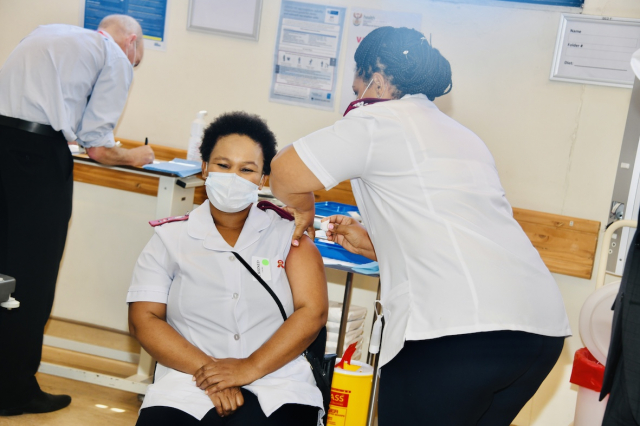
When injected, the vaccine trains your immune system to fight the virus that causes COVID-19.
The vaccine does not contain the Coronavirus and will not give you COVID-19.
Some mild side effects include tenderness at the injection site, feeling unwell, feverish and a headache for a few days and these are positive signs that the body is mounting an immune response to the Coronavirus.
When you encounter real Coronavirus particles in future, your immune system will be able to disarm the virus so that you either do not fall ill at all or if you do, the symptoms are mild and your chances of being hospitalised or dying are much lower.
How is it stored?
The vaccine has a long shelf life of two years at minus 20 degrees Celsius and can be safely stored in a domestic fridge for a month.
This makes it suitable for widespread rollout in warmer countries like South Africa as ultra-cold freezers are not needed.
How is the vaccine given and when does protection start?
The vaccine is given as a single dose into the upper arm.
Protection starts around 10 to 14 days after vaccination and even as early as seven days for severe disease and can also rise to good levels around a month after vaccination.
It is currently the only vaccine available that uses a single dose, while others require two shots.
No vaccine provides 100% protection. However, the jab is said to provide 57% protection against moderate-severe disease, 85% protection against severe disease, and 100% protection against death.
The researchers are still waiting for further results on how effective the vaccine is at preventing asymptomatic transmission.
It is important you continue to use masks, practise social distancing and good hand hygiene.
If you are a healthcare worker, you still need to wear your personal protective equipment (PPE) and stay vigilant, even after you are vaccinated.
Why is a research programme being used to make the vaccine available?
Manufacturers apply for vaccines to be licensed after trials show to be safe and effective.
The Johnson & Johnson trial results were released in early February and applications for licensing are underway in the United States, Europe and South Africa.
The Sisonke ‘Together’ programme allows the government to make this safe and effective vaccine immediately available to healthcare workers using a research study.
Sisonke is not the same as a clinical trial, rather a way that research can help to make it available while the licensing process takes place.
The South African government has chosen to move ahead with this programme because it would be unethical to withhold a vaccine known to be safe and effective.
The South African Health Products Regulatory Authority (SAHPRA) has approved the use of the vaccine for the programme while it processes the full licensing.
It is important to understand that the fact that it is not yet licenced does not mean that it is not safe or effective.
The third wave of COVID-19 is predicted to begin in South Africa this winter and protecting healthcare workers is a priority and so we must start vaccinating healthcare workers before the third wave arrives.
How is the Sisonke rollout going to work?
South Africa has secured 500 000 doses of the vaccine from Johnson & Johnson, enough to vaccinate half a million health workers.
The first batch of 80 000 doses arrived on Tuesday, 16 February and further deliveries will follow every two weeks.
Vaccines will be available at 17 hospitals throughout the country where teams of researchers and vaccinators will work together to deliver the vaccine to health workers up to 10 hours a day, seven days a week.
I am a health worker. How can I access the programme?
The first step to accessing a vaccine is to register on the country’s Electronic Vaccination Data System (EVDS). You can access the system by visiting this website: https://vaccine.enroll.health.gov.za
In general, patient-facing health workers will receive priority access to vaccines.
Non-clinical staff and traditional healers are also eligible to register on the EVDS system.
You will receive an SMS alert with a vaccination voucher and details on what vaccination centre to attend and when.
You will also be asked to read an information sheet and provide advanced consent for vaccination before your visit.
On the day of your vaccination, you will need to arrive with your voucher and an identity document.
Why do I need to sign consent for the vaccine?
Consent to be vaccinated against COVID-19 is being sought in most national vaccination campaigns around the world. This is common when vaccines are provided under Emergency Use Authorisation mechanisms.
You will also be asked to provide consent for the Johnson & Johnson vaccine as part of the early access arrangement through the Sisonke programme.
The information has been loaded on the EVDS system and you will need to read it and agree to receive it before you attend your vaccination visit. Staff will also recheck this with you to attend your vaccination.
It also includes consent to access your medical records to monitor any future episodes of COVID-19 or hospitalisations.
This information will include where appropriate, your ID number, name, date of birth, postcode and contact details.
This information will be kept safe and only Sisonke researchers will monitor the effectiveness of the vaccination programme and access secure and anonymised data.
Are there any reasons why you will not be able to access the programme?
The vaccine is unavailable to pregnant women during this initial stage, which is a common practice when vaccines are not yet fully licensed, such as during clinical trials.
This is done because at this stage there is very little information on the safety of the Johnson & Johnson vaccine in pregnancy.
It is highly expected that the jab will be found to be safe in this population and that pregnant women will become eligible for vaccination in the coming months.
Similar vaccines to the Johnson & Johnson COVID-19 vaccine have shown no safety concerns in pregnancy.
Access to COVID-19 vaccination for pregnant women is likely to be made available in the coming months.
However, the vaccine can be safely used in breastfeeding women.
KZN rolls out COVID-19 vaccination
KwaZulu-Natal Premier Sihle Zikalala has officially unveiled the COVID-19 vaccine rollout programme in the province, which will see frontline healthcare workers get vaccinated with the newly acquired Johnson and Johnson vaccine.
This follows the launch of the country’s vaccination programme by President Cyril Ramaphosa and Health Minister, Dr Zweli Mkhize, in Cape Town, on Wednesday.
A total of 80 000 doses of the Johnson and Johnson vaccine arrived in South Africa on Tuesday evening.
Zikalala, who was accompanied by Health MEC, Nomagugu Simelane-Zulu, received the first batch of the vaccine on Thursday, where healthcare workers were vaccinated at Prince Mshiyeni Memorial Hospital in Umlazi, south of Durban.
Speaking at the provincial vaccine rollout launch, Zikalala said the arrival of the vaccine in the province is an important step towards rebuilding lives.
“This vaccine is eagerly awaited in all parts of the provinces and if it was up to us, we would have administered it to all healthcare workers in the province on the same day so that they are all protected. For now, we have to make do with what we have,” Zikalala said.
The Premier urged healthcare workers to take the vaccine, ensuring them that government would never subject them to a vaccine that would be detrimental to their lives.
Simelane-Zulu said the province has laid the groundwork for the vaccine rollout.
“We have a continuous education programme and we are conducting webinars with all our stakeholders, including our traditional health practitioners.
“We had planned to vaccinate all healthcare workers within four days, but we had to revise the plan according to the amount of vaccines we get. The good thing about Johnson and Johnson vaccine is that it’s a once-off,” Simelane-Zulu said.
Unions welcome vaccine
Mlungisi Ndlovu, from the KwaZulu-Natal Public Servants Association of South Africa (PSA), welcomed the arrival of the vaccine in the province.
“Our people in KZN and healthcare workers need the vaccine. We must speed up the process of vaccinating people before the third wave arrives in order to reduce deaths,” Ndlovu said.
Democratic Nursing Organisation of South Africa (DENOSA) KZN Provincial Secretary, Mandla Shabangu, also welcomed the arrival of the vaccine and urged healthcare workers to vaccinate.
“With the arrival of the vaccine, our members are excited and enjoy coming to work. We want to fast-track how it is rolled out to other members.
“While we support the view that it’s not compulsory to vaccinate, we encourage our members to take the vaccine,” Shabangu said.
First day of vaccine roll-out programme a success
The Health Department has given South Africa the thumbs up as the country began its first round of the vaccination rollout programme on Wednesday.
Yesterday, the country watched as healthcare workers lined-up to receive the shot of the 80 0000 Johnson & Johnson vaccines that landed on Tuesday, alongside President Cyril Ramaphosa and Health Minister, Dr Zweli Mkhize.
“Day one of the first phase of COVID-19 Vaccine Rollout to health workers was a huge success today,” the Health Department said on Wednesday.
The department said South Africa secured the single-dose Johnson & Johnson vaccine for use in the Sisonke ‘Together’ study, which will be distributed to up to 500 000 healthcare workers in 18 public sector hospitals across all nine provinces.
Meanwhile, the organised labour leadership is expected to receive their shots as a demonstration of confidence in the safety and efficacy of the vaccine at Steve Biko Academic Hospital today.
“These are leaders who are health workers themselves,” the department explained.
The State reiterated that protecting frontline workers remains an urgent priority, who are three to four times more likely to contract COVID-19 than the general population.
Since the outbreak, the department has reported 40 000 South African health workers who have contracted COVID-19, while 6 473 have been hospitalised, with 663 deaths.
Oxford-AstraZeneca
South Africa’s rollout of the Oxford-AstraZeneca vaccine was suspended earlier this month after studies released showed that it is less effective against the mutated SARS-CoV-2 501Y.V2 variant, which is common in South Africa.
The department believes that Oxford-AstraZeneca may still play a role in the national programme. However, more research is needed to determine how and when it will be used.
“Vaccination using a safe and efficacious vaccine must start without delay to protect healthcare workers during a likely third wave this winter. The switch to the Johnson & Johnson vaccine allows the country to restart phase one vaccine rollout to keep our health workers safe.”
Safety first
The department said the single dose of the Johnson & Johnson jab protects against severe COVID-19 in South Africa.
“The safety and efficacy of the vaccine were assessed in the international phase three study, ENSEMBLE, which was conducted across Latin America, the United States and South Africa with more than 43 000 participants.”
South Africa had about 7 000 participants in the trial between October 2020 and February 2021, including those who were exposed to the 501Y.V2.
The department explained that the long-term follow-up of study participants is still ongoing, as is required for the process of regulatory approval by the South African Health Products Regulatory Authority (SAHPRA) for commercial or emergency use.
“However, since the safety and efficacy of the vaccine have already been proven, the current rollout is being conducted under The Sisonke Open-Label Program, to assess real-world effectiveness among healthcare workers, who have already been prioritised for vaccination by the South African Government’s COVID-19 Vaccination Strategy.”
The department has once again assured the healthcare workers that the vaccine has been shown to be safe, with no safety concerns reported from past trials or rollouts.
“The ENSEMBLE trial showed excellent protection of a single-dose vaccine against severe COVID-19, including in South Africa, and as such a delay in rolling out the vaccine would be unethical.”
The Sisonke rollout includes collaboration between a team from ENSEMBLE trial, Johnson & Johnson, the National Department of Health and the South African Medical Research Council.
The partners will closely monitor, track and assess the occurrence of hospitalisations and deaths, incidence of severe SARS CoV-2 infections, diversity of breakthrough infections and evaluate vaccine uptake among healthcare workers in South Africa.
“The protection of our healthcare workers through the rollout of the safe and efficacious vaccine is an urgent priority for South Africa.”
SA looks to Asian markets to revive economic growth
International Relations and Cooperation Minister, Dr Naledi Pandor, says government has created a significant footprint in Asian markets as part of efforts to return the country to pre-COVID-19 economic growth.
The Minister said this when she participated in the debate on the State of the Nation Address on Wednesday.
“We will identify new opportunities and expand those that have benefit for South Africa. In pursuit of this objective, South Africa has created a significant footprint in Asia, which is the continent showing the most promise of a speedy return to pre-COVID-19 levels of economic growth.
“Last year, South Africa acceded to the Treaty of Amity and Cooperation to take up significant trade and development opportunities available in this region. We will also benefit from the Regional Comprehensive Economic Partnership (RCEP) of these countries. This partnership created the world’s biggest trading bloc, estimated to account for about US $26 trillion or 30% of global GDP, and 28% of global trade,” Pandor said.
The Minister said in response to the President’s call of intensifying efforts to stimulate growth, government is working tirelessly to raise South Africa’s global visibility by also “promoting [South Africa] as the best place to be, to do business, to visit, to work, to study and to live”.
“We are also responding to new opportunities and harnessing the collective capabilities of DIRCO’s resources both at home and abroad,” Pandor said.
South Africa, the Minister said, will leverage engagement with the Association of Southeast Asian Nations (ASEAN) to enhance mutually beneficial trade, investment and tourism ties, and to support skills development and training for South Africans.
Pandor said South Africa secured significant beef export opportunities to the Malaysian market as of November 2020.
“Market access was also obtained for fruits to Thailand. Product protocols are being negotiated in the region and are at an advanced stage. These include table grapes to Vietnam and South Korea, avocadoes to India and Japan, and pears to China and India.
“Total two-way trade with Asia and the Middle East (inclusive of Oceania) breached the important milestone of R1 trillion, for the first time, in 2019 and is set to grow further.”
Many companies from the Asian region have made significant investment pledges during the President’s investment Summits and State Visits.
Companies such as Toyota, Isuzu, Tata Motors, Mahindra and Motherson Sumi have expanded their investments in the country.
China has pledged to invest $14 billion, and Saudi Arabia and the United Arab Emirates $10 billion each.
“We aim to build on these successes by ensuring growing global trade, which is one of the best ways to fight poverty, inequality and unemployment in our country and our continent,” said Pandor.
FS Health MEC, HOD get COVID-19 vaccine
Free State Health MEC Montseng Tsiu on Wednesday received the Johnson & Johnson COVID-19 vaccine.
The buoyant Tsiu, who is a professional nurse, took the vaccine alongside Dr David Motau, who is the Head of the Department of Health in the Free State.
“MEC Tsiu and HOD, Dr Motau, felt the need to take the vaccine first to give health care workers reasons to believe that there is nothing sinister about this vaccine because it has passed both the test of safety and efficacy,” the Free State Department of Health said in a statement.
The two leaders of Health in the Free State encouraged healthcare workers to voluntarily enlist to be vaccinated as part of the national drive to build herd immunity.
Building a herd immunity in the Free State means that 67% of the population which is 1.9 million of the 2.9 million in the Free State will be vaccinated to ensure that they are safe from getting the COVID-19 virus.
The vaccination campaign, which started on Wednesday with health care workers, will then be rolled out to all other sections of the population in line with the National rollout plan.
President Cyril Ramaphosa and Health Minister, Dr Zweli Mkhize, on Wednesday were among the first together with health workers to be vaccinated in Khayelitsha in the Western Cape when the rollout campaign started.
“At first I was a bit terrified of this long needle that was going to be embedded into my arm. But it happened so quickly, so easily. It was just a prick on my flesh and I really did not feel much pain,” President Ramaphosa said after taking the vaccine.
Before being vaccinated, Mkhize witnessed the first healthcare workers receiving the Johnson & Johnson vaccine. The first health worker to be vaccinated was Zoliswa Gidi-Dyosi.
The Johnson & Johnson vaccine, which has been approved by the South African Health Products Authority, arrived at the OR Tambo International Airport in Gauteng, on Tuesday night.
The first batch of 80 000 doses of the Johnson & Johnson vaccine is being prepared for distribution across South Africa with immediate effect.
About 500 000 vials of vaccines will follow in the next four weeks.
SA COVID-19 cases increase by 2 320
As the country witnessed the first vaccinations being administered on Wednesday, the country’s COVID-19 figures increased by 2 320 new cases.
According to the Health Minister, Dr Zweli Mkhize, the cumulative number of COVID-19 infections now stand at 1 496 439.
The latest statistics reveal that 165 more people died due to COVID-19 in the last 24 hours, which brings the death toll to 48 478 deaths.
Of the most recent fatalities, 76 are from Gauteng, 25 from the Western Cape, 22 from Free State, 15 from the Eastern Cape, 14 from KwaZulu-Natal, nine from the Northern Cape and four from Mpumalanga.
There are 48 132 people in the country who are currently infected, with KwaZulu-Natal having the most number of active cases sitting at 16 256.
The province is followed by the Western Cape with 7 565 active cases, while 7 050 are in Free State.
Mkhize said there are 1 399 829 people who beat COVID-19, representing a recovery rate of 93.5%.
The cumulative total of tests conducted to date is 8 772 743 with 35 413 recorded since the last report.
Global view
The World Health Organisation (WHO) said there are 109 217 366 confirmed cases of COVID-19, including 2 413 912 deaths, reported to date.
According to the WHO weekly epidemiological report, the number of global new cases reported has continued to fall, with 2.7 million new cases last week.
The world saw a 16% decline of over 500 000 fewer new cases compared to the previous week.
Meanwhile, the number of new deaths also saw a dip, with 81 000 new deaths reported last week, a 10% decline as compared to the previous week.
According to the agency, five out of six WHO regions reported a double-digit percentage decline in new cases, with only the Eastern Mediterranean region showing a 7% rise.
“Europe and the Americas continue to see the greatest drops in absolute numbers of cases. Meanwhile, the number of new deaths declined in all regions.”
In the past week, the five countries reporting the highest number of new cases continue to be the United States (673 630 cases, a 23% decrease), Brazil (318 290 cases, a 3% decrease), France (127 565 cases, a 6% decrease), Russia (104 602 cases, an 11% decrease), and the United Kingdom and Northern Ireland (97 271 cases, a 27% decrease).
The WHO said the 501Y.V2 variant, first discovered in South Africa, has now spread to 46 countries across all six WHO regions.
Johnson & Johnson COVID-19 vaccine arrives in SA
The first delivery of the Johnson & Johnson COVID-19 vaccine has arrived in South Africa.
The vaccine, which has been approved by the South African Health Products Authority, arrived at the O.R. Tambo International Airport in Gauteng on Tuesday night.
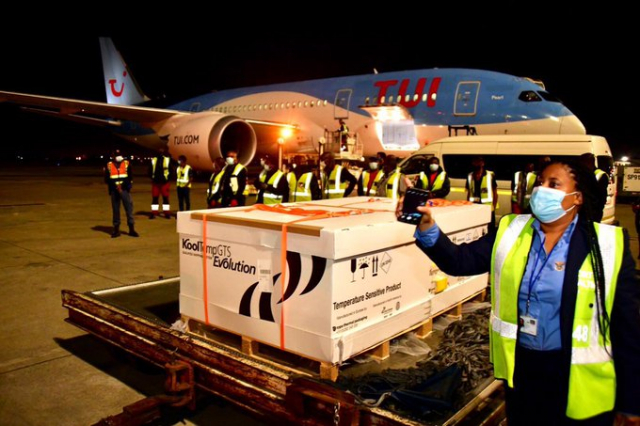
In a statement on Tuesday night, the Government Communication and Information System (GCIS) said the consignment would be moved to a secure facility in Gauteng before being distributed to the various vaccine centres in all provinces.
“Government remains committed to saving lives and protecting livelihoods. All citizens are reminded that adhering to health protocols together with the vaccine remains our best defence against the virus,” said the GCIS.
In his hybrid State of the Nation Address (SONA) last week, President Cyril Ramaphosa said the country has secured nine million doses of the Johnson & Johnson vaccine, of which 80 000 doses would arrive in the first batch.
About 500 000 vials of vaccines will follow in the next four weeks. This as the Johnson & Johnson shot has shown to be effective against the 501Y.V2 variant.
Meanwhile, the latest COVID-19 stats show that the country has a cumulative number of 1 494 119 COVID-19 cases, with 1 210 new cases recorded.
The cumulative total of tests conducted to date is 8 737 330 with 24 486 new tests recorded since the last report.
“Regrettably, 219 deaths have been reported: Eastern Cape 20, Free State 9, Gauteng 56, Kwa-Zulu Natal 43, Limpopo 29, Mpumalanga 10, Northern Cape 14 and Western Cape 38 which brings the total to 48 313 deaths
“We convey our condolences to the loved ones of the departed and thank the health care workers who treated the deceased patients,” Minister of Health, Dr Zweli Mkhize, said.
The country’s recovery figure now stands at 1 396 951, representing a recovery rate of 93.5%.