
COVID-19 crowned Newsmaker of 2020
The National Press Club (NPC) has named COVID-19 as the Newsmaker of the Year for 2020.
This comes a year since the Health Minister, Dr Zweli Mkhize, confirmed the first case of Coronavirus in South Africa on 5 March 2020.
The annual award, made possible by the NPC since 1980, honours a newsmaker in a calendar year based on the amount of media coverage received as well as the impact thereof.
The NPC Chairperson, Val Boje, said no story dominated the news in the past 365 days as COVID-19 did.
“From that first case through the five levels of lockdown, the ‘family meetings’ and vigorous debates around the regulations; the need for personal protective equipment and the demands made on the healthcare services; working from home and job losses; the socio-economic impact, and the need for vaccines,” Boje said on Thursday night.
Boje also dedicated the award to all those in this country and beyond who have spent the past year fighting the virus, especially doctors, nurses and other healthcare professionals.
She also made a special mention of scientists and others who have provided advice and worked on treatments and vaccines.
Mkhize has described the past year as “tumultuous”.
“I believe this award is for all the South Africans out there, fighting COVID-19, the health workers and all those who have had to endure the difficulties of the pandemic. We accept it on the basis that we all understand that those are the people that this award is honouring,” said the Minister.
The press club also took a moment to remember the 50 000 people who have lost their lives to the infectious disease.
“We urge everyone to continue taking the required precautions such as wearing a mask in public and regular hand and surface sanitising,” it said.
SA records 1 406 new COVID-19 cases, 96 deaths
South Africa now has 1 517 666 confirmed COVID-19 cases after the first case was reported in the country, one year ago.
At least 1 406 were confirmed to have contracted the virus on Thursday.
“Regrettably, 96 more COVID-19 related deaths have been reported,” said Health Minister, Dr Zweli Mkhize.
According to the Minister, Gauteng recorded the highest number of fatalities in the last 24 hours after 27 patients succumbed to the infectious disease.
The province is followed by 25 deaths in Free State, 18 in the Western Cape, 17 in KwaZulu-Natal, five in the Eastern Cape, two in Mpumalanga and one each in Limpopo and the Northern Cape.
The latest figures push the death toll to 50 462 since the outbreak.
“We convey our condolences to the loved ones of the departed and thank the healthcare workers who treated the deceased patients,” Mkhize added.
In addition, the number of healthcare workers vaccinated is 92 029 as of 6:30pm on Thursday.
The Minister also announced that 1 436 010 people beat COVID-19, representing a recovery rate of 94.6%, while the country has 30 799 active cases.
“The cumulative total of tests conducted to date is 9 178 323 with 30 799 new tests recorded since the last report.”
According to the World Health Organisation, there have been 114 853 685 confirmed global COVID-19 cases, including 2 554 694 deaths, to date.
Meanwhile, 248 987 115 vaccine doses have been administered worldwide as of today.
Over 80 000 healthcare workers vaccinated
South Africa has exhausted its first batch of the Johnson & Johnson COVID-19 vaccine in two weeks, with 83 570 healthcare workers vaccinated as of Wednesday.
“We are very encouraged that our first target of exhausting the first batch of 80 000 vaccines from Johnson & Johnson in two weeks has been achieved and exceeded.
“We have taken every opportunity to learn from this process and continue to refine the programme in preparation for the rollout to the larger community in the subsequent phases,” said Health Minister, Dr Zweli Mkhize.
The first consignment of the single-dose vaccine arrived in South Africa in February, while the second batch arrived this past weekend.
The Minister announced that 95 more people succumbed to COVID-19 in the last 24 hours.
Of these, 30 were reported in Gauteng, 25 in the Western Cape, 19 in the Free State, eight in KwaZulu-Natal, seven in Mpumalanga and five in the Eastern Cape, which pushes the death toll to 50 366.
“We convey our condolences to the loved ones of the departed and thank the healthcare workers who treated the deceased patients,” the Minister said.
Meanwhile, South Africa has recorded 1 516 262 cases after 1 447 new infections were identified since the last report.
According to the Minister, there are 1 434 772 people who beat COVID-19, while 33 498 patients are currently infected.
The information is based on the 9 147 524 tests performed, 33 498 of which were done in the last reporting cycle.
The World Health Organisation has reported 114 428 211 confirmed global cases of COVID-19, including 2 543 755 deaths to date.
Gauteng adds more COVID-19 vaccination sites
The Gauteng province has activated four new COVID-19 vaccination sites as of Wednesday, says Health MEC, Dr Nomathemba Mokgethi.
The four new sites are based at Charlotte Maxeke Johannesburg Academic Hospital, Dr George Mukhari Academic Hospital, Netcare Milpark Private Hospital and Lenmed Ahmed Kathrada Private Hospital, and are now operational.
“The more sites are added to the system, the more health workers will be reached. I am pleased to see that at all sites, there is a growing appetite among healthcare workers to participate in this early access study programme being implemented by the South African Medical Research Council as part of the Sisonke Vaccination Programme,” said the MEC.
The sites will supplement the first two sites, which are the Chris Hani Baragwanath Academic Hospital and Steve Biko Academic Hospital.
This brings to six the number of vaccination sites in the province. Mokgethi expressed her satisfaction at how well the activation of additional vaccination sites in the province has proceeded.
In this second round of inoculations, Gauteng has been allocated 18 040 doses of vaccines for both public (13 840) and private sector (4200) healthcare workers.
Half of the doses (8 520) will be used this week, while the other half (9 520) will be rolled out in the following week once delivered.
Previously, the province received 16 800 doses which were used ahead of schedule.
Deputy Minister for Health, Dr Joe Phaahla, was among those who were vaccinated at the Dr George Mukhari Academic Hospital.
The Deputy Minister emphasised the importance of protecting the healthcare system first, so that healthcare workers can lead form the front in ensuring that as many people as possible are eventually vaccinated.
The MEC, together with Gauteng Premier David Makhura, visited the Charlotte Maxeke Johannesburg Academic Hospital.
The hospital is the place where the first patient to present with COVID-19 in the public health sector in the country in 2020, Glynne Mitchell, expressed gratitude for the treatment she received at the facility.
She said the launch of early access vaccination at the facility was a great day for healthcare workers.
“Thank goodness I was in the best care. Dr [Jarrod] Zamperini was the doctor who treated me. He made the best choices for me, for the condition I was in.
“I’m eternally grateful for him. He put me at ease. He said I could not be in a better hospital. I’m so glad he is vaccinated today. It gives such faith and hope for all our frontline healthcare workers.”
On whether she will take the vaccine when the mass vaccination rollout starts, Mitchell said: “I will be vaccinated.”
Operational hours
The six Gauteng vaccination sites operate mainly during the week during working hours.
The provincial Health Department pointed out that operational hours might vary from site to site, and it is important that healthcare workers familiarise themselves with how their chosen site operates to avoid disappointments and delays.
Where a site is open during the weekend, communication will be made with the healthcare workers targeted for that site.
The department urged healthcare workers to comply with the registration process for vaccination, and to use government’s EVDS system to register on https://vaccine.enroll.health.gov.za.
In his address to the nation on Sunday, President Cyril Ramaphosa said that all provinces in the country have established vaccination sites, and more sites will be added.
He said the number of sites that will be available for vaccination will be expanded from 17 to 49.
Of the 49 sites, 32 will be at public hospitals and 17 sites in private hospitals. This includes sites in rural areas to improve access to rural healthcare workers.
SA records 856 new COVID-19 cases, 76 037 health workers are vaccinated
COVID-19 cases continue to fall in South Africa, with 856 new infections reported in the last 24 hours, bringing the cumulative number to 1 513 959.
Meanwhile, deaths due to Coronavirus have peaked by a further 194, pushing the tally to 50 271 since the outbreak.
Of the recent deaths, 80 occurred in KwaZulu-Natal, 43 in Gauteng, 29 in Free State, 15 in Limpopo, 12 in the Western Cape, eight in the Eastern Cape and seven in the Northern Cape.
“We convey our condolences to the loved ones of the departed and thank the healthcare workers who treated the deceased patients,” said Health Minister, Dr Zweli Mkhize.
Meanwhile, active cases are showing signs of declining, with 31 224 people who are battling the virus.
While the number has been dropping, KwaZulu-Natal continues to be an epicentre in terms of the active case with 9 456 patients who are currently infected, followed by the Free State with 6 251, and the Western Cape with 5 930.
In addition, 2 928 active cases are in Gauteng, 2 417 in the North West, 2 047 in the Northern Cape, 1 031 in Mpumalanga, 875 in Limpopo and 289 in the Eastern Cape.
“Our recoveries now stand at 1 433 320, representing a recovery rate of 94.6%.”
The information is based on 9 114 026 tests of which 23 753 were performed since the last reporting cycle.
According to the Health Department, the number of healthcare workers vaccinated is 76 037 as of Tuesday.
The World Health Organisation (WHO) said there have been 114 140 104 confirmed global cases of COVID-19 to date, including 2 535 520 deaths.
Global view
According to the WHO, over 2.6 million new cases were reported last week, a 7% increase compared to the previous week. This follows six consecutive weeks of declining figures.
The organisation said the spike in the Eastern Mediterranean (14%), South-East Asia (9%), Europe (9%) and the Americas (6%) has driven the peak.
“Possible reasons for this increase include the continued spread of more transmissible variants of concern, relaxation of public health and social measures and fatigue around adhering to these measures,” the WHO explained.
The agency said basic public health measures remain the foundation of the response, which include testing, contact tracing, isolation, supported quarantine and quality care.
“For individuals, it means avoiding crowds, physical distancing, hand hygiene, masks and ventilation.”
The WHO said the immunity conferred by vaccination takes weeks at the individual level and may take longer to affect the population-level.
In addition, global new deaths continue to decrease, with over 63 000 new fatalities reported last week, a 6% decrease as compared to the previous week.
The new fatalities decreased in four regions, Europe, Africa, the Western Pacific and the Americas. It has increased by 47% in the South East Asia region, due to retrospective reporting of deaths from Nepal.
“The Americas reported over 1.1 million new cases and nearly 34 000 deaths, which accounted for 42% of global cases and 53% of global deaths.”
In the past week, the five countries that reported the highest number of new cases were the United States (472 904 new cases, a 2% decrease), Brazil (373 954 new cases, an 18% increase), France (149 959 new cases, a 14% increase), Italy (112 029 new cases, a 32% increase) and India (105 080 new cases, a 21% increase).
According to the WHO, the 501Y.V2 variant, first discovered in South Africa has now reached five additional countries – now totalling 56 countries across all six WHO regions.
COVAX
According to the WHO, Ghana is the first country outside of India to receive COVID-19 vaccines shipped via the COVAX facility.
Last week, 600 000 doses of the AstraZeneca-Oxford vaccine arrived in Accra from the Serum Institute of India in Pune.
“This is the start of the largest vaccine procurement and supply operation in history, an unprecedented effort to deliver at least two billion doses of vaccine in 2021, including at least 1.3 billion donor-funded doses to 92 Advanced Market Commitment (AMC) countries through COVAX AMC,” said the WHO.
Gavi, the Vaccine Alliance, WHO and the Coalition for Epidemic Preparedness Innovations (CEPI), lead COVAX.
The initiative has been assisting governments to develop national vaccination plans, providing support for cold chain infrastructure, and stockpiling syringes and safety boxes for their disposal, masks and gloves to ensure the start of vaccination of priority groups.
“We will not end the pandemic anywhere unless we end it everywhere,” said WHO Director-General, Dr Tedros Adhanom Ghebreyesus.
He believes the move is a major first step towards realising the shared vision of vaccine equity.
“But we still have a lot of work to do with governments and manufacturers to ensure that vaccination of health workers and older people has begun in all countries within the first 100 days of 2021,” he said.
SA records 566 new COVID-19 cases
South Africa has recorded 1 513 959 COVID-19 cases, with 566 new cases identified in Monday’s report.
The cumulative total tests conducted to date is 9 090 273 with 12 794 new tests recorded since the last report.
“Regrettably, a further 84 COVID-19 related deaths have been reported, which brings the total to 50 077 deaths,” Minister of Health, Dr Zweli Mkhize, said.
The deaths were reported in Eastern Cape (2), Gauteng (19), North West (36), Northern Cape (6) and Western Cape (21).
“We convey our condolences to the loved ones of the departed and thank healthcare workers who treated the deceased patients.
Our recoveries now stand at 1 431 336, representing a recovery rate of 94.5%
The number of healthcare workers vaccinated under the Sisonke Protocol is 73 047 as at 6:30pm on Monday.
SA moves to lockdown Alert Level 1
With a fall in new COVID-19 cases, South Africa will move from Level 3 to Level 1 of the Risk Adjusted Strategy tonight.
Addressing the nation on developments in the country’s response to the COVID-19 pandemic on Sunday, President Cyril Ramaphosa said Cabinet had taken this decision earlier today.
Under Level 1 of the lockdown, the country’s curfew will move from 11 pm to 4am, to midnight to 4 am.
The move will also result in gatherings– including religious, social, political and cultural gatherings–being permitted, subject to limitations on size, adherence to social distancing and other health protocols.
Gatherings, sale of alcohol
The maximum number of people allowed at any gathering is 100 people indoors or 250 people outdoors. However, where the venue is too small to accommodate these numbers with appropriate social distancing, then no more than 50 per cent of the capacity of the venue may be used.
Under the new regulations, night vigils or other gatherings before or after funerals are still not permitted while the doors of nightclubs will remain shut.
The sale of alcohol will be permitted, according to normal licence provisions. In addition, no alcohol may be sold during the hours of curfew.
Facemasks, border posts
President Ramaphosa stressed that the wearing of masks in public places is still mandatory, with the failure to wear one remaining as an offence.
As the country prepares for a new week, the President said the 33 land border posts that have been closed throughout this period will remain closed, while the other 20 will remain open.
For those travelling, only five airports will be open for international travel with standard infection control measures. Namely these are: OR Tambo, Cape Town, King Shaka, Kruger Mpumalanga and Lanseria airports.
Vigilance
President Ramaphosa warned that the easing of restrictions does not mean that the public should let their guard down.
“As we ease restrictions, we cannot let our guard down. The few remaining restrictions under Alert Level 1 are meant to maintain low levels of infections and, in particular, to prevent super-spreading events.”
The President’s comments come as South Africa emerged from the second wave of infections that caused a greater loss of life than the first wave.
“The country has now clearly emerged from the second wave. New infections, admissions to hospital and deaths have fallen significantly and continue to decline steadily.
“In the week that has just passed, the country recorded just under 10,000 new infections,” he said adding that in the last week of January, the country recorded over 40,000 new cases.
He attributed the decline in infections to a combination of public health measures introduced, changes in behaviour and accumulating immunity in those who became infected in our communities.
The President said the new virus variant known as 501Y.v2,is now the dominant variant in the country which is transmitted more easily.
The variant has the potential to infect more people, place a greater strain on the health system and lead to a greater loss of life.
He stressed the importance of social distancing, the wearing of masks and avoiding of crowds.
Vaccines he said of which the country has already taken delivery of, should be seen as one of the measures available in the Coronavirus toolkit.
Green shoots
The President who last addressed the nation on 1 February, spoke of the importance to grow the economy and get people back into work.
The importance of economic reforms, the rollout of the employment stimulus and infrastructure investment programmes came to the fore.
“Many people still do not have their jobs back and many households are still feeling the effect of having lost much of their income. As I announced in the State of the Nation Address, we have therefore extended the period for the Special COVID-19 grant by a further three months, until the end of April.”
The move to Alert Level 1 means that most of the remaining restrictions on economic activity have been removed.
“We expect this to lead to higher consumption spending, bolstered by the steady recovery in employment. We expect businesses to implement the plans they may have been put on hold.
“As we undertake further structural reforms, this will entrench the green shoots we have begun to see in the economy.”
While restrictions have been eased, precautions should continue to be adhered to – this as a threat of a third wave is constantly present, as is the threat of yet more new variants.
Vaccine roll out programme gains momentum
Health Minister Zweli Mkhize says 52 647 health care workers have been vaccinated against COVID-19 under the Sisonke Protocol.
This comes as 1 676 new cases were reported in the country, as of Thursday, bringing the cumulative number of COVID-19 cases to 1 509 124.
The cumulative total of tests conducted to date is 8 999 322 with 31 862 new tests recorded since the last report.
“Regrettably, 144 deaths have been reported. We convey our condolences to the loved ones of the departed and thank the health care workers who treated the deceased patients,” said the Minister.
Seven deaths were reported in the Eastern Cape, the Free State had 25, Gauteng reported 14, KwaZulu Natal reported 10, Limpopo reported 22, Mpumalanga reported 10, North West 41, Northern Cape 2 and Western Cape 13.
The total number of deaths due to COVID-19 is now 49 667.
Recoveries now stand at 1 424 401, representing a recovery rate of 94%.
Global view
The number of global new cases reported continues to fall for the sixth consecutive week, with 2.4 million new cases last week, an 11% decline compared to the previous week.
The number of new deaths also continues to fall for the previous three weeks, with nearly 66 000 new deaths reported last week, a 20% decline as compared to the previous week.
This brings the global cumulative numbers to 110.7 million cases and over 2.4 million deaths since the start of the pandemic.
Over 41 000 health care workers inoculated
The Department of Health says 41 809 health care workers have been vaccinated against COVID-19 under the Sisonke Protocol.
South Africa kick-started its first phase of the vaccination rollout programme using the Johnson & Johnson vaccine earlier in February. Government has secured 500 000 doses to vaccinate health workers.
Meanwhile, a total of 1862 new cases of COVID-19 have been reported in South Africa. The cumulative number of COVID-19 cases in South Africa is 1 507 448.
The cumulative total of tests conducted to date is 8 967 460 with 34 510 new tests recorded since the last report.
“Regrettably, we report a further 110 COVID-19 related deaths. This brings the total to 49 523 deaths. We convey our condolences to the loved ones of the departed and thank the health care workers who treated the deceased patients,” said Health Minister Zweli Mkhize.
The North West and Limpopo recorded zero deaths, while the Eastern Cape reported 5, Free State 61, Gauteng 12, KwaZulu Natal 7, Mpumalanga 7, Northern Cape 1 and Western Cape 17.
The recoveries now stand at 1 422 622, representing a recovery rate of 94%.
Makhura calls for urgent roll out of vaccination
As the winter season approaches, bringing with it the possibility of a third wave, Gauteng Premier David Makhura has called for the urgent roll out of the COVID-19 vaccination programme.
In Gauteng alone, over 400 000 people contracted Coronavirus, while almost 10 000 succumbed to the respiratory disease.
“… Vaccines constitute the decisive weapon against pandemics. The vaccination plan has to be rolled out urgently and massively to save lives and enabled the economy to recover fully,” said Makhura on Tuesday when delivering the State of the Province Address.
The Premier told members of the legislature that the province intends to vaccinate 67% (10.4 million people) of Gauteng’s population.
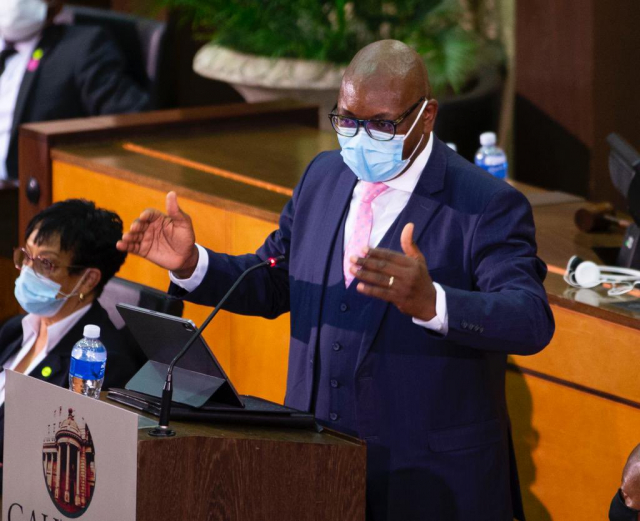
“We call on the people of our province to get ready to vaccinate in large numbers. Vaccines save lives.”
To date, 5 214 healthcare workers in Gauteng have already received their Johnson & Johnson shot since the programme was rolled out last week at Chris Hani Baragwanath and Steve Biko Academic hospitals.
The province is planning to vaccinate 215 101 healthcare workers in phase one of the vaccine rollout plan.
Phase two will focus on 7 372 924 essential workers and vulnerable sections of the population, such as the elderly and people with comorbidities.
The last phase will concentrate on 2 789 427 vaccinations for the rest of the population over 18 years.
Makhura said more than 150 vaccination sites have been identified at primary healthcare centres and vaccinators have been trained across the province.
The Premier has also paid tribute to the healthcare professionals who have worked tirelessly to save lives.
He commended thousands of essential workers such as the police, security officers, public servants, the military, agricultural workers, energy workers and workers in retail shops, who have kept the country going during the pandemic.
Health infrastructure capacity
Gauteng expanded the capacity of the public healthcare system with 4 265 new functional beds, while 4 992 posts were created and filled between April 2020 and January 2021.
The province is planning to add 1 425 more beds and staff from the start of the new financial year.
“This is a significant long-term investment that will outlive the COVID-19 pandemic. What is important is to improve patient care, clinical outcomes, meet the ideal clinic standards and prepare the health care system for the National Health Insurance,” said Makhura.
PPE corruption
Makhura assured that action is being taken over the personal protective equipment scandal unveiled by the Auditor-General and the Special Investigating Unit.
He believes the allegations of corruption constitute a serious dent to efforts made in the past five years towards clean governance and restoring integrity.
“We must and we will set an example with all those involved in malfeasance, both in the public and private sector,” he said, adding that the State should recover the money.
Food security
The COVID-19 pandemic has brought home the stark reality that 19% (three million) of Gauteng residents are unable to meet their daily nutritional needs.
“The food security intervention was one of the most successful in our COVID-19 response,” said Makhura.
Between April 2020 and December 2020, the province provided more than 650 856 households with food relief, reaching over 3.2 million Gauteng citizens.
“This is the biggest food security effort ever undertaken by the government,” the Premier said, noting the role of the private sector and non-profit organisations in supporting an additional one million residents.
In addition, the COVID-19 income relief grant for the unemployed reached more than 600 000 unemployed people in the province.
A total of 2 344 homeless people were provided with shelter, three meals daily psychosocial support, medical assessments, and treatment for substance abuse.
More than 1.3 million girl children have benefited from the Dignity Programme.”
Going forward, Makhura said Gauteng will intensify work to combat urban poverty, hunger and homelessness.
“We are supporting the creation of community and household food gardens to ensure that the three million food-insecure people participate in growing food for themselves so that no one goes to bed hungry.”
The Premier said he is advocating for urban agriculture as a key sector for employment, entrepreneurship and food security.