African business network and the South African position
By Phumla Williams

We live in a globally connected world where the fortunes of nations are interlinked. This is particularly true for African countries which are all interconnected on a people to people, social, trade and economic level.
Since the start of our democracy in 1994, South Africa has actively sought to strengthen ties with countries on the African continent. These partnerships not only seek to expand the continent’s economic base but also positively impact the daily lives of ordinary citizens.
Today these strong ties are being expanded across the continent in various ways, and most recently was further strengthened by Toyota South Africa exporting Hilux kits for reassembly in Kenya. The reassembly kits emanates from Toyota’s manufacturing plant in Durban, South Africa which already builds completed vehicles for markets in Europe.
With the first reassembled vehicles going on sale later this month, local consumers can expect better prices as they are now deemed locally manufactured and void of any import duties. Furthermore, job creation, skills development and technology transfer that often accompany such transactions will be strengthened.
The time is now for a new era of intra-African trade, where African countries no longer look abroad for the products and services. In supporting each other we can establish new industries, create jobs and open up new markets in Africa.
While Toyota SA will initially supply all parts for the Hilux reassembly, it is expected that over time local content such as batteries and glass for vehicles will be sourced from Kenyan companies themselves.
Importantly, the move deepens automotive manufacturing capabilities and expands the sector’s value chain for the East African region and the continent at large. Over the longer term, it can build Kenya’s vehicle assembly industry into a formidable sector.
South Africa supports these continental forays into vehicle manufacturing and envisions a series of regional industries across Sub-Saharan Africa. Similar advances to develop the vehicle manufacturing industry in Nigeria, Ghana and Ethiopia are already underway.
South Africa looks forward to share its expertise with African nations from it successfully attracting a number of multinational automotive producers as part of our Automotive Production and Development Programme. It promoted the country as an automotive manufacturing hub and South Africa is committed to use the strong relationship it has built to create manufacturing hubs across Africa.
We see South Africa, Kenya and Nigeria as central in their regions with neighbouring countries supporting the value chain with components, technology and services.
It is indisputable that our destiny as African nations are intrinsically linked and we must work together to grow business, trade and investment on the continent. The implementation of the African Continental Free Trade Agreement (AfCFTA) will go a long way in building a united economic and trade front as it creates the world’s largest free trade area once operational.
South Africa along with Kenya ratified the agreement because we appreciate the potential it has to act as a catalyst to Africa’s economic growth. Through AfCFTA, African nations can expected to benefit from an increase in foreign direct investment, while also gaining access to a broader range of expertise. Together we can tap into the many opportunities created by a single market of goods and services for 1.2 billion people.
In the spirit of advancing the African Continental Free Trade Agreement South Africa invites Kenyan businesses and investors to invest in the country. South Africa’s imports from Kenya include tobacco, textile fibres, tea, plastic products and copper. There are also a number of South African companies already operating in Kenya in the pharmaceutical, banking, engineering and retail sectors.
South Africa is open for business and we are increasing our efforts to increase trade with African countries. The recent attacks on foreign nationals in our country has been a great concern for our government. The criminal actions by a handful of perpetrators are in no way a reflection of the true state of relations between foreign nationals living and working within our communities.
South Africa is a multicultural society that promotes interaction among people of different backgrounds. In response, the attacks our law enforcement agencies have increased visibility in volatile hotspots, while the South African Police Service will continue to act against any acts of lawlessness.
There will also be ongoing continuous joint inspections by the different law enforcement agencies countrywide to ensure compliance with the laws of the country. These anti-crime operations have been implemented to create the space for South Africans and foreign nationals to go about their daily lives unhindered.
We are determined that South Africa belongs to all who live in it, and all who reside here must be free to participate in social and economic activities. In advancing Africa let us take hands with each other and Africans elsewhere on the continent to encourage greater social cohesion, trade and investment, nation building and African unity.
Phumla Williams is the Acting Director-General at GCIS
From the desk of the President (18 November 2019)
Dear Fellow South African,
 The three life sentences handed down to the rapist and killer of UCT student Uyinene Mrwetyana by the Cape High Court are befitting of this heinous crime. The life sentences serve the cause of justice and must act as a deterrent to men who rape and kill the women of our country.
We remain firm in our resolve that a life sentence must mean life. Those who commit crimes against women and children must know that they will be caught and tried, and that our courts will act firmly against those found guilty.
The pain we felt as a nation at the brutal killing of Uyinene, of Jesse Hess, of Leighandre Jegels, of Janika Mallo and of the many other slain women and children remains fresh. We dare not rest.
The violence perpetrated by men against women remains a scourge and national crisis that we must act urgently to end.
The Emergency Action Plan to deal with the scourge of gender based violence that I announced at a special joint sitting of Parliament in October is being implemented. The women of our country demanded that financial and other resources should be made available to address this national crisis. I directed that government should respond the call that had been made by the women of our country. The government has responded. The responsible government departments have together reprioritised R1.6 billion for the plan to be resourced and implemented.
The plan focuses on improving access to justice for survivors of violence and prevention campaigns to change attitudes and behaviour. It involves measures to strengthen the criminal justice process and to prioritise the creation of economic opportunities for women who are vulnerable to abuse.
I have directed that I be given weekly reports on the implementation of the plan. There has been notable progress on a number of aspects of the plan.
We are on track to achieve our target of establishing 11 more sexual offences courts by the end of the current financial year. A new Sexual Offences Court has been opened in Sibasa in Limpopo and eleven regional courts across all provinces have been identified for upgrade.
To protect the rights and dignity of child survivors and mentally disabled survivors, CCTV systems have been upgraded at 38 regional courts. Two weeks ago I opened the High Court in Mpumalanga and I was pleased to see that the court has the appropriate facilities to protect the rights and dignity of child survivors and mentally disabled survivors. Such facilities allow testimony to be given without having to face assailants in an open courtroom.
We are in the process of establishing three new Thuthuleza Care Centres centres in the Eastern Cape, KwaZulu-Natal and Gauteng. Provinces are identifying underutilised buildings that can be refurbished and used as shelters.
Clearing case backlogs is a priority. The National Prosecuting Authority is implementing a 100 day rapid results approach to speed up case turnaround times. Courts with significant backlogs in the North West, Eastern Cape and Limpopo have been identified for roll-out.
National and provincial 24-hour call centres to deal with complaints against police officials, prosecutors and magistrates on gender-based violence and femicide cases are now up and functioning. We are working to reduce the GBV case backlogs at forensic laboratories and are developing a tracking mechanism that will be rolled out in January 2020.
The SAPS has allocated 312 new recruits currently undergoing basic training to the Family Violence, Child Protection and Sexual Offences Units. To date, 7,000 rape evidence collection kits have been distributed to police stations across the country. A project to reopen unresolved murder and sexual offences cases (so-called cold cases) will soon be operational. It has already begun in the Eastern Cape.
Government employees who work with children and mentally disabled persons are being vetted against the National Register of Sex Offenders. To date, 1,222 officials have been vetted, including prosecutors and members of the SAPS.
Legislative reform is underway to tighten conditions around bail and sentencing for perpetrators of gender-based violence, as well as provisions that extend the protection afforded to women and children.
We are rolling out an education, awareness and prevention campaign on various media platforms. This includes providing information on how to access the Thuthuzela Care Centres and the gender-based violence command centre.
The women of our country are tired of living in fear. It is their rightful expectation that they should be protected from violence, and that perpetrators of such acts should be imprisoned.
I have taken personal responsibility to ensure the emergency plan is implemented, and I will provide our citizens with regular reports on our progress.
Gender-based violence is not a problem of the rich or the poor. It is not a problem of the townships or the suburbs or the villages. It impacts us all, and we have had enough of its deeply harmful effects: broken families, ravaged communities and lives destroyed.
Our success depends on the involvement of each South African. It is a responsibility none of us should abdicate. We must all get involved. Let us not look away.
Let us work together, in the words of the Freedom Charter, ‘sparing neither strength nor courage’ to eradicate this evil from our country.
With best wishes,
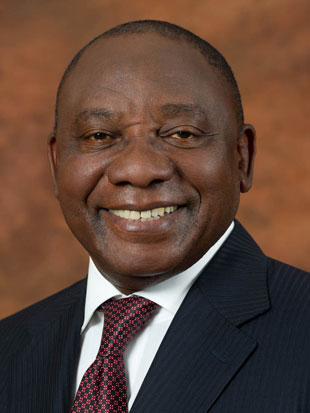
Cyril Ramaphosa is the President of South Africa.
From the desk of the President
Dear Fellow South African,
Last week, I met with the leadership of the Black Business Council where, among other things, we discussed issues of transformation. I took the opportunity to inform them about government’s commitment to transformation and non-racialism. Of all the achievements since the advent of democracy in1994, perhaps our most important is our sustained and unwavering commitment to transformation and non-racialism.
When we embarked upon this journey, we aimed, in the words of our Constitution, ‘to heal the divisions of the past and establish a society based on democratic values, social justice and fundamental human rights’.
We knew that we had to build a truly united nation, not merely to replace domination by one with domination by another.
Non-racialism is not the product of a negotiated compromise, but is a fundamental pillar of the new society we are building. It is only through advancing non-racialism that we will be able to reconstruct the fabric of our society and narrow social and economic divisions and build a new democratic society from the ashes of the old that had destroyed the potential of our country. It is a principle we will not abandon.
We know too well what happened when race was used to exclude the majority of South Africans, and we must actively guard against the return of attitudes that presume the colour of one’s skin should confer either privilege or disadvantage.
This is not to say that race can and should be ignored.Our Constitution affirms that we are a nation of diverse cultures, faiths and languages – and protects the right to self-expression and self-identification.
At the same time we also recognise the ‘unfinished business’ of nation-building: which is overcoming the deep divisions that apartheid created in our society.
That is why redress continues to be a crucial pillar of government policy, whether it is in land reform, employment equity or in economic transformation.
Although we have come a long way since 1994, the occasional expressions of racial and ethnic chauvinism shows that many in our society have yet to overcome what Joe Slovo once termed the ‘psychological barrier’ towards true non-racialism.
Whether it is reflected in the internal dynamics of political parties, in the workplace, or outwardly expressed on the letter pages of newspapers, one finds a reluctance on the part of some to accept that Africans, whites, Indians and coloureds all have an equal right to a seat at the table of our society.
As a country, we should not allow ourselves to be led down this dark path. We have witnessed elsewhere in the world the consequences of narrow forms of nationalism based on race or ethnicity. It is not the society we want for ourselves or our children.
Since 1994, we have actively sought to drive transformation through affirmative action and our broad-based black economic empowerment policies, through preferential procurement and initiatives like the Black Industrialists programme.
Within government itself, transformation of the public service to reflect this country’s demography has been critical. As we strive to rebuild the public service – including at our state-owned entities – it is our mission to appoint people who are capable, qualified, ethical and who embody the values of public service, whether they are black or white, men or women.
The significant progress that has been made in the public sector has not been matched by the private sector. The report released by the Commission for Employment Equity in August points, at best, to pooradherence to employment equity legislation, and, at worst, outright disregard for the law.
The upper echelons of management in private companies are still dominated by white men, although they make up just 5% of the economically active population. Africans only make up 15% of top management, despite accounting for 79% of the economically active population.
Business needs to urgently do some serious introspection. Our transformative agenda cannot succeed unless we work together to broaden the participation of all South Africans in our economy, and it begins in the workplace.
Poor labour relations is in part fueled by perceptions – backed up by the Employment Equity report – that black employees are relegated to the factory floor while white employees occupy management roles. This inequity naturally has ugly consequences when it comes to the discrepancy in incomes, where black workers will always earn a fraction of what white workers and managers earn.
Advancing black and female employees must be a cornerstone of any company’s operations. This must move beyond merely ensuring compliance, and towards succession planning, mentoring, training and skills transfer, and towards giving
employees a meaningful stake in the companies they work for.
Black economic empowerment and affirmative action are important tools to further non-racial transformation.
As we intensify the work we must do to address the injustices of the past – especially in correcting the skewed race and gender composition of our public companies – we must ensure that all South Africans, regardless of colour, have an opportunity to contribute to building a better, fairer and more prosperous nation.
I call upon South Africans to embrace each other as equals, and look beyond their preconceptions of someone merely by looking at their skin colour
Let us move beyond the psychological barrier in the interests of rebuilding this country together.
In the words of Martin Luther King Jnr: “We must learn to live together as brothers (and sisters) or perish together as fools.”
All the best,
Cyril Ramaphosa is the President of South Africa.