
Global fight against human trafficking

Parliamentarians across the world have been challenged to encourage governments to strengthen cooperation among law enforcement agencies to investigate, prosecute and share information to prevent human trafficking.
Fikile Masiko, who is among the South African delegation to the 144th Inter-Parliamentary Union’s (IPU’s) Assembly, which is currently underway in Nusa Dua in Bali, made the call during a preparatory debate in the Standing Committee on Democracy and Human Rights on the proposed theme for the draft resolution.
The proposed theme must be written for the standing committee’s consideration at the 145th IPU Assembly to take place later this year.
The theme concerns parliaments’ developmental role in countries with high levels of international migration, as well as their role in preventing all forms of human trafficking and human rights abuses, including that sponsored by the state.
Masiko called for cooperation between law enforcement agencies to be accompanied by strong extradition treaties, pointing out that South Africa has such treaties with 18 other countries, to date.
She also called on parliamentarians to exercise their constitutional mandate to strengthen social and labour protection frameworks, thereby eliminating the barriers that increase people’s vulnerability to slavery and other forms of exploitation.
“In South Africa’s view, the draft motion on this text should cover comprehensively the IPU’s intention to protect victims by ensuring their access to secure shelters, health services, including reproductive health services, psycho-social counselling, legal assistance, as well as documentation issues,” Masiko said.
As a matter of procedure at the IPU, standing committees debate and agree on a theme for a draft resolution and elect rapporteurs to compile a draft from which IPU member states make written comments.
The committee concerned then meets to discuss the draft resolution and consider written comments, in order to produce a final draft resolution to be tabled for adoption by IPU Assembly.
The Standing Committee on Democracy and Human Rights will reconvene again on Wednesday to officially adopt the proposed theme for its next draft resolution.
The standing committees on Peace and International Security and on Sustainable Development will also finalise their draft resolutions, to be tabled in the Assembly for adoption.
The 144th IPU Assembly plenary is expected to adopt the two draft resolutions that seek to reframe how peace processes are approached, with a view to facilitating lasting peace and leveraging information and communication technology to support the education sector, including in times of pandemic.
Couple convicted for R10m COVID-19 TERS fraud

The Unemployment Insurance Fund (UIF) Commissioner, Teboho Maruping, has issued a stern warning to those who attempt to defraud the UIF to be aware that they will be arrested and punished for their heinous actions.
This follows the recent conviction of a couple who cheated the UIF’s COVID-19 Temporary Employer-Employee Relief Scheme (COVID-19 TERS) out of more than R10 million.
Directors of Denmeng Trading, Moroko Moremi, 37, and his wife Treasure Moremi, 34, were recently found guilty of fraud by the Pretoria Specialised Commercial Crimes Court after applying for COVID-19 TERS for 553 workers when they only employed 22.
“Joint efforts by the UIF’s investigators, law enforcement agencies at the Fusion Centre such as the HAWKS, National Prosecuting Authority (NPA), and the Financial Intelligence Centre (FIC) led to the couple’s successful arrest and conviction,” the department said in a statement.
The couple is scheduled to be sentenced on 17 May 2022.
The department said that this latest conviction is against the backdrop of a recent court appearance of two suspects at the Pretoria Specialised Commercial Crimes Court after they received R2,7 million from the UIF, but allegedly failed to use the money in line with the Memorandum of Understanding (MOU) signed with the UIF.
Amongst others, the MOU requires that the COVID-19 TERS monies must be paid over to the qualifying workers applied for.
Commissioner Maruping has conveyed his gratitude to law enforcement agencies for the latest conviction and arrests.
He said that he hopes the latest conviction and arrests send a strong message to other would-be fraudsters that the long arm of the law will always catch up with them.
“Those who have helped themselves to funds earmarked for workers during the lockdown should always remember that the law is creeping towards them and they will not have any peace. We will not tolerate the siphoning of workers’ benefits by unscrupulous individuals. All fraudsters are on notice and we hope more suspects are arrested and sent straight to jail.
“Working together with law enforcement agencies, we will follow every lead pointing towards suspected fraud. We also thank the public for being vigilant about the abuse of COVID-19 TERS funds by blowing the whistle to us,” Maruping said.
To date, there have been four convictions of individuals who have defrauded the UIF of COVID-19 TERS funds, and more are expected as 15 cases have been referred to the SIU for further investigation.
In 2020, the Fund embarked on the “follow the money” project where close to R900 million was recovered.
The department said that the project is expected to resume in April 2022 upon the appointment of audit firms and it is anticipated that additional recoveries will be made, and more arrests will take place as fraudulent claims are uncovered.
Meanwhile, the Department has also noted and welcomed the sentence handed down by a Pretoria Magistrate Court on Tuesday to three undocumented immigrants for impersonating Labour Inspectors.
Okichukwu Michael Uzor (45), Loveness Mandivava (32), and Nyemudzai Muzvidza (33) were sentenced to twelve months in prison with an option of R10 000 fine.
The Department has applauded and welcomes the decision, stating that it sends a clear message to those posing as labour inspectors and performing any labour inspection functions to flee.
The Department said that it was concerned about the growing number of pretentious inspectors in the province but believes it is only a matter of time before the department pounces on them.
Limpopo Health department under SIU microscope
The Special Investigating Unit (SIU) is expected to begin an investigation into alleged corruption and maladministration at the Limpopo Department of Health.
This after President Cyril Ramaphosa signed a proclamation giving the corruption busting unit the authority to do so.
SIU spokesperson Kaizer Kganyago said although the investigation would zero-in on procurement of health waste management services in the province, it would not be limited to that scope.
“Furthermore, the SIU will probe payments which were made in respect thereof in a manner that was not fair, equitable, transparent, competitive or cost-effective; or contrary to applicable legislation or circulars or instructions issued by the National Treasury or the relevant Provincial Treasury,” he said.
According to Kganyago, officials at the department will also come under the microscope.
“The…investigation will also cover any unlawful, improper or irregular conduct by employees, officials or agents of the department; or any other person or entity, in relation to the allegations being investigated. The SIU will refer evidence of pointing to criminal conduct it uncovers during the investigation to the National Prosecuting Authority (NPA) for further action,” he said.
Kganyago explained that the investigation will cover a period of a decade at the department.
“The proclamation covers offences which took place between 1 January 2010 and 18 March 2022, the date of publication of this Proclamation, or which took place prior to 1 January 2010.
“It also covers any offences after the proclamation date that are relevant to, connected with, incidental to the matters or involve the same persons, entities or contracts investigated under authority of Proclamation R55 of 2022,” he said.
The spokesperson warned that where wrongdoing is found, the SIU will institute legal action against those found to have transgressed the law.
“The SIU is empowered to institute civil action in the High Court or a Special Tribunal in its name, to correct any wrongdoing uncovered during its investigation caused by acts of corruption, fraud or maladministration,” Kganyago said.
Bank for International Settlements publishes central bank digital currencies report
The Bank for International Settlements (BIS) Innovation Hub has announced the completion of prototypes for a common platform enabling international settlements using multiple central bank digital currencies (mCBDCs).
The BIS is comprised of the South African Reserve Bank (SARB), Reserve Bank of Australia, Bank Negara Malaysia, and the Monetary Authority of Singapore.
In a statement, the Hub said: “Led by the Innovation Hub’s Singapore Centre, Project Dunbar proved that financial institutions could use CBDCs issued by participating central banks to transact directly with each other on a shared platform. This has the potential to reduce reliance on intermediaries and, correspondingly, the costs and time taken to process cross-border transactions.”
The project was organised along three work streams: one focusing on high-level functional requirements and design, and two concurrent technical streams that developed prototypes on different technological platforms (Corda and Partior).
The BIS said the project identified three critical questions. These included the question of whether entities should be allowed to hold and transact with CBDCs issued on the platform. Among the other questions was how could the flow of cross-border payments be simplified while respecting regulatory differences across jurisdictions and what governance arrangements could give countries sufficient comfort to share critical national infrastructure such as a payments system.
The project proposed practical solutions for addressing these issues, which were validated through the development of prototypes that demonstrated the technical viability of shared multi-CBDC platforms for international settlements.
“A common platform is the most efficient model for payments connectivity but is also the most challenging to achieve. Project Dunbar demonstrated that key concerns of trust and shared control can be addressed through governance mechanisms enforced by robust technological means, laying the foundation for the development of future global and regional platforms,” said Andrew McCormack, Head of the BIS Innovation Hub Centre in Singapore.
The project’s findings also affirmed that any such arrangement should be subject to the governance deemed appropriate by central bank participants, including allowing them to retain control of the application of rules on a jurisdictional and currency level.
The details and conclusions of the project were published on Tuesday in a report that supports the efforts of the G20 roadmap for enhancing cross-border payments, particularly in exploring an international dimension of CBDC design.
“Even though multi-CBDC exploration is at its infancy, Project Dunbar highlights the possibilities of using multiple CBDCs issued on a shared platform for international settlement.
“While many unknowns remain, and a number of areas still require further investigation, it is only through our collective understanding and journeying together that we can meaningfully contribute to the G20 roadmap for enhancing cross-border payments. We are privileged to be part of this pioneering piece of work,” said Rashad Cassim, Deputy Governor of the South African Reserve Bank.
SA records 1 980 new COVID-19 cases
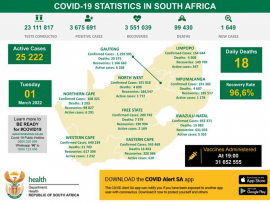
South Africa on Wednesday recorded 1 980 new COVID-19 cases, bringing the total number of laboratory-confirmed cases to 3 698 803.
The National Department of Health recorded 40 deaths and of these, three occurred in the past 24 – 48 hours, bringing the total fatalities to 99 767 to date.
There has been an increase of 46 hospital admissions in the past 24-hour reporting cycle.
To date, 23 485 052 tests have been conducted in both the public and private sectors.
In the public sector, 10 727 057 tests were conducted, while 12 759 995 were conducted in the private sector.
The majority of new cases are from Gauteng (39%), followed by the Western Cape (25%).
KwaZul- Natal accounted for 16%; Mpumalanga 5%; the Eastern Cape, Free State and the North West 4% each; Limpopo 2% and the Northern Cape 1% of the new cases.
Gauteng recorded 764 cases, Western Cape 493, Limpopo 38, Free State 73, Mpumalanga 102, Northern Cape 29, KwaZulu-Natal 317, the North West 82 and Eastern Cape 82.
Police probe F State learner for sale of ‘poisonous’ cakes
Police have taken in a Grade 10 learner, from Ntemoseng Secondary School in the Free State, for questioning, for the sale of allegedly poisonous cakes to fellow pupils.
According to reports, some of the learners who consumed the cakes are in a critical condition, while others have recovered after receiving medical attention. The learners who consumed the cakes are said to have started scratching themselves, with some experiencing headaches and others being hyperactive.
“Upon investigation, the learners alleged that they bought cakes from one Grade 10 learner when they arrived at school. About 17 learners were treated at the hospital and 12 have fully recovered,” said Free State Education MEC, Dr Tate Makgoe on Thursday.
The MEC said the learner who sold the cakes did so in contravention of the school code of conduct, and will “not be allowed at the school”.
“This should not be allowed in our schools. It is clear that older people are using our children to achieve their nefarious objectives. Collectively and individually as stakeholders, we to have condemn this in the strongest possible term,” Makgoe said.
The MEC extended his gratitude to the Department of Health for responding swiftly to the situation.
Ninety One lauded for supporting Youth Employment Initiatives
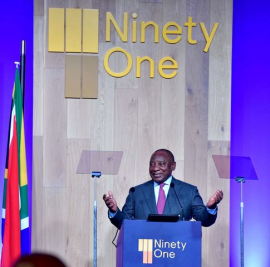
President Cyril Ramaphosa says government looks to companies like Ninety One to support initiatives like the Youth Employment Service, which provides young people with workplace experience, and the SA Youth.mobi network, which connects unemployed young people with training opportunities.
The President said that it was greatly encouraging that Ninety One has graduate and intern programmes that provide business mentoring for new entrants to the asset management industry.
“As responsible corporate citizens and as a proudly South African firm, we want Ninety One to be part of the national effort to create more jobs and to bring more young South Africans into the world of work,” he said.
The President was delivering a keynote address at the 30th Anniversary of a proudly South African assets management firm, Ninety One, at the Cape Town International Convention Centre on Wednesday.
The event was attended by leaders of the SA investment management industry, bankers, financial advisors, representatives of business, pension fund trustees and asset consultants.
President Ramaphosa encouraged that if there is an opportunity to align with existing interventions to give young people more workplace exposure, let us do so.
“These are just some of the ways in which this proud firm can continue to invest for a world of change – and thereby make a world of difference. As I have witnessed the growth of Ninety One, I have always been inspired by your optimism about South Africa and its prospects.
“Even as you continue to grow and expand, your feet remain firmly planted on South African soil,” the President said.
The President said that it was a great pleasure to celebrate this milestone with all the people who have been part of the Ninety One journey.
True to its founding ethos, the President said that Ninety One continues to invest for a world of change and continues to pursue change.
He said that it is a firm committment to transformation and gender equality.
“Ninety-One has signed the Women in Finance Charter, and, I understand, hopes to achieve a global target of 30% of women in senior management by 2023.
“It is truly commendable that half of the Board of Directors are women, and that in the 2020 reporting period Ninety One increased the number of women in senior management from 26% to 28% globally,” he said.
President Ramaphosa said that this says much about the firm’s vision that it recently joined the Net Zero Asset Managers Initiative to support investing that is aligned with the goal of net-zero emissions by 2050 or sooner.
“This 30-year journey has not been without its challenges and difficulties. Yet, Ninety One has persevered and made its mark on the domestic and international investment landscape, and will no doubt continue to do so well into the future,” he said.
The President said that government understands Ninety One’s vision and ambitions to be closely aligned with the national goals which is to improve the lives of all South Africans, to attract greater investment, and to grow and transform the economy so it benefits all people.
“He said that these goals are being pursued at a time when the South African economy, alongside the economies of many countries, is confronting strong headwinds.
“As a country, we are firmly focused on driving growth and creating employment for our people. The unemployment rate has reached astronomical levels,” he said.
President Ramaphosa noted that real GDP grew by 1.2 percent in the fourth quarter of 2021, taking the annual growth rate for 2021 to 4.9 percent.
He said that the annual increase in real GDP in 2021 was primarily led by higher economic activity in finance.
“This shows that our economy is recovering. But even as we expect 2.1 percent growth this year, it is far below the levels we need. It is not enough to turn the tide on unemployment and to lift millions of South Africans out of poverty.
“That is why in this year’s State of the Nation Address, I called for a new consensus for growth and employment,” the President said.
He reiterated that the country needs to deepen cooperation, build on progress in the implementation of the Economic Reconstruction and Recovery Plan, and focus the collective capabilities on unlocking the potential of the economy and people.
Progress in implementing structural reforms
The President noted that there has been progress in the implementation of much-needed structural reforms in vital economic sectors, notably in energy generation.
He said that last week, government began the auction of high frequency communications spectrum, unlocking new spectrum for mobile telecoms for the first time in over a decade.
“We are improving operational efficiency in our ports and railways, streamlining and modernising visa application processes to attract skilled workers, and providing the necessary support for small businesses to expand and grow,” he said.
The President said that a specialised Unit in the Presidency will be dealing with red tape reduction to improve the business operating environment.
“Through the Economic Reconstruction and Recovery Plan our national infrastructure build programme is proceeding apace.
“The Infrastructure Fund is preparing a pipeline of projects with an estimated value of R96 billion, with a number of catalytic projects expected to start construction this year,” he said.
He said government is working on strategies to harness the potential for new growth industries ranging from cannabis production to electric vehicles to green hydrogen.
He added that stakeholders have finalised new master plans for the steel industry, furniture and global business services as part of revitalising our manufacturing base.
Calls for municipalities to uphold the quality of drinking water

Deputy President David Mabuza has called on municipalities to ensure that the quality of drinking water remains compliant with minimum standards.
The Deputy President said this when he responded to oral questions from permanent and non-permanent delegates of the National Council of Provinces (NCOP) on Wednesday.
“We take this opportunity to urge municipalities to continue with ensuring that our country’s drinking water remains compliant with the set standards, while also fast-tracking efforts of improving the levels of access to water.
“With all these measures in place, we should not worry about the possibility of contamination of our drinking water,” he said.
In addressing the decline in water quality, the Deputy President had been asked by the ANC’s Eastern Cape delegate, Nokuzola Ndongeni, if government has engaged the Water and Sanitation Department on the growing concerns surrounding the quality of water.
Mabuza said the department has confirmed that the country’s water quality remains compliant with the minimum standards for drinking water, as specified by the South African National Standards.
He said this has been further confirmed in the recent announcement by the National Institute of Communicable Diseases (NICD) on reported cases of typhoid in different municipalities in parts of the country.
“The NICD has clarified that the detection of typhoid, between December 2021 and February of this year, was not linked to contaminated municipal water.
“Whereas there were reported cases of typhoid in the North West, Western Cape and Eastern Cape, the quality of water in these areas was found to be compliant with the national drinking water standards.”
The Deputy President said as an ongoing measure, the Department of Water and Sanitation will continue to monitor the processes that Water Services Authorities implement, and it will engage them where non-compliance is detected.
“For example, these entities are required to register for a monitoring programme on the Integrated Regulatory Information System, which indicates the sampling point of water, frequency of its monitoring and what factors are monitored related to water quality.
“It is mandatory for all Water Service Authorities to share their results on water quality on this system, and appropriate action is taken where challenges related to water quality are detected.
“The Department of Water and Sanitation has also revived the Blue Drop Certification Programme, which seeks to implement a proactive drinking water quality risk management approach in order to ensure that quality failures are minimised; and that where it occurs, acceptable interventions are implemented to safeguard affected communities.”
SA’s investment drive soldiers on despite COVID pandemic

South Africa’s investment drive has soldiered on, despite the devastating COVID-19 pandemic exacerbating slow economic recovery.
This was on Wednesday revealed during a business breakfast as South Africa gears to host the fourth instalment of the South African Investment Conference (SAIC) next week.
The SAIC spearheads government’s investment drive of attracting R1.2 trillion investment in five years. The business breakfast was attended by business executives and investment envoys representing various African states and representatives of the South African government.
“South Africa remains an investment destination of choice,” said Ambassador Sadick Jaffer, Department of Trade and Industry, Chief Director: Investment Promotion in InvestSA. InvestSA is a division of the Department.
“At the last SAIC held in Johannesburg in 2020, about 50 entities made new investment pledges to the value of R109 billion, bringing the 3-year total to 774 billion. Five of these projects, worth R4.3 billion have already been launched and 21 others are under construction or being rolled out – these are worth R34 billion,” Jaffer reported.
Of the 71 projects announced in 2019, 24 projects had been launched and an additional 25 projects worth R199.4 billion were under construction.
In addition, he said seven projects worth R45.6 billion, accounting for 12.5% of investments made in 2019, were in the early stages of implementation.
“Against the backdrop of slow economic recovery exacerbated by a devastating COVID-19 pandemic which disrupted the global supply chain, our investment drive soldiered on.
“We adapted and adopted new ways of engaging with potential investors with one central message – South Africa remains an investment destination of choice,” said Jaffer.
The chief director said the investments were monitored until completion, saying this was with the aim of identifying challenges timeously and assisting when required.
Presidential Investment envoy, Jeff Radebe, said South Africa’s strategic position within the Africa Continental Free Trade Area (AfCTA) placed it in good stead to benefit from opportunities presented by AfCTA.
“Africa offers investors access to a market of more than one billion people with a gross domestic product that exceeds $2.6 trillion,” he noted.
The former Minister said historic trade barriers were coming down and economic activities were increasingly conducted seamlessly across the continent.
“Africa is growing fast into an integrated investment destination,” he said.
AfCTA, which brings together 55 member states of the African Union, and came into effect in January 2021, aims to accelerate intra-continental trade and boost Africa’s standing in the global market.
“AfCFTA adds a new dimension to the 2022 Investment Conference,” Radebe added.
“Now we can demonstrate the significant advantages of investing in the South African economy and how returns can be multiplied through access to a much larger market. South Africa is an attractive destination for investors located outside of the continent. Many such companies also prefer to locate their regional headquarters here because of the access to quality infrastructure and connections to global supply networks.
“Through our participation in AfCFTA, we have preferential access to African markets and a deep understanding of business conditions on the continent.”
McCain sliced beans, Spar stir fry products recalled

The National Consumer Commission (NCC) has urged consumers in possession of certain McCain sliced beans and Spar stir fry products to return them to the point of purchase.
In a statement, Acting Commissioner Thezi Mabuza said the supplier informed the Commission of its precautionary recall after small fragments of glass were found in the products.
The products were packaged from July 2021, with best before dates between 2022 and 2023.
“We urge consumers who might have these products not to consume them and to return them to the retailer for a full refund or an exchange. The safety and protection of South African consumers is the mainstay of the Consumer Protection Act (CPA),” Mabuza said.
While the Commission welcomed the precautionary recall by manufactures and suppliers, Mabuza reiterated that regular quality check routines and processes are critical in order to deliver goods or services that will satisfy customers’ needs.
“The Commission is monitoring the recall based on its Recall Guidelines and also allowing the supplier to conduct further investigations to detect any further potential risk,” Mabuza said.