
KZN SAPS operations nab 8 600 suspects in February

A series of multidisciplinary operations targeting individual crimes on specific days of the week saw police in KwaZulu-Natal nab over 8 000 suspects, as the province confronts lawlessness head-on.
In a statement, provincial police spokesperson, Lieutenant Colonel Nqobile Gwala, said operations have been conducted in all districts across the province and will continue “as long as criminals engulf our neighbourhoods”.
“During these operations, police utilise various operational concepts such as roadblocks, stop and searches, raids on drug dens, as well as liquor outlets and suspect raids.
“Compliance inspections are carried out on specific entities that are contributing to our crime picture, such as second hand dealers, scrap yards and pawn shops,” said Gwala.
Between 1 and 28 February 2022, police officers across the province arrested 8 628 persons for various crimes.
A total of 2 681 arrests were made for contact crimes. The contact crimes arrests included 139 arrests for murder, 261 for robbery, 209 for rape, 1 780 for assault, as well as 108 for trio crimes (carjacking, house robbery and business robbery). A total of 352 arrests were made for property crimes such as burglary, theft of vehicles and stock theft.
Gwala said dangerous weapons, large quantities of drugs, liquor and counterfeit goods were seized by police during the operations.
A total of 1 839 suspects were arrested for drug related offences and 716 were arrested for liquor related offences in KwaZulu-Natal during this period, while 443 suspects were arrested for driving under the influence of liquor.
Police seized 273 illegal firearms, with 3 269 various rounds of ammunition in operations during the same period. All firearms seized will be subjected to ballistic testing to determine if they were used in any other crime.
Gwala said the increased involvement of communities in community policing forums and other legal crime fighting groups is most welcome, as vigilance is key to breaking the back of crime syndicates.
“During this period, many criminal groups were intercepted by police and security companies as they were prowling the streets with the intention of committing crimes.
“We also urge citizens to continue providing tip-offs to police on criminal activities by contacting your local police stations, as well as Crime Stop on 08600 10111 or by reporting via the MYSAPS App,” she said.
SA braces for steep fuel price hike

Mineral Resources and Energy Minister, Gwede Mantashe, has announced that the price of petrol and diesel are expected to increase at the beginning of March.
The fuel prices for March are expected to increase as follows:
- Both grades of petrol are expected to increase by at least R1.46.
- The price of 0.05% Sulphur Diesel is expected to rise by at least R 1.44.
- 0.005% Sulphur diesel is expected to cost at least R 1.48 more.
The Minister said a combination of factors, including the conflict between the Ukraine and Russia, contributed to the steep increases.
“The main reasons for the fuel price adjustments are due to the average Brent Crude oil price, which increased from $93.00USD [to] $96.47USD during the period under review; and the escalating crisis between Russia and Ukraine, which led to a surge in crude oil prices amid supply fears [and] subsequent sanctions on Russia by the USA and UK, which have contributed to the increase in crude oil prices,” Mantashe said.
Meanwhile, the prices of gas and illuminating paraffin are also on the rise. Prices are expected to increase as follows:
- Wholesale illuminating paraffin is expected to cost at least R1.21 per litre more.
- The single maximum retail selling price (SMRP) for illuminating paraffin is expected to go up by R1.61.
- The maximum retail price for LP Gas is expected to show a rise by at least 70c per kilogram.
The new prices are expected to take effect on Wednesday.
12 000 officers to beef up police ranks
The South African Police Service (SAPS) is on a recruitment drive, which is expected to boost the service with at least 12 000 more officers by the end of the year.
This was announced by the Minister of Defence and Military Veterans, Thandi Modise, at a media briefing of the Justice, Crime Prevention and Security (JCPS) Cluster on Sunday.
“The recruitment of 7 000 [officers] is in its final stages, while later in the year, the SAPS will recruit 5 000 to undergo training next year. The 7 000 are from the 2019/2020 intake, which was ready to embark on the Basic Police and Development Programme when the country was put under hard lockdown in March 2020.
“The training of this 7 000, plus an additional 3 000 made up of SAPS reservists and public service administration members, will commence in the 2022/2023 financial year.”
According to Modise, SAPS is also on a drive to recruit Bachelor of Science graduates and those from other fields of study.
“This will increase the strength of SAPS in its mandate to prevent and fight crime in communities. We will continually assess the capacity levels within SAPS and recruit accordingly to ensure that we increase the strength of the police from 180 000 officers to service the county’s population of more than 60 million people.”
The other specialist police areas are also being strengthened to fight crime within communities.
“[Units] like the Public Order Police, the Family Violence, Child Protection and Sexual Offences Investigating Unit, the frontline at police stations, as well as detectives will be beefed up with the apportionment of the new trainees to these much stretched units.
“Not only will the efforts of the police be bolstered to restore law and order in communities, but priority attention will also be given to the investigation of crimes against women, children, the elderly, and other vulnerable persons,” Modise said.
Intelligence
Modise said the capacity and strength of the country’s intelligence services, led by the State Security Agency (SSA), is receiving attention.
“Ministers are also re-evaluating and assessing the capacity and strength of the intelligence services to undertake surveillance and monitoring of stability in the country.
“The Report of the Expert Panel on the 2021 July unrest pointed to shortcomings in this area of work. The SSA and Crime Intelligence will ensure that critical posts are filled, which were left vacant by suspensions, resignations, promotions and deaths,” she said.
Furthermore, Modise said a forensic investigation into “all malfeasance in the agency” is underway.
“The agency has recently dismissed about four members already, who have been found guilty of fraud and corruption. The agency has also made much progress in terms of working with the Investigative Directorate to ensure that the persons who were involved in criminality are prosecuted,” she said.
Modise: Wheels of justice turning against corruption
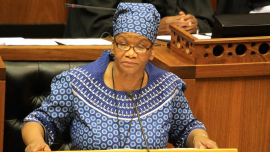
Defence and Military Veterans Minister, Thandi Modise, says law enforcement agencies are turning the screws on fraud and corruption in the country.
Modise was addressing a media briefing of the Justice, Crime Prevention and Security (JCPS) Cluster on Sunday.
“Despite the challenges, including those caused by the COVID-19 pandemic, members of the public will have seen that the wheels of justice, in relation to corruption, are starting to move more quickly and effectively.
“A number of notable arrests and court processes have been initiated in recent weeks, involving accused persons in the public and private sectors, including priority State capture matters.
“The efforts by law enforcement and criminal justice agencies are indeed starting to pay off, and more will be achieved when all are adequately capacitated to meet the extreme challenges of addressing State capture and high level complex corruption,” she said.
Modise said the JCPS Cluster is in full support of investigations into all those implicated in corruption and fraud.
“We wholly support the call made by the President that all those who are implicated and benefited unlawfully from State capture corruption and corruption related to the procurement of personal protective equipment must face the full might of the law.
“The NPA [National Prosecuting Authority] and the Directorate for Priority Crime Investigation [the Hawks] are collaborating to ensure that all implicated persons are brought to justice swiftly and appropriately.”
According to Modise, a new leader for the NPA’s Investigating Directorate will soon be announced following the resignation of former head, Hermione Cronje, in December last year.
“After a challenging set-up phase, the NPA’s Investigating Directorate (ID) is entering a new phase of impact under new leadership that will be appointed soon, with the right skills and resources to deliver on its mandate to tackle the most complex crimes, with a prosecution-guided investigation model.”
The Minister said law enforcement agencies are now collaborating with the Financial Intelligence Centre to combat financial crimes.
“These agencies — which include the DPCI, the NPA’s Asset Forfeiture Unit, Specialised Commercial Crime Unit, Investigations Directorate, Financial Sector Conduct Authority, Special Investigating Unit, Crime Intelligence, SSA, the South African Reserve Bank and South African Revenue Service — have issued 55 high priority financial intelligence reports that have been used to identify high-priority investigations.”
Modise also announced new measures in the protection of whistle blowers.
“All the measures that are put in place to fight corruption will not succeed if they are not supported by an effective whistle-blowing and witness protection system.
“A team reporting to the Anti-Corruption Task Team has been appointed to review the Protected Disclosures Act… and other applicable legislation, and undertake a comparative study of other jurisdictions to strengthen whistle-blower protection,” she said.
SANDF to support law enforcement agencies

The Minister of Defence and Military Veterans, Thandi Modise, says the South African National Defence Force (SANDF) stands ready to provide support to law enforcement agencies to help maintain stability in the country.
“The SANDF will continue to be on standby to protect all national key points, as well as economic corridors of the country, from any disruption or blockages, either arising from protesting truck drivers or any disruptive elements.
“The SANDF continues to defend the sovereignty and territorial integrity of the Republic and as such, continues to conduct border-safeguarding operations – in particular land borders. This is in order to curb cross border movement of undocumented persons, illicit goods and drugs, weapons, livestock and stolen vehicles.
“The defence force has registered spectacular successes in this regard by intercepting many luxury cars that were being smuggled into neighbouring countries and the interception of drug smuggling,” she said at a media briefing of the Justice, Crime Prevention and Security (JCPS) Cluster on Sunday.
The Minister said in addition to assisting law enforcement agencies, the SANDF is also assisting with the construction of bridges by availing the capacity of SA Army engineers to the Welisizwe Rural Bridges Programme.
“These bridges will assist in curbing the drowning of school children whilst trying to cross swollen rivers to get to school and assist pensioners to access their pension grants. Already we have constructed 16 bridges in KwaZulu-Natal and 18 in the Eastern Cape, and thus enabled thousands to cross dangerous rivers in order to reach clinics, schools and other service delivery centres.
“In the coming months and years, we will intensify this programme, consistent with the marching orders from the Commander-in-Chief.”
According to Modise, at least 2 000 new recruits are expected to join the ranks of the SANDF in the early weeks of March, a move she says is expected to “ensure that we have a well-capacitated defence, which is combat-ready and capable of discharging its constitutional mandate”.
Rule of law
Modise said the JCPS Cluster has flagged a “deliberate undermining of the rule of law” during protests as an area of concern.
“Our stance is very clear in this regard: our officers will enforce the rule of law without fear or favour where people deliberately undermine the authority of the State. No one has the right, irrespective of their grievances or dissatisfaction with anything, to break the law.
“[As] Ministers in the Security Cluster, we are committed to creating a safe and conducive environment that will reassure both citizens of this country and international tourists and investors alike, that they will be safe when they come to do business in this country.
“We therefore call upon all peace-loving people of this country to work with us as we transform and improve the security machinery that will serve all of us without fear or favour.”
Another concern of the cluster is the “low level of trust” between members of the public and law enforcement agencies.
“We will therefore endeavour to rebuild trust between the officers deployed in communities and community members. This will entail reviving the Community Policing Forums, which will work together with the local police stations to fight crime. This will ensure an inclusive approach to assessing the threats that exist in communities and putting in place the necessary responses,” Modise said.
Gender-based violence
Meanwhile, the JCPS Cluster welcomed the promulgation of the Criminal and Related Matters Amendment Act, Criminal Law (Sexual Offences and Related Matters) Amendment Act and Domestic Violence Amendment Act.
The three new pieces of legislation were enacted in a bid to secure more prosecutions in cases related to gender-based violence and femicide (GBVF).
Modise said thousands of South African Police Service members have undergone training to fight crime against women and children.
“The Department of Police has trained over 90 000 officers in an effort to sustain the decline in sexual offences. [SAPS] established GBVF desks at police stations across all provinces, which will be managed by trained GBVF desk officers.
“It is envisaged that these GBVF desks will be finalised by end of March this year and government will be prioritising the identified GBVF hotspots,” she said.
Public servants get access to WEF Strategic Intelligence Platform
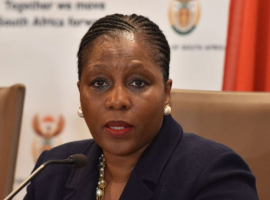
A partnership between the World Economic Forum (WEF) and the National School of Government (the NSG) will enable public servants to access information from WEF’s Strategic Intelligence Platform.
The collaboration was launched on Friday by the Minister of Public Service and Administration, Ayanda Dlodlo, supported by Chido Munyati, the head of WEF’s Regional Agenda Africa and Stephan Mergenthaler, the head of Strategic Intelligence.
The objective of the landmark partnership is to support public sector initiatives through access to a wide array of research, insight, publications, rich media and data for policy development, forecasting, decision-making, briefings and other needs by government departments and public sector institutions in WEF’s Strategic Intelligence Platform.
The information provided by the platform will be available for use by advisors, researchers, planners and content creators for different projects or activities.
The platform will complement other sources of data already available in South Africa and will provide quick access on topics from A – Z. Twelve government departments already have access to the WEF Strategic Intelligence Platform. The rest of the government departments will have access from April 2022.
WEF engages the foremost political, business and other leaders of society to shape global, regional and industry agendas.
South Africa has a longstanding partnership with WEF and participates in annual meetings in Davos, Switzerland and also hosts the WEF Africa Forum meeting from time to time.
Addressing the launch, Dlodlo said no government could innovate and solve its problems, take advantage of emerging opportunities and avoid potential challenges and threats if it does not use information.
“The government of South Africa has long held this view, and encourages evidence-based policy making to confront challenges and harness opportunities.
This platform will complement other data sources and will contribute to efforts towards evidence-based policy making, and the building of a capable and professional civil service.
The President of WEF, Børge Brende, said the organisation values its collaboration with South Africa and Africa.
“This is why we are pleased to be able to offer the National School of Governance and the wider South African public sector advanced access to our Strategic Intelligence Platform. We hope that this will play a valuable part in supporting national development efforts,” he said.
SA records 1 266 new COVID-19 cases
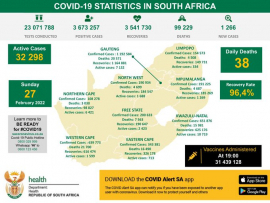
South Africa has recorded 1 266 new COVID-19 cases, bringing the total number of laboratory-confirmed cases to 3 673 257.
In a statement on Sunday, the National Institute for Communicable Diseases (NICD) said the increase in cases represents a 6.7% positivity rate.
The majority of new cases are from Gauteng (42%), followed by the Western Cape (18%).
KwaZulu-Natal accounted for 16%; Mpumalanga 8% and the North West accounted for 7%. The Free State accounted for 5%; Eastern Cape 3%; Limpopo 2%, while the Northern Cape accounted for 1% of the new cases.
“Due to the ongoing audit exercise by the National Department of Health (NDoH), there may be a backlog of COVID-19 mortality cases reported. The NDoH reported 38 deaths and of these, two occurred in the past 24 – 48 hours. This brings the total fatalities to 99 229 to date,” the NICD said.
A total of 23 071 788 tests have been conducted in both the public and private sectors.
There has been an increase of 11 hospital admissions in the past 24 hours.
President terminates employment of General Sitole
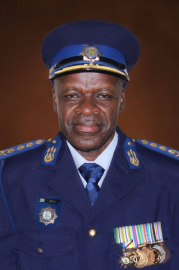
President Cyril Ramaphosa has, by mutual agreement, terminated the employment contract of the National Commissioner of the South African Police Service (SAPS), General Khehla Sitole.
In a statement, the Presidency said this is with effect from 31 March 2022.
“President Ramaphosa and General Sitole have agreed that the early termination of the Commissioner’s contract is in the best interests of the country,” said the Presidency.
The time in the lead up to Sitole’s departure will enable a proper hand over of various tasks, including all ongoing investigations, to one of the senior members of the team at the SAPS, who had been assisting Sitole.
“I am grateful to General Sitole for the constructive discussions we have had over the termination of his position as National Commissioner.
“I wish to convey my appreciation to General Sitole for his service to the nation over many years in the SAPS. I wish him the best in his future endeavours,” said President Ramaphosa.
An announcement will be made in due course on filling of the position of the SAPS National Commissioner following Sitole’s departure.
Sitole was appointed to the post in November 2017.
DPCI appoints new provincial heads

The National Head of the Directorate for Priority Crime Investigation (also known as the Hawks), Lieutenant General Godfrey Lebeya, has welcomed the appointment of the provincial heads of the Directorate for Priority Crime Investigation (DPCI) in the Free State and the Western Cape.
This follows the appointment of Major General Mokgadi Bokaba as the Free State Provincial Head and Major General Mathipa Makgato as the Western Cape provincial head.
Bokaba was previously the section head of Priority Crime Specialised Investigation (PCSI) within the directorate, specialising in major financial investigations. She cut her teeth in the investigation world when she was appointed as a junior investigator for the then Directorate of Specialised Operations (DSO), commonly known as the Scorpions, from 2002.
She subsequently held various roles within the DSO until 2007 when she was appointed as a senior investigator within the National Prosecuting Authority’ (NPA) Asset Forfeiture Unit (AFU).
During her tenure, she was part of a team tasked with investigating high profile cases that included theft, money laundering, fraud and racketeering. She had also previously worked at one of the major banks in the country prior to her tenure with the DSO.
Amongst other credentials, Bokaba holds a B-Tech in Forensic Investigation from the University of South Africa (UNISA), a National Diploma in Accounting from the Tshwane University of Technology, a Diploma in Forensic Auditing and Criminal Justice completed at the University of Johannesburg.
Makgato started his career as a constable in 1988 and climbed the ranks of the South African Police Service when he was promoted to captain in 2000.
During his tenure as a captain, Makgato served as a commander in the following units: Client Service Centre in Honeydew; Westonaria Detectives, as an area task team commander and as a group commander at Florida Detectives.
He was then promoted to Lieutenant Colonel in 2004 and appointed to the Serious and Violent Crimes unit.
He continued his work as Lieutenant Colonel at Organised Crime in Gauteng. He was transferred to Pretoria in 2010, where he assumed his duties as a group leader and investigator at Organised Crime.
In 2010, he was appointed as a Section Commander at DPCI and promoted to colonel in 2012 at the Serious Organised Crime unit in the Northern Cape.
During his tenure as a provincial commander, he was promoted to brigadier and appointed as the Section Head – Serious Organised Crime.
Makgato holds a National Diploma in Public Administration and a B-Tech Degree from Technikon South Africa, and is currently studying toward an M-Tech degree at UNISA.
Lebeya welcomed the new appointments, saying they will go a long way in addressing capacity challenges currently faced by the directorate.
SA records 2 334 new COVID-19 cases
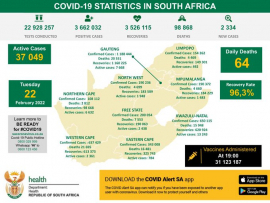
South Africa has recorded 2 334 new COVID-19 cases, bringing the total number of laboratory-confirmed cases to 3 662 032.
In a statement on Tuesday, the National Institute for Communicable Diseases (NICD) said the increase represents a 7.3% positivity rate.
The majority of new cases are from Gauteng (39%), followed by Kwa-Zulu Natal and the Western Cape, each accounting for 15%.
The North West accounted for 8%; Mpumalanga 7%; the Eastern Cape and Free State each accounted for 5%. Limpopo accounted for 3% and the Northern Cape accounted for 2% of the new cases.
“The proportion of positive new cases/total new tested today is 7.3%, which is lower than yesterday (7.4%). The 7-day average is 8.0% today, which is lower than yesterday (8.1%),” the NICD said on Tuesday.
Due to the ongoing audit exercise by the National Department of Health (NDoH), the NICD said there may be a backlog of COVID-19 mortality cases reported.
“Today, the NDoH reports 64 deaths and of these, one occurred in the past 24 – 48 hours. This brings the total fatalities to 98 868 to date,” the NICD said.
There has been an increase of 73 hospital admissions in the past 24 hours.
A total of 22 928 257 tests have been conducted in both public and private sectors.