
Talks on faecal sludge strategy underway

The Department of Water and Sanitation has committed to consider all relevant stakeholders’ inputs when developing the National Faecal Sludge Management Strategy.
The National Faecal Sludge Strategy responds to the United Nations Sustainable Development Goal (NSG) target 6.2 on Sanitation and Hygiene, which states that “by 2030, achieve access to adequate and equitable sanitation and hygiene for all and end open defecation, paying special attention to the needs of women and girls and those in vulnerable situations”.
Through the National Faecal Sludge Management Strategy, the department envisage to guide water and sanitation sector on the safe management of faecal sludge from non-sewered sanitation systems to prevent groundwater contamination, safeguard public health and protect environment from pollution throughout the sanitation value chain.
As part of the quest for dignified sanitation in communities, the department on Tuesday hosted a workshop on the strategy at George in Garden Route, Western Cape.
Department spokesperson, Sputnik Ratau, said the Western Cape workshop is part of a string of workshops held throughout the country to gather input from various sectors, in line with SDG goal/target 6.2.
“Providing, improving, and maintaining satisfactory sanitation affects all members of society, regardless of their economic status,” Ratau said.
During workshop, the department presented a draft National Faecal Sludge Strategy, which advocates some of the strategic propositions.
The strategic propositions includes a well designed and built onsite sanitation technologies which are safe and hygienic, and appropriate to the local context; and that green drop regulatory framework must be extended to faecal sludge, or alternatively develop a different programme to regulate non sewered sanitation systems.
The strategy also propose the promotion of involving local business in the development of technologies for containing, emptying, transportation, treatment, disposal and beneficial use of faecal sludge.
It further proposes that Water Services Authorities (WSA) regulate appropriate onsite sanitation options for households in their areas of jurisdictions, and start planning for areas where faecal sludge should be emptied, transported, treated for safe disposal for beneficial use.
Various stakeholders from the Garden Route welcomed the opportunity to contribute to the National Faecal Sludge Management Strategy.
The stakeholders called for concerted efforts to intensify hygiene and end users’ education about sanitation technologies, to ensure sustainability of sanitation services and that no faecal sludge management solutions should compromise surface and ground water resources.
The stakeholders highlighted a need for the development of financial and economic models, to ensure sustainable and viable sanitation solutions, and urged the department to enforce the principle of polluter pays.
During a workshop, the participants confirmed that there are potential economic opportunities in the entire sanitation value chain, especially if private sector and community-based partnerships are encouraged.
Ratau expressed appreciation for comments submitted on the draft National Faecal Sludge Strategy.
Comments on the strategy close on 10 March 2022. Inputs for the Western Cape Province can be directed to Mchumane Hlazo on HlazoM@dws.gov.za
R24 billion allocated to Infrastructure Fund blended financed projects

Public Works and Infrastructure Minister Patricia de Lille says R24 billion has been allocated to the Infrastructure Fund for blended finance projects that will, among other things, include student accommodation and social housing.
De Lille said this when she held a media briefing to update journalists on progress made over the past year on various projects in the Infrastructure Investment Plan.
“In August 2019, following a Cabinet approval, the Infrastructure Fund was announced as a ring-fenced division of the Development Bank of Southern Africa (DBSA).
“The Infrastructure Fund was operationalised in 2020 with a commitment of R100 billion from government over a 10-year period and has been capacitated with the requisite skills and capacity to enable it to achieve its blended financing mandate.
“Over the next three years, R24 billion has been allocated to the Infrastructure Fund for blended financed projects.”
De Lille said projects are approved by the Infrastructure Fund for blended finance with contributions from the fund and the remainder to come from the private sector.
Among the Infrastructure Fund pipeline projects that were submitted for Budget Facility for Infrastructure (BFI) consideration, include:
- For the 2021 Adjustment Budget, four student housing infrastructure projects delivering 9 500 beds at a cost of over R3 billion was considered. The BFI approved amount was R900 million from the Infrastructure Fund over two financial years.
- For the 2022 Budget, the following projects were considered by the relevant BFI committees: a social housing programme worth R1.1 billion. The Budget Facility for Infrastructure approved an amount of R304.5 million over the next two financial years from the Infrastructure Fund.
- Lepelle Northern Water with a total project cost of R4.5 billion. The Budget Facility for Infrastructure approved an amount of R1.4 billion over the next three financial years from the Infrastructure Fund.
“The Infrastructure Investment Plan forms a central part of the Economic Reconstruction and Recovery Plan (ERRP) aimed at stimulating economic growth and job creation as announced by President Cyril Ramaphosa in October 2020.
“The projects within the Infrastructure Investment Plan were gazetted as Strategic Integrated Projects (SIPs), in line with the Infrastructure Development Act, in July 2020 enabling them to follow an expedited path to ensure implementation.
“The projects have been gazetted as SIPs to contribute to economic growth by reviving the construction sector and creating much needed jobs for people.
“The Infrastructure Investment Plan was highlighted as the ‘flywheel to economic growth’ by the President and contains 62 projects across the country in various sectors which are at various stages,” she said.
Consumers urged to return Similac Alimentum infant formula

The National Consumer Commission (NCC) has urged consumers in possession of Similac Alimentum 400G infant formula to immediately discontinue use of the product, and return it to the point of sale for a full refund.
Acting Commissioner Thezi Mabuza says the supplier informed the Commission of the precautionary recall of Similac Alimentum in South Africa.
“The manufacturer, Abbott Laboratories-Nutrition, informed the Commission of a voluntary recall following a global recall, as announced by the supplier.
“We understand that this product is manufactured at their plant in Sturgin, MI, in the United States of America, and was imported to South Africa and other countries.
“The supplier confirmed that the recall was prompted by consumers who reported that their infants presented some symptoms after ingesting the formula in the USA,” Mabuza said.
According to Abbott Laboratories, only four cases were reported in the USA. The company said, however, that the presence of Cronobacter and Salmonella in the infant formula is a cause for concern.
“As the Commission, we want to emphasise that while there are no cases reported in South Africa as yet, we urge consumers who might have bought this product not to feed their infants but to immediately return it to the point of purchase for a full refund.
“Ingesting Salmonella may lead to diarrhoea, fever and abdominal cramps, while Cronobacter infection may also cause damage to the bowel system.
“We therefore encourage parents who have concerns that they might have fed their infants the product in question to seek medical attention. The Consumer Protection Act (CPA) provides for safety of consumers at all times, and minors are regarded amongst the most vulnerable consumers.
“We appreciate the precautionary recall by the supplier. However, producers/manufacturers are required to supply or distribute goods that are safe and of good quality to avoid these mishaps. The Commission is monitoring the recall based on its Recall Guidelines,” Mabuza said.
Department to finalize power purchase agreements from next month

Mineral Resources and Energy Minister, Gwede Mantashe, says over the next two months, the department will finalise power purchase agreements that are set to address the country’s energy shortfall.
Mantashe said this when he participated in the debate on the State of the Nation Address on Tuesday.
“Next month and in April, we will conclude the power purchase agreements for 2 000MW Risk Mitigation Independent Power Producer Procurement Programme (RMIPPPP).
“The challenge is that, not all of the RMIPPPP preferred bidder projects may be in a position to conclude power purchase agreements due to outstanding processes on their side,” he said.
President Cyril Ramaphosa announced in the SONA last week that due to the country’s ageing power stations, poor maintenance, policy missteps and the ruinous effects of State capture, South Africa has a shortfall of around 4 000MW of electricity.
The President said during the past year, government has taken firm steps to bring additional generation capacity online as quickly as possible to close the shortfall.
Participating in the debate on Tuesday, Mantashe said other power purchase agreements that will be concluded over the next two months include 2 600MW from the renewable energy bid window 5, for which preferred bidders were announced at the end of October 2021.
“In addition, at the end of March, we will issue a request for proposals for 2 600 MW from renewable energy Bid Window 6.
“In April, there will be a request for proposals for 513 MW from battery storage,” he said.
Mantashe said thereafter, additional bid windows, including bid window 7, will follow at six-month intervals.
“The IRP 2019 provides for gas as a transition fuel to support large penetration of renewable energy into the grid.
“It also provides for cleaner coal technologies and nuclear for sustaining some level of baseload power, necessary for power system stability.
“It is comforting to see that there is now growing global consensus on the role of gas and nuclear in the energy transition. The European Union has labelled these technologies as part of the green transition.”
Children urged to read in mother language

The South African Post Office (Sapo) partnership with non-profit organisation Nal’ibali now makes it possible for children, reading clubs, schools and libraries to collect free reading material from 508 branches throughout the country.
A year ago, the reading supplements were available at only 46 post offices. This increase has been made possible by the partnership Nal’ibali has with the post office.
“By the end of last year Nal’ibali was able to deliver 309 000 reading supplements every month through the post offices. Each copy has three stories – so that is nearly a million stories every month.
“We reached 2 279 reading clubs and about 216 000 kids. We could do this by using the branch network of the post office; everybody knows that there is a post office in almost every village,” Nal’ibali acting Managing Director, Katie Huston, said on Wednesday.
Nal’ibali enables young children to read in their mother language by producing interactive reading supplements with illustrations in nine of the 11 official languages of South Africa.
Nal’ibali produces interactive, fun reading material that the children assemble themselves, while the SA Post Office makes the reading material available for collection at its branches at no cost.
Research done by Nal’ibali indicates that the supplements support children, parents and teachers to develop reading habits and that people enjoy reading and using them.
Parents and teachers report that it helps children develop their reading skills, and it gives parents and children an opportunity to spend quality time together.
Research also shows that learning to read in one’s mother tongue early in school makes education more engaging, meaningful and enjoyable for children. Children who benefit from mother tongue instruction and learning also perform better in their second language.
“Language is a major factor that binds members of a community and a culture together. In a country like South Africa, famous for its marvellous diversity, the many languages we speak probably play a major role in keeping our varied cultures alive,” Sapo said.
The post office calls on teachers, learners, caregivers or librarians to join the Nal’ibali tribe, by sending an email to info@nalibali.org. The email contain the following details:
- The name and postcode of a local post office
- The name of a reading club, school or library
- A cell phone number of the school or reading club that can be put on the address label.
According to the United Nations (UN), languages play a vital role in development, in ensuring cultural diversity and intercultural dialogue.
“It is also vital in strengthening co-operation and attaining quality education for all, in building inclusive knowledge societies and preserving cultural heritage, and in mobilizing political will for applying the benefits of science and technology to sustainable development,” the UN said.
Forensic company appointed to investigate NSF maladministration, corruption
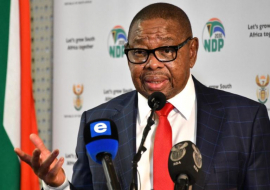
Higher Education, Science and Innovation Minister, Blade Nzimande, has appointed a forensic company to conduct a full-scale forensic investigation into the financial affairs of the National Skills Fund (NSF).
This follows the Auditor-General’s report that found that a large amount of just under R5 billion could not be properly accounted for over two financial years by the National Skills Fund.
The forensic company’s appointment is in addition to the Ministerial Task Team (MTT) appointed by Nzimande to conduct a strategic review of NSF, including general operations of NSF, its efficiency, and relevance with regards to the national skills priorities of the country.
The review also includes the mandate, policy scope and analysis of NSF capacity, systems and organisational modelling, in relation to its mandate as a Schedule 3A skills levy entity.
Nzimande said the MTT held numerous stakeholder engagements from August 2021 to December 2021, ranging from NSF itself, related government departments, labour entities, as well as business and fund beneficiaries also conducting in loco inspections across the country in the sites in which NSF funded skills development projects.
“I expect that the MTT recommendations will clearly outline the strategic role and optimal future functional business model to enable NSF’s catalytic contribution to skills development and innovation in the country, considering the revolutionary changing nature of work and change of dynamic between the world of training and the world of work,” Nzimande said.
The Minister added that work is underway, and the MTT will be providing him the monthly reports regarding its work.
The MTT is expected to present a final report on their findings and recommendations to the Minister in June 2022.
“The current work by the Department of Higher Education and Training will go a long way in responding to the concerns raised by the Standing Committee on Public Accounts (Scopa) and other Parliamentary oversight committees on challenges experienced by the NSF,” Nzimande said.
2022 May/June examination registration deadline extended

The Basic Education department has extended the deadline for the registration of the May/June 2022 examination to 21 February 2022 after some candidates experienced difficulty with the online registration.
“This examination instruction also serves to remind PEDs [Provincial Education Departments] and their district offices of the criteria relating to the registration for the 2022 May/June examination.
“It needs to be noted that the 2022 May/June examination accommodates both National Senior Certificate (NSC) and Senior Certificate candidates,” the department said.
The criteria relating to the registration of National Senior Certificate (NSC) candidates states that all candidates who registered for the October/November examination, as from 2008, may register for the 2022 May/June examination.
The department said this is the first year that the 2022 May/June examination is open to NSC candidates from previous years.
“Candidates may only register for subject/s for which they were previously registered in a previous October/November examination. Candidates who register for the 2022 May/June examination, must have completed their School Based Assessment tasks, Practical Assessment tasks and the Language Oral tasks in a previous October/November examination,” the department stated.
With regards to candidates who were absent with a valid reason (ill-health, death in the immediate family or other special reasons), from one or more question papers, the department said they may register for the 2022 May/June examination.
“Documentary proof substantiating reasons for the absenteeism must be submitted to the school principal or at the office where the registration form is submitted,” the department said.
Candidates who want to improve their overall achievement status, or only want to improve their achievement or non-achievement in a specific subject, may also register for the May/June examination.
In the case where a candidate was absent for one or more question papers in the October/November examination with a valid reason, the department has stated that the candidate must write all the question papers in the 2022 May/June examination.
In a case where an irregularity is being investigated, provisional enrolment may be granted to the candidate concerned, pending the outcome of the investigation.
The department said NSC candidates may only register manually at a district office or at the school where they previously wrote the examination.
Criteria for registration of Senior Certificate candidates
The following learners will qualify for admission to the Senior Certificate:
· Adult learners who are 21 years and older who have General Education and Training Certificate (GETC) or Grade 9 school report (or the old standard seven), stating that they have passed Grade 9 or Standard 7; or recognised equivalent qualification obtained at NQF Level 1, which requires two official languages.
· Adult learners who are 21 years and older with an incomplete Senior Certificate qualification.
· Adult learners who are 21 years and older with an incomplete National Senior Certificate
· In exceptional cases, out of school youth, who are 18-21 years old and who could not complete their school education due to circumstances beyond their control, as verified by the Head of Department.
· Adult candidates who are 21 years and older with an incomplete NSC may choose to complete the NSC, or convert to the Senior Certificate. Should the candidate choose to convert to the Senior Certificate, they may not revert to the NSC and attempt to complete the NSC qualification.
· Adult candidates who have already obtained a Senior Certificate qualification but wish to improve their results/status.
In addition to the above group of candidates who may register to write the 2022 May/June examination, the department said candidates who have written the 2021 October/November examination either with the IEB or SACAI, may also write the 2022 May/June examination administered by the DBE. Further directions will be provided in relation to the resulting of these candidates.
In the case of Senior Certificate candidates, there are two registration options which are available for candidates who qualify to write the 2022 May/June Senior Certificate examinations.
“The manual registration process is managed by the district offices in the provinces. There is also an electronic registration (e-Registration) process available,” the department said.
Candidates who opt for the electronic registration must use the www.eservices.gov.za portal. For more information on registration criteria, subject choices and promotion requirements candidates can visit the Senior Certificate (as amended) page on https://www.education.gov.za/Curriculum/SeniorCertificate.aspx.
e-Registration candidates are urged to note that they need to have a valid RSA Identity number, a valid email address and cellphone number.
SA records 2 364 new COVID-19 cases
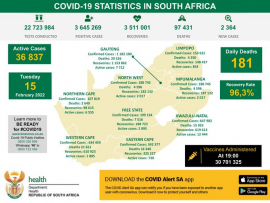
South Africa has reported 2 364 new COVID-19 cases, bringing the total number of laboratory-confirmed cases to 3 645 269.
This increase represents a 7.7% positivity rate.
There has been an increase of 110 hospital admissions in the past 24 hours.
The Department of Health has reported 181 deaths and of these, seven occurred in the past 24 – 48 hours. This brings the total fatalities to 97 431 to date.
In total, 22 723 984 tests have been conducted in both public and private sectors.
In the private sector, 12 322 333 tests were conducted, while 10 401 651 tests were conducted in the public sector.
According to the Department of Health, the majority of new cases are from Gauteng (42%), followed by Western Cape (16%).
KwaZulu-Natal accounted for 14%, Mpumalanga accounted for 9%, Free State and North West each accounted for 5% respectively. Limpopo accounted for 4%, Eastern Cape accounted for 3% and the Northern Cape accounted for 2% of the new cases.
The cumulative number of cases by province is as follows:
Gauteng 983, Western Cape 374, Eastern Cape 101, North West 123, Limpopo 106, Mpumalanga 177, Free State 131, Northern Cape 43 and KwaZulu-Natal 326.
SAPS PPE corruption accused granted bail

Some 10 people have been granted bail in the Palm Ridge Specialised Crimes Court where they appeared in a matter related to the procurement of Personal Protective Equipment for the South African Police Service (SAPS).
There are at least 15 accused in the case – including former police officials and officers, officers who were still employed by the police and businesspeople.
According to National Prosecuting Authority Investigating Directorate spokesperson, Sindiswa Seboka, the cohort allegedly committed theft, fraud, forgery and corruption in relation to the awarding of SAPS contracts worth at least R1.9 million.
Sebok said bail was granted for accused businessperson, Lorette Joubert, Kumarasen Prithiviraj, Volan Prithiviraj, Maricha Joubert, former police officers Ramahlapi Mokwena, Lesetja Mogotlane, Veeran Naipal, Alpheus Makhetha and Kysamula Mabasa and SAPS clerk Marcell Marney.
“The group was granted bail of R20 000 each. The court ruled that they are to hand over their passports and not be in communication with Muthray and Associates law firm, or the court will not hesitate to revoke their bail.
“The reason for the gang not to reach out to the law firm is because, in another matter, the law firm represented some of the accused and legal services paid for by the company claimed (Siyanqoba) to have unduly benefitted from cover quoting contracts within SAPS,” Seboka said.
Seboka said at least two others were denied bail in the hearing.
“The pair [Kishene Chetty and former police manager Brigadier James Ramanjalum] were denied bail on the basis of having allegedly committed corruption while out on bail in other matters.
“The state did not oppose bail for three [others] who are retired police officer Isaac Ngobeni and serving police officer Stephinah Mahlangu and civilian Salamina Khoza, who were granted bail last week,” she said.
Seboka explained that the accused were nabbed last week in a joint operation by a task team of the National Police Commissioner and the NPA’s Investigating Directorate.
“The arrests follow an investigation into the capture of the SAPS procurement and supply chain to aid front companies to score lucrative contracts and facilitate kickbacks to SAPS senior officials. This is the sixth case by the ID tackling the scourge of corruption within the police service,” she said.
The accused are expected back in court next month.
NPA seized with 37 high profile State Capture cases

Justice and Correctional Services Minister Ronald Lamola says the National Prosecuting Authority (NPA) is currently seized with 37 high profile State Capture cases.
He said this when he participated in the debate on the State of the Nation Address on Tuesday.
“The NPA’s Investigating Directorate is seized with 37 high profile state capture cases, with 14 matters enrolled in court relating to the various sectors it is focused on. In the next month, the Investigating Directorate will be enrolling additional three seminal matters.”
Lamola said in terms of asset forfeiture, the Gauteng High Court granted an order to seize assets worth R1.4 billion belonging to the accused implicated in the corruption scandal involving the construction of Eskom’s Kusile power station.
“In the Bloemfontein High Court, the NPA has been granted an unlimited restraint order to the value of R 520 million for assets in relation to various Gupta-linked companies. A preservation order was filed by the NPA for the Optimum Mine estimated at R8 billion.
“This is on the back of R870 million and R1,1 billion recovered from McKinsey & Company for their involvement in [the] Transnet and Eskom saga respectively, R217 million has been recovered from Bain and Company and the SIU has recovered over R1.5 billion from ABB South Africa,” he said.
Progress made to prosecute COVID-19 related corruption
Lamola said, meanwhile, that the Fusion Centre, established by government to bring together key law-enforcement agencies to tackle COVID-19 related cases, is making headway in the fight against corruption.
“The Fusion Centre, established by government to bring together the key law enforcement agencies to strengthen the collective efforts to prevent, detect, investigate, and prosecute COVID-19 related corruption, has enrolled 45 cases in court with 101 accused facing charges as of January 2022, 16 of these cases have been finalised with a guilty verdict.”
He said the NPA’s Asset Forfeiture Unit has recovered R168 million on COVID-19 related matters.
Lamola also said that the Special Tribunal, announced by President Cyril Ramaphosa in 2019, has recovered R500 million through preservation, review and setting aside orders.