
COVID-19 booster shot for immunocompromised South Africans

Health Minister, Dr Joe Phaahla, has announced that the Ministerial Advisory Committee (MAC) on COVID-19 Vaccines has advised that additional doses be given to individuals with compromised immunity.
This includes those who are on long-term oral steroid therapy for autoimmune conditions and various treatments for haematological or immune malignancies.
The group will also comprise those with solid organ or bone marrow transplants, renal dialysis and primary immunological disorders.
“The advice is that these categories of patients be offered an additional dose over the prescribed normal, but this must be strictly under the referral by their medical doctor under their supervision,” Phaahla explained.
Johns Hopkins Medicine defines a COVID-19 booster shot as an additional dose of a vaccine given after the protection provided by the original shot(s) has begun to decrease over time, which is designed to help people maintain their level of immunity for longer.
The Minister was on Friday addressing a media briefing on government efforts in the fight against COVID-19 and the national vaccination rollout programme.
Healthcare workers
He also touched on the matter by some healthcare workers who were vaccinated under the Sisonke Study with Johnson & Johnson (J&J), who are calling to be considered for booster COVID-19 vaccine doses as eight months have passed since their first jab.
“The request is receiving attention and we are working with the South African Medical Research Council (SAMRC) on a possible approach,” he said.
In addition, he said the SAMRC has since applied to the South African Health Products Regulatory Authority (SAHPRA) to consider a J&J booster to follow the Sisonke Study.
According to the Minister, this will be subsequently used in the second study on the possible benefit of enhanced immunity with a booster of the otherwise one dose vaccine.
The first study commenced on 17 February 2021 and concluded on 17 May 2021, reaching over 470 000 healthcare workers in over 120 sites across the country.
Mixing vaccines
He also spoke about another issue of people who come from other countries have received vaccines, which are not used now in South Africa.
According to Phaahla these are either foreign nationals who reside in South Africa, had gone home, and received a vaccine such as AstraZeneca, Moderna, Sputnik or Sinovac.
“We are not able to provide second doses where they are required and neither can we give them a vaccine certificate when they need one.”
However, the Minister said his department has received a recommendation that these individuals can be offered one dose of Pfizer to complete their two doses, as there is evidence that AstraZeneca and Moderna combine well with Pfizer.
“It’s believed that it’s safe with the others as well,” he added.
Phaahla has once again called on South Africans to come forward and contribute towards their health safety and that of their families, friends and co-workers by vaccinating.
“By so doing we can reclaim our lives as experienced by the 2 000 fans at the Bafana Bafana versus Ethiopia game of which I was honoured to be a part of.”
KZN municipalities urged to reduce unnecessary water losses

KwaZulu-Natal municipalities and the provincial Water and Sanitation Department have been urged to step up measures to curb water losses.
Addressing water services authorities on the second day of a working session at Olive Convention Centre in eThekwini on Thursday, Water and Sanitation Minister, Senzo Mchunu, emphasised that the scale of water losses in the province is alarmingly high, and this is due to leaks, burst pipes, illegal connections, vandalism and ageing infrastructure.
“It is the right of the communities to receive water from us, it is not a favour, and it is also important to note that water is the main priority and the main supporter of life. This is a commodity that is not in abundance in the country,” Mchunu said.
Mchunu encouraged municipalities and the provincial department to endeavour to unearth innovative ideas of utilising rainwater.
This proposal is triggered by the fact that recently, KwaZulu-Natal has been getting the highest rainfall in the country on average.
Joined by his deputies, David Mahlobo and Dikeledi Magadzi, Mchunu is on a ministerial visit to KwaZulu-Natal to assess the state of water projects.
The visit also includes meetings with various stakeholders to assess the status of water and sanitation security, focusing on the deficit of availability of water resources and funding required for water infrastructure, among others.
Mahlobo reiterated the issue of water losses as a matter of grave concern that needs to be urgently attended to.
Mahlobo noted that eThekwini Metro is losing the most amount of water in the country, with the Newcastle District Municipality losing approximately 30 million litres of water on a daily basis.
“This is a clear indication that the gravity of water losses in the province is extremely huge,” the Deputy Minister said.
Magadzi said a comprehensive strategy is required in order to recoup lost water.
She stressed that wasteful utilisation of water is “a thing of the past”, and urged municipalities to move towards ensuring the installation of meters in order to receive revenue.
UIF pays out R63bn to workers
Since the beginning of lockdown last year, the Unemployment Insurance Fund (UIF) has disbursed R63 billion, bringing relief to about 5.4 million workers across the country.
It has been 17 months since the COVID-19 Temporary Employer / Employee Relief Scheme (TERS) was introduced to save jobs and ease the financial burden on businesses, and most importantly, their vulnerable workers who lost income during the lockdown.
In a statement on Thursday, the Employment and Labour Department said the money paid out is the largest sum that has been paid by government to help workers, businesses and the economy mitigate the impact of the lockdowns.
“Considering the fact that the initial budget was R40 billion, which has now been exceeded by R23 billion, is a remarkable feat by all standards.
“While we celebrate the positive impact of COVID-19 TERS to employers and employees, many pay outs are still outstanding largely due to employers who were none-compliant prior to submitting claims for their workers. In some cases, the delays are as a result of ‘errors’ committed by employers in the process of lodging applications,” the department said.
The department has commended 404 employers, who heeded the recent call to fix errors, which resulted in the payment of R9 633 516.74 to 10 181 employees.
The bulk of errors relate to incorrect banking details; incorrect ID or passport numbers; no declarations found; applications for: deceased, underage, incarcerated, and government employees, and incorrect salary received during lockdown.
Dishonesty and fraudulent acts
The department is concerned over grievances that employers did not pay over the money to their workers.
The department said the first reports of the “Follow the money project”, which was instituted to address accountability on these monies, painted a picture of dishonesty and fraudulent acts by some employers.
“This included employers claiming for employees who are working; employers submitting false claims; money being utilised for personal expenses such as paying for credit cards and buying luxurious cars; [money being] utilised for operating costs, and the employer claiming COVID-19 TERS but still paying employees a full salary, meaning there should have been no TERS claim,” the department said.
The department said it has noted the same tendency appears present in claims for the unrest in parts of KZN and Gauteng in July.
Acting UIF Commissioner, Advocate Mzie Yawa, said: “We have also noted that some have false SAPS case numbers and luckily, our system can pick up through checks that the cases are not genuine. We urge all to act honestly. These are hard earned monies for vulnerable workers, not ‘get rich quick schemes.”
Meanwhile, through collaboration with law enforcement agencies, 18 arrests have already been effected with the latest culprits arrested by the Hawks in Gauteng last week for fleecing the Fund R10 million in COVID-19 TERS payments.
“Following extensive investigations and through the involvement of the ‘Follow the money’ project forensic audits, the suspects were arrested and charged. We are delighted that this project is bearing fruits, as we have been able to recover close to R900 million to the UIF’s coffers,” Yawa said.
Yawa said while the UIF celebrates this achievement, there are still many outstanding claims awaiting correction of errors by employers.
“We have and continue to proactively communicate to employers through letters, calls, webinars, as well as social media guiding them to fix the error codes on the COVID-19 TERS portal, so we can process outstanding claims.
“We are also working with social partners at NEDLAC to help encourage their business members to correct the error codes,” Yawa said.
Yawa said the Fund continuously re-processes claims that are already in the system so that those that have been corrected and have passed validations can be paid when payment re-runs are conducted.
“We are confident that working with NEDLAC social partners, we shall meet our target of having these at zero by the end of December 2021.”
The Fund will increase the frequency of re-running the system to pick up those applications that have been corrected in order to ensure that it meets the target of having a zero outstanding claims by 31 December 2021.
The lists of employers who must fix errors and those that appear to have engaged in fraudulent activities can be found on the department’s website.
Treasury publishes updated paper on Financing a Sustainable Economy

National Treasury has published an updated version of its “Financing a Sustainable Economy” document as part of efforts to encourage more long-term investments in sustainable economic assets, activities and projects.
The technical paper was first published in May 2020.
In the updated paper published on Friday, Treasury said while financial institutions previously only focused on the return on investment of projects, the focus on sustainable finance encourages them to also be cognisant of how their investment decisions impact the environment.
“It is envisaged that this will assist in reducing pressures on the environment, including supporting the transition to a low carbon economy by phasing out greenhouse gas emissions and optimising the use of natural resources.
“The impact of climate change on the global and South African financial sector is potentially significant, if not effectively mitigated,” Treasury said.
In the paper, Treasury broadly classified climate-related risks for the financial sector as:
- Physical risks from extreme weather – directly affecting financial institutions’ own operations or assets that they finance through damage, business disruption or default risks;
- Transition risks – resulting from disruptive technologies, changing regulation, consumer or market preferences; and
- Liability and disclosure risks – resulting from loss and damages, rising insurance costs, director’s liability and disclosure failures.
Comments received broadly support the recommendations and proposed workflow on sustainable finance. The main recommendations include introducing a green finance taxonomy; creating technical guidance for disclosure aligned to the Financial Stability Board (FSB) Task Force on Climate-related Financial Disclosures (TCFD), and developing a benchmark climate risk scenario for use in stress tests by the financial sector and financial regulators.
Treasury said the paper also takes into consideration emerging international climate finance and policy developments, including the G20 and FSB roadmap for addressing climate-related financial risks.
The updated technical paper was broadly amended to incorporate substantive issues such as allowing for a more holistic approach to sustainable finance over time, by expanding the paper beyond climate risk issues to include the broader sustainability and social issues.
The paper was also amended to incorporate the recognition of broader sustainable financing opportunities than those represented by green bonds, by including an expanded list of sustainable finance instruments, and better addressing issues of biodiversity, circular economy, water and environmental risk.
The updated technical paper and comments matrix are available on the National Treasury website (www.treasury.gov.za) and Sustainable Finance Initiative website https://sustainablefinanceinitiative.org.za.
Comments were received from 15 different stakeholders, including the Department of Environment, Forestry and Fisheries, other departments and the financial sector regulators (the Financial Sector Conduct Authority and Prudential Authority).
Extensive feedback from other departments, industry stakeholders and civil society was also received.
The updated technical paper published today incorporates responses to the comments received, accompanied by a comments matrix.
Eskom, City of Johannesburg sign power MOU

Eskom and the City of Johannesburg (CoJ) have entered into a memorandum of understanding which is expected to facilitate the transfer or sale of electricity distribution in certain parts of the city from Eskom to municipality’s power utility, City Power.
The development comes a week after the CoJ signed a power purchase agreement with private electricity supplier Kelvin Power Station to add 100MW of electricity supply sent to the city.
Eskom emphasised, however, that the transaction itself has not yet been concluded with affected stakeholders also expected to participate in the decision making process.
“Should an agreement be reached on the discussions, the parties will seek the requisite regulatory approvals and give the affected customers an opportunity to contribute to a settlement in a public participation process.
“Among the regulators from whom approvals are required are the National Energy Regulator of South Africa (Nersa), National Treasury, and the Department of Mineral Resources and Energy,” the power utility said.
According to Eskom, the areas which are expected to be affected by the transfer or sale include parts of Soweto, Sandton, Orange Farm, Ivory Park and Diepsloot.
Eskom explained that in terms of the memorandum of understanding, City Power will undertake a due diligence study of the power utility’s existing assets and infrastructure in those areas.
“The due diligence study will consider, among others, the state and value of the infrastructure that would eventually be sold to City Power, the outstanding debt owed by customers to Eskom, and other corporate information that will be material to an eventual agreement”.
City of Johannesburg Mayor Mpho Moerane said the MOU signals the beginning of the city’s plan to find a “long term solution to power supply challenges in the city”.
“What remains now is for City Power and Eskom to explore, in detail, how the takeover from the national utility by our municipal entity can be best executed. Once these plans are finalised and agreed upon by all parties, we will update Johannesburg residents on progress and timelines,” Moerane said.
Police arrest 56 suspects for taking Cabinet Ministers hostage

About 56 suspects were arrested on Thursday in Centurion after they allegedly held hostage two Cabinet Ministers – Mondli Gungubele ([Presidency) and Thandi Modise (Defence and Military Veterans) and her Deputy Thabang Mokwetla.
In a video posted on Twitter later in the evening, Gungubele confirmed the incident. According to reports, the incident occurred at the St Georges Hotel in Irene, Centurion.
He said: “We found ourselves in a situation which I consider untenable, legally unacceptable, where we thought we were in a meeting [which] its intention was to attend to matters that affect military veterans.
“We could not agree on how the meeting should take place. We reached a point where I thought we were agreeing that it should adjourn.”
As the Ministers attempted to leave the meeting venue, he said members of the military veterans’ contingent closed the doors.
“It is at this point that we realised that we were being held hostage. It is a situation that was averted by the security forces, very effectively and successfully. We want to thank [Police] Minister Bheki Cele and all other security forces, whatever branch that was involved for the prompt and timeous intervention,” he said.
He said they expected the law to take its cause “in dealing with the behaviour of this nature”.
The intervention was on Thursday evening confirmed by the National Joint Operational and Intelligence Structure (NATJoints) in a statement.
NATJoints spokesperson Brigadier Vishnu Naidoo said: “This evening police successfully rescued at least three hostages at a hotel in Centurion, Pretoria”.
The drama is said to have begun at 7:15pm when police received a report of a possible hostage situation in which two Cabinet Ministers and a Deputy Minister were allegedly taken hostage.
He said: “After attempts to negotiate with the hostage takers to release the hostages had failed, police resorted to a tactical approach and successfully rescued the hostages”.
There were no shots fired during the rescue.
Naidoo said at least 56 people, including seven women, were arrested and were likely to face charges of at least three counts of kidnapping.
“While processing the suspects, three of them have been taken for medical checks after they complained of pains,” he said.
R11bn allocated to Presidential Employment Stimulus

A total of R11 billion in new funding has been allocated by National Treasury for the next phase of the Presidential Employment Stimulus (PES) in the 2021/22 financial year.
The Presidency has announced that phase two will be launched on 1 November 2021.
This was revealed at a media briefing on Thursday, led by the Minister in the Presidency, Mondli Gungubele, together with the Minister of Employment and Labour, Thulas Nxesi and Minister of Public Works and Infrastructure, Patricia de Lille.
The Presidential Employment Stimulus was launched by President Cyril Ramaphosa in October 2020 in response to the devastating impact of the Coronavirus pandemic on employment.
As part of the Economic Reconstruction and Recovery Plan, the stimulus aims to create new employment, provide livelihood support and protect existing jobs in vulnerable sectors.
Addressing the briefing, Gungubele said Phase 2 of the employment stimulus has now commenced implementation, which will support the continuation of some programmes from Phase 1, as well as a range of new programmes.
“The recruitment of 287 000 young people as school assistants is already underway, and participants will be placed in November. Phase 2 will include the establishment of a new Social Employment Fund, which will support work for common good in communities provided by organisations outside of the State.
“Phase 2 will also support the Presidential Youth Employment Intervention, including the establishment of the national Pathway Management Network, the revitalisation of the National Youth Service, and a new model of skills training for unemployed youth linked to employment,” Gungubele said.
The Minister said the stimulus represents a new way of working across government to achieve a common objective, as 11 national departments were responsible for implementing programmes supported by the stimulus in Phase 1.
To date, more than 550 000 jobs and livelihoods have been supported as part of Phase 1, with an overall target of 694 120 opportunities.
Gungubele said several programmes are still in implementation, and the number is expected to increase further.
“This represents more than half a million South Africans, who have already benefitted directly from the stimulus, either through employment or by receiving a grant to sustain their own economic activity.”
Gungubele said the continued success of the employment stimulus reflects government’s commitment to address unemployment and to support employment while the labour market recovers.
Scaling up public and youth employment
Minister of Employment and Labour, Thulas Nxesi, has reiterated that government is steadfast and resolute in fighting unemployment, inequality and eradication of poverty in the country.
He said the Presidential Employment Stimulus supports a wide range of programmes, which have an explicit focus on youth, given the severity of youth unemployment in South Africa.
“In Phase 1, [a total of] 84% of participants across all programmes, including public employment and livelihoods support, were young people below the age of 35, and two-thirds of all participants were women,” Nxesi said.
Phase 2 of the employment stimulus supports the implementation of the Presidential Youth Employment Intervention, which aims to provide support and expand opportunities for young people who are unemployed.
The Minister revealed that a total of R838 million has been allocated for this programme as part of the overall budget for the stimulus.
“As part of this intervention, the Department of Employment and Labour is leading the establishment of the national Pathway Management Network, which is also known as SA Youth. This network allows young people to register and receive active support to find employment, and aggregates opportunities from a wide range of partners within and beyond government,” he said.
In Phase 1 of the employment stimulus, a total of 170 000 unemployed youth were placed in various work opportunities through the Pathway Management Network, of which 132 406 were placed as school assistants and 2 000 were placed in jobs in global business services.
The Pathway Management Network will provide an entry point for young people to access opportunities during Phase 2 of the stimulus, by registering their profile on SAYouth.mobi.
Nxesi said Phase 2 of the stimulus will also support demand-led training as a new approach to skills development that links training for young people directly to jobs that are available.
Adding on to youth employment, Minister of Public Works and Infrastructure, Patricia de Lille, said that government’s employment efforts are also focused on ensuring that specific targets are set for the employment of women and youth.
The Minister said the PES has focused on ensuring that the work performed creates real public value, which can be seen and felt by the communities in which it takes place.
“For example, the more than 300 000 school assistants, who were employed through the stimulus, relieved the burden on teachers during a period in which they had a significantly higher workload due to COVID-19,” De Lille said.
In addition to providing overall support for the stimulus, the Department of Public Works and Infrastructure (DPWI) was able to expand its own employment programmes in infrastructure with additional funding in Phase 1.
“I am very proud that as DPWI, aside from the EPWP programme, we were also able to employ graduates in various projects in the department as part of the PES Programme. This included the employment of graduates for the Welisizwe Rural Bridges Programme, as well as artisans and professionals in facilities management and waste management,” De Lille said.
During the 2020/21 financial year, the department appointed 1 886 beneficiaries and more than 500 of these graduates were able to secure external employment. For the current financial year, the department has recruited 1 296 beneficiaries, which comprises 737 females and 559 males, and 98% youth in all nine provinces.
De Lille has praised the Presidential Employment Stimulus for encouraging real innovation in how public employment programmes across government are delivered – from recruiting participants to the type of work that is supported.
DBE set to launch National Schools Hygiene Programme

The Department of Basic Education (DBE) will tomorrow launch the National Schools Hygiene Programme (NSHP) and kick-start the extended Hand Hygiene Programme at Zimasa Primary School in Langa, Cape Town.
The department’s implementation of the National School Hygiene Programme is an initiative supported by Unilever through its brands Lifebuoy, Mentadent P and Domestos.
“This programme involves a 21-day behaviour change intervention in class regarding the washing of hands with soap, brushing of teeth with a toothbrush and toothpaste, and proper cleaning of school toilets,” the department said in a statement.
The Deputy Director-General of Care and Support in Schools, Dr Granville Whittle, will deliver the keynote address at the launch.
Global Handwashing Day is globally celebrated on October 15 each year. It is a campaign to motivate and mobilise millions around the world to wash their hands with soap at critical times.
The 2021 Global Handwashing Day is commemorated under the theme, ‘Our Future is at Hand – Let’s Move Forward Together’.
The department said that the Western Cape province will pioneer the implementation of the Extended Hand Hygiene Programme.
“Grade 1 educators and peer educators have received training on NSHP and Extended Hand Hygiene Programme in preparation for the implementation after its launch, which is on Global Hand washing Day,” the department said.
Somali leaders, taxi associations called to find solution to defuse Gqeberha violence

The Select Committee on Trade and Industry, Economic Development, Small Business Development, Tourism, Employment and Labour has appealed to the Somali community leaders and taxi associations in Gqeberha to meet urgently and find a solution to defuse the reported tensions.
The call follows the burning of about eight minibus taxis allegedly by Somali shop owners at Durban Road in Korsten, Gqeberha, on Wednesday afternoon.
According to police reports, violence broke out following a motor vehicle accident between a taxi and a sedan believed to belong to a local businessman.
It is alleged that retaliation between local businessmen and taxi drivers ensued and resulted in eight taxis being set alight, two taxis damaged and a civilian vehicle set alight. No injuries were reported.
In a statement on Thursday, Committee Chairperson, Mandla Rayi, said the committee condemns any act of violence directed either at minibus taxi operators or at Somali owned spaza shops.
“The reported violence should not occur and certainly our people should not allow to be divided by these acts of violence. The leaders of the Somali community in that area and the management of minibus taxi operators should urgently meet and seek a resolution on this matter.
“The revival of the economy after it was negatively affected by the outbreak of the Coronavirus pandemic in March last year is the responsibility of all. Regional economies like Gqeberha are a key component and should be used as a point of strength,” Rayi said.
Rayi appealed to the leaders of the Somali community, taxi associations in Gqeberha and other peace role players to find a solution to the problem, and defuse the tensions that have the potential to perpetuate violence.
“[This] is an antithesis to the call for the revival of the economy in Gqeberha,” said Rayi.
Rayi said the brandishing of heavy weaponry among citizens, as reported in Gqeberha, is a matter that needs to be investigated and acted upon by relevant law enforcement agencies.
Meanwhile, Police Minister, General Bheki Cele and Deputy Minister of Police, Cassel Mathale, are today visiting Gqeberha following violence and wanton destruction of property.
“The Police Ministry and senior South African Police Service officials will travel to the area and receive a full report from the provincial SAPS management on this incident, as well as the spate of murders that have taken place in the Walmer township over the weekend,” Police Ministry spokesperson, Lirandzu Themba, said.
Cele, Mathale visit Gqeberha in wake of violent clashes
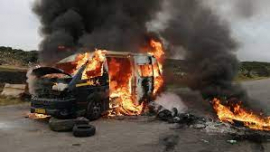
Police Minister, General Bheki Cele, and his Deputy Cassel Mathale are today expected to visit Gqeberha following violence and wanton destruction of property, which saw several businesses and taxis torched.
On Wednesday, violence broke out in the city’s Durban Road in Korsten after a motor vehicle accident between a taxi and a sedan believed to belong to a local businessman.
In a media advisory, the Police Ministry said initial investigations revealed that the single incident led to the torching of several vehicles and property.
“According to police reports, alleged retaliation between the local businessmen and taxi drivers ensued, resulting in eight taxis being set alight. Two taxis were damaged and a civilian vehicle was also set alight. No injuries were reported,” said Ministry spokesperson Lirandzu Themba.
During the visit, Cele, Mathale and national SAPS management are expected to receive a full report from the provincial police top brass on the incident, as well as the spate of murders that have taken place in the Walmer township over the weekend.