
Contractors warned against building of houses of poor quality
North West Cooperative Governance, Human Settlement and Traditional Affairs MEC, Mmoloki Cwaile, has warned contractors that his department will not hesitate to take steps against those who build poor quality houses with sub-standard material.
“We state it unequivocally that we will not tolerate corruption under any circumstances. We will not tolerate shoddy work by our contractors,” Cwaile said.
Cwaile warned that his department will not hesitate to blacklist non-performing contractors on the Treasury’s database for non-performance, fraud and corruption, barring them from getting tenders from the department.
“You cannot continue as if it’s business as usual. Consequence management will apply to those departmental officials who condone these acts, they will also face the full might of the law,” Cwaile said.
Cwaile said this when he delivered the Human Settlements’ R1.8 billion budget to the provincial legislature in Mafikeng this week.
The MEC said over 280 000 houses have been constructed in the North West Province in the past 27 years of democracy.
For the financial year 2021/2022, the department has committed to focus on constructing 5 225 low cost houses, eradicating informal settlements, especially in mining areas, procuring land to build townships and issuing of title deeds to low cost houses beneficiaries.
He said the department will further strive to address the backlog on housing delivery across the province.
The MEC acknowledged that the province is continuously experiencing service delivery challenges, especially with the slow delivery of housing over the years, resulting in backlogs and blocked projects, widespread mushrooming of informal settlements, land invasions, and a gross shortage of affordable rental stock, especially in areas where economic opportunities are located.
He assured that all the challenges will be addressed, including disclaimers by the Auditor-General.
Urgent need for government to reskill 3.5 million youth
As the country gears up for Youth Month, Deputy President David Mabuza says the main priority for government is to reskill, retrain and support approximately 3.5 million young people who are not in employment.
The Deputy President said this when he participated in the debate on The Presidency Budget Vote during a hybrid sitting of the National Assembly on Wednesday.
“Our priority as this Administration, is to reskill, retrain and support these approximately 3.5-million young people not in employment, education or training to address the emergent skills mismatch.
“It is within our power to translate South Africa’s demographic dividend into practical benefits, by aligning skills to industry needs,” he said.
This comes at the back of this week’s release of the quarterly labour force survey by Statistics SA, which found that in the first quarter of 2021, the unemployment rate stood at 43.2%, with youth unemployment standing at 74.7%.
Addressing the National Assembly, the Deputy President said during this Youth Month, The Presidency recognises the past, present and future role of young people in shaping and influencing the political, economic and technological landscape of our country.
“During all periods of social change and reform in our country, the masses have always cherished and trusted young people as custodians and carriers of hope in the development of our nation.
“As a people, our expectations on the youth is a firm belief that the sustainability of our democratic order and state, would best be achieved when they are active in public affairs.
“We are mindful that the youth of our country is burdened unfairly so, with challenges of structural unemployment, lack of adequate skills for demands of this century, and general exclusion from meaningful activities that can bring material meaning to their young lives.
“According to the StatsSA Quarterly Labour Force Survey released yesterday, the youth aged 15-24 and 25-34 years recorded the highest unemployment rate of 63.3 and 41.3 percent respectively. This is a cause for genuine alarm.”
The Deputy President said the reality has further been made more urgent by the COVID-19 pandemic, wherein certain industries have been completely redefined.
“That is why at the level of the Human Resources Development Council, we are recalibrating the focus of our Human Resource Development Strategy towards developing skills and training that is innovation-led, entrepreneurial-focused, and technologically advanced.
“Such focus would complement the implementation of a mixture of interventions under the Presidential Employment Stimulus package,” he said.
Promoting accountability
The Deputy President said, meanwhile, that The Presidency’s contribution as Leader of Government Business in the National Assembly seeks to promote people’s participation in the affairs of the state by ensuring that their voice is heard, that their plight is addressed and the right to development is nurtured.
“Those of us in leadership and the public service, are accountable to the people who give us the mandate at every cycle of elections.
“As society we must fight the scourge of corruption that undermines our development and provision of government services to the people. Together let us draw a line in the sand against corruption and maladministration.
“This deepening of democratic cultures and practices goes beyond the parliamentary floor.
“Instead, it extends to building partnerships between government and all segments of civil society, in particular women, youth and the private sector in order to strengthen solidarity, moral regeneration and cohesion among the people.”
Building a prosperous society requires a capable developmental state
Acting Minister in the Presidency, Khumbudzo Ntshavheni, says to improve the quality of the lives of all South Africans requires a capable and developmental state.
She said this when she participated in the debate on The Presidency Budget Vote on Wednesday.
“The work to build a prosperous and equal society requires a capable and development state. The President…has clearly articulated that this Presidency is seeking to restore the capability of the state and engender a developmental approach to the work of the state and that this is our topmost priority,” she said.
Ntshavheni said the Presidency has anchored its work of restoring state capacity on five focus areas:
– A better coordinated and focused government;
– An integrated government;
– A competent government;
– An ethical government; and
– A developmental state.
District-based development model rolled out to all districts
Ntshavheni said to strengthen the implementation of the intergovernmental coordination framework, the 6th administration has introduced and is currently embedding the District–based Development Model to foster a unitary approach in the implementation of national priorities.
“The Sixth Administration adopted the District-based Development Model as an approach to break silos among state institutions and foster collective investment in district spaces through partnerships with all stakeholders including private sector in a particular district.
“The District-based Development Model, which was initially piloted in the Ethekwini Metro, Waterberg District Municipality and O.R. Tambo District Municipality, has since been rolled out to all districts in South Africa.
“The President designated all Ministers and Deputy Ministers as district champions who work closely with the leadership at provincial and local government levels.
“We are starting to register progress in developing One Plan with One Budget for each district informed by the national priorities of government and the material socio-economic conditions of the particular district,” she said.
Ntshavheni said government is implementing the District-based Development Model to mobilise all stakeholders in society towards investing in communities.
She said the District-based Development Model “one plans” will contain commitments by all citizens in a particular district towards better delivery of services and government’s realisation its development aspirations in aspects such as health, housing, water, sanitation, environment, local economic development, tourism, and so forth.
“Through this model, the Presidency and mobilise national and provincial governments, as well as business and civil society, to support municipalities to perform their mandates.
“The Presidency is working closely with the Department of Cooperative Governance and other transversal departments like the National Treasury, to ensure better implementation of the District-based Development Model.
“Improved District-based Development Model institutional arrangements will also help ensure that when the new leadership of municipalities comes into office after the 2021 local government elections, it can build better and capable municipalities that serve our people,” she said.
Bribe lands Limpopo traffic officer in hot water
A traffic officer has been sentenced to 24 months imprisonment, suspended for five years for accepting a bribe.
Isaac Clifford Lubisi was arrested in 2017 as part of Operation Siyabangena, which sought to address traffic officer corruption in Limpopo.
“Lubisi’s trial was lengthy and had many postponements but he was eventually found guilty and sentenced. He no longer qualifies to work as a traffic law enforcement officer and his registration will be cancelled,” the Road Traffic Management Corporation (RTMC) said on Wednesday.
Lubisi was sentenced in the Tzaneen Magistrate’s Court.
Meanwhile, the Johannesburg Magistrate’s Court has sentenced Olusey Babatunde Ajayi to a R10 000 fine or 12 months imprisonment with half of either sentence suspended for five years for operating as a bogus doctor.
“Ajayi was arrested as part of Operation Recall by the National Traffic Anti-Corruption Unit [NTACU] and the Health Professional Council of South Africa to address doctors who were irregularly issuing medical certificates to heavy motor vehicle drivers seeking to apply for professional driving permits. A total of 16 bogus doctors were arrested as part of that operation and 14 of them have been convicted,” the RTMC said.
Ajayi’s co-accused Adeniyi Adeyemi Ogunsula is expected to appear before the same court for the conclusion of his trial soon.
“The outcomes of these trials provides for further evidence that the work of our anti-corruption team is bearing fruit. We call on members of the public to assist by reporting suspicions of traffic related corruption to ntacu@rtmc.co.za or on WhatsApp line 0832937989,” the RTMC said.
Government cash balances increase in May
During the month of May 2021, net domestic short-term loans decreased by R6 661 million, says the National Treasury.
In a statement, the department said net domestic long-term loans inclusive of redemptions and switch transactions increased by R26 118 million.
“In addition, foreign loans of R6 million were repaid. National Revenue Fund receipts of R356 million were recorded resulting from revaluation profits on foreign currency transactions, premiums on debt portfolio restructuring and premiums on bond transactions,” reads the statement.
National Revenue Fund payments of R168 million were incurred resulting from premiums on debt portfolio restructuring.
The Treasury said government’s cash balances in May increased by R13 325 million to R304 846 million.
“The South African Reserve Bank accounts, sterilisation and foreign currency deposits, amounted to R136 608 million. Cash balances with commercial banks amounted to R168 238 million,” it said.
More detailed information on the provisional figures will be included in the monthly statements of the National Revenue, Expenditure and Borrowing, which will be released on 30 June 2021.
Decline in KwaZulu-Natal political killings
The Inter-Ministerial Committee (IMC) on political killings in KwaZulu-Natal has reported a significant decline in the crime since 2016, says Police Minister Bheki Cele.
President Cyril Ramaphosa appointed the IMC in 2018 in the wake of an escalation in politically related incidents in the province.
The IMC was made up of the Ministers of State Security, Defense, Justice and Correctional Services and Police.
Its mandate was to ensure that perpetrators were brought to book, and to put an end to political violence in the province.
In July of the same year, an integrated multi-disciplinary Task Team consisting of the South African Police Service (SAPS), the National Prosecuting Agency supported by the State Security Agency and Correctional Services was established.
Cele said the IMC at a recent meeting concluded that it was abundantly clear that the work of the Task Team had and continues to heed the President’s call of not allowing KwaZulu-Natal to become killing field.
The team achieved an 83% conviction rate.
“Since 2018, the Task Team has investigated 226 dockets in which 251 arrests have been made on politically related cases. Forty-six accused have been found guilty of which 30 were convicted for murder,” said the Minister on Wednesday.
Out of 34 murder cases, nine life sentences were handed down, while 22 accused have each been handed down 10 to 50-year sentences.
“Twelve accused have been convicted for no more than 10 years and the remainder, are going through the court processes.
“In addition, 69 case dockets unrelated to the Task Team’s mandate, were also considered for investigation by the Task Team. The reason for this is that these cases were somehow linked to politically related cases, either with similar suspects or through ballistics.”
Over and above the allocated and parallel politically related matters, the Task Team was conducting intelligence-driven operations targeting unlicensed firearms, which has resulted in 107 cases being investigated.
He said over 200 unlicensed firearms had since been confiscated and were now off the streets.
The Task Team has conducted firearms compliance inspections in over 25 security companies, municipal properties, a gun shop as well as a police station.
During these inspections, 2360 firearms were seized and sent for ballistic testing.
A total of 34 cases were opened and 41 suspects were arrested and charged in terms of the Firearms Control Act 60 of 2000 and according to Private Security Regulatory Authority (PSIRA) regulations.
Cele said it remains a concerning factor of the involvement of law enforcement agencies. In this regard, 16 SAPS officers have been arrested for their links in politically related crimes. The involvement of other law enforcement officials is also being closely looked into.
Progress made
He said the IMC was happy with the progress made by the Task Team.
“This progress is as a result of the intergrated approach of the multi-disciplinary Task Team which has helped to improve the peace and stability in KwaZulu-Natal.
“This team remains in place and its capacity will be further strengthened through added resources,” he said.
“Currently the province is relatively calm in respect of political killings. We have seen a huge decrease in political murders.”
While 31 such murders were reported in 2016, this had plummeted to just four in 2021.
There were 20 killings in 2017, 12 in 2018 and 14 each in 2019 and 2020.
We are not in the clear yet, he said, adding that political intolerance through intimidation and extortion remains a cause for concern. This was especially as the country approached the 27 October local government elections.
“Interventions are in place to deal with this, proactively and reactively,” said the Minister.
KZN opens driving license testing centres on weekends
Various KwaZulu-Natal Driving License Testing Centres (DLTC) will open their doors to the public over the weekends this month.
Residents of Pietermaritzburg and the Midlands will be able to go to the Mkondeni centre on the 5th and 6th of June, the 12th of June and 13th June, 19th and 20th June as well as 26th and 27th June to access services.
The centres will operate between 7 am and 1 pm.
Services that will be available include drivers and PRDP (Professional Driving Permit) licence renewals; collection of driver’s licences; booking of learner’s and driver’s licences; and learner’s licence tests.
“Members of the public must also bring an eye certificate from an optometrist that is not older than three months,” said the KwaZulu-Natal Department of Transport.
Residents of Verulam and KwaDakuza (Stanger) can get assistance on Saturday and Sunday in June from 7am to 2pm and residents of Winklespruit can access services from 7am to 2pm.
The Ray Nkonyeni (Port Shepstone) centre will also open from 8am to 12 pm on weekends.
The Rossburgh testing centre in Durban will operate between 7:30am and 1:30pm on all Saturdays and Sundays in June, while the Empangeni and Pinetown centre will operate between 7am and 1pm on weekends.
SA surpasses 1 million COVID-19 vaccinations nationwide
South Africa has topped the one million COVID-19 vaccination mark, as the country works around the clock to speed up its inoculation rollout plan.
According to Health Minister, Dr Zweli Mkhize, the country has vaccinated 479 768 people under the Sisonke Programme, while at least 565 336 elderly people have received their first shot of the Pfizer jab.
“Therefore, today it is my pleasure to announce that we have breached the million mark and have vaccinated 1 045 104 individuals,” the Minister said on Tuesday.
The Minister thanked all those who were involved in the vaccination campaign, from the Director-General of Health to every vaccinator continuing to battle it out for the nation in the frontlines.
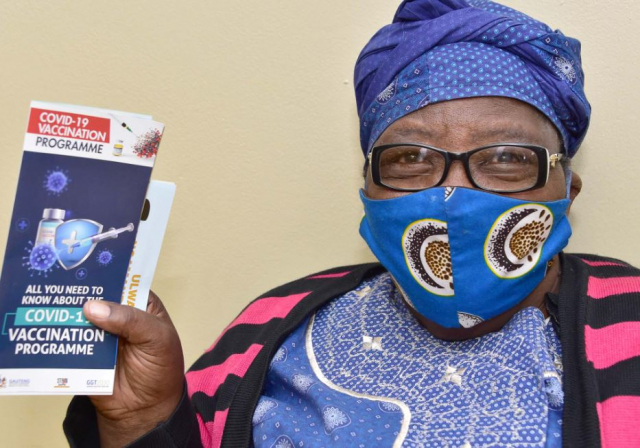
“We will continue to ramp up daily vaccinations, working together with the private sector, towards attaining the targets we have committed to as government,” Mkhize added.
Western Cape launches non-metro vaccination drive
On Tuesday, the Western Cape launched the province’s non-metro vaccination drive with Evita Bezuidenhout.
Affectionately known as Tannie Evita, a resident in the West Coast District, received her vaccine at the Wesbank Community Hall in Malmesbury.
“Yes, I am so very relieved to get my vaccine, but I have a smartphone. I have a computer. I have internet. I have a car. I am 85 and I still drive myself. But many, many of my generation and younger don’t know how to register,” Tannie Evita said.
She has pleaded with the youngsters to assist the elderly to register adding that the vaccine is safe and offers excellent protection against severe COVID-19 related illness and death.
“My son De Kock registered me; I couldn’t get the little blue letters on the screen to turn black.”
Health MEC, Nomafrench Mbombo, said the province will open additional sites as more vaccines arrive.
“The plan for this week is to increase the number of daily vaccinations administered to increase from 6 000 a day last week, to over 12 000 a day this week.”
The MEC appealed to people to spend time helping their old relatives to sign up for the vaccine.
She said the Western Cape would increase the number of public vaccination service points to over 137, which includes public and private centres, as well as temporary outreaches to places like old age homes.
According to the Western Cape Premier, Alan Winde, the province needs as many people as possible to register for their COVID-19 vaccination for the rollout to succeed.
“Our registration numbers are growing nicely, now exceeding 315 000, but we still have a long way to go.”
Registration is simple and can be done by:
- Visiting https://vaccine.enroll.health.gov.za/#/ or www.westerncape.gov.za
- Dialling *134*832# and follow the prompts (FREE on all South African networks); or
- WhatsApp the word REGISTER to 0600 123456.
Department condemns shutdown of water treatment plant
The Department of Water and Sanitation in Limpopo has strongly condemned the closure of Nandoni Water Treatment Plant by protesting residents in Tshiulungoma and Muloti villages.
According to Water and Sanitation Provincial Head, Lucy Kobe, the protestors overpowered the security personnel guarding the plant and took the keys.
Kobe warned that this will have far reaching implications, as it has affected water supply to communities that are benefiting from the plant.
“These acts of criminality have no place in Limpopo and whatever issues community members feel aggrieved by should not lead to the shutdown of the plant,” Kobe said.
Kobe said while the department fully understands that people have a constitutional right to protest, “no one has a right to infringe on someone else’s right to have access to water”.
She said such conduct has negative implications on service delivery, compliance of municipalities and water wastage that cannot be afforded in the midst of unreliable rainfall.
“The protestors also endangered the lives of the people guarding the plant, something that is against the law as well and we condemn that,” Kobe said.
Kobe said national government is aware of the water challenges experienced in the area, and they are working closely with the provincial and local governments to come up with immediate solutions.
“Part of the problem has been the non-functional pump station pumping water from Tshiulungoma to Mutoti village. The pump station has since been fixed, but it cannot be tested now since the plant is closed,” Kobe said.
Committee supports return to daily attendance for primary school learners
The Portfolio Committee on Basic Education has come out in support of Basic Education’s (DBE) decision to return primary school learners (Grades R to 7) to the daily attendance and traditional timetabling model from 26 July 2021.
Committee Chairperson Bongiwe Mbinqo-Gigaba said the committee supports the decision, as long as the department can ensure that there is a safe and secure environment to go back to school.
“I have noticed that there has been regress when the younger ones only have alternative days of schooling,” Mbinqo-Gigaba said.
On Tuesday, the committee received a presentation from the DBE on the status of school preparedness for a possible COVID-19 third wave.
This follows the directions issued recently by the department that provide clarity on the date of the return of all learners in primary schools.
The committee heard that at the start of the third term, South Africa may be over the COVID-19 third wave. This synchronised with the vaccination of teachers will be important for herd immunity and safer schools.
Mbinqo-Gigaba said the committee noted the loss in learning hours that has already occurred in the 2021 school year due to the academic year starting later, with the majority of learners not attending five days of schooling per week, as they were using a rotational system.
“This, together with the loss of learning hours in 2020 does not bode well for our education system. We know and understand that it is not a South African phenomenon but a world-wide challenge. However we remain concerned,” Mbinqo-Gigaba said.
The committee also heard that DBE has identified the key issues that are most likely to compromise compliance with health protocols and organised it into 14 dashboard indicators.
These include facilities, adequate water, basic sanitation and hygiene packages, special schools, number of infrared thermometers, learner transport, schools’ nutrition programme, the number of screeners, provision of COVID-19 essentials, psychosocial support to learners and staff, quality of learning and teaching campaign (QLTC), and communication.
Basic Education Minister Angie Motshekga informed the committee that the department’s decisions on the return to school is done in consultation with the Department of Health.
Motshekga noted that, should the Health Department advise otherwise [or] if the possible third wave hits the country, the department will reconsider and revise its position regarding the daily return of learners.
Regarding the Grade 12 class of 2021, the Minister said education authorities will try to keep the learners in school for as long as possible, in order to try to cover the gaps.
“They are Grade 11s of 2020 and already the whole curriculum was not covered. They lost close to 60% of school time over the period,” Minister Motshekga told the committee.
Consultation with South African Weather Services
The committee further heard that the department is in consultation with the South African Weather Services regarding the winter period, which tends to lead to more people contracting colds and flu.
Most parts of the country will have above-normal rainfalls with above average minimum and maximum temperature expected.
“The DBE informed the committee that it will, on a weekly basis, track progress each province is making and that good practices identified during weekly one-on-one virtual meetings with the provinces, will be shared with all the provinces,” the chairperson said.