
KZN unveils database to recruit unemployed graduates

The KwaZulu-Natal provincial government has set up a database aimed at helping unemployed graduates.
Launched on Monday, the Provincial Unemployed Graduates Database aims to help recruit youth for internships and learnerships, as well as establish youth trends which can help to inform policy.
Through the Youth Chief Directorate and the Information and Communication Technology (ICT) unit, the provincial government has devised a template to collect and collate integrated, up-to-date data on unemployed graduates in the province.
“The aim of the online database – which will be accessible to government departments, municipalities, government agencies and the private sector – is to help recruit youth for internships and learnerships, as well as establish youth trends which can help to inform policy.
“The Provincial Unemployed Graduates Database will also be accessible to national programmes such as Infrastructure Strategic Projects for unemployed youth that seeks job training opportunities in various sectors,” the provincial government said.
It said rife unemployment among graduates is a cause for concern for the province.
“The unemployment of graduates has also become a thorn in the flesh of the provincial government, which if not addressed properly, can become a raging inferno with devastating effects. The advent of the novel Coronavirus more than a year ago has worsened the unemployment of graduates in South Africa, and particularly in KwaZulu-Natal.”
The province wants to eradicate and lessen the triple challenges of unemployment, poverty and inequality, through the establishment of the database. Registration for the database is accessible on the KwaZulu-Natal online website (www.kznonline.gov.za) and will be continuous, without a closing date.
Unemployed graduates can populate the template, which will be easily accessible on various social media platforms.
“Even graduates from rural and outlying areas of the province can have access to the template through the mobile vehicle offices which will provide access to information through technology. The Youth Development Chief Directorate will then collate information on the template and update the database on a regular basis,” the provincial government explained.
Data released by Statistics South Africa earlier this month showed that the country’s unemployment rate reached 32.6% in the first three months of 2021. According to the data, the official unemployment rate among youth (15-34 years) was 46.3% in quarter 1, 2021.
“It is against this background that KwaZulu-Natal is doing its all in its power to address the rising unemployment among youth and graduates. Hopefully this venture will go a long way in alleviating the plight of unemployed graduates, thus relieving the stressful load on their shoulders,” said the provincial government.
SIU to investigate corruption, maladministration at KZN Transport
Allegations of corruption and maladministration in the KwaZulu-Natal Department of Transport will come under scrutiny when the Special Investigating Unit (SIU) probes the claims.
This comes after President Cyril Ramaphosa signed Proclamation R16 of 2021, authorising the SIU to investigate the department’s affairs.
If the allegations are proven true, the SIU will have to recover any financial losses suffered by government.
“The investigation will focus on the 10 August 2018 procurement of, or contracting for the construction of an 8km concrete barrier wall between uMkanyakude and Mozambique Border, and payments made in respect thereof,” the SIU said in a statement.
The tender was awarded to a joint venture between ISF Construction and Shula Construction to the value of over R85 million.
A report of the Portfolio Committee on Public Works and Infrastructure shows that only 0.166 km work was completed and an enormous amount of R48 million has already been paid to the contractor. This amount was supposed to have been spent on a 3 kilometer border wall placement.
Meanwhile, the SIU has instituted civil proceedings against service providers, who were awarded a R1.2 million contract to supply 50 000 masks to the North West Education Department.
This comes after an SIU investigation revealed that the provincial department had irregularly appointed the service providers.
“It could not be determined whether masks were indeed delivered,” the SIU said.
The SIU said its investigation will determine whether the procurement and payments made in relation to the construction of barrier were done in a manner that was fair, competitive, transparent, equitable or cost-effective; or contrary to applicable legislation and guidelines issued by the National Treasury or the relevant Provincial Treasury.
The SIU will also look at whether there was any related unauthorised, irregular or fruitless and wasteful expenditure incurred by the institutions or financial losses suffered by the institutions or the government.
Furthermore, the SIU will investigate any irregular, improper or unlawful conduct by contractors, employees or officials of the institution; or the suppliers, service providers or any other person or entity, relating to the allegations of corruption and maladministration.
The investigation will cover transactions that took place between 13 July 2016 and 7 May 2021, and transactions that either took place before July 2016 or after 7 May 2021 but relevant to, connected with the same persons, entities or contracts being investigated.
RTMC urges youth to be cautious on the road
The Road Traffic Management Corporation (RTMC) has urged young people to exercise caution on the road to avoid getting into accidents.
“As the country commemorates Youth Month, we reflect on the impact that road fatalities have on youth in particular.
“While many youth are left with disabilities, many are left with permanent emotional scars that prevent them from fully exploring the joys life has to offer them, all as a result of road crashes,” the RTMC said in a statement.
Statistics indicate that youth account for the highest number of road fatalities annually when compared to other age groups.
In 2019, youth aged 20 – 24 years constituted 11.54% of total fatalities. Those aged 25 – 29 constituted 21.79%, while those aged between 30 and 34 constituted 8.97% of fatalities.
Statistics for the previous year indicate that the 20 – 24 years age group constituted 12.84% of fatalities, while those aged 25 – 29 constituted 19.27% and the 30 – 34 age group constituted 11.01%.
“The death of youth robs the nation of much needed resources and skills, a tragedy we can change.
“The future of any country is in its youth and during this Youth Month, the RTMC calls on youth to say no to road carnage by becoming active road safety ambassadors, who aim to promote change and influence South Africans to demonstrate responsible road user behaviour,” the RTMC said.
Court services at Protea Magistrates Court temporarily suspended
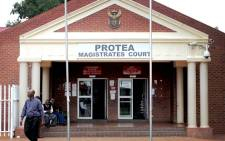
The Department of Justice and Correctional Services has announced the temporary suspension of services at the Protea Magistrates Court until further notice.
This, according to the department, is due to water supply challenges due to damaged and aging piping infrastructure.
All matters that were scheduled at the court will be postponed. Members of the public, who are supposed to appear before the court, are advised to visit the court to secure new court appearance dates.
Justice services will in the interim, be offered at Lenasia, Kliptown, Orlando, as well as Meadowlands Magistrates’ Courts.
“The department is working around the clock with the Department of Public Works to ensure the speedy restoration of services, and apologises for any inconvenience this may cause,” the department said in a statement.
For service related enquiries, members of the public are advised to contact the Area Court Manager, Ms Susan Maswanganwe, on 082 855 9280 or the Acting Court Manager, Ms Magdeline Sithole on 083 543 6572.
Woman to appear in court for murdering infant

A 24-year-old woman is expected to appear before the Middelburg Magistrate’s Court today, after she allegedly murdered her three-month-old baby girl.
The horrific incident happened on Friday evening in Avontuur near Middelburg.
On the day of the incident, the woman and the baby reportedly visited the infant’s father at the farm where the latter works.
Upon their arrival, the man refused to let them in and the woman allegedly threatened to kill the baby.
It is said that the woman then threw the infant on the ground.
The matter was then reported to the police, whereupon on the arrival of the paramedics, the child was certified dead. Police opened a murder case and immediately arrested the suspect.
The investigation by the police has since revealed that the woman is originally from Zimbabwe and she is not in possession of legal documents to be in South Africa, hence a charge of contravention of the Immigration Act has been added to the murder charge.
The Acting Provincial Commissioner of the SAPS in Mpumalanga, Major General Thulani Phahla, has strongly condemned the incident and labelled it as inhumane.
“Parents should not use children to settle their love triangle scores,” Phahla said.
‘Unsuitable’ J&J vaccines won’t be released for use in SA

The South African Health Products Regulatory Authority (SAHPRA) has decided not to release the long-awaited Johnson & Johnson (J&J) vaccines for use in the country.
However, SAHPRA said about 300 000 doses from batches that have been cleared by the US Food & Drug Administration (FDA) meet the requirements and will subsequently be released and shipped to South Africa.
This comes after the FDA authorised two batches of the drug substance produced by Emergent BioSolutions in Baltimore, United States, and determined that several others are not suitable for use.
“SAHPRA reviewed the data provided by the FDA and has made a decision not to release the vaccine produced using the drug substance batches that were not suitable,” the drug watchdog said.
The FDA has been investigating potential contamination problems at a COVID-19 vaccine plant in Baltimore, which has had a knock-on effect locally.
Concerns were identified by the FDA, relating to non-compliance to good manufacturing practices during the manufacturing of some active pharmaceutical ingredient used in the vaccine.
“SAHPRA focuses on the quality, safety and efficacy of all health products, including COVID-19 vaccines and will ensure that the safety and well-being of South Africans will not be compromised in any way,” said SAHPRA CEO, Dr Boitumelo Semete-Makokotlela.
Meanwhile, according to the National Health Department, the FDA announced that they approved an extension of the expiry date after careful evaluation of these doses, after determining that the vaccine can be stored in a normal bar fridge for 4.5 months instead of three.
“Work is being undertaken to identify more safe doses for the rest of the mass vaccination programme,” the department said.
In the meantime, the department said it is hoping that more doses of J&J will be made available to the international community, including South Africa, as the US regulator continues to assess some batches.
“Further announcements will follow in due course. We remain committed to the success of the South African mass vaccination campaign and are doing everything in our power to source safe and effective vaccines for all people residing in South Africa,” the department said.
SA logs 7 657 new COVID-19 cases, with 78 more deaths
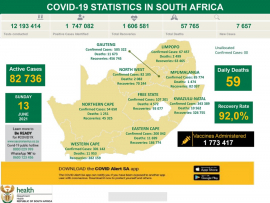
South Africa detected 7 657 new COVID-19 cases on Sunday, representing a 17.2% positivity rate.
According to the latest data from the National Institute for Communicable Diseases (NICD), the majority of the new infections were logged in Gauteng after 4 891 people were confirmed to have contracted the virus.
Meanwhile, the Western Cape recorded the second highest number of cases at 663, followed by the North West with 521.
This brings the total number of laboratory-confirmed cases to 1 747 082 since the outbreak.
In the last 24 hours, there was also an increase of 632 hospital admissions and 78 in-hospital fatalities, bringing the death toll to 57 731.
The information is based on the 12 193 414 tests performed, 44 560 of which were conducted since the last reporting cycle.
So far, 1 773 417 people have received the Johnson & Johnson and Pfizer vaccines.
Globally, as of 13 June 2021, there have been 175 306 598 confirmed cases of COVID-19, including 3 792 777 deaths, reported to the World Health Organisation (WHO).
In addition, 2 156 550 767 vaccine doses have been administered as of 10 June 2021.
NICD confirms third wave as infections continue to soar
South Africa on Thursday logged 9 149 new COVID-19 cases, which represents a 15.7% positivity testing rate.
According to the National Institute for Communicable Diseases (NICD), figures from the past seven days show that South Africa is now experiencing the third wave.
“South Africa technically entered the third wave today as the national seven-day moving average incidence of 5 959 cases, which now exceeds the new wave threshold, as defined by the Ministerial Advisory Committee (MAC),” the NICD said on Thursday.
The MAC, which provides recommendations on managing the COVID-19 pandemic, defines the new wave seven-day moving average threshold as 30% of the peak incidence of the previous wave.
The majority of the new infections are from Gauteng, with 5 597 cases (61%), followed by the Western Cape with 932 (10%).
This brings the total number of laboratory-confirmed cases to 1 722 086 since the outbreak.
The NICD also observed an increase of 844 admissions, pushing the total to 7 300 patients in health institutions across the country.
An additional 127 in-hospital deaths were reported in the past 24 hours.
The data is based on the 12 044 072 tests conducted, 58 322 of which were done since the last reporting cycle.
To date, 1 619 011 people have been vaccinated in South Africa.
According to the World Health Organisation, as of 10 June 2021, there have been 174 061 995 confirmed global cases, 3 758 560 deaths and 2 156 384 616 administered vaccine doses.
Progress made in implementing economic recovery plan

President Cyril Ramaphosa says progress has been made in implementing the Economic Reconstruction and Recovery Plan.
“The Economic Reconstruction and Recovery Plan is a necessary response to the severe economic impact of the coronavirus pandemic.
“The Plan aims to ensure a swift and lasting economic recovery, with measures to limit the immediate impact of the pandemic on vulnerable workers and households, and to revive economic growth in the short-and medium-term.
“Significant progress has been made since the announcement of the plan less than eight months ago,” said the President, when responding to oral questions in the National Council of Provinces on Thursday.
The President said the Infrastructure Fund has been established, and its investment committee has been constituted.
“A total of R18 billion has been allocated to the Infrastructure Fund over the next three years for blended finance arrangements that will leverage private sector funding.”
To achieve greater energy security, a total of 1 200 MW of new generation capacity has now been connected to the grid from projects approved through Bid Window 4 of the Renewable Energy Independent Power Producers (IPP) Programme.
“A request for proposals has been issued for 2 600 MW of power from wind and solar PV projects through Bid Window 5.
“Eleven preferred bidders have been approved as part of the emergency power procurement programme, which will together deliver nearly 2 000 MW of power to the grid over the next 18 months.
“As I announced earlier this afternoon, Schedule 2 of the Electricity Regulation Act will soon be amended to increase the licensing threshold for embedded generation projects from 1 MW to 100 MW,” said President Ramaphosa.
Presidential Employment Stimulus
The Presidential Employment Stimulus, meanwhile, has supported close to 700 000 work opportunities across a range of programmes, through the creation of new work opportunities, the protection of existing jobs in vulnerable sectors, and support for livelihoods.
Four sector Masterplans are currently in implementation in the automotive, sugar, poultry, and clothing, textiles, footwear and leather sectors.
“This approach, which relies on close collaboration with stakeholders to develop a tailored action plan for high-growth sectors, is already demonstrating results.
“According to data released by the South African Revenue Service, South Africa experienced a cumulative trade surplus of close to R150 billion for the first four months of this year.
“This reflects a massive increase in our exports to the rest of the world, driven largely by the unique strategic value of our mineral resources,” President Ramaphosa said.
The President said funding for the measures contained in the Economic Reconstruction and Recovery Plan is included in the budgets of all national departments for their areas of responsibility, ensuring that the plan is mainstreamed in the work of government.
“Through the effective implementation of this plan, as well as the structural reforms that form part of Operation Vulindlela, we are reviving our economy and placing South Africa on a new growth trajectory.
“The success of the recovery plan is based on a strong partnership with business, labour and other social partners, as a whole-of-society effort to promote our economic recovery.”
NERSA welcomes intervention intended to achieve energy security

The National Energy Regulator of South Africa (NERSA) has welcomed the decision to amend Schedule 2 of the Electricity Regulation Act, 2006 (Act No. 4 of 2006), to exempt generation facilities up to 100MW from the licensing requirement.
President Cyril Ramaphosa announced on Thursday that the regulation will be amended in an effort to resolve the country’s energy supply shortfall and reduce the risk of load shedding.
“The exemption is aimed at achieving energy security, and reducing the impact of load shedding on businesses and households across the country.
“The exemption includes generation projects connected to the grid, as well as those not connected to the grid. However, the generation facilities will still be required to apply to NERSA for registration to ensure that they meet all the requirements,” NERSA said on Friday.
NERSA said it will await the gazetted Schedule 2 of the Electricity Regulation Act, 2006, from the Department of Mineral Resources and Energy for implementation.
“Any material changes necessitated by the amended Schedule 2 will be communicated in due course,” NERSA said.
The Department of Mineral Resources and Energy is expected to publish the final version of the amendment to Schedule 2 within the next 60 days or sooner.