
35 – 49 age group to be vaccinated from 1 August
South Africa’s COVID-19 vaccination programme is next month expected to gain further momentum, with those aged between 35 and 49 years, set to be vaccinated.
While registrations will begin on 15 July, government will begin inoculating this group on 1 August.
This was on Friday revealed by Acting Health Minister, Mmamoloko Kubayi-Ngubane, during a media briefing. The briefing was held amid a sustained rise in infections, hospitalisations and related deaths in the past seven days.
Healthcare workers were the first to be vaccinated in March under the Johnson & Johnson Sisonke programme. A month later, government began administering vaccines in the over 60 population.
Two weeks ago, over 500 000 basic education workers began receiving their doses. Last week, the programme began focusing on those aged 50 and above. Personnel in the security sector this week started being vaccinated.
In the last 24 hours, the country recorded 22 910 new cases, representing a 34.4% positivity rate. Of these, 11 747 were in Gauteng.
Overall, Kubayi-Ngubane said government’s vaccination programme has made significant strides.
“We have learned lessons from when we started, and we continue to improve our systems as we work and continue moving forward,” she said.
Last week, the programme received a shot in the arm when the South African Health Products Authority (SAHPRA) granted approval for the use of the Sinovac vaccine.
“The approval came at a time when the demand for vaccines was [increasing].
“More people are yearning to get vaccinated. [This] will boost the vaccine supply for the country’s vaccination rollout programme.”
Sinovac is in addition to the Pfizer and Johnson & Johnson vaccines already utilised in the country.
Kubayi-Ngubane said while indications are that the number of cases in Gauteng have peaked and are now declining, the province remains the country’s epicentre.
“We should never let our guards down and think that [it is over].”
She expressed concern over the rise in numbers in the Western Cape, Limpopo, North West, KwaZulu-Natal and Mpumalanga.
In this regard, she said government is ramping up its vaccination rollout programme to ensure that vaccines can reach the majority of the population and ensure that more people are protected from the impact of the virus.
As of Thursday, South Africa was surpassing 191 000 vaccinations a day.
“We’re expecting to surpass 250 000 vaccinations by next week,” the acting Minister said.
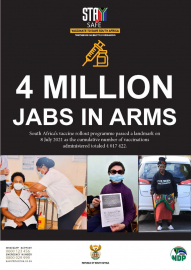
Overall, the country has to date vaccinated four million people – partially or fully.
“This is [a] milestone, although we know that many people are saying this is not yet enough because when we compare it with the percentage of the population, it’s still a bit of a challenge.
“We have to make sure that the vaccine reaches all South Africans as quickly as possible. We will now pay attention to vaccinations per district, and make the research intervention, working together with provinces, to ensure that in each district in every local municipality, there is access to the vaccine,” she said.
This week, the Department of Health held a bilateral meeting with National Treasury to discuss the funding of the vaccination programme.
In this regard, the department will begin availing of human capital to vaccinate over weekends from 1 August.
SA records 460 COVID-19 related deaths
A total of 22 910 new COVID-19 cases have been identified in South Africa, which brings the total number of laboratory-confirmed cases to 2 135 246, according to the National Institute for Communicable Diseases (NICD).
This increase represents a 30.4% positivity rate.
Gauteng reported 11 721 new infections, the Western Cape reported 2557 and Limpopo reported 2124.
“As per the national Department of Health, a further 460 COVID-19 related deaths have been reported, bringing total fatalities to 63 499 to date,” said the institute.
There has been an increase of 711 hospital admissions in the past 24 hours.
Meanwhile, 13 694 914 COVID-19 tests have been conducted in both public and private sectors.
Also, 191 833 vaccinations have been administered in the last 24 hours – 13 948 Johnson and Johnson vaccines and 177 885 Pfizer vaccines.
In terms of vaccine registrations, 91 080 self and assisted registrations were recorded.
The NICD, a division of the National Health Laboratory Service, will continue the monitoring and surveillance of COVID-19 in order to inform the public health response.
SAPS Deputy Commissioner succumbs to COVID-19
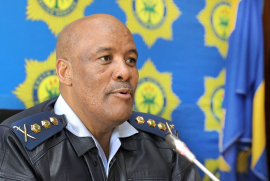
The COVID-19 third wave has claimed the life of the Deputy National Police Commissioner (DNC), Lieutenant General Sindile Mfazi.
The news was on Friday confirmed by National Police Commissioner, General Khehla Sitole, in a statement.
At the time of his passing, Mfazi, 59, was DNC for Crime Detection.
Mfazi was a highly decorated senior officer, who served the South African Police Service (SAPS) for 39 years.
During this period, he held various executive roles.
Between 2003 and 2008, he was Deputy Provincial Commissioner responsible for Corporate Services in the Western Cape. In 2008, he was transferred to the Eastern Cape, where he was the Provincial Head of Crime Intelligence.
When he left the post in 2018, he moved to the National Head Office in Pretoria, following his appointment by Sitole as DNC for Management Advisory Services.
From March 2020 up until his passing, Mfazi held the position of DNC for Crime Detection, a position to which he was appointed in line with the new structure.
Sitole described Mfazi as an exemplary leader, who was dedicated to the cause of serving and protecting the people of South Africa.
“The SAPS has lost one of its reliable, dedicated and greatly respected leaders in the organisation. Mfazi led by example and served this country with distinction until his death. On behalf of the SAPS family, we extend our deepest condolences to his family, friends and colleagues,” he said.
Memorial and funeral details will be communicated in due course.
SA builds 18-day COVID-19 vaccine stock

As South Africa continues to administer COVID-19 vaccines and receive doses from manufacturers, the Department of Health has confirmed that it currently has enough stock for 18 days.
“As of [Thursday] evening, the country had in total – both the Johnson & Johnson and Pfizer vaccines – 3.6 million doses. At the current rate of vaccination, that’s about 18 days of vaccine [stock] for the country.
“Some of it is still with the central distributor. There… are vaccines… in the central hospitals and tertiary hospitals being brought down into the clinics and community health centres every day,” said the department’s Deputy Director-General, Dr Nicholas Crisp, at a ministerial briefing on the country’s response to COVID-19 on Friday.
The private sector also has vaccines in their central wholesale, in private hospitals and community pharmacies, among others.
“We get a report at the end of every day, through our stock visibility system, of what vaccines have been used, and we track what is used against the reports of vaccine doses that are reported on the EVDS [Electronic Vaccination Data System] to check what’s happening.
The systems also determines losses suffered, if any.
“As we stand at the moment, that’s about 18 days of vaccine [stock], which is the strongest position we’ve ever been in.
“This morning, we have received some information about the coming period into August, so this at least gives us vaccine security,” he said.
The Pfizer vaccine, Crisp said, had stock abailability until 26 July. For the Johnson & Johnson vaccine, Crisp said figures were not in the general population stats due to the short expiry date on the 1.5 million doses.
These doses were currently being used in the dedicated cluster rollouts by the departments, Crisp said.
Turning attention to the vaccination of targeted population groups, Crisp said there were some hurdles in the rollout for the older segment of the population.
“We are hoping that, and we’re already starting to see the trend that when the 50 plus population comes in, and I suspect the younger population too, they will bring along a lot of the older people,” Crisp said.
To counter this, government is actively embarking on initiatives to encourage vaccination.
“There’s a pilot project that’s been running in the pension pay points this week. I am sure that we will get feedback on that list of lessons to be learned.”
He encouraged everyone to help the others in the community to get vaccinated.
On the question of prioritisation, Crisp said it was “extremely difficult” to prioritise any group.
“The reason we have proposed that we should open to all (to other age groups) faster is rather than spending effort on trying to selectively identify and define any particular group, it’s far better to go as quickly as possible through the general age groups and to not spend time on the administration of the programme, but to rather vaccinate the people,” said Crisp.
SA records 21 427 new COVID-19 cases, 411 deaths
South Africa on Wednesday recorded 21 427 new COVID-19 cases, bringing the number of infections in the country to 2 112 336 since the outbreak of the virus.
The new infections represented a 30.3% positivity rate, said the National Institute for Communicable Diseases (NICD), a division of the National Health Laboratory Service. It continues the monitoring and surveillance of COVID-19 in order to inform the public health response.
In the same reporting period, a further 411 COVID-19 related deaths were reported, bringing total fatalities to 63 039 to date.
The majority of new cases today are from Gauteng (49%), followed by Western Cape (13%). Limpopo accounted for 9%; KwaZulu-Natal and North West each accounted for 8% respectively; Mpumalanga accounted for 6%; while Eastern Cape and Free State each accounted for 3% respectively. The Northern Cape accounted for 1% of Wednesday new cases.
The country has conducted 13 619 638 tests in both public and private sectors.
SA records 15 501 new COVID-19 cases, 457 deaths
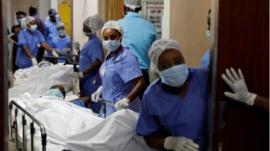
South Africa has recorded 15 501 new COVID-19 cases, bringing the total number of laboratory-confirmed cases to 2 090 909.
“This increase represents a 26.2% positivity rate, which is lower than yesterday (31.6%),” the National Institute for Communicable Diseases (NICD) said on Tuesday.
As per the National Department of Health, a further 457 COVID-19 related deaths have been reported, bringing total fatalities to 62 628 to date.
The majority of new cases are from Gauteng (59%), followed by Western Cape (10%).
KwaZulu-Natal accounted for 8%; North West accounted for 6%; Mpumalanga accounted for 5%; Eastern Cape and Limpopo each accounted for 4%; Free State accounted for 3%; and Northern Cape accounted for 1% of the new cases.
A total of 13 548 841 tests have been conducted in both public and private sectors.
Meanwhile, an increase of 790 hospital admissions have been reported in the past 24 hours.
SAPS vaccination programme gains momentum
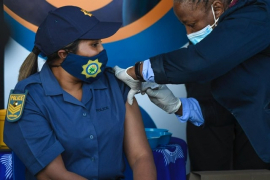
Two days after launching COVID-19 vaccinations for its members, the South African Police Service (SAPS) Vaccination Programme is gaining momentum.
This comes after just over 1000 more SAPS personnel received their jabs on Tuesday.
“On day two of the programme, a total of 2055 vaccines had been administered to police officers and support personnel at both the Orlando Stadium in Soweto and the SAPS Tshwane Academy vaccination sites,” the SAPS said in a statement.
At Orlando Stadium, 760 members were vaccinated, bringing the total number of members who have been vaccinated over the first two days at the site to 1 285.
At SAPS Tshwane Academy, the second vaccination site, a total of 770 members had been vaccinated over two days.
Constance Makhaye, a cleaner at the SAPS Tshwane Academy, was among those who got vaccinated on day two. The 58 year-old with 25 years of service said she was elated to have finally received the vaccine.
“I feel very happy about today, I was initially scared to vaccinate, now that I have recieved my vaccine, I am going to encourage my other colleagues to come and be the next in line to get vaccinated,” she said.
Captain Daniel Dhanarajan, a 48 year-old trainer attached to the SAPS Atteridgeville Academy, expressed equal delight.
“I feel very strong and relieved to know that my colleagues, family and I will be safe and guarded against the severe effects of this virus,” he said.
As of Tuesday evening, the number of members that have tested positive for the virus remains at 32 565. The number of recoveries stood at 30 955.
However, the number of those who succumbed to their COVID-19 illnesses rose to 673.
The SAPS reiterated that while vaccination is voluntary, it will continue to encourage all members to get vaccinated in a bid to operate optimally in serving and protecting the people of South Africa.
“Vaccinating our members does not mean we should stop adhering to the non-pharmaceutical health and safety protocols. The service will continue to ensure that all health and safety protocols at all service points remain in place and are adhered to by members,” it said.
The SAPS said there is an exclusion criteria for vaccination, this means that there are those who will not qualify to be vaccinated.
Among the excluded were those who had contracted COVID-19 in the last 30 days, any person who had received a flu vaccine within 14 days, and any member who had been vaccinated prior to the SAPS vaccination rollout programme commencing.
The police will continues to monitor preparations in place for the nationwide rollout at all 108 registered sites. The provincial rollouts will commence on Thursday in eight provinces. Gauteng will begin administering jabs on Friday.
Cape Town set to open mass vaccination centre

The City of Cape Town and Discovery Health on Tuesday conducted an oversight visit at the Cape Town International Convention Centre mass Vaccination Centre of Hope to check on its preparation ahead of its activation today.
Between July and December this year, this mass vaccination centre is expected to administer over 750 000 vaccinations in Cape Town, playing a critical role in the Western Cape and South Africa’s vaccination programme.
The oversight visit was attended by the Premier of the Western Cape Alan Winde; Provincial Minister of Health, Dr Nomafrench Mbombo; Mayor of Cape Town, Dan Plato; Community Services & Health MMC in the City of Cape Town, Zahid Badroodien; Discovery Group Executive, Adrian Gore and Discovery Health CEO, Dr Ryan Noach.
A virtual tour was also conducted with the public and the media, who joined online, to help create awareness.
Winde said the Vaccination Centre of Hope is a pioneering collaboration that shows what is possible when the private and public sector work together.
“I am so proud to see this collaboration take shape, demonstrating what is possible when we work together with the private sector to deliver quality services to our residents. I hope this is the beginning of many more joint projects in this space.
“All eligible residents, whether they have a medical aid or not, will be assisted at this site. No person will be left behind because every life matters,” Winde said.
The City of Cape Town worked to make the site fully operational before handing it over to the Western Cape Government and Discovery Health.
The Western Cape government will be primarily responsible for overall coordination, supply of vaccines, clinical and facilities management, while Discovery Health will be responsible for client experience, various aspects of the technology solution and administrative functions.
Plato said he is looking forward to the site becoming operational, helping vaccinate hundreds of thousands of Capetonians across the city.
“The city, province and Discovery Health are ready to provide a significant boost to the vaccination campaign and we have urged national government to increase its procurement and rollout of vaccines so that more age groups can access the vaccine.
“I am proud of all the city officials who made this site a reality through intensive and time-pressured project management. The success of the COVID-19 vaccination drive relies on a joint effort between all stakeholders, including government, the private sector and our residents.
“An expanded and ramped up national vaccination rollout would bring an end to the need for further national lockdowns that harm livelihoods and impact the recovery of the economy. As a fully vaccinated resident myself, I encourage residents to come forward to receive the vaccine as soon as possible,” Plato said.
The Cape Town International Convention Centre (CTICC) Vaccination Centre of Hope will be one of the largest and most sophisticated vaccination sites in the country, leveraging the combined resources and capacity of both the public and private sector, and thereby accelerating access to vaccination for greater numbers of residents.
“This is a welcomed boost for South Africa’s vaccination programme. When it comes to the national mass vaccination rollout, there is strong alignment between saving lives and saving livelihoods – two inseparable priorities.
“This site will contribute significantly to the national target to provide access to COVID-19 vaccination for 41.7 million adults in South Africa, to reach population immunity and prevent further waves of infection,” Noach said.
He said they are encouraged by early vaccine efficacy data analysis on Discovery members who have been vaccinated, which provides strong evidence of the protective effect of the COVID-19 vaccination.
“Preliminary data analysis shows 47% reduction in COVID-19 infection rates among vaccinated populations 21 days after receiving the first Pfizer-BioNtech vaccine dose, and an estimated 50% reduction in hospitalisation post first dose.
“These findings are congruent with international experience and highly encouraging from a South African perspective,” Noach said.
How the CTICC vaccination centre will work
The CTICC Vaccination Centre of Hope will be one of the biggest vaccination sites in the country.
Fifty vaccination stations will be operational at the site, with the related administrative and support staff in place to support operations.
This will mean that more than 4 000 people can be vaccinated per day when it reaches its full operational capacity.
Onsite registration will be possible at the site to help those who need assistance.
Vaccinations will be free of charge for everyone visiting the site, enabled by payment agreements between medical aids and the Western Cape Department of Health to provide a hassle-free experience to all residents.
The site will have sophisticated cold-chain refrigeration, waste management processes and IT infrastructure, and the capability to administer both the Pfizer-BioNTech double dose and Johnson & Johnson single dose vaccines.
“The COVID-19 vaccines used in South Africa are approved by the South African Health Products Regulatory Authority (SAHPRA) and are safe. They are also proven, through rigorous tests, to provide excellent protection against severe COVID-19 related illness. That is why it is important that every single person gets vaccinated as soon as possible.
“I urge you to register when it is your turn, so that we can fight back against COVID-19 and continue to save lives and livelihoods,” said Winde.
Everyone over the age of 50 is currently eligible to register for their COVID-19 vaccine on the Electronic Vaccination Data System, and is urged to do so by using any of the following steps:
• Visit http://vaccine.enroll.health.gov.za/ (which can also be accessed on www.westerncape.gov.za)
• WhatsApp the word REGISTER to 0600 123456
• Dial *134*832*ID number# if you don’t have internet access.
12 513 new COVID-19 cases reported

South Africa has recorded 12 513 new COVID-19 cases, bringing the total number of laboratory-confirmed infections to 2 075 409.
“This increase represents a 31.6% positivity rate, which is higher than yesterday (30.2%),” the National Institute for Communicable Diseases (NICD) said on Monday.
The majority of new cases are from Gauteng (60%), followed by the Western Cape (10%). Limpopo accounted for 7%, KwaZulu-Natal accounted for 6%, the North West and Mpumalanga each accounted for 5%, the Eastern Cape accounted for 3%, the Free State accounted for 2% and Northern Cape accounted for 1% of the new cases.
“As per the National Department of Health, a further 331 COVID-19 related deaths have been reported, bringing total fatalities to 62 171 to date,” the NICD said.
A total of 13 489 570 tests have been conducted in both public and private sectors.
Meanwhile, an increase of 566 hospital admissions have been reported in the past 24 hours.
Security sector vaccination programme rolls out with SAPS
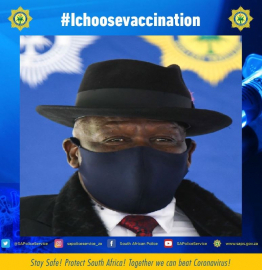
Government’s COVID-19 vaccination programme reached a milestone on Monday, with government rolling out the inoculation of the security sector.
Police Minister Bheki Cele and National Police General Khehla Sitole were the first to receive their jabs at the launch of the programme at the Orlando Stadium in Soweto, on Monday.
The sector is the latest to join government’s phased vaccination programme that started early this year.
Healthcare workers were the first in March in the Johnson & Johnson Sisonke programme. A month later, government began administering jabs on the over 60 population.
Two weeks ago, over 500 000 basic education workers began receiving their doses. Last week, the programme began focusing on those aged 50 and above.
The launch of the security sector vaccination programme was part of government’s tiered approach in an attempt to drive the country towards reaching herd immunity.
In the past four months, over 3.1 million vaccinations had been administered.
Speaking at the launch, at which 900 SAPS personnel were to receive doses, an elated Cele expressed delight.
“It has been a long walk [to reach this point] for us as the family of the SAPS. The sad part is that we reach this point when we have already lost about 672 of our members.
“We wish it could have been earlier so that we don’t lose those members and those 32 500 of them who have been infected – we thank God that 30 000 of them have recovered,” he said.
The Minister said the jabs would assist the SAPS to work in a protected way.
“We have 180 000 plus members and we hope everyone will get the vaccine. It will start here with the rollout. The proper day of the rollout will be the 8th. We hope it will be finalised as soon as possible and we believe we will be much safer after that.
“I want to see things happen. It’s a beautiful Monday – it’s not every Monday that I am happy,” he said.
Speaking at the event, acting Health Minister Mmamoloko Kubayi described the milestone as important.
She said dates for correctional services and metro police staff would be communicated in due course.
“This is a milestone as we move towards herd immunity.”
The country, she said, had in recent days made inroads in its vaccination programme. The programme was expected to shift a gear higher with the South African Health Products Regulatory Authority (SAHPRA) at the weekend announcing it had granted conditional use approval of the Sinovac vaccine.
“[This] boosts our moral and boosts positively towards our vaccination programme. It now means we have multiple vaccines that are available to us,” she said.
Behind the scenes, she said scientists continue to analyse developments around the use of the AstraZeneca vaccines in the country. South Africa in February temporarily suspended the rollout of the AstraZeneca vaccine after studies showed that it was less effective against the mutated SARS-CoV-2 501Y.V2 variant (Beta), which was at the time common in South Africa.
“Currently we are still cautioned against AstraZeneca though we are seeing the Delta variant dominating or growing; we still have the Beta variant, which makes it difficult for us to move.
Police are being vaccinated with the Johnson & Johnson vaccine, in an attempt to ensure that the vaccination programme gained momentum.
“This is very critical,” she said.
Kubayi said the vaccination of the SAPS was important as police were critically assisting the Department of Health manage the pandemic.
“We are doing our best in terms of hospitalisation, in terms of recommending restrictions and all of that. It needs law enforcement in the forefront to ensure that what the NCCC has pronounced together with the President is implemented. So it is important for them to get this vaccine,” she said.
Police urged to get jabs
Sitole urged police officers to get their jabs, saying it was important for the SAPS to fight crime with a healthy workforce.
“Today is a demonstration of this deliverable. It is important for us to show members of the SAPS force that we invest in their health and we want to make sure that, as they go out, they are safe.
“This is part of the safety strategy. As you see them here today, they are the ones in the frontline. They’ve been deployed to support the department of health in their endeavour to, firstly, ensure that we control the virus but also further make that we secure the vaccine.
Illicit vaccines
He said police had noted a new modus operandi pertaining to the virus.
“We have done take downs where vaccines were [illicitly] being brought into the country in other ways. There has been other ways to try and disrupt the vaccine programme,” he said.
He urged members to continue to rendering a “patriotic” and “selfless” service.