
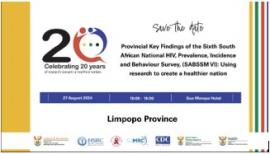
Limpopo sees a decline in HIV prevalence, but gaps remain
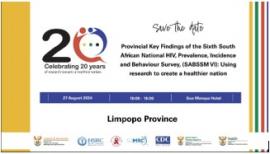
The Sixth South African HIV Prevalence, Incidence and Behaviour Survey (SABSSM VI) for Limpopo has found that the province had one of the lowest HIV prevalence levels among all provinces in 2022, at 8.9%, down from 10.1% in 2017.
This translates to an estimated 570 000 people living with HIV (PLHIV) in Limpopo, a 2% decrease from the 580 000 reported in 2017.
The data is based on the Human Sciences Research Council (HSRC) which released the key findings of the SABSSM VI for Limpopo.
The findings were released at the Meropa Hotel in Polokwane on Tuesday.
The survey found that in 2022, HIV prevalence in the province was disproportionately higher among the 25 to 49 year old age group, with females recording a prevalence of 22.3% and males 17%.
“Moreover, HIV prevalence was high, 7.4% among individuals living in rural formal or farm areas. Notably, females consistently showed a higher HIV prevalence across all selected demographic variables compared to their male counterparts,” the data revealed.
According to the overall principal investigator of the study, the HSRC’s Professor Khangelani Zuma, the survey revealed that the HIV epidemic profile peaked at an HIV prevalence of 29.4% among people aged between 50 and 54 in 2022, down from a peak of 36.9% in 2017 among those aged 40 to 44.
“There was a decrease in HIV prevalence in 2022, except among those zero to 14 years, 35 to 39 years, and 50 to 54 years, compared to 2017,” Zuma noted.
The data presented was for three Limpopo districts – namely Vhembe, Capricorn, and Mopani.
Among the three districts, the highest HIV prevalence was found in Mopani at 9%.
The SABSSM VI survey, conducted between 2022 and 2023, aimed to maintain surveillance of HIV infection and behaviours in South Africa, evaluate the progress of the South African national HIV and AIDS, STI and TB Strategic Plan, and monitor HIV indicators for national and international reporting.
Antiretroviral treatment
Shifting the focus to antiretroviral treatment (ART) coverage, the HSRC said the estimates closely mirror the national outlook, increasing to 80.8% in 2022 from 62.8% in 2017.
This translates to an estimated 430 000 PLHIV in the province receiving treatment in 2022, up from 290 000 in 2017.
ART use among all people living with HIV in the province was 80.8%, with males (73.1%) having lower coverage than females (84%).
Additionally, ART coverage was lower among those residing in urban areas (79.7%) than in other localities.
The lowest ART use was reported in Vhembe (76.4%), followed by Capricorn (80.8%).
Viral load suppression
The survey further revealed that in 2022, among all provinces, Limpopo had one of the lowest proportions of PLHIV who achieved viral load suppression (VLS) at 77.0%, up from 60.8% in 2017.
VLS was slightly lower among females (76.6%) than males (77.8%), with a more significant disparity in rural informal or tribal areas, where females achieved VLS at a rate of 75.2% compared to males at 83.9%.
“Low levels of VLS are concerning in that there is a high risk of HIV transmission during unprotected sexual acts with a person who is virally unsuppressed.”
Knowledge of HIV status
Meanwhile, Zuma expressed concern that people living with HIV aged 25 to 49 make up the majority of those in Limpopo who are unaware of their HIV status (65.0%), aware but not on ART (63.3%), and on ART but not virally suppressed (65.9%).
However, he noted that adolescents and youth aged 15 to 24 disproportionately contribute to gaps in treatment, comprising only 4.8% of all people living with HIV, yet accounting for 15% of those unaware of their status, 13.3% of those aware but not on ART, and 11.4% of those on ART but not virally suppressed.
Among females, those aged 15 to 24 years account for a minority of female people living with HIV (4%).
Sex debut
Regarding the key drivers of the HIV pandemic, the Professor noted that the proportion of adolescents and youth aged 15 to 24 who reported having sex before the age of 15 years decreased to 8.7% in 2022 from 13.5% in 2017.
In 2022, the percentage of adolescents and youth aged 15 to 24 who had their sexual debut before the age of 15 years was higher among males (14%) compared to females (3.1%).
“This percentage varied by district, with the lowest rate in Capricorn (4.8%) and the highest rate in Vhembe (12.9%).”
Multiple partners
The survey revealed that in Limpopo, 11.4% of people aged 15 and older reported having multiple sexual partners in 2022, a decrease from 12% in 2017.
Notably, males (18.5%) were 3.7 times more likely to report having multiple sexual partners than females (5%).
The highest proportion of multiple sexual partners was found among those aged 15 to 24 (15.8%), compared to other age groups.
Condoms
Regarding condom use, the survey found that in Limpopo, 29.8% of people reported using a condom with their most recent sexual partner in 2022, a decline of 11.8% from 41.6% in 2017.
Condom use was lower among certain groups, including those aged 25 to 49 (28.7%) and females (25.4%).
In Limpopo, a higher proportion (53%) reported never using a condom with their most recent sexual partner, while only 4.4% reported using a condom almost every time.
“The consistency of condom uses with the most recent sexual partner among people aged 15 and older in the province was higher among adolescents and youth aged 15 to 24 (31.7%) compared to those aged 25 to 49 (19%).
“However, nearly 60% of adolescents and youth aged 15 to 24 reported using condoms only sometimes or never,” noted the report.
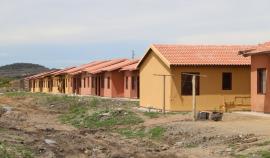
Concern over unaffordability of housing

By Keneilwe Velaphi
Human Settlements Minister, Mmamoloko Kubayi has expressed concern at the high number of people who cannot access housing.
Just less than six million mortgage and home loan applications were received and processed between 2018 to 2022 and of this number, two million were from previously advantaged persons (PAPs) with just over one million approvals.
At a briefing in Pretoria on Monday, the Minister announced government plans and developments in the human settlements sector.
She said the country’s gap market was experiencing serious difficulties in accessing housing.
WATCH | Minister Kubayi briefs media
According to an analysis of applications from historically disadvantaged persons (HDPs), the total number of applications over five years is about four million valued at R2 trillion, and the number has been on the increase over the years although it slowed down in 2020 because of COVID-19.
“The total number of approved applications over five years is 49% of the total valued at R1 trillion compared to a decline which is valued at R636 billion and approximately half of the applications are declined which is an indication the number of people who can’t access housing is still high,” said the Minister.
She added that the number of “HDPs applications is twice as high as that of their white counterparts. In addition, the average mortgage loan approved per HDPs was R527,000 compared to PAP at an average mortgage value of R2,5 million which still indicates wealth inadequate,” Kubayi explained.
The Minister also noted a higher number of applications, 1.3 million from women are approved compared to 1.1 million received from men.
High interest rates resulting in the high cost of living, limited access to finance, higher property prices, a high level of indebtedness and limited supply of affordable housing were some of the reasons touted for the unaffordability of housing.
The Minister also highlighted the work the department is doing in collaboration with other stakeholders, such as building material suppliers and financial institution to ease the burden of housing for first-time homeowners in the gap market.
READ | Interventions to make housing affordable
Home loan market activities
She noted that the Home Loan and Mortgage Disclosure Act (HLAMDA) was promulgated in the year 2000 and that the Act is intended to compel financial institutions to disclose information about their leading activities and practices in the home loan market.
“The information is disclosed to the Office of Disclosure through the Secretariat which is within the Department of Human Settlement, and the information submitted to the Office of Disclosure is mortgages, pension-backed leading and unsecured lending for home loan /use purpose only.
“In the past, it had only been possible to ascertain the number of home loans granted by financial institutions, but not those home loan applications which have been declined and reasons,” Kubayi explained.
She said that these trends highlight the performance of financial institutions, and it helps them to establish the home loan leading patterns and practices of financial institutions.
In her presentation on mortgage approvals for lower -medium-income brands (R0-15,000), the Office of Disclosure’s analysis of the past five years showed a concerning trend in the affordability of housing for the gap market.
She said the decline in the approvals in the gap market is quite significant, and this indicates that access to mortgage finance for the gap market is becoming increasingly difficult.
Home Loan and Mortgage Disclosure Amendment Bill
Meanwhile, Kubayi underscored the need to finalise the Home Loan and Mortgage Disclosure Amendment Bill to address discriminatory lending practices and promote fair access to housing finance.
“The Office of Disclosure is an important institution which is a critical element in achieving spatial transformation and integrated human settlements. Currently the information it receives is riddled with data duplication and incompleteness.
“Without data quality control and non-compliance by financial institutions, the picture we have just presented could be worse than we think. It is therefore important that this office be given all the necessary support including legislative amendments to strengthen its ability to discharge its responsibilities,” Kubayi said.
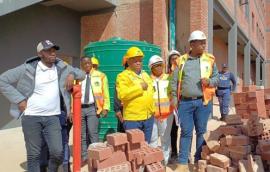
Zikalala sets six-month deadline for the completion of Soshanguve Magistrate’s Court
Wednesday, August 14, 2024
Public Works and Infrastructure Deputy Minister, Sihle Zikalala, has set a six-month deadline for the completion of the delayed Soshanguve Magistrate’s Court in Tshwane.
Speaking after conducting Operation Siyahlola at the magistrate’s court on Tuesday, Zikalala said the construction of the court will be completed by February next year.
Siyahlola is aimed at unblocking stalled Department of Public Works and Infrastructure (DPWI) projects.
READ | DPWI minister to conduct inspection at Port Shepstone Magistrate construction site
The construction of the Soshanguve Magistrates’ Court, which commenced in 2019, has been delayed by various factors, including the COVID-19 pandemic and different professionals withdrawals mid-way through the construction. This led to most of the construction work being done by the professionals of the department itself.
“Through Operation Siyahlola, we inspect departmental projects, focusing on those that are delayed.
“We intervene and fast-track the implementation of those projects. We also ensure that new projects are rolled out, providing vital infrastructure for communities. We also want to build capacity to do the work [ourselves].
“The Siyahlola programme has uncovered a few challenges that we would like to address, including the integration of local community leaders in projects, transparency, and employment opportunities for local communities,” Zikalala said.
The two-phased Soshanguve Magistrates’ Court project was initially earmarked for completion in 2022, with the latest deadline being February 2025.
The two project phases include additional accommodation and renovation of the old court. The additional accommodation is 89% complete. The renovation of the old court will resume upon completion of the additional accommodation.
Zikalala has called for holistic project management, which incorporates every aspect of the project, where all professionals work together.
Local government called to be responsive to community needs

KwaZulu-Natal Cooperative Governance and Traditional Affairs MEC, Thulasizwe Buthelezi, has urged local government office bearers to be responsive to the needs of communities or face the consequences from the electorate.
Speaking at the South African Local Government Association (SALGA) KZN Sustainable Governance and Accountability Symposium in Durban last week, Buthelezi underscored the importance of sustainable governance and innovative solutions to meet the challenges facing municipalities throughout the province.
Buthelezi pointed out the complexities confronting municipalities, including climate change, financial limitations, and the imperative for enhanced service delivery.
He advocated for a unified approach to governance that is rooted in sustainability and accountability, which he believes is essential for long-term development and resilience.
“Our municipalities are the cornerstone of our communities, and their effectiveness in service delivery is vital for the welfare of our citizens. The current challenges necessitate a re-evaluation of our governance methods and the adoption of new strategies,” Buthelezi stated.
The MEC said the financial model for municipal funding ought to be reassessed, especially considering the recent veld fires that resulted in 15 fatalities last month. This, he said, demonstrates the urgent need for municipalities to be better equipped for such disasters.
He emphasised the importance of revising the financial support structures for local governments to ensure their preparedness for future challenges.
Buthelezi further praised the joint efforts of all parties involved in promoting accountability and transparency in municipal governance.
He encouraged mayors and senior officials to persist in these endeavours, reminding them that sustainable governance is an ongoing process that demands consistent commitment.
“The prosperity of our municipalities relies on our collective capacity to collaborate, innovate and maintain accountability. Our primary objective is to forge a brighter future for the people of KwaZulu-Natal,” Buthelezi said.
The SALGA KZN Sustainable Governance and Accountability Symposium brought together key local government stakeholders to deliberate on ways to improve governance practices, focusing on sustainability and accountability.
Have your say on tax proposals
The National Treasury and the South African Revenue Service (SARS) has published draft tax bills and draft regulations for 2024, for public comment.
The bills and draft regulations contain tax proposals made in the Budget Speech.
These proposals include the 2024 draft Taxation Laws Amendment Bill (2024 draft TLAB), the 2024 draft Revenue Laws Amendment Bill (2024 draft RLAB), the 2024 draft Tax Administration Laws Amendment Bill (2024 draft TALAB), draft Regulations on the method for determining the VAT liability in respect of casino table games of chance, issued in terms of section 74(2) of the Value-Added Tax Act, 1991, draft Regulations on amendments to the Carbon Offset Regulations prescribing carbon offsets in terms of section 19(c) of the Carbon Tax Act, 2019, and draft Regulations on domestic reverse charge relating to valuable metal in terms of 74(2) of the Value-Added Tax Act.
The 2024 draft tax bills, the accompanying draft Explanatory Memoranda containing a comprehensive description of the proposed tax amendments contained in the 2024 draft TLAB, 2024 draft RLAB, draft TALAB, the draft Regulations on determining the VAT liability in respect of casino table games of chance, draft Regulations on domestic reverse charge, draft Regulations on electronic services and Carbon Offset Regulations, can be found on the National Treasury (www.treasury.gov.za) and SARS (www.sars.gov.za) websites.
“More general information underlying the changes in rates, thresholds or any other tax amendments can be found in the 2024 Budget Review, available on the National Treasury website.
“With respect to the 2024 RLAB published for comment on 21 February 2024 and public workshops held on 6 June 2024, National Treasury and SARS invite a second round of comments in writing on this revised 2024 draft RLAB,” the Ministry of Finance said on Thursday.
The public can forward written comments to the National Treasury’s tax policy depository at 2024AnnexCProp@treasury.gov.za and SARS at acollins@sars.gov.za by close of business on 16 August 2024.
National Treasury and SARS invites comments in writing on the 2024 draft TLAB, 2024 draft TALAB, the draft Regulations on determining the VAT liability in respect of casino table games of chance, draft Regulations on domestic reverse charge and draft Regulations on electronic services and Carbon Offset Regulations.
Written comments can be sent to the National Treasury’s tax policy depository at 2024AnnexCProp@treasury.gov.za and SARS at acollins@sars.gov.za by close of business on 31 August 2024.

Appeal for more organ donors

The Department of Health has appealed to citizens to sign up to become organ and tissue donors in a bid to improve someone’s quality of life or even save someone’s life, especially those who are very sick or dying from a life-threatening disease or organ failure.
“Organ donation is when organs such as the heart, lungs, liver and kidneys are removed from one person and transplanted into another person,” the department explained, adding that one donor can save up to seven lives and transform over 50 lives.
Meanwhile, tissue donation is when tissues in the body such as skin, corneas and bone are removed from one person and transplanted into another person.
It is estimated that over 2 500 people are on the active waiting list for organ and tissue donation, while others lose their lives while waiting to receive a lifesaving gift.
“Currently, organ donors are in very short supply because of limited knowledge amongst citizens,” the department said.
The department, in collaboration with various non-governmental organisations, said they will use the month of August as part of Organ and Tissue Donation Awareness Month.
According to the department, anyone aged 18 years or older can become an organ or tissue donor without expecting financial reward, and subject themselves to certain medical conditions that require one to wait or be physically well.
“One can donate organs such as the kidney and liver lobe and continue to live a normal and healthy life because organs like the liver regenerate over time.”
However, it is illegal in South Africa and other parts of the world for anyone to sell or trade human organs or tissues as that can perpetuate organ and human trafficking.
“An organ transplant takes place in both government and private hospitals after an individual has been declared circulatory (heart stopped beating) or brain dead, but is still being supported by artificial life support.
“The tissue donation and retrieval can still take place several hours and even days after death, but consent from the loved ones must be given.”
Potential donors can go to their nearest public or private hospital to ask for assistance on the steps to follow for one to donate, alternatively, call the Organ Donor Foundation on 0800 22 66 11 or visit www.odf.org.za.
Those interested can also contact the SA Bone Marrow Registry at 021 447 8630 or the Centre for Tissue Engineering at Tshwane University of Technology at 012 349 3500 or visit www.tissuedonation.org.za.
Justice department condemns alleged racism incidents
The Department of Justice and Constitutional Development (DJCOD) has condemned the alleged acts of racism at South African schools and committed to intensify the awareness of constitutional rights, including the prohibition against hate crimes and hate speech and the prevention and combating of these offences.
A racism row erupted at the Pretoria High School for Girls following the discovery of a WhatsApp group in which a group of white pupils allegedly sent messages to each other with racial undertones.
This was followed by the revelation of an incident at Table View High School where a substitute teacher allegedly used the ‘k’ word during a history lesson and another incident at Pinelands High School involving a ‘slave auction’ of black learners by their coloured counterparts. Both those schools are in the Western Cape.
“The [department] unequivocally condemns any acts of racism and racial discrimination and will intensify its efforts, in collaboration with the South African Human Rights Commission, the Commission for Gender Equality and the Commission for the Promotion and Protection of the Rights of Cultural, Religious and Linguistic Communities, to promote awareness of constitutional rights, including the prohibition against hate crimes and hate speech, aimed at the prevention and combating of these offences.
“The [department] is engaging the Department of Basic Education and will be monitoring how these matters will be handled and eagerly awaits the outcome thereof,” the DJCOD said in a statement.
The department emphasised that there remains no place in South African society for the use of racist language and behaviour.
“Our courts, especially our designated Equality Courts have pronounced on the use of the derogatory k-word – there is no place for such in a constitutional democracy which seeks to foster unity in diversity. Indeed, there is no place for racism or any other form of related intolerance in our constitutional democracy, which is anchored on the supremacy of the Constitution. Such incidents perpetuate harmful racial discrimination, and are stark and painful reminders of our Apartheid past.
“This year South Africa marks 30 years of freedom and democracy since the country’s democratic elections in 1994. The advent of our constitutional democracy 30 years ago, ended decades of oppression under white minority rule, based on the racist ideology of black inferiority and white superiority, and ushered in a transition to a society “based on democratic values, social justice and fundamental human rights”,” the department added.
The department said hate speech and hate crimes have been declared an offence following the operationalisation of the Prevention and Combating of Hate Crimes and Hate Speech Act 16 of 2023.
This, notwithstanding the Constitutional imperatives on unfair discrimination and obligations of the Promotion of Equality and Prevention of Unfair Discrimination Act, 2000.
“South Africa’s National Action Plan to Combat Racism, Racial Discrimination, Xenophobia and Related Intolerance [NAP] was approved by Cabinet in 2019. The NAP gives effect to South Africa’s constitutional and international obligations, thus signifying government’s commitment to achieving the objectives of the NAP at the highest level.
“The [department], as the focal agency tasked by Cabinet to lead and coordinate the implementation of the NAP, in line with its constitutional mandate, unequivocally condemns all and any acts of discrimination, in whatever form they occur.
“It is of great concern that learners, almost all of whom were born in a country that is democratic and more inclusive, have to both experience racism and some still continue to hold such beliefs of racism, intolerance, hurtful and demeaning behaviour,” the DJCOD said.
DPWI to institute a commission of inquiry into Telkom headquarters building
Friday, August 2, 2024
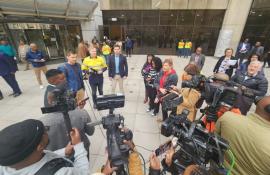
Public Works and Infrastructure Minister Dean Macpherson says he will commission an independent report into the purchase of the former Telkom headquarters building in 2016 for R695 million and its subsequent renovation for R250 million.
The commission is meant to provide the Minister with recommendations within 60 days following its appointment and the necessary steps to address and remedy the situation.
Joined by the City of Tshwane Mayor, Cilliers Brink, on an oversight visit to the building on Thursday morning, Macpherson said it is unacceptable that for the past eight years, the building complex has barely been utilised and has been left vacant.
“It is disheartening that so much public funding has been spent to purchase and renovate the building, [and it has been] vandalised and occupied by criminal elements, thereby creating an additional burden for the City of Tshwane,” Macpherson said.
“We simply cannot spend more than eight years trying to establish how to secure public property while it deteriorates into lawlessness,” he said.
The Minister said the terms of reference for the independent investigation will be to provide him with answers to the following questions:
- What led to the Department of Public Works and Infrastructure buying the Telkom Tower complex and whether the purchase was necessary?
- What was the process which was followed for contracts to be appointed and whether the contractors were fit for purpose?
- Whether the purchase of the complex by the Department of Public Works was the best option for the South African Police Service?
- Whether any officials should be held accountable for the position the department finds itself in, in relation to the purchase and renovation of the building?
- Are there any grounds to reclaim any monies paid to contractors where work was not done, or not done according to building standards or health and safety standards?
- What will be the best way forward considering the current state of the building?
- What steps can be taken to avoid the situation from occurring again?
“As the Department of Public Works and Infrastructure, we need to start moving faster to ensure that public investments are secured and utilised to avoid the wastage of any public monies in a fiscally constrained environment.
“We simply cannot be spending millions to repair and address vandalism, and poor planning and spending by the department,” the Minister said.
“We will have to start working closer with role players such as the City of Tshwane to ensure our buildings are used for the public good and do not fall into disrepair and cause a burden for the municipality. By working together, we can reclaim these buildings, unleash infrastructure investment and turn the country into a construction site. Let’s Build South Africa,” the Minister said.
Electoral Commission receives clean audit
The Electoral Commission has received a clean audit report for the fourth time in a row.
“The Electoral Commission is proud to announce that the Auditor-General has concluded the external audit procedures on the 2023/2024 financial statements of the Electoral Commission as well as Party Funding. The outcome of both these external audits is clean audit opinion.
“This feat is achieved for the fourth consecutive time,” the Commission said in a statement on Thursday.
The commission said the clean audit opinions speak to the financial probity as well as the strength of internal controls which remain of the highest standards adding that the adherence to prescripts in the form of the Public Finance Management Act (PFMA) and its corresponding regulations.
Electoral Commission CEO Sy Mamabolo welcomed the clean audit and commended staff for working tirelessly to ensure that accountability, proficiency, and transparency is always at the centre of the organisation’s business practices.
“Throughout the years we have implemented internal controls to manage performance of the organisation. We strive to maintain this standard going forward, even during busy election periods,” said Mamabolo.
He went further to say, “as the Electoral Commission we have not only committed ourselves to delivering reputable elections but have also made it our business to ensure our business practices are of the highest standard through the consistent implementation of internal controls.”
The audit report, together with the Annual Report, will be presented to the seventh iteration of the National Assembly in line with the provisions of the Electoral Commission Act and the PFMA.

Fund members urged to get financial advice on pension fund withdrawals

With the President signing into law the Pension Funds Amendment Act (31 of 2024), National Treasury has urged fund members to seek trustworthy financial advice to consider the implications for withdrawals from the savings component.
“Fund members should also note that administration costs and tax at marginal rates will be deducted from such withdrawals. Members will lose out on all related future growth and the retirement benefit originally intended for those funds,” National Treasury said on Tuesday.
The signing into law of the Pension Funds Amendment Act ushers in the last part of the significant amendments required to implement the two-pot system to commence on 1 September 2024 after proclamation by the President.
The Pension Funds Amendment Act provides for certain amendments to the Pension Funds Act, 1956, the Post and Telecommunications-related Matters Act, 1958, the Transnet Pension Funds Act, 1990 and the Government Employees Pension Law, 1996, which are necessary to enable retirement funds, including public sector funds, to implement the two-pot reform.
READ | President Ramaphosa signs Pension Funds Amendment Bill into law
These changes follow the related amendments to the Income Tax Act, which are contained in the Revenue Laws Amendment Act (12 of 2024).
“The main intention of the two-pot system reform is to improve South Africa’s retirement outcomes for members at retirement through the preservation of a larger portion of the retirement savings.
“At the same time the reform allows some measured access in cases of financial distress without a member having to resign from employment.
“The new two-pot retirement system creates a more sustainable retirement fund system, while increasing flexibility to cater to the differing needs of members. The system will provide a welcomed relief mechanism for people in real crises to access emergency funds without resorting to loan sharks or having to quit their jobs to access their retirement savings, while ensuring a larger portion of those savings are preserved until retirement,” National Treasury said.
Retirement funds and trustees are now in the process of aligning their fund rules with the changes to the acts and should be communicating with fund members about these rule changes and processes to be followed for savings benefit withdrawal claims.
Fund rule amendments still need to be submitted to the Financial Sector Conduct Authority for approval before implementation.
“Most funds are set to implement the new split for contributions to the two new components (i.e. savings component and retirement component) on 1 September 2024, as planned.
“They will also calculate the once-off seeding capital value using the vested component (i.e. retirement savings accumulated before implementation date) on 31 August 2024, that will be available for transfer to the savings component and accessible to members from 1 September 2024.
“However, not all funds will likely be able to process withdrawal requests immediately on 1 September 2024, as the systems to do so and the mechanics to request such withdrawals will still be new or are being installed. Funds that are ready for such withdrawals will also need some time to process requests,” National Treasury said.