
R2 million to help agricultural sector suppress pest affecting export crops
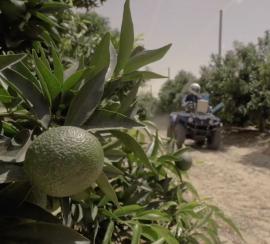
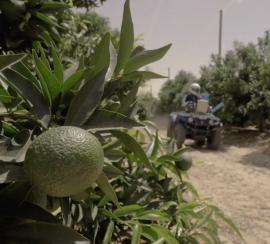
The Western Cape Department of Agriculture has handed over a R2 million cheque to the Citrus Growers Association (CGA) to support their Sterile Insect Technique (SIT) Programme aimed at suppressing False Codling Moth (FCM).
False Codling Moth is a phytosanitary pest affecting export crops including citrus, table grapes, and stone fruit.
The programme offers immense potential in reducing pests and ensuring that South African agricultural products meet the strict standards required by international markets.
The programme, which uses cutting-edge science, also reduces the reliance on environmentally harmful pesticides and leads to improved fruit quality.
Western Cape Agriculture MEC Dr Ivan Meyer said addressing False Codling Moth will contribute to increased export earnings for especially the citrus industry, creating jobs and uplifting rural communities.
“Colonies of False Codling Moth are raised in special facilities where the male and female insects are sterilised using radiation from the isotope Cobalt-60 and are safely released in large numbers. Females mated with sterile males then lay eggs that do not hatch. A large decline in the pest population follows,” Meyer said.
Meyer said the trials for the programme in Citrusdal began in 2005 through a collaboration with the United States Department of Agriculture and the International Atomic Energy Agency.
“The successes that followed lead to the founding of X Sterile Insect Technique (X-SIT). X-SIT now administers the SIT programme lending the programme their expertise.
“Despite its immense potential, the SIT programme faces challenges in that it is expensive. The high cost of SIT compared to cheaper but much less sustainable alternatives threatens its long-term viability,” Meyer said.
The MEC said the programme currently covers 20 400 hectares but has the potential to expand to over 4 ,000 hectares with adequate funding, and this could facilitate the creation of an estimated 50 job opportunities.
Meyer said the Citrus Growers Association has emphasised the critical need for financial support to sustain and grow the program, ensuring the continued production of export-quality residue-free fruit.
Meyer said the entire programme is currently funded by citrus and table grape growers who use the service themselves.
However, he said, the R2 million funding would alleviate some of the financial burden of the Western Cape growers and help ensure the continuation and expansion of this vital pest management strategy.
“Our support for the SIT programme underscores our commitment to a sustainable agricultural sector. This funding will help secure the future of our citrus industry, ensuring that it remains competitive in the global market while protecting our environment and creating jobs,” Meyer said.
Citrus Growers Association CEO Justin Chadwick expressed his gratitude, saying the support from the provincial government is a significant boost for X-SIT and everyone involved.
“The CGA hopes this type of agricultural innovation will find widespread support, as developing new technologies, though essential, does not come cheaply,” Chadwick said.
Electronic payment system for child maintenance and other services suspended
Friday, May 24, 2024
The Department of Justice and Constitutional Development (DJCOD) has announced the temporary suspension of electronic payment system for third-party funds – including child maintenance – following “attempts to compromise the system”.
The department said an investigation into the incident is underway.
“In light of this development, child maintenance beneficiaries are urged to promptly visit their nearest court with their original identity documents to receive manual payments until the electronic service is fully restored.
“The Department has assembled a dedicated forensic team to thoroughly investigate any suspicious activity. We are committed to continually fortifying our systems to prevent and mitigate the risk of future breaches.
“We sincerely apologise to all beneficiaries for any inconvenience caused and deeply appreciate the patience and understanding during this period,” the DJCOD said.
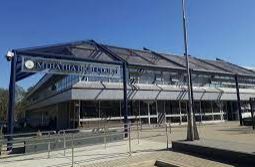
Meanwhile, this morning (Friday), DJCOD Minister Ronald Lamola, is expected to preside over the launch and renaming of the refurbished Justice College.
The launch will also be attended by Minister of Public Works and Infrastructure, Sihle Zikalala, and Deputy Chief Justice of the Constitutional Court, Mandisa Maya.
“Established in 1957, Justice College has grown into reputable institution, offering comprehensive training programs for legal practitioners. From its modest beginnings as Justice Training, it now encompasses diverse aspects of legal education, including specialised training for judicial officers, prosecutors and interpreters.
“[The] Justice College’s influence extends beyond South Africa’s borders. Officials from Swaziland, Botswana, Namibia, Lesotho, the Republic of South Sudan, the Democratic Republic of Congo and Uganda regularly attend our courses, fostering regional collaboration.
“The refurbished college boast[s] state-of-the-art training facilities, ensuring an optimal learning environment for future legal professionals,” the department said.
Bringing government services closer to communities
Friday, May 24, 2024
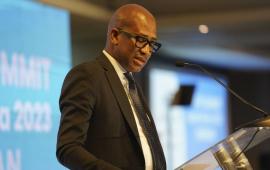
Deputy Minister in The Presidency Kenny Morolong will launch the Loeriesfontein Thusong Service Centre in the Hantam Local Municipality in the Northern Cape on Friday.
The launch of this Thusong Centre will bring government services and information closer to the people of Loeriesfontein.
The establishment of Loeriesfontein Thusong Service Centre is one of the initiatives made possible through the private partnerships established between the Northern Cape Office of the Premier, Loeriesfontein 2 and Khobab Wind Farm and the Government Communication and Information System (GCIS).
To date, there are 197 Thusong Service Centres countywide and 121 of those are fully operational and have thus far reached approximately five million beneficiaries every year.
The launch of the Thusong Centre takes place against the backdrop of the country’s commemoration of 30 years of freedom under the theme: “30 Years of Democracy, Partnership and Growth”.
The Deputy Minister will be accompanied by the Mayor of Namakwa District Municipality, Mervyn Cloete and the Mayor of Hantam Local Municipality, Koos Alexander.

NHI does not signal end of private healthcare – President Ramaphosa
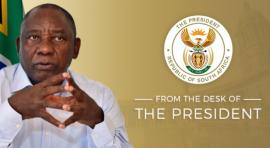
President Cyril Ramaphosa has dismissed claims that the National Health Insurance (NHI) will signal the end of private healthcare.
“To the contrary, the NHI aims to use the respective strengths and capabilities of both the private and public health sectors to build a single, quality health system for all,” the President wrote in his weekly newsletter on Monday.
He explained that the NHI Fund will procure services from accredited public and private service providers for every person in need of health care.
“The NHI will be a lifeline for millions of poor South Africans whose resources will be freed up for other essential needs. It will also alleviate the burden on those who are increasingly paying more in medical aid premiums for increasingly fewer services.”
According to the President, South Africa’s private health sector has world-class expertise and is a major source of domestic and foreign investment.
He also praised the public sector, which also has numerous centres of excellence and is staffed by well-trained and experienced personnel.
While there may be different views on how NHI will be progressively implemented, the reality is that the current healthcare system is unsustainable.
Access to quality, decent healthcare should not depend on one’s ability to pay, he said, adding that the “current situation does not serve the poor, does not serve the middle class and does not serve the country.”
However, with careful planning, effective oversight and monitoring, and the strategic allocation of resources, the country’s commander-in-chief believes that South Africa can achieve universal health coverage (UHC).
“Working together in partnership, as both the public and private sectors, we can make the dream of quality health care for all a reality.”
This as the country edges closer to affordable quality healthcare for all after the President signed the NHI Bill into law last week.
“For many years, we have had parallel healthcare systems operating in our country. The majority of the population, 84%, uses public health facilities, while 16% are covered by medical schemes, enabling them to access private healthcare facilities. A small percentage of people use both,” he added.
The President is of the view that this has perpetuated inequality, with the quality of healthcare one receives being determined by one’s ability to pay.
“This runs contrary to our aspiration to be a society that is just and equal.”
While achieving social justice is a key objective of NHI, he stated that efficiency and better resource allocation are equally important.
“We have said that the challenge in implementing NHI lies not in the lack of funds but in the misallocation of resources that currently favour the private health sector at the expense of public health needs.
“There is a misconception that the private health care sector operates and is funded completely independently of government.”
However, he said the training of doctors, nurses and other healthcare personnel who work in both the public and private sectors is subsidised by the State.
Secondly, the State pays billions of rands annually in subsidies for employees who are members of various public sector medical aid schemes.
“Thirdly, taxpayers claim tax rebates for medical aid expenses amounting to approximately R37 billion. This is the money the state should earn in taxes which it foregoes to subsidise private health care.
“We therefore have a situation where the state both directly and indirectly helps to fund a private health care sector that serves only a minority of society.”
In addition, he said access to private healthcare through medical aids is also costly for users.
“It is said that without the tax rebate private healthcare would not be affordable to the majority of users. Medical aid contributions are increasing faster than inflation. At the same time, benefits are being reduced.”
The President cited the 2016 Healthcare Market Inquiry, which found that private healthcare services and medical scheme coverage are frequently over-used without clear improvements in health outcomes.
“The resources that are spent both by the state and private individuals can, therefore, be more efficiently used to build a single, unitary health care system that serves all.”
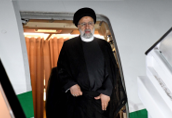
Condolences for the people of Iran following air disaster
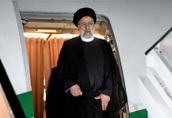
President Cyril Ramaphosa has, on behalf of the South African people and government, extended his condolences to the people of Iran following the death of President Ayatollah Ebrahim Raisi and well as that country’s Foreign Minister.
President Raisi and Foreign Minister Hossein Amir-Abdollahian as well as other personnel died when the helicopter they were travelling in crashed in East Azerbaijan on their way back to Iran on Sunday.
President Ramaphosa said government joins that country “in this moment of mourning”.
“This is an extraordinary, unthinkable tragedy that has claimed a remarkable leader of a nation with whom South Africa enjoys strong bilateral relations and whom we were honoured to welcome to the BRICS fold in Johannesburg in 2023.
“Our hearts go out to the affected families and the administration of the Islamic Republic of Iran,” he said.
In a statement, the Presidency said: “On behalf of the Government and people of South Africa, President Ramaphosa offers his deep condolences to the Supreme Leader of Iran, The Grand Ayatollah Sayyid Ali Khamenei, and the government and people of the Islamic Republic. President Ramaphosa’s thoughts are with the families of the late President and Foreign Minister as well as the relatives of the personnel and air crew who perished”.

Elections out of the country commence

Today is the first of two days South African citizens abroad can cast their vote in the National and Provincial Elections 2024.
“South African citizens living in other countries will cast the first ballots on 17 May 2024. Nine countries will cast ballots on Friday while the rest of the 102 will cast ballots on Saturday, 18 May 2024,” Electoral Commission (IEC) Chief Electoral Officer Sy Mamabolo said.
Given the high numbers of expected voters in London at 24 194, this station will operate on both the 18 and 19 May 2024.
The international segment of the voters roll for out-of-country voters has 56 698 voters, but the total number of people expected to vote is 76 580.
“This comes after the approval of 20 886 VEC10 notifications from voters who informed the Chief Electoral Officer of their intention to vote outside of the country due to temporary absence,” Mamabolo said.
The commissioner said the IEC was ready to ensure that voting goes smoothly in 111 foreign missions around the world.
“All missions have already received the election materials, which include ballot papers, voting booths, ballot boxes, envelopes and a voter list.”
Voting stations will be open from 07:00am to 19:00pm, allowing 76 580 voters to exercise their right to vote in South Africa’s 2024 National Elections.
“On both voting days abroad, the Electoral Commission will keep extended hours to assist voters with any enquiries,” he said.
WATCH | Full IEC briefing
SA citizens voting out-of-country in the 2024 National Election can only vote on one day at their mission:
– Missions with a work week from Sunday–Thursday vote on Friday, 17 May, from 7am to 7pm. The following countries are determined to vote on this Friday: Algiers, Amman, Cairo, Damascus, Jeddah, Kuwait City, Ramallah, Riyad and Teheran.
– Missions with a work week from Monday–Friday vote on Saturday, 18 May, from 7am to 7pm.
Two days of special votes have been determined for the UK based on the number of voters who will vote at that mission.
R1.5 million irrigation system to boost vegetable farmers
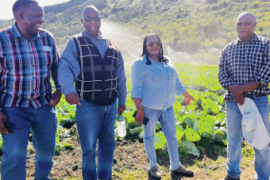
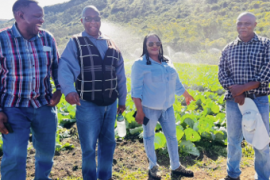
Vegetable farmers in Mthatha, Eastern Cape, are set to increase their agricultural productivity and income, thanks to a brand-new irrigation system received from the Provincial Rural Development and Agrarian Reform Department.
Eastern Cape Rural Development and Agrarian Reform MEC, Nonkqubela Pieters handed over an irrigation system worth R1. 5 million to vegetable farmers at Nonkobe in Orange Grove village, Mthatha, in a bid to support the enterprise to access formal markets.
The enterprise has 24 members, including 18 females and six young people producing a variety of vegetables.
Pieters said the department has invested a total of R2,7 million to ensure the enterprise has good agricultural activities (GAP) certification that will allow them to sell their products to supermarkets and other places.
The enterprise was originally assisted by the Department of Social Development in 2006 and was converted from a farrow irrigation system to a sprinkler irrigation system.
Pieters said the department’s investment will ensure that all 17 hectares used by the enterprise will be irrigated and fenced, while storage facilities will be constructed.
The department will also assist the farmers with water rights application.
Pieters commended the active involvement of young people in the enterprise, noting it will ensure the continuity of the enterprise.
“We urge young people to understand that farming is a credible source of income. We want to motivate you so that this enterprise can reach commercial stages,” Pieters said.
To show their commitment, the members bought two diesel engines that amounted to R500 000 from their produce.
Enterprise Chairperson, Walter Mnqwazi described the department’s investment as a game changer for their enterprise, noting that the youth is now showing interest in joining the enterprise.
“Since the installation of the irrigation system, we have seen a huge difference. We have increased our production, and our income has also increased,” Mnqwazi said.
While serving both the formal and informal market, Mnqwazi said the enterprise has well established ties with Kei Fresh Produce Market.
Local headman, Msindise Mdemka commended the government for the assistance, saying the tools of trade will make an enormous impact in the development of the area.
The MEC also handed over vegetable seedling, fertilisers, and knapsack to assist the enterprise to spread pesticides in their field.

Campaign to protect Eskom transformers

As the winter season approaches and temperatures plummet, Eskom is launching a campaign under the theme ‘Save Your Transformers, Save Lives’.
According to the power utility, over 2 000 transformers across the country are overburdened due to illegal connections and tampering, which leads to overloading and explosions.
“This situation can result in extended periods without electricity in communities,” the utility said in a statement on Thursday.
In the past 12 months, Eskom said it spent over R300 million replacing failed transformers and mini-substations, without any revenue for its efforts.
“This threatens the ability to deliver on its mandate to supply quality electricity to its customers.”
The call-to-action campaign, Eskom said, urges electricity users to reduce their consumption to ease the load on the power system and prevent related injuries.
The utility also warned that several safety incidents and equipment failures are directly linked to these unlawful activities.
They, according to Eskom, not only endanger lives but also disrupt supply continuity and cause extensive damage to transformers and related infrastructure.
Meanwhile, illegal connections, network equipment theft, vandalism, meter bypasses, unauthorised network operations, purchasing electricity from illegal vendors, and indiscriminate electricity use significantly burden network equipment.
“As the load increases, transformers can fail and explode, posing serious safety risks to unsuspecting members of the public, potentially resulting in injuries and fatalities. The failure of transformers, mini-substations, and other equipment also causes great inconvenience to customers, as replacements can take days to months, given the frequency of such damages.”
This is the reason that members of the public can contribute to the ‘Save Your Transformers, Save Lives’ campaign by refraining from illegal connections and promoting responsible energy practices.
“This will help protect lives, safeguard property, and maintain the reliability of the electrical infrastructure,” Eskom added.
Plans to establish government service delivery points in Durban townships
The Department of Employment and Labour in KwaZulu-Natal has announced plans to establish service delivery points within the township communities of Durban.
Provincial Operations Chief Director, Edward Khambula, made the announcement during an Employer Breakfast Session held at the KwaMashu Indoor Sports Centre, north of Durban, on Thursday.
Khambula said the Employment and Labour Service Delivery Office Points programme is in the pipeline for areas covering Inanda, Ntuzuma, KwaMashu (INK); and Umlazi township.
Khambula said the establishment of service points, which has been approved, will bring services closer to the communities.
“We are trying to expand to other townships such as Umlazi as well, because we can see that it does not help for people to travel to town to receive services. We would like to plead with the community to use the service point offices properly,” said Khambula.
The breakfast session, held in collaboration with the Department of Small Business Development, aims to provide a platform for small business operators to engage with the department, while informing and teaching them about various labour laws to comply with in the country.
It also formed part of the department’s plan to get closer to the shopping centres and provide services to the people.
“Because we know that the small businesses in townships sometimes struggle to comply with labour laws, there has been a proposal for us to get closer to the people and teach them and clarify the manner that can assist them to comply without necessarily having to employ the services of consultancy agencies,” Khambule said.
Khambule said there are ways for employers and the small business community to mitigate and negotiate if a business is unable to comply with the labour laws, adding that the department provide assistance free of charge.
“The department is fully aware of the challenge of unemployment and the state of the economy is dire. There is an exemption to apply from the department to mitigate certain non-compliance issues,” Khambula informed the employers.
Instead of running away from the inspectors, Khambula urged the employers to seek guidance from the department in order to get guidance on how they can obtain an exemption.
He emphasised that the department has no intention of closing down businesses, which will consequently result in unemployment.
“We have also heard that you can pay the money you owe through instalments so that the facility exists, and the officials are sensitive about it. The department is wary that an employee can lose a job due to its interventions,’’ Khambula said.
Employment and Labour Minister, Thula Nxesi, is expected to attend the Jobs and Careers Fair to take place at Umlazi on Friday.

Government supports Caster Semenya in legal battle

The Department of Sport, Arts and Culture (DSAC) has expressed that it stands in solidarity, with unwavering commitment, to seek justice for Caster Mokgadi Semenya as she is back in the Grand Chamber of the European Court of Human Rights in France.
The court will reportedly consider whether the double Olympic champion must lower her testosterone levels in order to participate in competitions.
“The department is committed to advocating for fairness and equality in sport. As the country celebrates 30 Years of Democracy, every athlete, regardless of their gender or physical attributes, should have the right to compete without facing unjust obstacles.
“We trust that the Grand Chamber’s judgment will uphold these principles and deliver a positive outcome for Caster and all athletes affected by similar challenges,” DSAC Acting Director-General, Dr Cynthia Khumalo, said on Wednesday.
Government is working in collaboration with the Commission for Gender Equality (CGE), Norton Rose Fulbright (NRF), Probono.org, and various other stakeholders to support Semenya on the matter.
“The DSAC notes the hearing scheduled for Wednesday, 15 May 2024, where the Grand Chamber will evaluate the matter presented by the Swiss government in relation to the European Court of Human Rights’ July 2023 decision. Caster Semenya has endured years of unfair discrimination based on her gender.
“The 2019 regulations imposed by the World Athletics body created significant challenges for athletes with Differences in Sex Development (DSD), who wish to compete in their chosen sport. This ruling reaffirmed the international legal requirement for World Athletics to refrain from engaging in discriminatory practices, barring exceptional circumstances,” the DSAC said.
The CGE has called on all to rally behind Semenya’s endeavour to seek justice not only for herself, but for other affected athletes.
“A finding by the Grand Chamber that issues between international athletics bodies, such as World Athletics and individual athletes, are not a matter of private law but of public human rights law are transformative and progressive.
“A favourable outcome will be of massive importance to athletes with differences in sexual development worldwide,” Chairperson of the CGE, Advocate Nthabiseng Sepanya-Mogale said.
READ | Kodwa welcomes Court’s ruling on Semenya’s appeal
DSAC said the referral to the Grand Chamber is in accordance with the violations identified by the Court in Switzerland vs Caster Mokgadi Semenya.
“These violations encompassed a breach of the prohibition on discrimination, a denial of the right to an effective remedy, and a failure to respect private life.
“Government, through the department, has consistently advocated and supported initiatives aimed at resolving this matter equitably. The DSAC remains optimistic that the Grand Chamber’s decision will reflect the values of justice, inclusivity and diversity that underpin the South African sporting sector,” DSAC said.