

SANRAL invests R27.1 billion in road infrastructure
The South African National Roads Agency SOC Limited (SANRAL) spent R4.1 billion on toll roads, while expenditure on non-toll roads came in at R23 billion in the 2023/24 financial year.
Of the R23 billion that was spent on non-toll roads, R12.3 billion went towards capital projects and R10.7 billion on maintenance.
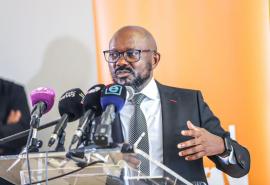
“The significant investments in both toll and non-toll roads underscore our dedication to enhancing South Africa’s road infrastructure, ensuring safer, more efficient mobility for all,” SANRAL CEO, Reginald Demana, said on Friday.
Looking at the financial performance, total assets stood at R772 billion, 17% up from the previous year, while both operating activities and investing activities increased by 23% and 7%, respectively.
Demana explained that many targets were not just achieved, but significantly exceeded.
“On an engineering level, we set out to resurface 1 200km of our network but had in fact achieved 1 984km. This is significantly up from 687.9km in the previous year and speaks to a robust commitment to maintenance and management of our assets,” Demana said.
While engineering is a core focus, SANRAL far exceeded its target for work on transformation, job creation, road safety and capacity creation.
Against a target of 75%, SANRAL achieved 99.6% on Routine Road Maintenance (RRM) work performed by Black-owned small, medium and micro enterprises (SMMEs).
The total target for the number of SMMEs participating in SANRAL projects was 1 800. SANRAL achieved 2 249, significantly up from 1 928 the previous year.
SANRAL had set out to create 12 000 full-time equivalent (FTE) jobs but had achieved 12 652, also up from 11 366 the previous year.
“Looking at the road ahead, SANRAL is on solid financial standing, with R87 billion allocated by National Treasury for the next three years.
“Borrowing capacity has increased to R16.5 billion, allowing for larger-scale project funding. The acceleration of spending on projects is resulting in reduced cash balances through faster project execution,” the agency said.
Demana attributed the achievement to steady operational and strategic growth.
“We are a growing organisation with an increasing network size that currently stands at 24 384 km, plus an additional 3 350 km of roads under assessment for transfer from provincial authorities.
“It has been a challenging year on many fronts, but we have risen to those challenges, guided by our unwavering commitment to infrastructure development that fosters economic growth and drives transformation.
“SANRAL’s role in creating opportunities, particularly for Black-owned enterprises, remains central to our mission. As we move forward, we will continue to ensure that our projects contribute meaningfully to job creation, community upliftment, and the economic empowerment of South Africans.
“Our dedication to these developmental outcomes is steadfast, and we will use our investments to catalyse positive change for generations to come,” the CEO said.
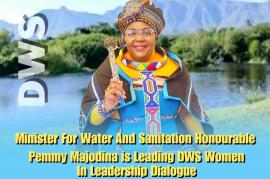
Leaders challenged to ensure women enjoy full access to water, sanitation
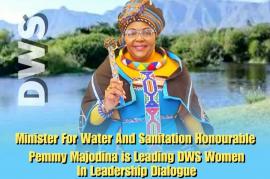
Minister Pemmy Majodina has challenged women leaders in her department and its entities to ensure that the rights enshrined in the Constitution, especially access to water and sanitation, become the lived experience for all women in South Africa.
“The Constitution guarantees access to water and basic sanitation as a fundamental human right,” Majodina said.
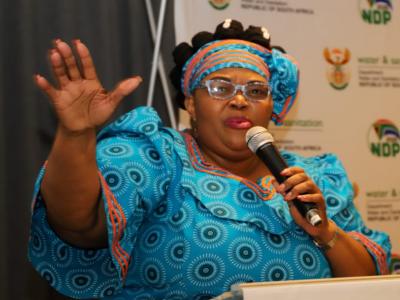
Majodina, the Minister of Water and Sanitation, was speaking at the Women in Leadership Dialogue held in Pretoria on Friday, 4 October.
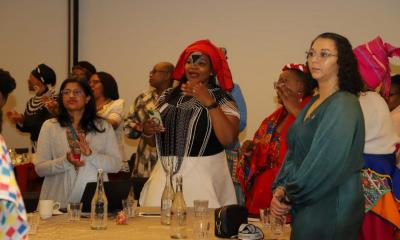
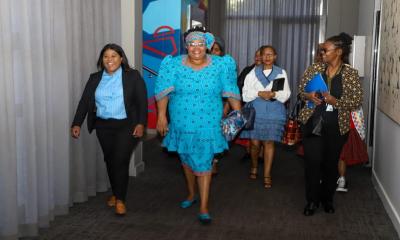
The dialogue was hosted by the Department of Water and Sanitation (DWS) for women in leadership positions in the department and its entities. It aimed to reflect on the strides made by women and the role played by women in leadership within the sector to uplift women, and expand access to basic services, especially water and sanitation.
Majodina said women and girls are the hardest hit by lack of access to clean water and basic sanitation.
The Minister noted that while significant strides have been made to empower women and promote gender equality since 1994, “the stark reality is that the majority of people living in conditions of poverty are women and the poorest households are headed by women”.
She said women are the hardest hit by a lack of access to clean water.
“Collecting water by carrying 25 litres on the head or pushing wheelbarrows while pregnant can cause health complications. Giving birth in a setting without safe drinking water or sanitation poses a serious risk for the survival of both mother and child.
“Lack of access to water and sanitation at home and school impacts negatively on girl children. They have to spend time collecting water or finding a safe place to relief themselves in the open,” Majodina said.
If there is no water and sanitation facilities, the Minister said, women dignity and self-esteem are affected.
PHOTOS | DWS Women in Leadership Dialogue
 |
 |
 |
The Minister also noted that women are vulnerable to harassment and violence when they have to travel long distances to fetch water, use shared toilets or relieve themselves in unsafe places.
She stressed the importance of leaders in the water and sanitation sector understanding the negative impact of lack of water and sanitation, so that they are well-positioned to make a difference.
“Let our programmes and practices be inspired by the values and vision of a truly equal and non-sexist society. Let us ensure that a gender perspective permeates all decision-making processes and programmes of the department,” Majodina said.
She further called on the Director-General and senior leadership of the department to ensure that the department and its entities create a conducive environment for women employees to work and thrive.
“[Senior leadership] carries a responsibility to ensure that the department becomes a safe space for women, where their rights are promoted and protected,” the Minister said.
UK investors encouraged to establish their business operations in SA

Deputy President Paul Mashatile has encouraged United Kingdom businesspeople to establish their presence in South Africa to penetrate the rest of the African market.
“South Africa is often referred to as a gateway to the African market and offers several economic opportunities.
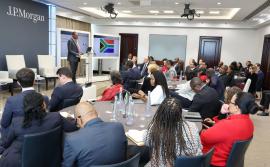
“I officially encourage UK businesses to visit our lovely country for business objectives as well as tourists to appreciate the beauty of our country,” the Deputy President told the JP Morgan-hosted event attendees in London.
The country’s second-in-command is in the United Kingdom for the second leg of his working visit to improve trade and investment relations between the two nations and woo investors.
The Deputy President said he was confident that the visit would forge new partnerships and unlock new opportunities for collaboration between the United Kingdom and South Africa.
“Together, we can build a stronger, more prosperous future for our nations and contribute to the economic prosperity of our regions.”
He stressed the importance of collaboration which, he believes, is the key to unlocking new opportunities, mitigating risks, and delivering better outcomes for all stakeholders involved in the financial sector.
“As we look around us, we see how interconnected and interdependent the global financial ecosystem has become.
“No longer can any single entity, whether it be a bank, a fintech company, a regulatory body, or a government, hope to address the complex challenges we face on its own,” he added.
He told the attendees that the South African government believes in the power of collaboration.
“By working together with our industry partners, regulators, and stakeholders, we have been able to drive positive change, innovate our products and services, and create value for our customers.”
However, he acknowledged that the State has a significant amount of work ahead.
The Deputy President urged all stakeholders to commit to a more collaborative approach in tackling the pressing issues facing the financial sector such as enhancing cybersecurity measures, promoting financial inclusion, or developing sustainable investment strategies. “We must be willing to share knowledge, resources, and expertise to achieve our common goals.”
He reminded the attendees that collaboration is not just about working together but about leveraging collective strengths, embracing diversity of thought and building trust, and transparency.
“By fostering a culture of collaboration, we can drive positive impact, foster innovation, and create a more resilient and inclusive financial sector for all.”
The Deputy President stressed that the global economy is rapidly evolving and that adapting and innovating are crucial to seizing these opportunities more than ever before.
He took the opportunity to tell potential investors that South Africa was committed to creating an enabling business environment that attracts investment, spurs economic development, and creates much-needed job opportunities.
“We understand the significance of collaboration with countries like UK, which share our values and aspirations for a better future.”
As a country, he said government was pushing ahead with enhancing exports of valuable goods and services to the United Kingdom.
“It is admirable that the two countries already trade in food and beverages. However, I must admit that the global pandemic has hindered our trade partnership, leading to only modest progress.
“We must identify measures to expedite international trade and investment. I firmly believe that we have the potential to significantly boost the volume and value of various products, including those produced.”
Meanwhile, he pointed out that there were “real signs” of early-stage entrepreneurial growth in the country and that there was already a lot of awareness of the potential partnerships and benefits to both countries.
“Already, there are large numbers of foreign companies setting up service operations in South Africa. We’re hoping to see more UK companies in our country,” he added.
He encouraged foreign companies to invest in South Africa and benefit from the free movement of goods, services, and people from South Africa to other parts of Africa.
Civil society must advocate for access to human rights
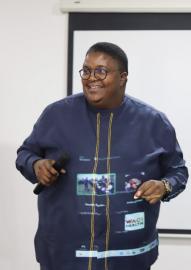
Civil society must, in real terms, advocate for the advancement of access to human rights, which will lead to the socio-economic development of those most vulnerable to society’s ills.
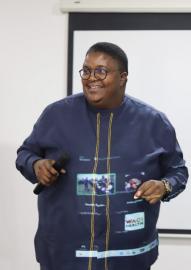
Deputy Minister in the Presidency for Women, Youth and Persons with Disabilities, Mmapaseka Steve Letsike, made the remark when addressing global civil society organisations and movements united (C20), held at Lakefield, Benoni on Tuesday.
The Civil 20 (C20) has been an official Engagement Group of G20 since 2013.
Since then, the C20 initiative has grown stronger every year, to ensure that world leaders listen to the recommendations and demands of organised civil society, to protect the environment and to promote social and economic development, human rights, and the principle of leaving no one behind.
In her address, Letsike argued that a woman is paid less for work of equal value than a male counterpart.
“A young girl who identifies outside the binary understanding of gender identity and sexual orientation in a ‘conservative society’ must not fear to walk the streets because there is a threat of corrective rape or even victimisation from a legal system that criminalises relationships outside the binary.
“Census data should no longer paint the face of poverty, inequality, and unemployment as young, Black and female.”
Letsike emphasised that financial systems’ lending practices must not disenfranchise women, thereby enabling an emergent female entrepreneur in any part of the world without collateral because of historical, social, and cultural structural barriers to access to finance at affordable rates.
“Access to basic services and amenities should not be gendered. Education, healthcare, safe drinking water, sanitation, housing, food security, safety and transport should adopt a gender responsive lens that will ensure women have equitable access.
“This is the ideal, where all people, including women, girls, LGBTQIA+ [ lesbian, gay, bisexual, transgender, queer or questioning, intersex, asexual, and more] persons, persons living with disabilities, and those from low socio-economic backgrounds have an inherent right to access whatever amenities are necessary to participate meaningfully in all areas of human endeavour,” Letsike explained.
Disproportionate challenges facing women
The Deputy Minister also acknowledged the disproportionate challenges faced by women including a United Nations Office on Drugs and Crime (UNODC) report which revealed that approximately one woman or girl is killed intentionally every 11 minutes globally.
Meanwhile, the International Finance Corporation (IFC) report showed that women are considerably less likely to access finance on account of collateral requirements such as land and property as men have a disproportionate control of these assets in most societies.
“The global conviction rate for rape stands at about 5% or less, meaning that the vast majority of cases that are reported do not lead to a conviction. Many more cases go unreported. Women in the LBGTQIA+ community continue to face compounded discrimination on account of their social indicators such as being Black women, persons with disabilities, or women from lower socio-economic backgrounds. These intersections intensify the challenges faced, as we experience both racism, ableism, or classism alongside homophobia,” Letsike said.
The World Health Organisation (WHO) has also estimated that around two billion people lack access to safe drinking water, with women and girls disproportionately affected by the burden of water collection.
The organisation further reported that in low- and middle-income countries, women face barriers to healthcare access, with one in three women lacking access to essential health services, particularly reproductive health services.
“With the advancements in modern medicine, it is appalling that so many women continue to experience higher mortality rates related to childbirth.”
The C20 initiative aims to secure increased investments for the Global Fund (GF) and prioritise the health needs of communities on the global health agenda.
The upcoming C20 process hosted by South Africa in 2025 presents a crucial opportunity to amplify civil society voices on issues critical to global health and make a call towards the G20 member states to commit ambitious financial pledges towards the 8th Global Fund Replenishment.
‘New era of opportunity’ for China, South Africa cooperation
President Cyril Ramaphosa says the relations between South Africa and China have entered a new “era of opportunity”.
The President was addressing the nation through his weekly newsletter following an official State Visit to the People’s Republic of China last week.
“During the state visit, China and South Africa agreed to upgrade our relationship to an All-Round Strategic Cooperative Partnership in a New Era. This signifies the strengthening of the political, economic and social ties between the two countries.
“The strengthening of ties with major trading partners like China continues to yield benefits for the South African economy and people. It is clear that relations between South Africa and China have entered a new era of opportunity.
“Our visit has strengthened trade and investment ties and cemented our shared commitment to grow our economy, create jobs and advance prosperity for the people of our two countries,” he said.
Trading partners
The President revealed that during the visit, Chinese President Xi Jinping expressed that he would like to see more finished goods from South Africa entering Chinese ports.
The Asian country is South Africa’s largest trading partner but, President Ramaphosa pointed out, there is an “imbalance in the structure of our trade”.
“South Africa exports mainly minerals and agricultural products to China and imports largely manufactured products from China.
“During our discussion, Chinese President Xi Jinping expressed his support for the development of South Africa’s manufacturing capacity and to receive greater volumes of finished goods from South Africa.
“President Xi has committed China to open its markets to more South African products and would seek to further broaden the frontiers for Chinese investment in the South African economy,” President Ramaphosa said.
The President added that government is buoyed by potentially increased cooperation between the two countries in “pursuit of low-carbon, climate resilient economic growth” and infrastructure.
“For example, South Africa has investment opportunities in the electric vehicle sector, renewable energy, green hydrogen and energy storage – and China has a proven track record in developing innovative solutions in these areas.
“There is also great potential, and much interest, for Chinese private commercial firms, state-owned enterprises and banks to invest in our country’s infrastructure build programme. This aligns with our plans to modernise our infrastructure by investing in the expansion of ports, rail and road networks,” he said.
Beyond our shores
President Ramaphosa emphasised that enhanced relations between China and South Africa can bring opportunities beyond the two countries.
While on the State Visit, the President attended the Forum on China-Africa Cooperation (FOCAC) where the African Continental Free Trade Area (AfCFTA) and its potential were discussed.
“The [AfCFTA], which will provide access to a market of over 1.3 billion people, provides an even greater incentive for investment by China and other countries in Africa’s manufacturing capacity.
“This was underlined during the FOCAC summit attended by more than 50 African countries, where President Xi announced ten partnership actions that China would take together with African countries to support the modernisation of their economies. These actions cover areas like trade, industrial development, agriculture, health and infrastructure.
“At a time when African economies are growing closer together, China’s technological capabilities can support Africa’s industrialisation and enable the continent to export more than just raw commodities,” the President said.
SA increases imports to China
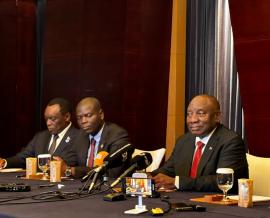
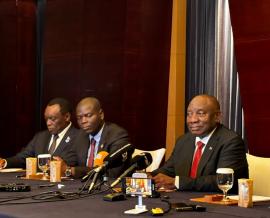
Beijing, China – With the agreements that South Africa has signed with China in relation to trade, the country will see an increase in the imports of agricultural and manufactured products to China.
“We were able to sign eight agreements, many of which have to do with increased trade between the two countries and that has led to the opening up of the Chinese market for South African products, particularly with regards to beef,” President Cyril Ramaphosa said on Thursday in Beijing, China.
Addressing members of the media on the conclusion of his visit to the People’s Republic of China, Ramaphosa said the importation of beef into the Chinese market kept fluctuating as a number of areas in South Africa were affected by livestock diseases such as foot and mouth disease.
“That is a great achievement because it will lead to the increase of our agricultural products coming into China and we should see increased production in South Africa. Whenever such an occurrence would happen, they would ban the whole country, and we were able to reach an agreement that if there is an outbreak of foot and mouth disease it would just be restricted to one area in the country.
“That is a great achievement because it will lead to the increase of our agricultural products coming into China and we should see increased production in South Africa.
“The other area is for manufactured goods and products, to have an easier entry into China. With the agreement that we signed we were able to ensure that China would enable more manufactured goods from South Africa to be brought in. That for us is an important development,” the President said.
Agreements
He noted that China has achieved enormous development in technological development.
“We were able to reach an agreement on science, technology and innovation in terms of cooperation in relation to innovation research and we were able to have good discussions.
“We were able to reach agreements on aspects of our energy security. South Africa has been going through a huge challenge of energy security. China’s assistance in this regard is going to stand us in good stead so therefore our other objective was achieved.
“We also wanted enhanced cooperation on international issues in relation to our cooperation in BRICS is consolidated and solidified and in other multilateral organisations such as the United Nations and financial institutions that there needs to be reforms,” the President explained.
Relations with China
He said at a state level, South Africa has achieved a great deal during the visit to China.
“Our visit has been hugely successful. We will see a lot of progress in the country in developing our relationship with China, remembering that China is the second largest economy in the world. For us as South Africa it is important for us to promote our relations with China.
“China is our biggest trading partner, and we want an all-round cooperative strategic partnership in the new era to take it to a higher level. President Xi Jinping is at pains when he talks about not having enough manufactured goods from South Africa. He wants to see more goods in China from South Africa.”
To this end, President Xi opened the Chinese market for African countries to come and exploit the Chinese market.
“As the most industrialised country on the continent South Africa stands to benefit immensely from this relationship. This is an important market for us as South Africans. This is a county that is willing to deal with us at a very serious, economic and political level.
“This is an important market, and we have seen increased trade between our two countries. At the moment, the trade is imbalanced and in favour of China, rather than in our favour and it is this that we are focusing on, to correct that imbalance.
“That is why we welcome the opening up of the Chinese market for more and more finished goods from South Africa.
“We want to upgrade that economic activity to a higher level, so we are able to bring in more finished mineral goods, products or commodities into China and more finished agricultural products,” the President said.
Government working ‘urgently’ to resolve logistics challenges
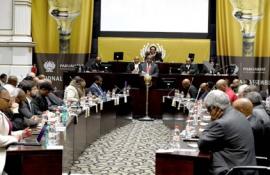
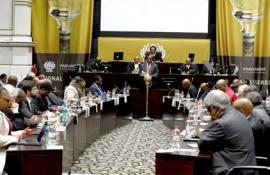
Government remains confident that the implementation of the Freight Logistics Roadmap will enable investment in South Africa’s ports and rail systems, said President Cyril Ramaphosa.
The President was speaking during a question and answer session in the National Assembly (NA) on Thursday.
“We are confident that through…efforts, and by implementing the Freight Logistics Roadmap, we will enable massive new investment in our ports and rail system. This will unlock economic growth and create jobs.”
The President said an “an efficient and well-functioning logistics system” is critical for the growth of South Africa’s economy.
He acknowledged that for many years, the system was underdeveloped and that standards declined.
“That is why we have focused on the logistics sector as part of our broader agenda for economic reform. For many years, our rail system and ports have suffered from underinvestment in infrastructure, equipment and maintenance. This has contributed to deteriorating performance.
“This trend was exacerbated during the state capture period. Funds were diverted away from pressing infrastructure needs. The poor condition of our rail network and the inefficient operation of our port terminals now represent a binding constraint on economic growth and job creation.
“This has implications for key sectors such as mining, agriculture and manufacturing,” he explained.
Collaborative efforts
The President informed the NA that government is now working “urgently to restore our logistics system to world-class standards” by among others, joining hands with the private sector.
This began during the sixth administration through the implementation of Operation Vulindlela which commissioned research that found that there is an appetite for private investment in ports and rail.
Operation Vulindlela is a joint initiative of the Presidency and National Treasury to accelerate the implementation of structural reforms and support economic recovery. It aims to modernise and transform network industries, including electricity, water, transport and digital communications.
At Thursday’s session the President assured the nation that as government and the private sector begin to work together, the state will retain ownership of infrastructure.
“Private sector participation is being introduced in container terminals. This is starting with an equity partnership between Transnet and an international terminal operator for the Durban Pier 2 Container Terminal.
“A dedicated Private Sector Participation Unit has been established by the Department of Transport to identify and develop further opportunities for private investment. These opportunities would be realised through concessions, joint ventures and other models.
“At the same time, we have made it clear that port and rail infrastructure will remain in public ownership, even as competition is introduced in operations,” he said.
In the rail system, a draft statement has been published which seeks to allow private rail operators to “access the network for the first time”.
The full Freight Logistics Roadmap is available for download here: https://www.transport.gov.za/wp-content/uploads/2023/02/Roadmap-for-the-Freight-Logistics-System-in-South-Africa-FINAL-FOR-RELEASE.pdf
Smaller scale farmers are being supported
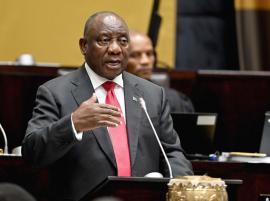
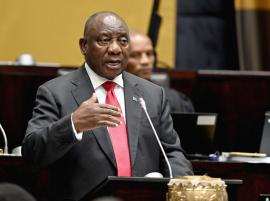
Government is prioritising support for the growth of smaller scale and previously disadvantaged farmers in South Africa.
This is according to President Cyril Ramaphosa who addressed Parliament’s National Assembly (NA) on Thursday.
The President told the members of the NA that the Agriculture and Agro-processing Master Plan addresses the challenge of the concentration of ownership, production and market access in certain hands.
“The Master Plan aims to build an agriculture and agro-processing sector that is inclusive, competitive, job-creating, sustainable and growing.
“Pillar 5 of the Master Plan specifically seeks to facilitate market expansion, improve market access and promote trade. This will be achieved through, among other things, strengthening partnerships with established industry associations to ensure SMMEs can access existing networks that facilitate exports,” he said.
Further, government – with the assistance of the Perishable Products Export Control Board – is assisting small scale and previously disadvantaged farmers to comply with food safety regulations and standards.
“The ability of previously disadvantaged farmers to consistently supply the markets is also as a result of low throughput. It is for this reason that the Master Plan has prioritised producer support as one of its critical pillars. This support includes financing and extension and advisory services.
“By 2030, the Master Plan aims to increase the share of black producers in production of grains from four percent to 20 percent, in livestock from 32 to 40 percent, in fruits from two to 10 percent and in vegetables from 15 to 29 percent,” he said.
Meanwhile, the President said the different spheres of government are working together and committed to “delivering housing solutions and improving the living conditions of the people of Alexandra”.
He was answering a question from a member of the NA on progress made in providing housing solutions for the people of that area.
“Plans are underway to build approximately 40 000 houses in Frankenwald and Linksfield, benefiting Stjwetla residents and others in Alexandra.
“One of the urgent tasks is to relocate approximately 8000 households who are in the flood lines of the Jukskei River. An enumeration process to establish which households will be affected has been completed.
“Various land parcels have been identified for relocation. Studies on the suitability of the land have been completed on secured land portions. One project, known as the Linksfield Development, has secured township proclamations for a proposed 10 000 units,” the President said.
Another project, the Frankenwald Development, is expected to yield at least 30 000 units while work to unblock and complete stalled housing projects is also underway.
“Progress has been made on projects like the Helen Joseph Hostel and KwaNobuhle Hostel, with design approvals and beneficiary administration processes underway.
“The City of Johannesburg has obtained an evacuation order to relocate households in flood-prone areas of Stjwetla. Environmental assessments are underway to identify affected households and efforts are being made to secure land for relocation. Units have been constructed in other smaller projects, like Marlboro Gardens, Marlboro 2nd Avenue and Madala Hostel,” he said.
The President highlighted that there were specific challenges to housing development in Alexandra but assured that government would not leave the people of that area behind.
“These challenges require a multi-faceted approach and collaboration between various stakeholders to overcome them.
“Progress is being made. And government remains committed to delivering housing solutions and improving the living conditions of the people of Alexandra,” President Ramaphosa said.

Trains ready to ferry fans to Springboks game

The Passenger Rail Agency of South (PRASA) and the Gautrain have announced that its all systems go for the integrated train service to ensure fans can travel safely and conveniently to and from this weekend’s rugby game.
South Africa will take on New Zealand on Saturday at Emirates Airline Park, also popularly known by its old name Ellis Park Stadium, in Johannesburg.
“The Gautrain and PRASA will be offering a seamless and integrated train service for the upcoming test match to ensure ease of movement and convenience for all rugby spectators attending the Rugby Championship Test Match.
“Fans can catch PRASA’s People’s Train from Park Station to Ellis Park Station, which is situated at the heart of the stadium precinct,” a joint statement said on Thursday.
With over 62 000 spectators expected to attend the game, the people’s train has the capacity to carry 2 400 per train trip, making it the ideal mass carrier to the game.
The train will run at 15-minute intervals from Park Station to Ellis Park Station from 10:30am until 9:30pm.
“The Gautrain has extended its evening service and will run the normal train schedule. The journey on the Metrorail service will be free for valid match ticketholders, while the standard Gautrain train and parking fares will apply.
“Fans can catch the Gautrain from various Gautrain stations to Park Station and at Park Station proceed to the Metrorail platforms. Marshalls will be on standby to guide commuters to the PRASA trains. The last PRASA train departs Ellis Park Station at 21:30 and the last Gautrain train departs Park Station at 22:00 to all Gautrain Stations,” the statement said.
Both train services will integrate with other modes of transport including e-hailing and corporate busses that will be ferrying rugby fans to Park Station.
For ease of mobility and efficiency, fans are encourages to take the Gautrain from all the stations to Park Station, e-hail to Park Station, or park their private vehicles at Park Station.
A R50 flat fee will apply for parked vehicles. For convenience and safety of fans, PRASA has made its head office adjacent to Park Station available for drop-off and pick-up for e-hailing services.
This special train service has been planned to accommodate the large number of fans expected to attend, providing an efficient and stress-free alternative to road travel. Fans are encouraged to take advantage of this service to avoid traffic congestion at the stadium or cellphone network interruption.
“Safety and security remains our priority. To this end, the City of Joburg, South African Police Service (SAPS), Gautrain and PRASA will provide additional security at the stations, inside the trains and in and around the stadium precinct for the security of match-goers,” the statement said.
Gautrain Management Agency Chief Executive Officer Tshepo Kgobe said this initiative forms part of Gautrain’s efforts to be more inclusive by integrating with other modes of transport, and encouraging passengers to use the Gautrain to get to exciting sporting and lifestyle events such as this upcoming Bokke game.
“Fans can avoid road congestion by hopping on the Gautrain for a hassle-free, fast, comfortable and safe transport service to Park Station,” Kgobe said.
PRASA Group Chief Executive Officer (GCEO) Hishaam Emeran said this was an exciting time for PRASA as it rebuilds and restores commuter rail services across the country.
“To date, we have recovered 31 of the 40 corridors nationally. The Park Station to Germiston line, where the Ellis Park Station is located, is already operational. Using our internal staff, we have refurbished the station in time to welcome thousands of rugby fans on the day.
“Our role on Saturday demonstrates that we are more than just a commuter service for work and economic opportunities. We also play a vital role as a mass carrier, transporting people for leisure, entertainment, and sporting events.
“Our stations are strategically located near various iconic stadiums, and soon, we will be able to provide transport for other sporting codes,” Emeran said.
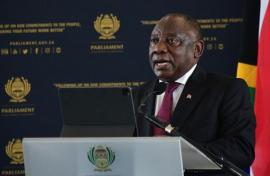
President Ramaphosa to respond to questions in the National Assembly
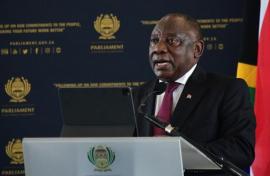
President Cyril Ramaphosa will on Thursday afternoon account to the nation on the work of government when he responds to Questions for Oral Reply in the National Assembly in Parliament, Cape Town.
During this session, President Ramaphosa will, among other questions, brief Parliament on steps government is taking to encourage private sector investments to improve ports, railways and other infrastructure to drive economic growth.
“This will also include expansion of access to agricultural markets for small-scale and emerging farmers as productive sectors of the economy.
“The President will reflect on the alignment of South Africa’s foreign policy with the needs of the African continent and steps being taken to ensure that South Africa continues to contribute to promoting African unity and self-determination,” the Presidency said in a statement.
Other international issues such as combating illicit trade in illegal substances will also be addressed.
Furthermore, the President will provide updates on the development and strategic goals of the Sovereign Wealth Fund and progress in building housing for the residents of Alexandra.