
President saddened by deaths of 12 learners in road accident
President Cyril Ramaphosa is deeply saddened by the deaths of 12 learners from Rocklands Primary School and Laerskool Blyvooruitsig in Carletonville who were involved in a road incident in the Merafong City municipal area on Gauteng’s West Rand.
President Ramaphosa has in a statement sent his condolences to the families, friends, learners and educators of the deceased children.
The President has also wished a speedy and full recovery to the seven learners who suffered injuries in the incident that involved a scholar transport vehicle.
“The loss of such young lives at the start of a new school term touches all of us as a nation,” President Ramaphosa said.
“We wish the affected families and school communities the best as they mourn the passing of children who have been deprived of fulfilling their potential and spending their lives with families and friends.
“This tragedy, which regretfully is not the first of its kind to confront us, demands that we exercise our obligation to protect our children with the utmost care,” the President said.
Transport Minister Barbara Creecy and her Deputy Transport Minister Mkhuleko Hlengwa have also extended their deepest condolences to the families.
The Road Traffic Management Corporation (RTMC) is investigating the cause of the fatal accident, which occurred on the D92 at 06:42 on Wednesday morning.
The crash involved a minibus carrying school children and a light delivery van.
Speaking at the South African Transport Conference at the CSIR earlier this week, Minister Creecy said road safety will receive priority attention in the seventh administration.
Gauteng online learner registration process to start on Thursday
Wednesday, July 10, 2024
The Gauteng Department of Education says online registration for the 2025 academic year for Grade 1 and Grade 8 admissions will begin on Thursday, 11 July 2024, at 8am and end on Monday, 12 August 2024, at midnight.
The department has stressed that as long as parents apply online and on time, their children are assured to be placed at a school in time for the 2025 academic year.
Gauteng Education spokesperson Steve Mabona appealed to parents to apply on time.
He said parents are allowed to choose a minimum of three schools and a maximum of five schools.
Placements for pupils will begin on 16 September.
Mabona said parents who have no access to internet services must use any of the department’s 80 centres across the province, and they will not be charged a fee.
The spokesperson said the online process has improved and is user-friendly.
“Our system has improved and we can assure parents that problems experienced in the past will not happen again,” Mabona said.
In the past, the system had experienced challenges and would remain offline due to high volumesof applications received.
Required documents for online applications
– SA parent ID or passport and child’s birth certificate or passport.
– Refugee permit.
– Asylum seeker permit.
– Permanent residence permit.
– Study permit.
– Proof of home address.
– Proof of work address.
– Latest Grade 7 school report (Grade 8 applicants only).
– Clinic card/immunisation report (Grade 1 applicants only).
Eskom marks 100 days of no load shedding
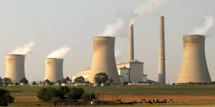
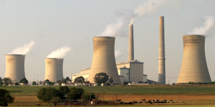
State power utility Eskom has reached 100 days without implementing load shedding for the first time since 2020.
“Considering the Intensity and the levels of load shedding in 2023, the ability to get to 100 days without load shedding is significant, while acknowledging that the risk of load shedding still exists.
“The 100 days milestone includes around a – R6.2 billion reduction in OCT [Open cycle gas turbines] diesel expenditure from 1 April 2024 to 30 June 2024, compared to the same period last year and if we maintain our trajectory on reduced diesel spend, it will be a strong driver in a possible return to profit in FY25,” Eskom’s Group Chief Executive Dan Marokane said.
The power utility’s Head of Generation, Bheki Nxumalo, highlighted that the 100 days is a result of the “tireless efforts” of those working to keep the lights on at the power utility.
“The achievement of 100 continuous days without load shedding is the outcome of diligent execution of recovery plans and the tireless efforts of our 40 000 dedicated and skilled Eskom employees.
“If we maintain a 70% Energy Availability Factor (EAF) and add significant capacity within the country we can ensure adequate available capacity to meet demand without a significant risk of load shedding,” Nxumalo said.
READ | Ramokgopa pleased with 100 days of no load shedding
Targeted initiatives
Eskom explained that the current upward trajectory stems from, amongst others, a “multi-dimensional Generation Operational Recovery Plan…and aggressive planned maintenance”.
The utility explained that these initiatives have led to a reduction in unplanned outages at power stations from some 18 000MW to an average of 12 000MW – marking an improvement of 6000MW since May 2023.
“This has contributed to a sustained improvement in the EAF, which has increased from 54.56% at the end of FY23/24 to a year-to-date achievement of 61.50%, an increase of 6.94% over the past three months.
“Our immediate focus remains on implementing the Generation Operational Recovery Plan, aiming to recover about 1600MW from the generation coal fleet following the successful commercial operation of Kusile Unit 5 and 930MW from Koeberg Unit 2 before the end of the calendar year. This will significantly improve the EAF by the end of March 2025,” the power utility said.
Eskom thanked government and the National Energy Crisis Committee (NECOM), and other stakeholders for their collaborative efforts, which have enabled the successful execution of its plans.
“We will persist in implementing the operational recovery plan, strengthening governance, and future-proofing the organisation to ensure energy security, growth, and long-term sustainability for the benefit of South Africa and sub-Saharan Africa.
“We remain committed to improving the current business while laying the groundwork for future opportunities and initiatives. We will continue to seize every opportunity presented by industry changes for the benefit of all our stakeholders.
“The pace of change is rapid, and we are prepared to deliver on the future through improved implementation and disciplined execution,” Eskom concluded.

GNU: A new era for SA
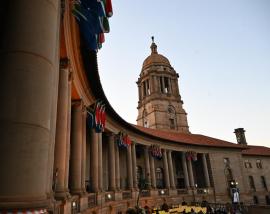
As the new Cabinet of the seventh administration gets to grips with the workings of their various portfolios – it has been advised to place ordinary South Africans at the heart of the administration.
“Show the ordinary South Africans that their well-being is the ultimate goal and at the heart of those running government and the administration,” Extraordinary Professor at the Department of Political Sciences at the University of Pretoria, Henning Melber, told SAnews.
Melber’s comments follow on the announcement on Sunday, 30 June 2024, of the new National Executive of the seventh administration by President Cyril Ramaphosa.
The much-anticipated announcement is the result of the National and Provincial Elections that were held on 29 May. For the first time in democratic South Africa’s history, that election did not result in an outright majority for a single party to lead the country for the next five years.
The will of the people
In those initial days following from the point where voting took place, up to the announcement of the results, ordinary citizens were wondering what would happen next. After all, we were accustomed to living in a country that since the advent of democracy, was led by a single majority party.
However, from the hotly contested elections themselves to the announcement of the election results, peace was the order of the day. This also extended to the period of the swearing in of Members of Parliament (MPs) and other MPs at a later stage, as well as the election of National Assembly (NA) Speaker Thoko Didiza and National Council of Provinces (NCOP) Chairperson Refilwe Mtsweni-Tsipane. The election and inauguration of Cyril Ramaphosa as President and head of government of the seventh administration was also peaceful.
An acceptance of the will of the people at the ballot box also played an important part in where the country finds itself today with the seventh administration’s Government of National Unity (GNU) starting to take shape.
This GNU, however, differs from the one that South Africa had, following the seminal elections of 1994 that saw the African National Congress (ANC) go into a GNU with two other political parties, despite having won an outright majority. The current GNU comprises 11parties across the political spectrum.
These parties are: the African National Congress (ANC), Democratic Alliance (DA), Patriotic Alliance, Inkatha Freedom Party, Good Party, Pan Africanist Congress of Azania, Freedom Front Plus, United Democratic Movement, Al Jama-ah, Rise Mzansi and the United Africans Transformation.
Collaboration
In an interview with SAnews, Melber further advised parties involved in the GNU to “collaborate with members of other parties based on trust; seeking to improve efficiency in service delivery.”
With this rather eventful week drawing to a close, South Africans not only witnessed the announcement of the new Cabinet, but also the swearing in of the new executive, including Deputy President Paul Mashatile as well as the induction programme of new MPS in the Western Cape.
And yes, it did take some time to get to where we are now as a country, but we must remember that Rome was not built in a day.
In his address to the nation on Sunday, President Ramaphosa acknowledged the length of time it took to put together the administration.
Confidence vs Time
However, Melber points out that given the different elements at play, the process in truth did not take too much time.
He said that given the rather unusual, if not complicated blend of parties who needed to secure common ground, and agreeing on an acceptable power sharing arrangement in terms of portfolios -, this process had actually not taken that long.
“And it was a necessary investment in building a minimum degree of confidence and trust as a point of departure. There are democracies who for months (among others The Netherlands, Sweden) if not years (Belgium) had not a proper government and were neither less politically stable. Many observers at least in the Western democracies were hoping for such a power-sharing arrangement and did not expect this to happen much faster. Building a reliable collaboration between political parties so different in their programmes needs time,” Melber explained.
A new era
In his inauguration address on 19 June 2024, President Ramaphosa described the GNU as “the beginning of a new era” adding that it requires a common mission, which is anchored in safeguarding national unity, peace, stability, inclusive economic growth, non-racialism and non-sexism.
Asked about his thoughts on the GNU, Melber said: “Under the given circumstances of the election result, the decision to form a GNU seemed to be a wise and considerate move, aiming to accommodate a broad middle for political stability in a government, in which the ANC remains the major party.”
The announcement of the new Cabinet also came with changes in government departments that involve the merger of the Ministries of Electricity and Energy as well as the announcement of a separate Ministry of Mineral and Petroleum Resources. The President also announced the separation of the Ministry of Agriculture from the Ministry of Land Reform and Rural Development, among others.
“This is a necessary adjustment to accommodate divergent interests seeking influence in governance. If in the end – despite some further bloating of the structures – it provides a reliable operational structure to make improvements in delivery – it is a well justified investment,” said the Professor.
South Africa’s future under a GNU is now underway with Minister in the Presidency Khumbudzo Ntshavheni having held the first media briefing of the seventh administration on Thursday, 4 July 2024.
At that briefing, the Minister outlined the process that would be followed to set government’s priorities and programme of action for the seventh administration. These said the Minister, will be articulated in the Medium-Term Strategic Framework (MTSF), which is normally guided by the election manifesto of the governing party. However, in this case of the GNU, a unique case for government, this will be guided by the election manifestoes of the 11 parties to the GNU.
To give effect to the signed Statement of Intent as signed by parties to the GNU, the Forum of South African Directors-General (FOSAD), chaired by the Director-General in The Presidency, has undertaken the work of analysing the manifestoes of parties to the GNU.
After thorough scrutiny, the Directors-General will then submit a proposal for consideration and adoption at the Cabinet Lekgotla scheduled for 11-12 July.
The two-day Lekgotla will deliberate on the proposals of the Directors-General, after which the programmes and priorities of government will be announced.
“The adopted programme of action (MTSF) will be announced by the President at the Opening of Parliament on Thursday, 18 July 2024. After the adoption of the MTSF, the individual departments will then develop their Strategic Plans linked to the MTSF and Annual Performance Plans for implementation of the MTSF targets,” explained Minister Ntshavheni.
Happiness trajectory
Following the elections and Sunday’s cabinet announcement, South Africa’s happiness trends have been on an upright trajectory.
This is according to the Gross National Happiness (GNH) index. The index is the brainchild of Professor Talita Greyling of the University of Johannesburg (UJ) and Prof Stephanie Rossouw of the Auckland University of Technology, with the technical support of AFSTEREO (Pty) Ltd.
According to UJ, the GNH is the first index of its kind and measures the real-time sentiment of the country.
“The much-anticipated announcement by President Cyril Ramaphosa of the new GNU Cabinet on 30 June 2024 is being experienced positively by the South African people, as shown by the near real-time Happiness Index of the GNH.today project.
“The happiness levels in South Africa have been trending upward since the election results were announced in June 2024, from 5.36 to 5.42,” the university said in a statement.
The GNH.today project measures happiness in near real-time based on specific emotion words used in Google searches.
“The GNU ensures a broad representation and a solid mandate to govern the country, contributing to higher levels of transparency, accountability, and trust in the government. It also explains the higher happiness levels, reflecting hope for a better future,” said the university.
In analysing the positive trend in the happiness index, the team found that positive emotion words used in South Africa increased, such as “hope”, “happiness”, and “joy”.
However, there was an increase in negative emotion words such as “bad” and “afraid”, but with a positive net effect.
“The increase in both positive and negative words is expected as it indicates the debate around the newly appointed cabinet. Different parties criticise the portfolio allocations and the ministers appointed. The increased size of the government is also critiqued. On the other hand, there is relief that the Cabinet was announced after almost a month of negotiations.
“This announcement implies an agreement about power-sharing,” said the university.
Asked about whether he thinks the GNU will stick, Professor Melber is hopeful.
“I’m afraid I have misplaced my crystal ball,” he chirps.
“More seriously [though,] one hopes for the sake of South African citizens that this GNU manages to operate and serve the best interest of the people. If this construction holds, it is a win-win situation for all the parties who were able to compromise for the sake of the people and the country’s stability,” he said.

Good news for motorists as fuel prices decrease
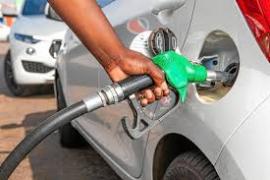
The Department of Mineral and Petroleum Resources has announced a decrease in prices for all grades of fuel for July, bringing much needed relief to consumers.
This is the second month in succession that a fuel price decrease has been implemented.
The fuel prices for July are adjusted as follows:
- Petrol 93 (ULP and LRP): R1,05 decrease.
- Petrol 95 (ULP and LRP): 99c decrease.
- Diesel (0.05% sulphur): 30c decrease.
- Diesel (0.005% sulphur): 24c decrease.
- Illuminating Paraffin (wholesale): 18c decrease.
- Single Maximum National Retail Price for illuminating Paraffin: 24c decrease.
- Maximum LP Gas Retail Price: 22c decrease
In a statement, the department attributed the decrease in prices to several factors in the international market.
“The average Brent Crude oil price decreased from 82.98 US Dollars (USD) to 82.24 USD per barrel, during the period under review. The main contributing factors are the increased production by the US and other non-OPEC countries amid slow economic growth globally.
“The average international product prices of petrol decreased following the lower Brent Crude oil prices during the period under review. The movement in product prices has led to a lower contribution to the Basic Fuel Price (BFP) of petrol by 93.66 – 99.65 c/l, diesel by 17.55 – 23.80 c/l and illuminating paraffin by 16.87 cents per litre,” the department stated.
Furthermore, the Rand’s strength against the dollar also influenced prices.
“The Rand appreciated slightly, on average, against the US Dollar (from 18.46 to 18.44 Rand per USD) during the period under review when compared to the previous one. This led to lower contributions to the Basic Fuel Prices of all products by about 1.50 cents per litre on all products,” the department added.
The adjusted prices are to take effect from Wednesday, 03 July 2024.
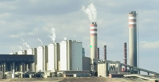
Kusile Power Station’s Unit 5 reaches commercial operation
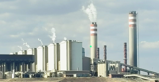
Eskom’s Kusile Unit 5 has achieved commercial operation, adding some 800MW to the grid.
This comes as the power utility has maintained at least 90 days of uninterrupted electricity supply.
Eskom Group Chief Executive Dan Marokane said the move is part of the power utility’s focus on its recovery plan.
“We stated in our winter outlook…that we would add new generation capacity to the grid with Kusile Power Station Unit 5, as part of our intense focus on delivering the Generation Operational Recovery Plan. This addition is part of a total of 2500MW that will be added before the end of this calendar year.
“Eskom will continue to focus on implementing operational recovery, strengthening governance and future proofing the organisation to enable energy security, growth and long-term sustainability to the benefit of South Africa and sub-Saharan Africa,” Marokane said.
Kusile Power Station is located in Mpumalanga.
The power utility’s Group Executive for Generation Bheki Nxumalo added that the addition of the much-needed megawatts is a result of the collective efforts of all Eskom employees.
“The delivery of the unit, as part of our Generation Operational Recovery Plan, showcases the remarkable achievements possible when our 40 000 employees work together as a collective.
“I extend my gratitude to all Eskom employees and contractors for their diligent work in bringing this unit to commercial operation. This achievement aligns with our commitment to maximising grid capacity,” Nxumalo said.
According to Eskom, the unit was first synchronised to the grid in December 2023 but will now “begin contributing power, increasing Kusile Power Station’s total output to 4000MW”.
“Since its synchronisation…the unit has met performance expectations, supported the grid and helped to reduce load shedding. Upon completion, Kusile Power Station will consist of six units, producing a maximum of 4800MW.
“Additionally, Kusile is equipped with wet flue gas desulphurisation (WFGD) technology, making it the first power station in South Africa and Africa to use this emissions abatement technology. WFGD removes sulphur dioxide from flue gas before it is released into the atmosphere, ensuring compliance with international air quality standards.
“Construction of the remaining Kusile Unit 6 is progressing as planned, with it expected to be synchronised to the grid in November 2024,” the power utility said.
Meet SA’s new cabinet
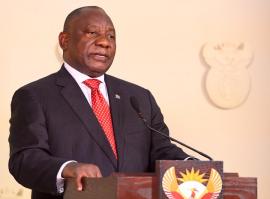
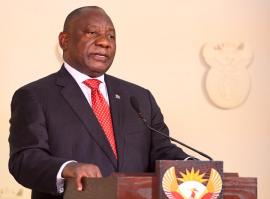
President Cyril Ramaphosa has today, Sunday 30 June 2024, announced the new members of the National Executive for the seventh administration, which is inclusive of all the parties to the Government of National Unity.
The highly anticipated announcement took place after Ramaphosa was elected as the President by the National Assembly on Friday, 14 June 2024, after which he was inaugurated on Wednesday, 19 June 2024.
The eleven parties to the GNU include the African National Congress, Democratic Alliance, Patriotic Alliance, Inkatha Freedom Party, Good Party, Pan Africanist Congress of Azania, Freedom Front Plus, United Democratic Movement, Al Jama-ah, Rise Mzansi and the United Africans Transformation.
Addressing the nation on Sunday evening, the President said given the challenges that the country faces and considering the electoral mandate this government must implement, he has decided to make certain changes to the national government portfolios.
“In the course of the sixth democratic administration, we indicated our intention to reduce the number of portfolios in the National Executive. However, due to the need to ensure that the National Executive is inclusive of all the parties to the Government of National Unity, this has not been possible.
“In some instances, we have considered it necessary to separate certain portfolios to ensure that there is sufficient focus on key issues,” Ramaphosa said at the Union Buildings in Pretoria.
WATCH |
Changes to portfolios
He said the Ministries of Electricity and Energy will be merged.
“There will be a separate Ministry of Mineral and Petroleum Resources. The Ministry of Agriculture will be separated from the Ministry of Land Reform and Rural Development.
“The Ministry of Higher Education will be separated from the ministry of Science, Technology and Innovation. The ministry of Justice and Constitutional Development will be separated from the ministry of Correctional Services.
“There will no longer be a Ministry of Public Enterprises. The coordination of the relevant public enterprises will be located in the Presidency during the process of implementing a new shareholder model,” the President said.
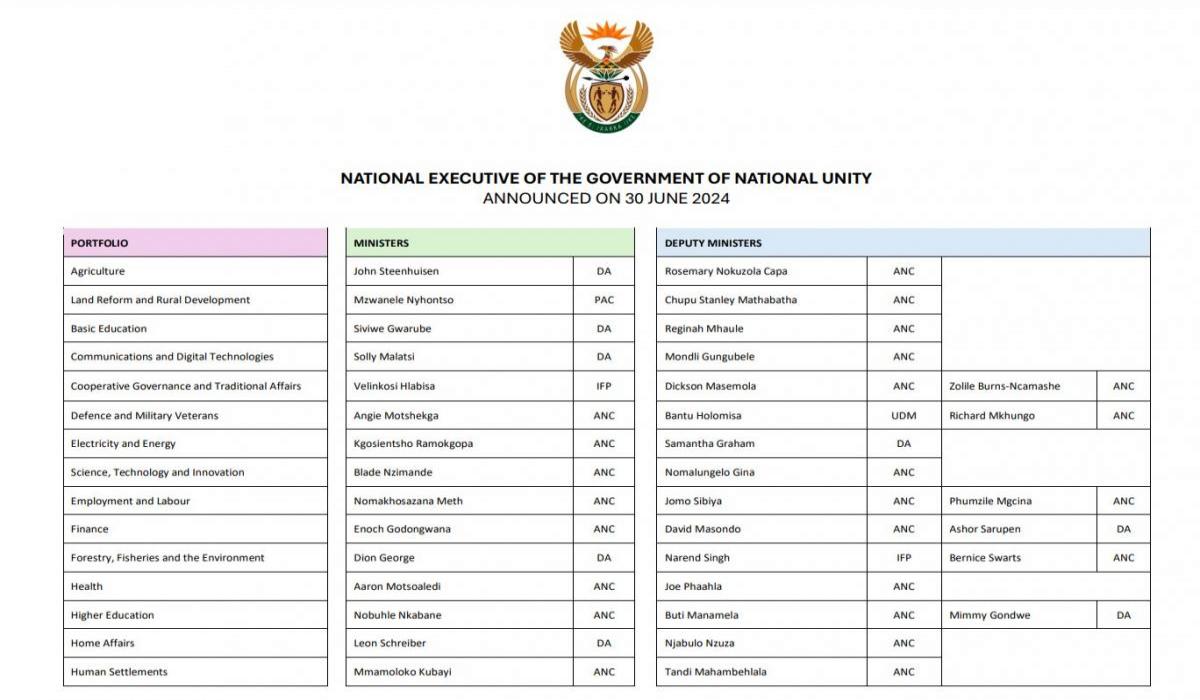
The new National Executive
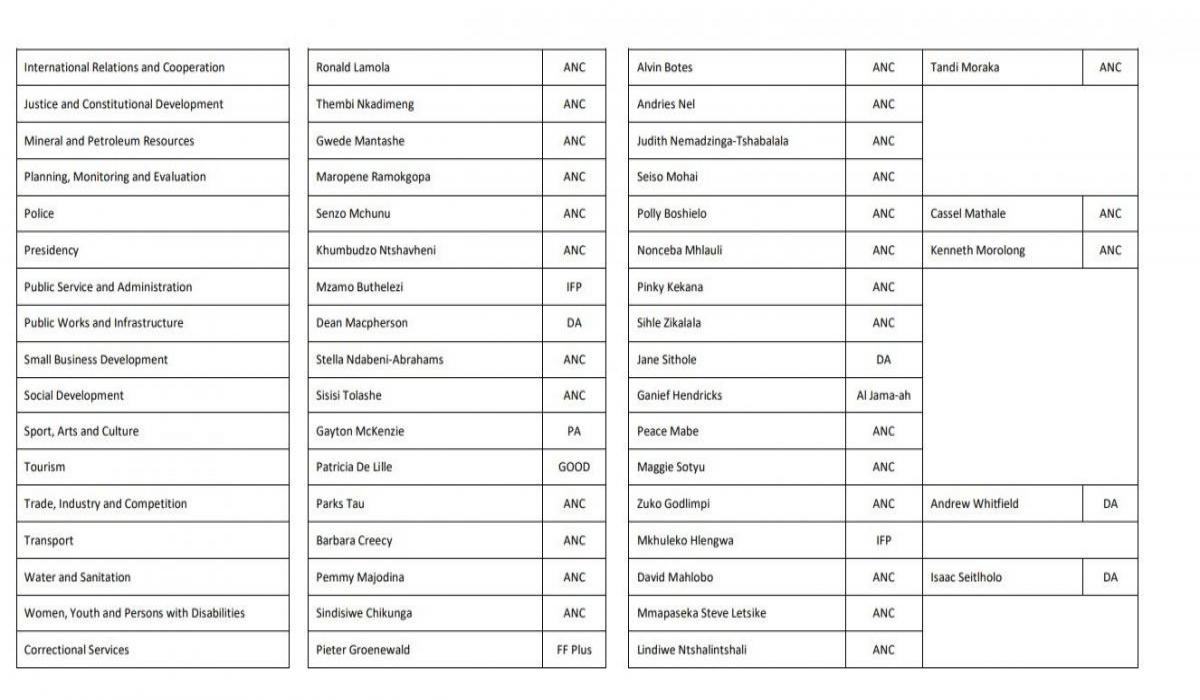
Ramaphosa has decided to make the following appointments to the National Executive:
- The Deputy President is Paul Mashatile.
- The Minister of Agriculture is John Steenhuisen.
- The Deputy Minister of Agriculture is Rosemary Nokuzola Capa.
- The Minister of Land Reform and Rural Development is Mzwanele Nyhontso.
- The Deputy Minister of Land Reform and Rural Development is Chupu Stanley Mathabatha.
- The Minister of Basic Education is Siviwe Gwarube.
- The Deputy Minister of Basic Education is Reginah Mhaule.
- The Minister of Communications and Digital Technologies is Solly Malatsi.
- The Deputy Minister of Communications and Digital Technologies is Mondli Gungubele.
- The Minister of Cooperative Governance and Traditional Affairs is Velinkosi Hlabisa.
- The Deputy Ministers of Cooperative Governance and Traditional Affairs are Dickson Masemola and Zolile Burns‐Ncamashe.
- The Minister of Defence and Military Veterans is Angie Motshekga.
- The Deputy Ministers of Defence and Military Veterans are Bantu Holomisa and Richard Mkhungo.
- The Minister of Electricity and Energy is Kgosientsho Ramokgopa.
- The Deputy Minister of Electricity and Energy is Samantha Graham.
- The Minister of Science, Technology and Innovation is Blade Nzimande.
- The Deputy Minister of Science, Technology and Innovation is Nomalungelo Gina.
- The Minister of Employment and Labour is Nomakhosazana Meth.
- The Deputy Ministers of Employment and Labour are Jomo Sibiya and Phumzile Mgcina.
- The Minister of Finance is Enoch Godongwana.
- The Deputy Ministers of Finance are David Masondo and Ashor Sarupen.
- The Minister of Forestry, Fisheries and the Environment is Dion George.
- The Deputy Ministers of Forestry, Fisheries and the Environment are Narend Singh and Bernice Swarts.
- The Minister of Health is Aaron Motsoaledi.
- The Deputy Minister of Health is Joe Phaahla.
- The Minister of Higher Education is Nobuhle Nkabane.
- The Deputy Ministers of Higher Education are Buti Manamela and Mimmy Gondwe.
- The Minister of Home Affairs is Leon Schreiber.
- The Deputy Minister of Home Affairs is Njabulo Nzuza.
- The Minister of Human Settlements is Mmamoloko Kubayi.
- The Deputy Minister of Human Settlements is Tandi Mahambehlala.
- The Minister of International Relations and Cooperation is Ronald Lamola.
- The Deputy Ministers of International Relations and Cooperation are Alvin Botes and Tandi Moraka.
- The Minister of Justice and Constitutional Development is Thembi Nkadimeng.
- The Deputy Minister of Justice and Constitutional Development is Andries Nel.
- The Minister of Mineral and Petroleum Resources is Gwede Mantashe.
- The Deputy Minister of Mineral and Petroleum Resources is Judith Nemadzinga‐Tshabalala.
- The Minister of Planning, Monitoring and Evaluation is Maropene Ramokgopa.
- The Deputy Minister of Planning, Monitoring and Evaluation is Seiso Mohai.
- The Minister of Police is Senzo Mchunu.
- The Deputy Ministers of Police are Polly Boshielo and Cassel Mathale.
- The Minister in the Presidency is Khumbudzo Ntshavheni.
- The Deputy Ministers in the Presidency are Nonceba Mhlauli and Kenneth Morolong.
- The Minister of Public Service and Administration is Mzamo Buthelezi.
- The Deputy Minister of Public Service and Administration is Pinky Kekana.
- The Minister of Public Works and Infrastructure is Dean Macpherson.
- The Deputy Minister of Public Works and Infrastructure is Sihle Zikalala.
- The Minister of Small Business Development is Stella Ndabeni-Abrahams.
- The Deputy Minister of Small Business Development is Jane Sithole.
- The Minister of Social Development is Sisisi Tolashe.
- The Deputy Minister of Social Development is Ganief Hendricks.
- The Minister of Sport, Arts and Culture is Gayton McKenzie.
- The Deputy Minister of Sport, Arts and Culture is Peace Mabe.
- The Minister of Tourism is Patricia De Lille.
- The Deputy Minister of Tourism is Maggie Sotyu.
- The Minister of Trade, Industry and Competition is Parks Tau.
- The Deputy Ministers of Trade, Industry and Competition are Zuko Godlimpi and Andrew Whitfield.
- The Minister of Transport is Barbara Creecy.
- The Deputy Minister of Transport is Mkhuleko Hlengwa.
- The Minister of Water and Sanitation is Pemmy Majodina.
- The Deputy Ministers of Water and Sanitation are David Mahlobo and Isaac Seitlholo.
- The Minister of Women, Youth and Persons with Disabilities is Sindisiwe Chikunga.
- The Deputy Minister of Women, Youth and Persons with Disabilities is Mmapaseka Steve Letsike.
- The Minister of Correctional Services is Pieter Groenewald.
- The Deputy Minister of Correctional Services is Lindiwe Ntshalintshali.
Click here for the Summary of the new National Executive |

Call to dispel myths associated with albinism
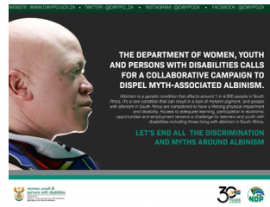
The Department of Women, Youth and Persons with Disabilities has joined the global community in calling for more efforts to raise awareness of the rights of persons with albinism.
Albinism is a genetic condition that affects around one in 4 000 people in South Africa.
It is a rare condition that can result in a lack of melanin pigment, and people with albinism in South Africa are considered to have a lifelong physical impairment and disability.
The department’s Director-General, Advocate Mikateko Maluleke, said access to adequate learning, participation in economic opportunities and employment remains a challenge for learners and youth with disabilities, including those with albinism in South Africa.
“The National Albinism Task Force in South Africa and Amnesty International called on the South African government to take immediate steps to respect, promote, and fulfil all the rights of persons with albinism and ensure that all those who violate such rights are held accountable.
“For this reason, we call on all the youth of South Africa to support all the youth programs and initiatives from civil society; government, and the private sector aimed at educating and creating awareness on albinism,” Maluleke said.
Maluleke highlighted that the Constitution of the Republic of South Africa guarantees that everyone has the right to life, emphasising that people with disabilities, especially youth with disabilities, are particularly at risk and require specific measures to protect this right.
“The Department of Women, Youth and Persons with Disabilities, through its Disabilities Rights Awareness Campaign continue to encourage civil society organisations and the private sector to invest in public educational programmes that will help to dispel the misconception and discriminatory practices on albinism,” Maluleke said.

Northern Cape road maintenance projects to create opportunities for five years
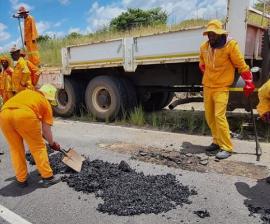
Two new Routine Road Maintenance (RRM) contracts in the John Taolo Gaetsewe (JTG) District of the Northern Cape will create scores of opportunities for subcontracting and local labour over a period of five years, the South African National Roads Agency SOC Limited (SANRAL) has announced.
SANRAL is currently evaluating tenders received for these contracts and hopes to appoint contractors later this year.
Speaking at a recent stakeholder engagement session with small business owners in Mothibistad, just outside Kuruman, SANRAL Project Manager Rudi Joubert unpacked the significant opportunities for project participation, job creation, skills development, training and enterprise development that come with projects of this magnitude.
“The work will focus on maintenance of the N14 and will include grass cutting, removal of alien vegetation, cleaning of culverts (a tunnel carrying a stream or open drain under a roadway), clearing of litter at rest areas and keeping the road reserve and the fences clean.
“Maintenance of the N14 will be done on an ongoing basis and small, medium and micro enterprises (SMMEs) should prepare to take advantage of the opportunities for subcontracting,” Joubert said.
The first of the two projects runs between Olifantshoek and the North West border and spans about 250 kilometres.
The second project starts between Danielskuil and Kuruman, through Kuruman, past Hotazel, continuing to the Botswana border.
“Both projects will be solely focused on RRM, so they do not deteriorate over time. If there is a pothole, it will be fixed and if there are cracks, they will be sealed,” Joubert said.
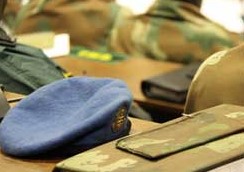
President Ramaphosa mourns the death of two SANDF members
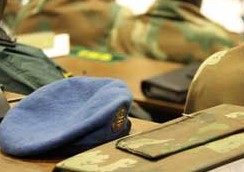
President Cyril Ramaphosa has expressed deep sadness at the deaths of two South African National Defence Force soldiers, following a mortar attack at their base in Sake in the eastern Democratic Republic of Congo (DRC).
Twenty other soldiers sustained injuries.
As Commander-in-Chief of the South African National Defence Force (SANDF), President Ramaphosa has offered his deep condolences to the families of the fallen troops as well as their commanders and colleagues.
The President’s thoughts are also with the SANDF members who are recovering from their injuries.
“As we mourn the deaths and casualties inflicted on our soldiers, we value and are humbled by the sacrifices they have made for the cause of peace and stability in our region, and they shall not be forgotten,” the President said in a statement on Thursday.
The President also assured the bereaved families and the injured troops that the SANDF will take the utmost care to provide the necessary logistical and psychosocial support to all those affected.
South African forces are part of the Southern African Development Community (SADC) Mission in the Democratic Republic of Congo (SAMIDRC) which was deployed on 15 December 2023 to support the Government of the DRC to restore peace and security in the eastern DRC.
This was in response to an increase in conflicts and instability caused by the resurgence of armed groups.