
SA to host first ever Africa’s Travel and Tourism Summit

The Department of Tourism and South African Tourism will host Afrca’s first ever Travel and Tourism Summit.
The hybrid summit, which coincides with Tourism Month in South Africa, is set to take place from 19 to 21 September 2021.
The summit aims to be a catalyst for engagement on the current state of tourism on the African continent.
Speaking ahead of the summit, Acting SA Tourism CEO, Sthembiso Dlamini said taking into account challenges facing the global tourism industry, Africa’s Travel and Tourism Summit will, through various engagement sessions, gather the tourism sector to share insights and ideas to explore collaborative efforts that can lead to recovery.
With an array of issues currently facing the sector, Dlamini said the summit aims to attract African community delegates, African Tourism Ministers, industry associations, tourism boards, destination marketing organisations, as well as various partners across the tourism value chain.
He said that some of the major topics to be discussed at the summit include aviation, innovation, technology, the health and safety protocols currently in place, as well as the continent’s positioning post the COVID-19 pandemic.
“The African continent is resilient and this summit is important, as it will contribute towards picking up the momentum within the sector, as it works towards an inclusive recovery.
“The COVID-19 pandemic may have dealt both business and leisure tourism a heavy blow, but we are now in the recovery phase, and a summit of this nature is critical in ensuring that we are aligned as a continent, whilst reigniting the tourism industry,” Dlamini said.
Dlamini noted that the delegates participating at the summit will have the option of attending virtually or at an identified venues across South Africa, or at three additional locations on the rest of the African continent, pending COVID-19 lockdown regulations.
“All venues will have COVID-19 health and safety protocols in place. We have opted for the hybrid format in order for us, as a continent, to lead the way in demonstrating how tourism can be enjoyed safely whilst adhering to health protocols. It is important that we are diligent in reigniting the sector, as it contributes significantly to the African economy,” Dlamini said.
Due to the COVID-19 pandemic, the Department of Tourism as well as South African Tourism were not able to host the Meetings, Incentives, Conferences and Exhibitions (MICE)-focused Meetings Africa, and leisure-focused Africa’s Travel Indaba 2021 editions, which usually take place in February and May annually.
Africa Tourism Partners CEO, Kwakye Donkor said while Africa’s Travel and Tourism Summit should not be seen as a replacement, it provides a platform to showcase the African continent’s leisure tourism offerings and business event capabilities.
“In the absence of Africa’s Travel Indaba in 2020 and 2021, Africa’s Travel and Tourism Summit is an innovative initiative for promoting intra-Africa tourism and also for sharing insights into the “state of readiness” for South Africa and the rest [of] Africa to welcome the world during, and post COVID-19 pandemic.
“I commend South African Tourism and the South African National Convention Bureau, for once again, showing commitment and leadership in tourism promotion across the continent. It will be so great to meet traditional and emerging trade partners again during the summit. We look forward to a very fruitful Summit,” Donkor said.
Committed to ongoing transformation and development of the South African tourism industry, Africa’s Travel and Tourism Summit will on 19 September feature a dedicated day to empower Small, Medium and Micro Enterprises (SMMEs) in the sector, as a precursor to the two-day conference on 20 and 21 September 2021.
Registration for the summit will open on the afternoon of 20 August 2021.
SA collaborates with foreign varsities to preserve indigenous African languages

Higher Education, Science and Innovation Minister, Dr Blade Nzimande, has commended South African universities for collaborating with foreign universities in an effort to revive and preserve indigenous African languages.
The Universities of Rhodes, North West, KwaZulu-Natal and Western Cape have collaborated with foreign universities on indigenous African languages, through Project Baqonde (meaning “let them understand” in Nguni languages).
Project Baqonde is funded by the European Union, and aims to facilitate and promote the use of indigenous African languages as mediums of instruction at higher education institutions in South Africa.
“As South Africa, we welcome this important initiative by the four South African universities and also appreciate the Salamanca University in Spain, Trinity College Dublin in Ireland, and the University of Groningen in the Netherlands, who are the three partner European institutions taking part in the initiative,” Nzimande said.
He reiterated his long-held view on the importance of the development of African languages in the education system.
“Over the years, we have witnessed the gradual dearth of our languages, apart from English and Afrikaans, in the absence of their development as languages of teaching and learning, commerce and academia more generally.
“The debate is no longer whether we should develop African languages as languages of scholarship in academia, but rather when and how these languages should be part of our academic discourse beyond the mere symbolism that is currently at play at most of our universities,” Nzimande said.
Language Policy Framework
The Minister acknowledged a number of other initiatives in this regard from other universities in the country.
He called upon all South African universities to intensify work on this front, as part of implementing the South Africa’s Language Policy Framework for Public Higher Education Institutions, which he signed in August 2020.
“Project Baqonde will undoubtedly contribute to the higher education policy framework, and also build on the results of a similar initiative I had initiated in October 2010, in my former capacity as Minister of Higher Education and Training, to strengthen and develop African languages as languages of science and academia,” Nzimande said.
The South African Language Policy Framework for Public Higher Education Institution aims to provide a framework for the development and strengthening of all South African 11 official languages, with a particular focus on the development of African languages as languages of scholarship, teaching, learning and communication at universities, amongst others.
“The policy provides guidelines for the development, implementation, monitoring and evaluation of institutional language policies and contributes to transformation in higher education, with specific reference to universities, through enhancing the status and roles of previously marginalised South African languages to foster institutional inclusivity, as well as social cohesion.
“The development of African languages is an indispensable component of transformation and of higher education in our country. The development of African languages is tied to social justice, which is an indispensable element of nation building and the promotion of social cohesion,” the Minister said.
The development of all official languages is a necessity for human rights and dignity, access and success at post-school institutions, preservation of heritage, communication and culture, Nzimande said.
Have your say on Social Security Reform green paper

Social Development Minister Lindiwe Zulu has published the Green Paper on Social Security and Retirement Reforms for public comment.
According to the paper, high unemployment levels have left those between the ages of 18 and 59 who do not qualify for grants, with no means to an income.
“There are no provisions to address the plight of individuals who have no income but do not meet the means test criteria to receive social grants (the 18 – 59 age group challenge). The expectation that this group would derive their income primarily from selling their labour has proven to be ineffective in the context of persistent, long-term and structural unemployment.
“This gap also falls short of the constitutional mandate and the social protection floor envisaged in the National Development Plan, and this led to the proposal to investigate the feasibility of a basic income grant,” the paper says.
The paper also raises concern that millions of workers are currently not adequately covered for retirement, disability and survivor benefits, and suggests that a National Social Security Fund (NSSF) could fill this gap.
“Although private occupational and voluntary schemes partially fill this gap, some 6.2 million formal sector workers – primarily low-income earners, informal workers and informal sector workers – are excluded from such arrangements.
“Therefore, the key reform proposal is the introduction of a National Social Security Fund (NSSF), a centrally managed public fund to provide retirement, survivor, disability benefits and unemployment benefits. All employers and employees will be obliged to initially contribute between eight and 12 per cent of qualifying earnings up to a ceiling, based on the Unemployment Insurance fund (UIF) ceiling, which is currently at R276 0004 per annum,” the paper said.
According to the paper, those earning less than R22 320 per year will not be obliged to contribute to the fund.
In terms of the expansion of social security grants, the paper proposes that all dependent children, the disabled and the elderly and those of working age, be eligible for income support, regardless of their income or assets.
“This basic income will form part of a comprehensive social protection floor and is the basis of the Pillar 1 reforms. The additional expense to the fiscus could be phased in over time through changes to the structure and value of tax rebates, subsidies and the possible introduction of additional tax. The proposal for the universalisation of the existing grants is premised on the fact that State benefits are mostly universal already, but fragmented, with different systems,” the paper said.
The green paper is accessible on the website of the Department of Social Development at https://www.dsd.gov.za/index.php/component/jdownloads/?task=download.send&id=296:green-paper-on-comprehensive-social-security-and-retirement&catid=7&m=0&Itemid=101.
Comments on the green paper can be sent to the following address, no later than 10 December 2021:
The Director-General: Department of Social Development, 134 Pretorius Street, HSRC
Building, Pretoria; Private Bag X901, Pretoria 0001.
For attention: Mr John Tebeila, Acting Director: Retirement Reform
Email: GreenPaperCSS@dsd.gov.za
Tel: 012 741 6820
Government to transport people to mass vaccination sites
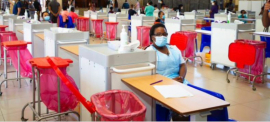
The National Department of Health will launch a pilot project to transport people to vaccination centres, as government works around the clock to drive up inoculation rates.
“There must be more focus on taking the vaccine to the people, rather than getting people to come to the vaccine,” Health Minister, Dr Joe Phaahla, said at a health briefing on Friday.
According to the Minister, the transportation model will first be tested in Gauteng, the Eastern Cape and KwaZulu-Natal.
Phaahla told the media that the goal is to provide transport from high-density population areas to mass vaccination sites in urban areas.
“Details of this will be provided by the three provinces where the trial will be running. In Gauteng, this pilot test will transport people from places like Alexandra and Tembisa to places like the Gallagher Estate in the Midrand, where there is huge capacity and a lot more people [can be vaccinated],” he explained.
Phaahla said government will also prioritise mobile and outreach teams.
He has since called on young people, whom he described as the future of South Africa, to come in numbers to get vaccinated.
This comes after the country has opened up COVID-19 vaccinations to those aged between 18 and 34 years old from today.
“Don’t be confused by fake news, especially doing the rounds on social media. The possibility of liberating ourselves from the clutches of COVID-19 is now in our hands,” the Minister said.
He believes that immunisation is the answer to the re-opening of more economic activities, religious, cultural, and sporting activities.
“Sporting activities with friends in stadiums is a possibility. We have seen that happening in Europe.
“We can have a better last quarter of 2021, better than 2020. We can have a better Christmas and an even better 2022, and all we need now is to take the first step.”
Phaahla also thanked the health workers who are saving lives, and those stationed at vaccination, mobiles and outreach sites.
“These are our heroes and heroines. We also want to thank media houses that have come forward, offering opportunities to communicate the benefits of saving lives and livelihoods through vaccination. Together, we can defeat COVID-19,” he said.
SA administers over 10 million COVID-19 doses
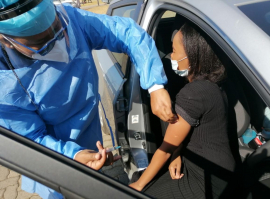
South Africa has surpassed the 10 million mark of administering COVID-19 jabs.
According to the Department of Health, the country distributed 191 806 COVID-19 shots on Thursday, taking the number of administered jabs to 10 167 749 since the start of the vaccination rollout programme.
In addition, 137 215 people were fully inoculated in the last 24 hours, pushing the tally to 4 629 371, translating to 7 808 626 people who have received the shot.
Meanwhile, the National Institute for Communicable Diseases (NICD) said 13 672 new COVID-19 cases were detected yesterday, which brings the total number of laboratory-confirmed infections to 2 652 652.
The majority of the new cases were recorded in KwaZulu-Natal (3 911) followed by the Western Cape (3 707), Gauteng (1 579), and the Eastern Cape (1 436).
“This increase represents a 19.9% positivity rate,” the NICD explained, adding that the seven-day moving average daily number of cases has peaked.
Meanwhile, 317 more people lost their lives to COVID-19, bringing the death toll to 78 694.
In addition, the public health institute said 536 more people were admitted to hospitals in the past 24 hours, meaning there are currently 13 940 patients in hospitals out of the 162 205 active cases.
The information is based on the 15 821 074 tests of which 68 540 were conducted since the last reporting cycle.
Globally, as of 19 August 2021, there have been 209 201 939 confirmed cases of COVID-19, including 4 390 467 deaths, reported to the World Health Organisation.
Government working tirelessly to deliver on public wage agreement

The Department of Public Service and Administration (DPSA) Director General Yoliswa Makhasi has reiterated government’s commitment to implementing the 2021/2022 wage negotiation agreement for public servants as soon as possible.
This as the Public Service Coordinating Bargaining Council (PSCBC) Resolution 1 of 2021, which provides for improvements in conditions of service in the Public Service, was recently concluded.
Makhasi reassured public servants that the Department’s officials are working tirelessly to ensure a smooth delivery on the agreed commitments.
“We would like to thank public servants for their patience during the negotiations and remain highly appreciative for the service that they continue to provide, in making a difference to the lives of citizens, especially the poorest of the poor, in the midst of the Covid-19 pandemic,” she said on Thursday.
PSCBC Resolution 1 of 2021 provides for the implementation of two distinct types of benefits for employees on salary levels 1–12 and those employees covered by occupation specific dispensations (OSDs) on equivalent levels namely:
1.1 The payment of a non-pensionable monthly cash allowance with effect from 1 April 2021 to be implemented on or before 15 September 2021; and
1.2 A once-off pensionable salary adjustment of at least 1.5% to employees who do not qualify for a pensionable increase derived from pay progression with effect from 1 July 2021, including employees on the maximum notch of their salary levels.
The implementation of the once-off 1.5% pensionable salary adjustment will be dealt with separately and will be communicated as soon as possible.
The Non-Pensionable once off allowance effective from 1 April 2021 that will be implemented on or before 15 September 2021 is as follows:
- LEVEL AMOUNT
- Levels 1-5 R1220.00
- Levels 6-7 R1352.00
- Levels 8-9 R1450.00
- Level 10-11 R1640.00
- Level 12 R1695.00
18 to 35 age group to get their jabs from 20 August
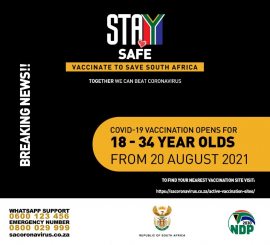
South Africa’s COVID-19 vaccination programme is expected to increase drastically following Cabinet’s approval for the vaccination of people aged between 18 and 35 years from 20 August 2021.
Cabinet said it had received a report from the National Coronavirus Command Council (NCCC) indicating that over nine million vaccines have been administered in South Africa to date, with over seven million people partially vaccinated and over four million fully vaccinated.
“Cabinet welcomed the vaccination roll out plan to increase the uptake of vaccines, particularly in provinces that had shown a reduction in the uptake of vaccines. As part of increasing the vaccination roll-out programme, Cabinet approved the vaccination of persons aged between 18 and 35 years from 20 August 2021,” Cabinet said in a statement on Thursday.
Cabinet urged people to dispel unfounded and misleading conspiracy theories about the vaccines and choose life by vaccinating.
“Scientific evidence confirms that vaccinated people stand a better chance of surviving from COVID-19 than unvaccinated people. Cabinet encourages all unvaccinated people in South Africa to get vaccinated because vaccines protect us from getting seriously ill from COVID-19 and they save lives.”
Cabinet said the process to get vaccinated is easy.
“Simply visit your nearest vaccination site with your identity document to be registered and vaccinated. You can find your closest site from the more than 3 000 vaccination sites across the country at www.sacoronavirus.co.za/active-vaccination-sites.”
Cabinet has further approved the keeping of the country under the Risk-Adjusted Alert Level 3 of the national lockdown, as advised by the Ministerial Advisory Committee.
Funding package to support business affected by unrest

Cabinet has called on all eligible businesses affected by the recent civil unrest in KwaZulu-Natal and Gauteng to apply for industrial loan support at zero-percent interest, under the R3.75-billion Economic Recovery Support Package offered by government.
“The Department of Trade, Industry and Competition (the dtic) and its development finance institutions – the Industrial Development Corporation and National Empowerment Fund – have put together a funding package to support various business recovery interventions. This includes the rebuilding of infrastructure, equipment, fittings for premises, stock and working capital,” a Cabinet statement said on Thursday.
The funding will help to alleviate the socio-economic challenges facing businesses affected by the unrest.
Cabinet has welcomed and endorsed the announcement by JP Morgan to provide financial and non-financial support to the tune of R340 million through the Abadali Equity Equivalent Investment Programme (EEIP).
The programme consists of Abadali Fund – a Black Business Growth Fund and Abadali Grant (R40 million).
Energy
Cabinet also welcomed this week’s gazetting of the regulations that increase the threshold for embedded generation from the current one megawatt (MW) to 100 MW.
In June 2021, President Cyril Ramaphosa announced the amendment of Schedule 2 of the Electricity Regulation Act, 2006 (Act 4 of 2006) to increase the National Energy Regulator of South Africa’s licensing threshold for embedded generation projects to allow for more private generation of electricity.
“Companies in energy-intensive sectors will now be able to generate their own electricity without the need for a licence. The new generation capacity will increase energy security by reducing reliance on the power grid and unlocking significant private sector investment.
“These initiatives will support inclusive economic growth and job creation within the small and medium-sized businesses, particularly in the manufacturing and green economy sectors,” Cabinet said.
Meanwhile, South Africa is expected to participate at the upcoming World Expo.
Cabinet approved the participation in December 2019 but the event was subsequently postponed due to COVID-19.
“The multinational event, which is held every five years in different countries, provides a large and attractive market to showcase South African goods and services to a global audience. It will be held as a hybrid of virtual and on-site exhibitions in Dubai, United Arab Emirates, from 1 October to 31 March 2022,” Cabinet said.
The dtic will next week host a media briefing to unpack South Africa’s participation at the World Expo 2020.
South Africans reminded to apply for special COVID-19 SRD Grant
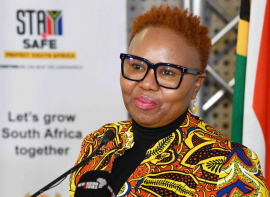
Cabinet has reminded South Africans to submit their applications for the COVID-19 Social Relief of Distress (SRD) grant to support people who have no income.
Applications for the grant opened on Friday, 6 August 2021.
In a statement on Thursday, Cabinet said it is conscious of the hardships caused by the COVID-19 pandemic and the recent public violence in some parts of KwaZulu-Natal and Gauteng.
Cabinet said the R350 per month grant is an important safety net for families, who would otherwise be devastated by the scourge of poverty and unemployment.
People between the ages of 18 and 60, who have no financial support of any kind, should apply. The first payments are expected to be made in the last week of August 2021.
The new iteration is for a period of eight months, with effect from August 2021 until March 2022.
“The South African Social Security Agency (SASSA) opened new channels, where applications can be submitted via the govchat.app and Facebook Messenger, in addition to its website: https://srd.sassa.gov.za or through WhatsApp on 082 046 8553,” Cabinet said.
An amount of R26.7 billion has been allocated for the new iteration. This includes the administrative costs borne by SASSA.
The eligibility criteria for the COVID-19 SRD grant include:
– South African citizens;
– permanent residents or refugees registered on the Home Affairs database;
– persons who are holders of special permits under the Special Angolan Dispensation, the Lesotho Exemption Permit dispensation and the Zimbabwe Exemption Permit Dispensation;
– asylum seekers whose section 22 permits or visas are valid or were valid on 15 March 2020;
– currently residing within the borders of the Republic of South Africa;
– unemployed;
– not receiving any social grant;
– not receiving an unemployment insurance benefit and does not qualify to receive an unemployment insurance benefit;
– not receiving a stipend from the National Student Financial Aid Scheme (NSFAS) and other financial aid;
– not receiving any other government COVID-19 response support; and not a resident in a government funded or subsidised institution.
Caregivers, who are not receiving any grant on their own behalf, should also apply for the special grant.
Have your last say on Hate Crime, Hate Speech bill

Public comments on the Hate Crimes and Hate Speech Bill are expected to be re-advertised, according to the Portfolio Committee on Justice and Correctional Services.
The committee met on Wednesday to receive a briefing from the Justice and Correctional Services Department following a Constitutional Court ruling on the case regarding an opinion article penned by the late Jon Qwelane.
The Constitutional Court made a ruling on what it called a “delicate balancing exercise between the fundamental rights to freedom of expression [versus] dignity and equality”.
According to a statement released by the committee, Chairperson Bulelani Magwanishe said the committee waited on the court judgement as it relates to offensive language towards members of the Lesbian, Gay, Bisexual, Transgender, Queer and Intersex (LGBTQI+) community.
“The committee had intended to hold public hearings after the closing date, but due to its heavy workload and the looming National Elections at the time, this could unfortunately not happen and the Bill lapsed at the end of the fifth Parliament,” the statement said.
The bill seeks to make hate crime and hate speech an offence and would put measures to prevent and fight against these.
According to the committee’s statement, the bill also seeks to “address the increasing number of incidents motivated by prejudices, in the form of hate crimes and hate speech, and to assist persons who are victims thereof”.
“The current Bill excludes from hate speech any bona fide interpretation and proselytising or espousing of any religious tenet, belief, teaching, doctrine or writings. Artistic creativity or performance or espousal of religious doctrine will not qualify for exemption from hate speech if it advocates hatred that constitutes incitement to cause harm based on any protected grounds,” the statement read.
Magwanishe added that the Constitutional Court judgement directed the committee on how to move forward with the bill.
“Due to the length of time since then and the court judgement, although it specifically only referred to amending the Promotion of Equality and Prevention of Unfair Discrimination Act 4 of 2000, the committee has agreed to re-advertise the Hate Crimes and Hate Speech Bill for public input. The court judgement provides clear parameters on how the committee should approach the Bill,” he said.
Details for public engagement will be published in the near future.