
SA exceeds 6 million mark for fully vaccinated adults
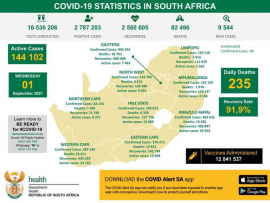
South Africa has surpassed over six million adults who are fully vaccinated, 149 362 of which were vaccinated in the last 24 hours.
As of 1 September 2021, a total of 6 145 216 South Africans had been fully vaccinated, according to the Department of Health. Of these, 2 884 840 received the Johnson & Johnson shot, while 3 260 376 were given the Pfizer vaccine.
Meanwhile, the country administered 253 160 vaccines on Wednesday, pushing the total to 12 841 537.
In addition, the National Institute for Communicable Diseases (NICD) said the country logged 9 544 new COVID-19 infections, bringing the number of laboratory-confirmed cases to 2 787 203.
The majority of new cases were recorded in KwaZulu-Natal (2 681), followed by the Western Cape (2 049), Eastern Cape (1 392) and Free State (964).
“This increase represents a 15.6% positivity rate,” said the institute, adding that the latest figure is higher than the average number of new cases per day over the seven preceding days.
Meanwhile, a further 235 COVID-19 related fatalities have been reported, bringing the death toll to 82 496.
According to the NICD, there has been an increase of 430 hospital admissions in the past 24 hours.
The information is based on the 16 536 206 tests, 61 027 of which were conducted since the last reporting cycle.
As of 1 September 2021, there have been 217 558 771 confirmed global cases of COVID-19, 4 517 240 deaths and 5 272 630 490 administered vaccine doses reported to the World Health Organisation.
Cabinet raises concern over GBVF incidents

Gender Based Violence and Femicide is one of the biggest challenges currently facing the country, Cabinet said on Thursday.
This is according to Minister in the Presidency, Mondli Gungubele, who was briefing the media on the outcomes of the Cabinet meeting, held on Wednesday.
Cabinet expressed condolences to the families of Nosicelo Mtebeni, Palesa Maruping and Pheliswa “Dolly” Sawutana following their gruesome murders last month.
“These heinous crimes were committed during the commemoration of Women’s Month in August, which was the month to celebrate the strides we have made in bridging the gender inequalities in our society. These crimes have reminded all of us that GBVF remains the biggest challenge facing the country. It requires all of us to work harder to strengthen the protection of women.
“Cabinet has called on law-enforcement agencies to ensure justice is served for these women and their families,” Gungubele said at a media briefing.
Gungubele said that at least R21 billion has been allocated by government to implement the National Strategic Plan on Gender Based Violence and Femicide.
He added that the whole country also needs to intervene to fight the scourge.
“A number of interventions have been put in place to strengthen our criminal justice system. These include increasing dedicated regional courts to deal with sexual offences, strengthening our sexual offences laws and equipping our police officers with the requisite skills to deal effectively with such offences.
A number of government buildings have been converted to create more shelters for women in distress. Cabinet calls on all of us to join hands in creating a safe and secure environment for women in the country,” he said.
To obtain assistance and counselling on Gender Based Violence and Femicide (GBVF) matters, call the GBV Command Centre on 0800 428 428 (0800 GBV GBV).
Callers can also request a social worker from the Command Centre to contact them by dialling *120*7867# (free) from any cell phone.
Public emergency medical services colleges to now offer qualifications

Higher Education, Science and Innovation Minister, Dr Blade Nzimande, has published a government gazette giving the green light to public emergency medical services education institutions to offer accredited emergency medical care qualifications.
These include qualifications registered on the Higher Education Qualifications Sub-Framework (HEQSF) of the National Qualification Framework NQF) from January 2022.
The nine institutions, commonly known as emergency medical services colleges, listed in the gazette will be permitted to grant certificates, diplomas and degrees.
These range from Higher Certificates, Diplomas, Advanced Diplomas, and Postgraduate Graduate Diplomas to Bachelor’s Degrees.
According to the department, this is until such a time that these institutions are declared as public higher education colleges in terms of the Higher Education Act.
“In order to offer these qualifications, these colleges should meet the accreditation requirements of the Council on Higher Education (CHE) and the Health Professions Council of South Africa (HPSCA) and should be registered on the NQF by the South African Qualifications Authority (SAQA),” explained the department.
Nzimande has described these colleges as the primary platform for emergency medical care education and training in South Africa.
He believes they are pivotal for producing emergency medical care personnel to support the public health sector.
“We have a responsibility to ensure that the public emergency medical services colleges are effectively integrated into the higher education and training landscape, and that they are able to offer their aligned qualifications next year.”
He said both Departments of Higher Education and Training and Health are confident that these public colleges will continue with their important work and admit a new cohort of students from 2022 onwards into their newly accredited HEQSF registered qualifications.
Gauteng launches drivers’ license renewal campaign

The Gauteng Department of Roads and Transport has launched the ‘Request A Slot” campaign aimed at addressing the renewal of drivers’ licences backlog.
The campaign started on Wednesday and will continue until 31 March 2022.
Gauteng MEC for Roads and Transport Jacob Mamabolo presented the initiative before the Gauteng Provincial Legislature’s Portfolio Committee on Roads and Transport. The committee is optimistic that the initiative will be of great assistance to motorists in renewing their driver’s licenses.
At a special committee meeting held on Wednesday, the department shared detailed plans to deal with the backlog following the announcement by the Minister of Transport Fikile Mbalula on the extension of drivers’ license renewals to 31 March 2022.
The committee is pleased with what seems to be efficient and innovative plans that will address the demand for renewals.
These include, amongst others, renewal facilities at selected Gautrain stations and more Driver License and Traffic Centres (DTLC) with extended operating days and hours from 7 am to 9 pm at some, with the introduction of biometric systems to accelerate efficiency in service delivery.
“This is an exciting programme which the Portfolio Committee on Roads and Transport supports. The committee will, of course, exercise its oversight role on the implementation of the different initiatives.
“The department is expected to provide regular reports and updates on this programme. This matter will be a standing item on the agenda in all our portfolio committee meetings,” said Chairperson Gregory Schneemann.
The committee has encouraged Gauteng citizens to use the avenues that have been made available by the department to renew their licenses and not wait for the 11th hour.
For license renewal, motorists are advised to request a slot online on: https://online.natis.gov.za and on Android-based APP: RenewOnline_GP (to be launched soon on Google Play Store).
Motorists can also renew their driver’s licenses by sending an email on at: requestaslot@gauteng.gov.za or requestaslot@rtmc.co.za
Minister tackles Eastern Cape water crisis
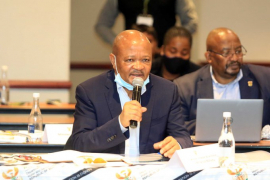
The top brass of the Water and Sanitation Department has held a series of meetings with officials in the Eastern Cape to find solutions to the water crisis afflicting the province.
Water and Sanitation Minister Senzo Mchunu, along with his Deputy Ministers, David Mahlobo and Dikeledi Magadzi, this week met with the Eastern Cape provincial leadership, led by Premier Oscar Mabuyane and the Amatola Water Board Management.
Top on the agenda were issues of governance, delays of finishing water projects, sources of water to supply the province and mismanagement of certain entities.
During the Minister’s engagements, Mabuyane raised concern on the delays of completing water projects, especially the Mzimvubu Water Project and ageing water infrastructure.
Mchunu emphasised the importance of joint planning with key stakeholders in the water sector.
The Amatola Water Board, led by Acting CEO Z. Xalisa, requested the Minister to intervene on the operation of water tankers procured by the DWS, as an intervention to supply communities in the province with water where drought persists.
Mchunu said Amatola Water should find means for these tankers to be utilised and not “gather dust”.
In the past years, the Ndlambe Local Municipality was impacted by a stubborn drought and water shortage.
The DWS intervened through its Regional Bulk Infrastructure Grant (RBIG), which approved an amount of R80 million for construction purposes. The Department of Cooperative Governance and Traditional Affairs contributed R20 million towards fast tracking of the Ndlambe project, while the Ndlambe municipality contributed R72.2 million. Of this amount, R65.59 million is for operation and maintenance over a three-year period.
On Wednesday, Mahlobo and Magadzi visited the Ndlambe Sea Water Reverse Osmosis Plant (SWROP) to experience the operation of the plant.
The ministerial visit in the province ends today.
Cele to visit Umlazi murder scenes

Police Minister Bheki Cele will today be briefed by the KwaZulu-Natal South African Police Service (SAPS) management on the recent gruesome double mass murders in Umlazi.
In a statement, the Police Ministry said Cele had learnt with shock of the double mass murders that claimed the lives of 11 people between Sunday and Tuesday.
On Sunday, six people were shot and killed at U Section in Umlazi.
“Two days later, three gunmen opened fire inside a house in W Section killing five people who were shot in the head,” Ministry spokesperson Lirandzu Themba said in a statement.
Three others sustained serious injuries and were rushed to hospital on Tuesday.
She said investigations continue and police are yet to make arrests.
The Minister will receive a full briefing on both the incidents by the SAPS provincial management team, before making his way to the crime scenes, she said.
Among the murdered were women and a minor.
SA unable to accommodate Afghanistan refugees
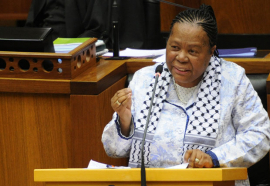
The South African government has said it is not able to accommodate citizens of Afghanistan seeking refuge in the country.
The Middle Eastern country has been facing violence and instability, culminating in a mass exodus of Afghan citizens looking for safer regions to live in, with the United Nations Refugee Agency estimating that at least half a million Afghan citizens have been displaced since the beginning of the year.
In a statement, the Department of International Relations and Cooperation (DIRCO) said it had noted “overtures made to the country to consider receiving a number of Afghanistan refugees who have sought refuge in Pakistan”.
“The request is that they be accommodated in South Africa en-route to their final destinations. The South African government is unfortunately not in a position to accommodate such a request. South Africa is already home to a substantial number of refugees and is seized with addressing their needs. Most of them already benefit from social assistance and free medical health programmes offered by our country,” the statement said.
The department cited that international law states that refugees are “best served by remaining in the first country of arrival – Pakistan – pending their final destinations”.
Employment and Labour readies to implement new Employment Equity Act

The Department of Employment and Labour is gearing for the implementation and enforcement of the new Employment Equity (EE) Act, once Parliamentary processes are finalised by March 2022.
In a statement on Thursday, the department’s Director for Employment Equity, Ntsoaki Mamashela, said now that Parliament has resumed from recess, hopes were high that the processing of the EE bill would be expedited.
The bill is expected to go to the National Council of Provinces for consideration soon.
The Amendment of the EE Act of 1998 is intended to, among other things, reduce the regulatory burden on small business; empower the Employment and Labour Minister to regulate sector specific EE numerical; and promulgate section 53 of the Employment Equity Act for the issuing of the EE Compliance Certificate.
Mamashela made the remarks at the start of the department’s series of EE national workshops to update on the EE amendments and EE sector targets. The initial workshop was targeting stakeholders in Limpopo province.
“The expected introduction of five-year sector targets will mark the beginning of a clean slate. All current EE plans will fall away on 22 September 2022 and the new plans will have to be aligned with five-year targets. Self-regulation has not worked,” she said.
Mamashela said further sector engagements, which started in 2019, on sector targets will continue.
“These have already been held with sectors such as mining, financial & business services, wholesale & retail, and construction. By June 30, 2021, the department had engaged with all 18 economic sectors and concluded an agreement with the financial and business services sector.”
The department is currently analysing written submissions in response to the proposed sector EE targets from the remaining 17 sectors with the view of conducting follow-up engagements in an attempt to reach consensus.
“It is envisaged that the sector engagements will be concluded by February 2022 with proposed targets,” she said.
The department’s annual employment equity workshops are being held through virtual Microsoft Teams in each of the nine provinces under the theme: “Real transformation makes business sense”.
The workshops, which will run until 28 September, will focus on respective provincial EE status; update on EE Amendments and EE Sector targets; how to access copies of the EEA2 online by completing the EEA11 form, including 2021 EE reporting; and EE inspections and enforcement in the labour market.
The workshops are targeted at employers and their employers’ organisations; human resources executives and practitioners; EE Forum members; assigned senior managers/transformation managers, academics; employees and trade unions; labour relations practitioners; and civil society organisations, among others.
The schedule for the remaining planned virtual workshops is as follows:
- Free State – Thursday, 02 September 2021
- KwaZulu-Natal – Tuesday, 07 September
- Eastern Cape – Wednesday, 08 September
- Western Cape – Tuesday, 14 September
- Gauteng – Wednesday, 16 September
- Northern Cape – Tuesday, 21 September
- North West – Wednesday, 22 September
- Mpumalanga – Tuesday, 28 September
Petrol price increases

Minister of Mineral Resources and Energy, Gwede Mantashe, has announced a four cent increase in the price of both grades of petrol.
As of Wednesday, the price of 95 (ULP and LRP) and 93 (ULP and LRP) increased by four cents a litre.
This means that a litre of 95 ULP in Gauteng, which was R18.30, now costs R18.34 cents a litre.
Meanwhile, diesel (0.05% Sulphur) will decrease by 15.22 cents a litre, while the price of diesel (0.005% Sulphur) costs 14.22 cents less.
The price of illuminating paraffin (wholesale) will decrease by 15 cents.
The price of illuminating paraffin (SMNRP) will decrease by 20 cents, while the Maximum Retail Price for LPGAS will increase by 94 cents per kilogram.
In a statement, the DMRE said the average international product prices for petrol, diesel and illuminating paraffin decreased during the period under review.
“The rand depreciated against the US Dollar during the period under review, on average, when compared to the previous period,” said the Department of Mineral Resources.
Register to rewrite your matric supplementary exams
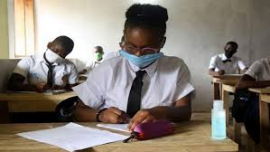
Candidates who registered to write this year’s matric May/June supplementary examinations but either missed, failed a subject, or want to improve their marks, have another chance to improve their results.
According to the Department of Basic Education (DBE), National Senior Certificate (NSC) candidates can now sign up to write in November 2021.
Registration opened on 24 August and interested individuals are encouraged to register at their nearest District Office before the closing date, 7 September 2021.
“This is only for those who wrote the NSC June 2021 examinations,” the department stressed.
The May/June examination is a special examination offered to adult candidates that have not attained a matric qualification and those that wrote the previous November exams but may not have met the requirements for a pass or passed but wish to improve their results.
Meanwhile, those who wrote the Senior Certificate (SC) June 2021 exams can only register for the June 2022 SC assessments.
Registration opens in October and the exact dates will be communicated in due course, the department said.
Last week, the DBE released the results for the “second chance” exam, for which 239 024 NSC and SC candidates had enrolled.
According to the department, a significant number of candidates attained a pass in the gateway subjects.
The total number of students who attained a pass in mathematics and physical sciences is 11 557 and 8 258, respectively.
The results are available at the District Office or at the centre where the examination was written.